
violence

A small symbol, but a big deal. Last weekend, Facebook Inc. updated its architecture to better represent users who marry same-sex partners. Until this point, a relationship status of “married” was ubiquitously accompanied by a cake-topper-like icon of a man and a woman.

Now, users can select a male-female, female-female, or male-male icon to digitally represent their matrimony. I want to take this occasion to briefly discuss what it means to construct a self via template, and question the extent to which the binds of templated identity construction are more (or less) severe than general practices of categorization. more...
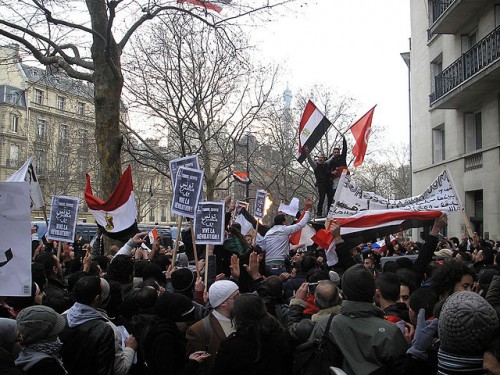
Egyptian solidarity protest in Paris, Jan. 2011. Image by Jacques Delarue.

When it comes to thought and research on social movements and technology (separately and together), emotion is that crucial piece of the picture that everyone technically sees but hardly anyone explicitly acknowledges as worth paying attention to in its own right. Some of this is likely because emotion is hard to study in any way that social science would consider rigorous; it’s often taken as something fundamentally irrational and therefore fundamentally inexplicable. It is highly subjective. It is culturally and situationally constructed, and therefore conceptually slippery. It is interior; it is a difficult thing to see and to know. If explicitly drawing it out as an important factor is problematic for some, identifying it as a variable capable of carrying any causal weight is even more so.

Regarding technology and social movements combined, there is the question of how the digital and physical play out as far as what ends up really being important. What is the relationship between the two? Where exactly is the body in augmented contention and is the way in which it matters changing? What is really going on when we see a bunch of street protesters carrying smartphones?

more...