TIME

YouTube Preview Image _____

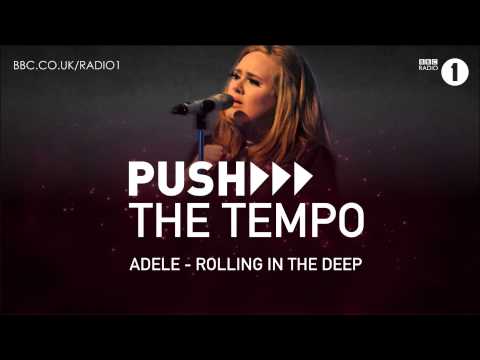
___Danny Howard, a DJ on BBC Radio 1, has a weekly feature called “Push The Tempo.” Here, he takes several remixes of the same song and puts them in order of increasing tempo (BPM). It sounds like you’re listening to one song or mix that gradually speeds up. Or rather, the song “develops” (in the traditional musicological sense of elaborating a basic theme and becoming more complex) by progressing toward a temporal telos (ancient Greek for goal/end)–instead of dialectically achieving “Absolute Spirit,” these mixes sound like they’re ratcheting up to something like absolute speed. In this way, the mix’s aesthetic is a bit too literally “accelerationist” (the actual speeding up of the songs performs, aesthetically, the moves that accelerationist ideology idealizes, politically). Effectively, the mix is also a tour of various subgenres of EDM, house, & techno. Insofar as each of these subgenres has a rather narrowly-drawn range of standard tempi, the only way to dramatically increase the tempo of the overall mix is to begin with a relatively slower genre (sometimes even sub-120 BPM)  and work up to something jungle-y or gabber-y that conventionally approaches 200+ BPM.

 

YouTube Preview Image

  more...

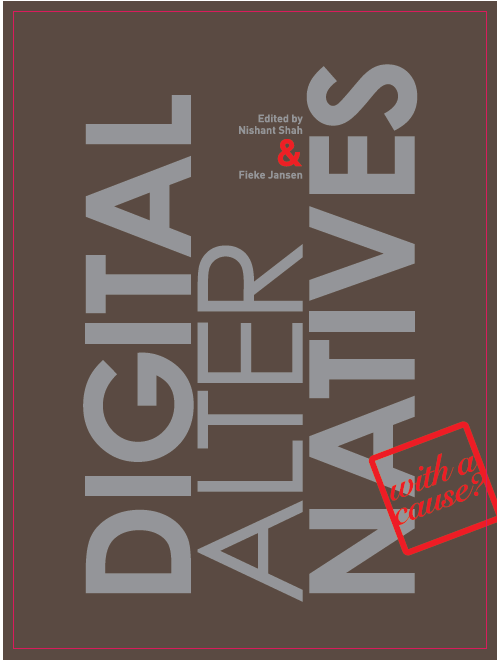
Review of ‘Digital Natives and the Return of the Local Cause’ by Anat Ben-David. Essay from the Digital AlterNatives with a Cause? book collective, published by Centre for Internet and Society, India and HIVOS, The Netherlands

Ben-David’s piece is an informed attempt to resolve the conceptual fuzziness of the term “Digital Native.” She attempts this in a philosophical manner: trying to move away from the ontological “who are Digital Natives?” to an epistemological “when and where are Digital Natives?” Her reasoning is that this change in perspective will allow us to unpack the hybrid term and thus  determine if it refers to a unique phenomenon worth exploring.

To answer the when and the where, Ben-David situates the term into its constituencies: digital and native, contextualizing the words using two approaches; historiographical (when) for the digital and geopolitical (where) for the native.

Digital” is situated, semantically, in the broader framework of technology-mediated social activism. The author applies the concept placing two events side-by-side: First, the 1999 manifestations against World-trade Organization protests in Seattle and then the 2011 Tahir Square protests in Egypt. Are these two phenomena different in nature? Is Tahir Square a more technologically advanced version of Seattle? Are the basic mechanisms the same, albeit with new faces and shinier phones? more...

photo by nathan jurgenson, taken at Occupy Toronto, November, 2011

At exactly the moment when tents are disappearing, when, at least for the winter, Occupy is trading long-term omnipresence for short-term actions, Occupy DC made news for building a large, wooden, winterized structure in a city park. The Occupy DC barn fiasco can be understood, in part, as a move to double-down on the endurance of the Occupy movement precisely when it is at risk of losing that secret ingredient that made it powerful: time.

As Sarah Wenechak wrote, tents pitched in city parks come to be more than practical but also symbolic. And part of this value is that they represent time. Overall, much of the writing about Occupy has focused on space. Traditional protest actions, like marches, claim physical space but merely do so for short periods of time (especially as the march moves from location to location occupying any particular space for a only very brief amount of time). While that big umbrella term “occupy” certainly refers to space, there has also been a special focus on time.

A tent, for example, proclaims that more...

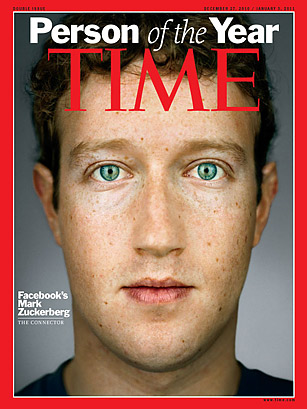
The premise of this blog is that technology is fundamental to our selves, lives and all of reality. And this point is best exemplified by Facebook. The site’s founder and CEO is TIME magazine’s 2010 Person of the Year. Is this the correct choice? Perhaps Julian Assange? Donna Haraway, anyone?