

tactics

“Those who make revolutions half way only dig their own graves.”

“Power to the imagination.”

“I don’t like to write on walls.”

-Graffiti in May of 1968 Paris, France. 

I was gonna write something about how I appreciate Procatinator more than everyone else, but I can’t bring myself to do it. Not today anyway. Remember when the United States had this popular uprising and everyone was talking about it and the political establishment was actually afraid of what it could accomplish?  When hundreds of thousands of Americans were exposed to political organizing and direct action for the first time? That started a year ago today, and while the summer did not see massive protests, the Fall promises a new start. A resurgence built upon… arbitrary calendar dates, I suppose. Truthfully, I see no reason why Zuccotti park should be re-occupied, nor should anyone feel the need to act out of a fear of “losing momentum.” Momentum is important for steering large ships, but direct action is all about swimming against the tide. Anarchist movements (and Occupy undeniably fits this category) are by their very definition: voluntary, small, functional, and temporary. We don’t need another occupation of Zuccotti Park. We need something new. more...
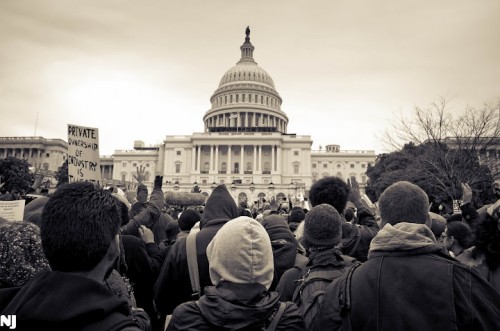
Academics usually do not talk about “tactics.” There are theories, methods, critiques, but we -as professionals-rarely feel comfortable advocating for something as unstable or open to interpretation as a tactic. In the latest edition of the Science, Technology, and Human Values (The flagship journal for Society for Social Studies of Science) three authors threw caution to the wind and published the paper “Postcolonial Computing: A Tactical Survey” [over-priced subscription required]. While the content of the paper is excellent, what excited me the most was their decision to describe their new “bag of tools” as a set of tactics. Kavita Philip, Lilly Irani, and Paul Dourish take a moment in their conclusion to reflect on their decision:

We call our results tactics, rather than methodologies, strategies, or universal guarantors of truth. Tactics lead not to the true or final design solution but to the contingent and collaborative construction of other narratives. These other narratives remain partial and approximate, but they are irrevocably opened up to problematization.

I will employ the language and approach of the “tactical survey” to offer a new set of conceptual tools for understanding augmented protest and revolution. It is my aim that they prove useful for activists as well as academics and journalists following Occupy Wall Street and similar movements. This first part focuses on the intersections of transparency, social media, privilege, and public depictions of protest. Part 2 will cover the utilization of corporate technological systems (e.g. Apple productsTwitter) and building alternatives to those systems (e.g. Vibe, Diaspora). These tactics are forged from observations (first hand and otherwise) of the #OWS movement. They are intentionally abstract, because they are menat to apply to a wide range of instances and scenarios.  more...