subcultures

You may not be a fan of the wub-wub-wubbing musical genre known as dubstep, but it is increasingly taking center stage in American popular culture. For example, a recent NorthFace advertisement uses it while a snowboarder glides down a snowy mountainscape, Britney Spears  and Rihanna have both incorporated some dubstep into their recent work, teen heartthrob Justin Bieber is rumored to be working on his own dubstep album, and the teaser trailer for the new Mission Impossible film features a distinct wub-wubbing in the background. So what is dubstep anyway? And where did it come from?

Dubstep Goes to College
Dubstep was conceived in the London dance music scene in the late 90s and early 00s. It takes mainly from drum and bass and grime genres, but is influenced by many different styles of music, including dancehall and hip-hop. The heavy influence of grime, the dark elements of drum and bass and the guttural bass lines give it an almost dirty sound. This along with the layer of synthesizers are what people in the scene refer to when they describe the music (or party) as “grimey.”

Dubstep entered the mainstream club scene in 2006 in great part with the release of producer Oliver Jones’ (aka Skream) debut album “Skream,” which took club culture by storm in Europe (Woolliams 2008). The album also became widely popular in the United States EDM (electronic dance music) scene.
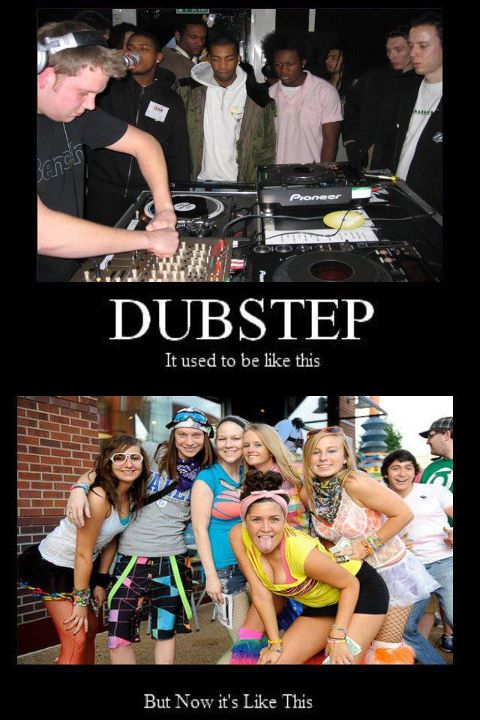
Internet memes like this serve to articulate anxiety about perceived subcultural changes.

more...

Popular dubstep DJ Skrillex performing live.

Below is the first of a two-part essay exploring the popularity of dubstep, a musical genre formerly associated with the underground EDM (electronic dance music) scene.

Part 1

You may not be a fan of the wub-wub-wubbing musical genre known as dubstep, but it is increasingly taking center stage in American popular culture. For example, a recent NorthFace advertisement uses it while a snowboarder glides down a snowy mountainscape, Britney Spears  and Rihanna have both incorporated some dubstep into their recent work, teen heartthrob Justin Bieber is rumored to be working on his own dubstep album, and the teaser trailer for the new Mission Impossible film features a distinct wub-wubbing in the background. So what is dubstep anyway? And where did it come from?

Dubstep Goes to College
Dubstep was conceived in the London dance music scene in the late 90s and early 00s. It takes mainly from drum and bass and grime genres, but is influenced by many different styles of music, including dancehall and hip-hop. The heavy influence of grime, the dark elements of drum and bass and the guttural bass lines give it an almost dirty sound. This along with the layer of synthesizers are what people in the scene refer to when they describe the music (or party) as “grimey.” more...

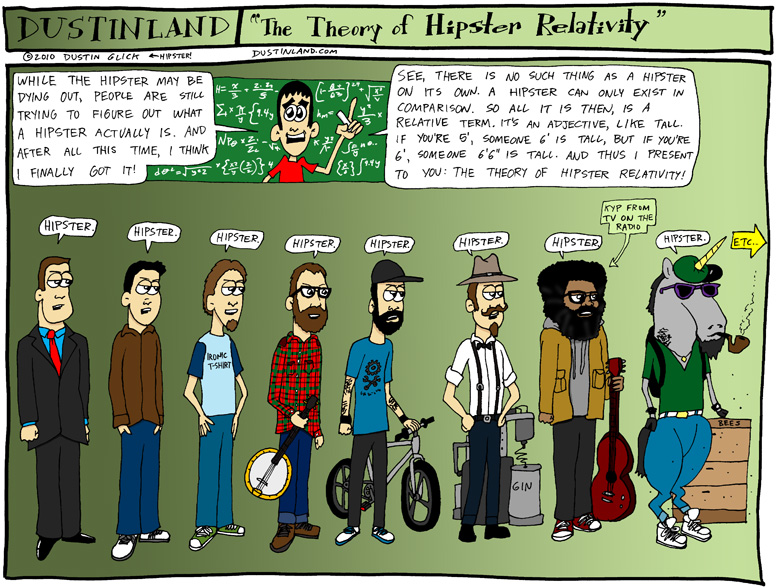
A few of us here at Cyborgology have a running joke going about #HipsterStudies, so I thought I would compile a couple comics that likewise intellectualize this subcultural movement. The first, sent in by reader Letta Wren Page, is a comic by Dustin Glick:

Dustin Glick's "Theory of Hipster Relativity"

This image does a great job illustrating the inherent relativity of the hipster label. That is, as a largely pejorative label, one can only be deemed a hipster by comparison. Much like Thornton (1996) discovered in her study of UK youth raves, where club kids used pejorative labels to denote the bounds of group membership, the hipster as label serves to undermine attempts to mimic subcultural forms (and hence, it serves as a way to deny these actors any semblance of subcultural capital). more...

Since these hipster blog posts are generating so much great discussion I thought I would bring you another example of the subculture. I came across this website after my girlfriend attempted to get me to listen to some folk bands or something that she liked. I can’t exactly recall how it happened, but I do recall her sending this website to me.

The entire website for Plan-It-X Records is a simple .jpg image seen above.

more...

This post is somewhat of a stretch, but I think it remains applicable nonetheless. Below I have embedded three video clips, each dealing with “the hipster” as a relatively recent subcultural form and social type.

First, we have the “Hipster Olympics,” a viral video that made the rounds a few years back. The video makes a parody of the hipster, mocking their supposed elitism, pretension, dependency on new technologies, and obsession with authenticity as a source of subcultural distinction (note the subtle play on Pabst Blue Ribbon).

Second, we have a short clip from the “2 Broke Girls” a new CBS television series focusing on the epicenter of the hipster subculture, the gentrified Williamsburg neighborhood of Brooklyn, NY. In the clip we see the confluence of hipsters and homelessness, which ultimately serves to as a satire on the “Poor Chic” fashion trends of New York’s urban hipsters (Halnon 2002). We also notice the association between hipsters and personal hygiene (or lack thereof), a stereotype that has also been foisted upon the #Occupy protestors.

more...

I came across this post a couple weeks back about the “11 Sounds That Your Kids Have Probably Never Heard” and it got me thinking about hipsters, nostalgic revivalism, and technological regression as a source of authenticity.

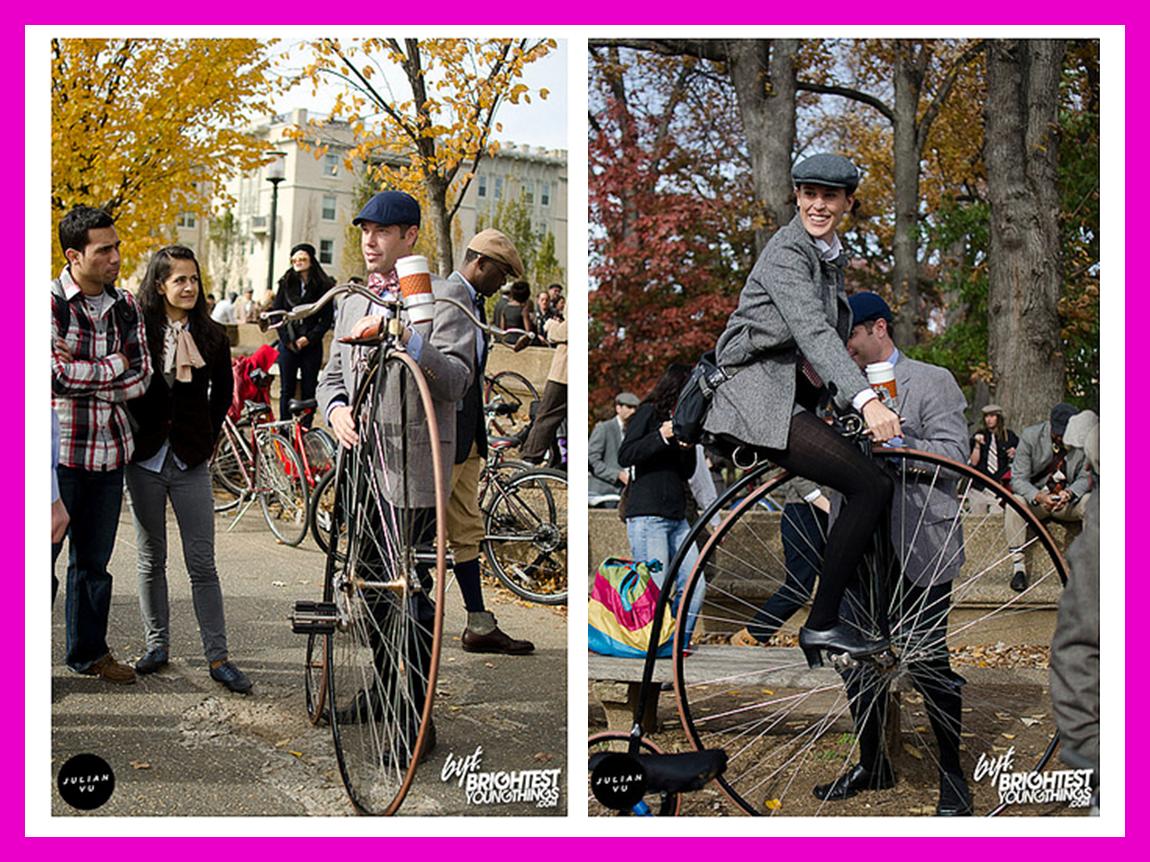
DC hipster shows off his ride at the 2011 Brightest Young Things Tweed Ride in Washington, DC.

more...