space

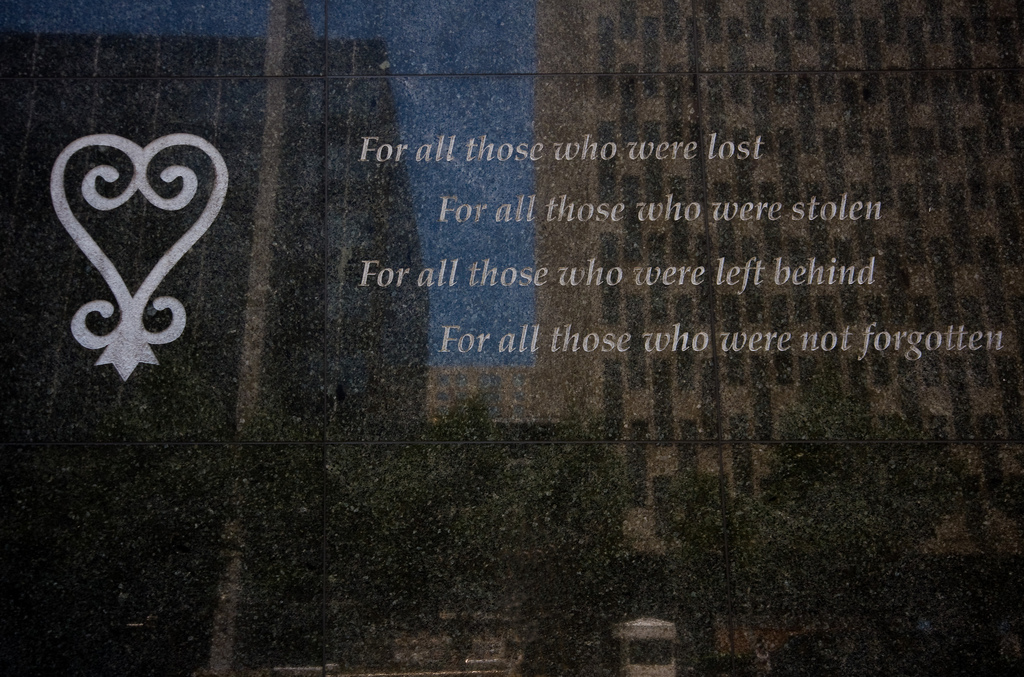
African Burial Ground Monument with Office Building Reflection.

Towards the beginning of Italo Calvino’s novel Invisible Cities, Marco Polo sits with Kublai Khan and tries to describe the city of Zaira. To do this, Marco Polo could trace the city as it exists in that moment, noting its geometries and materials. But, such a description “would be the same as telling (Kublai) nothing.” Marco Polo explains, “The city does not consist of this, but of relationships between the measurements of its space and the events of its past: the height of a lamppost and the distance from the ground of a hanged usurper’s swaying feet.” This same city exists by a different name in Teju Cole’s novel, Open City. It’s protagonist, Julius, wanders through New York City, mapping his world in terms reminiscent of Marco Polo’s. One day, Julius happens upon the African Burial Ground National Monument. Here, in the heart of downtown Manhattan, Julius measures the distance between his place and the events of its past: “It was here, on the outskirts of the city at the time, north of Wall Street and so outside civilization as it was then defined, that blacks were allowed to bury their dead. Then the dead returned when, in 1991, construction of a building on Broadway and Duane brought human remains to the surface.” The lamppost and the hanged usurper, the federal buildings and the buried enslaved: these are the relationships, obscured and rarely recoverable though they are, on which our cities stand. more...


The Jager Bomb:
Ingredients:

  • One 8 oz. can of Red Bull
  • One shot of Jägermeister
  • Willingness to overpay for an overhyped experience

The shot of Jager is dropped into a glass of Red Bull and chugged until all evidence disappears down the throats of the youthful.

Felix Baumgartner jumps higher and faster than anyone ever before. Image c/o AP

As I (and a record 8 million other live Youtube viewers) witnessed Felix Baumgartner jump from a floating platform 128,000 feet in the air, I could not help but think about those little red bulls on his helmet. Red Bull, the ubiquitous energy drink and funder of all things Extreme™, had branded nothing less than a moment in human history. A monumental achievement brought to you by a peddler of a sugary drink that has fueled some of the worst decisions in the world [NSFW]. There was a day when the United States government was in the business of dazzling humanity with its feats of technological superiority and raw tenacity. For three years we were landing on the moon almost every six months. We made it look easy. Baumgartner’s jump is truly incredible, but it also makes me a little angry. I am tempted to bemoan the fall of civic life and the rise of corporate-sponsored spectacle, but ultimately I cannot find a moral handhold. Do I want an arms race or consumer capitalism to fund the greatest technological achievements of my lifetime? more...

I’ve been thinking a lot about this question lately. I even wrote an essay awhile back for The New Inquiry. But, honestly, none of the answers I come up seem complete. I’m posting this as a means of seeking help developing an explanation and to see if anyone knows of people who are taking on this question.

I think question is important because it relates to our “digital dualist” tendency to view the Web as separate from “real life.”

So far, I see three, potentially compatible, explanations: more...

Review of ‘Digital Natives and the Return of the Local Cause’ by Anat Ben-David. Essay from the Digital AlterNatives with a Cause? book collective, published by Centre for Internet and Society, India and HIVOS, The Netherlands

Ben-David’s piece is an informed attempt to resolve the conceptual fuzziness of the term “Digital Native.” She attempts this in a philosophical manner: trying to move away from the ontological “who are Digital Natives?” to an epistemological “when and where are Digital Natives?” Her reasoning is that this change in perspective will allow us to unpack the hybrid term and thus  determine if it refers to a unique phenomenon worth exploring.

To answer the when and the where, Ben-David situates the term into its constituencies: digital and native, contextualizing the words using two approaches; historiographical (when) for the digital and geopolitical (where) for the native.

Digital” is situated, semantically, in the broader framework of technology-mediated social activism. The author applies the concept placing two events side-by-side: First, the 1999 manifestations against World-trade Organization protests in Seattle and then the 2011 Tahir Square protests in Egypt. Are these two phenomena different in nature? Is Tahir Square a more technologically advanced version of Seattle? Are the basic mechanisms the same, albeit with new faces and shinier phones? more...

photo by nathan jurgenson, taken at Occupy Toronto, November, 2011

At exactly the moment when tents are disappearing, when, at least for the winter, Occupy is trading long-term omnipresence for short-term actions, Occupy DC made news for building a large, wooden, winterized structure in a city park. The Occupy DC barn fiasco can be understood, in part, as a move to double-down on the endurance of the Occupy movement precisely when it is at risk of losing that secret ingredient that made it powerful: time.

As Sarah Wenechak wrote, tents pitched in city parks come to be more than practical but also symbolic. And part of this value is that they represent time. Overall, much of the writing about Occupy has focused on space. Traditional protest actions, like marches, claim physical space but merely do so for short periods of time (especially as the march moves from location to location occupying any particular space for a only very brief amount of time). While that big umbrella term “occupy” certainly refers to space, there has also been a special focus on time.

A tent, for example, proclaims that more...