social studies of science

8270445558_4663509bf0_z
Photo Credit: Bill Dickinson

Science, to borrow a phrase from Steven Shapin, is a social process that is “produced by people with bodies, situated in time, space, culture, and society, and struggling for credibility and authority.” This simple fact is difficult to remember in the face of intricate computer generated images and declarative statements in credible publications. Science may produce some of the most accurate and useful descriptions of the world but that does not make it an unmediated window onto reality.

Facebook’s latest published study, claiming that personal choice is more to blame for filter bubbles than their own algorithm, is a stark reminder that science is a deeply human enterprise. Not only does the study contain significant methodological problems, its conclusions run counter to their actual findings. Criticisms of the study and media accounts of the study have already been expertly executed by Zeynep Tufecki, Nathan Jurgenson, and Christian Sandvig and I won’t repeat them. Instead I’d like to do a quick review of what the social sciences know about the practice of science, how the institutions of science behave, and how they both intersect with social power, class, race, and gender. After reviewing the literature we might also be able to ask how the study of science could have improved Facebook’s research. more...

This essay is cross-posted with TechnoScience as if People Mattered

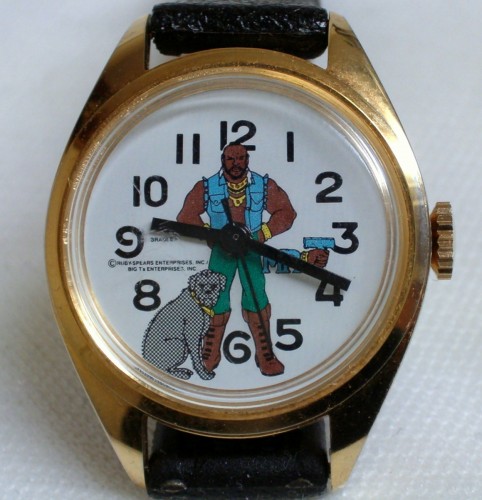
A Swiss-made 1983 Mr. T Watch. Timeless. (Source)

Micah Singleton (@micahsingleton) over at the Daily Dot has a really great essay about one of the biggest problems with the Apple Watch. You should read the whole thing but the big takeaway is that really great watches and mainstream tech have a fundamental incompatibility: nice watches usually become heirlooms that get handed down from generation to generation, but consumer technology is meant to be bought in product cycles of a only a couple of years. A really nice watch should be “timeless” in a way our devices never have been. Compared to the usual 2-year contract phone purchase, the technological evolution of high-quality watches moves about as fast as actual biological evolution. Is it possible to deliberately build timelessness into electronics? more...

#review Features links to, summaries of, and discussions around academic journal articles and books. This week, I’m reviewing:

Sayes, E. M. “Actor-Network Theory and Methodology: Just What Does It Mean to Say That Nonhumans Have Agency?” Social Studies of Science (2014) Vol. 44(1) 134–149. doi:10.1177/0306312713511867. [Paywalled PDF]

Update: The author, E.M. Sayes has responded to the review in a comment below.

Image from You as a Machine

A few weeks ago Jathan Sadowski tweeted a link to Sayes’ article and described it as, “One of the best, clearest, most explanatory articles I’ve read on Actor-Network Theory, method, & nonhuman agency.” I totally agree. This is most definitely, in spite of the cited material’s own agentic power to obfuscate, one of the clearest descriptions of what Actor-Network Theory (hereafter ANT) is meant to do and what it is useful for. Its important to say up front, when reviewing an article that’s mostly literature review, that Sayes isn’t attempting to summarize all of Actor-Network Theory, he is focused solely on what ANT has to say about nonhuman agents. It doesn’t rigorously explore semiotics or the binaries that make up modernity. For a fuller picture of ANT (if one were making a syllabus with a week of “What is ANT?”) I suggest pairing this article with John Law’s chapter in The New Blackwell Companion to Social Theory (2009) entitled “Actor Network Theory and Material Semiotics.” Between the two you’d get a nice overview of both of ANT’s hallmark abilities: articulating the character of nonhuman agency and the semiotics of modern binaries like nature/culture and technology/sociality. more...

Academics usually do not talk about “tactics.” There are theories, methods, critiques, but we -as professionals-rarely feel comfortable advocating for something as unstable or open to interpretation as a tactic. In the latest edition of the Science, Technology, and Human Values (The flagship journal for Society for Social Studies of Science) three authors threw caution to the wind and published the paper “Postcolonial Computing: A Tactical Survey” [over-priced subscription required]. While the content of the paper is excellent, what excited me the most was their decision to describe their new “bag of tools” as a set of tactics. Kavita Philip, Lilly Irani, and Paul Dourish take a moment in their conclusion to reflect on their decision:

We call our results tactics, rather than methodologies, strategies, or universal guarantors of truth. Tactics lead not to the true or final design solution but to the contingent and collaborative construction of other narratives. These other narratives remain partial and approximate, but they are irrevocably opened up to problematization.

I will employ the language and approach of the “tactical survey” to offer a new set of conceptual tools for understanding augmented protest and revolution. It is my aim that they prove useful for activists as well as academics and journalists following Occupy Wall Street and similar movements. This first part focuses on the intersections of transparency, social media, privilege, and public depictions of protest. Part 2 will cover the utilization of corporate technological systems (e.g. Apple productsTwitter) and building alternatives to those systems (e.g. Vibe, Diaspora). These tactics are forged from observations (first hand and otherwise) of the #OWS movement. They are intentionally abstract, because they are menat to apply to a wide range of instances and scenarios.  more...

Congressman Darrell Issa (R-CA) is the sponsor of the "Research Works Act"

It seems as though Congress, having grown tired of pissing off large swaths of the country, are now opting to write bills that anger a very particular group of people. Almost a month ago, on December 16, 2011, California Republican Congressman Darrel Issa introduced the “Research Works Act” which would kill government-assisted open-access journals. As PJ said before, journals (especially the closed private ones) are the dinosaurs of academia and as Patricia Hill Collins later noted, more...


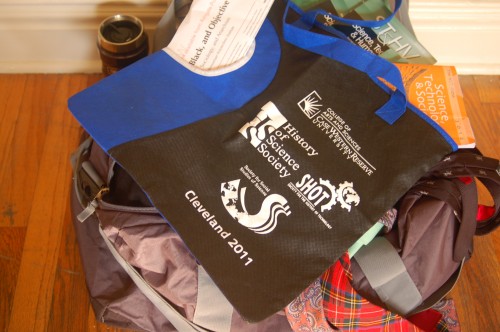
I'm pretty bad at unpacking from conferences...

Unlike my fellow Cyborgologists, who are based in sociology departments, I am working towards a Ph.D in an interdisciplinary field called Science and Technology Studies (STS). The field emerged in the late 60s amongst (and directly influenced by) the environmental movement, the anti-nuke movement, and second wave feminism. Today STS is an established field with departments all around the world. The interdisciplinary nature of the field makes it difficult to have one single umbrella conference, but the closest we get is the annual Meeting of the Society for the Social Studies of Science, or simply “4S.” The conference has panels on a wide variety of topics including, “(Re)Inventing the Internet: New Forms of Agency“, “Evidence on Trial: Experts, Judges and Public Reason“, and “Reproductive and Contraceptive Technologies: Shifting Subjectivities and Contemporary Lives“. There are also two sister conferences that happen simultaneously at nearby hotels: The Society for the History of Technology (SHOT) and the History of Science Society (HSS). While the conference was enjoyable, and the talks were fascinating, I was left wondering if STS is up to the task of changing how we talk about technology, science, and innovation. more...