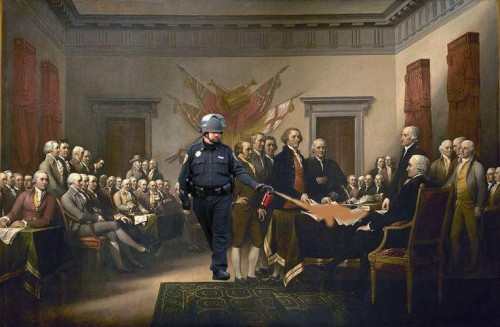
Sarah Wanenchak

up-41435e2014e71d77143bf31e27e27801

I have watched my fair share of Upworthy videos. They’re generally fun to hate-watch, and they make for good Newsfeed fodder. Sharing Upworthy videos with your “Family” or “High School Friends” Facebook list can make you feel like a prime time MSNBC anchor. Each video is an opportunity to reveal something to your assumedly uninformed, selfish friends. The leading, absolutely begging to be parodied titles range from confusing (You Should Watch This Strange Man Rub A Stick Of Butter On A Tree. For A Really Good Reason) to the cloyingly heinous (Obama Takes A Second To Talk About Jews In America. It’s MEGA Inspiring). These could be dismissed as cludgy rhetorical tools for Facebook arguments, but there’s something else about these videos that is actively destructive to the American left. Upworthy packages soundbites of elite white paternalism for mass distribution and consumption through social media. more...
marathon-cartoon
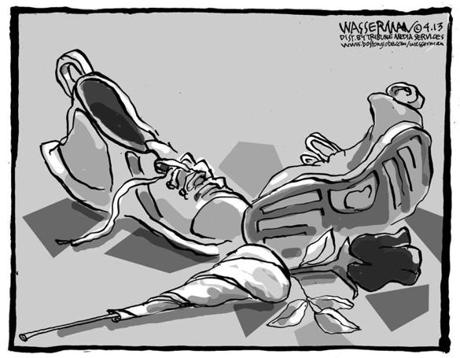
“Marathon Massacre” by Dan Wasserman, for The Boston Globe

As I write this, it’s 5:00 PM on April 15th, 2013. From my window over Massachusetts Avenue (we call it “Mass Ave”) in Cambridge—which I have open to let in one of the first nice spring days of the year—I can hear waves of sirens from the emergency vehicles that are still moving in response to the two explosions at the Boston Marathon finish line that went off just before 3:00 PM. The Mass Ave bridge between Boston and Cambridge is reportedly closed; large shuttle buses are trying, awkwardly and uncertainly, to make the turn off of Mass Ave onto one of my cross streets. The flags at both Cambridge City Hall and the Cambridge Post Office are still flying high, but I imagine they’ll be at half mast by the time you read this tomorrow. Even tomorrow, this intentional tragedy will still be very recent, very fresh, and very raw.

I’m sad in ways I can’t fully identify or explain, grateful that (so far as I know) everyone I care for here is okay, and—as I said on Twitter—longing for that time in the recent past when all the bombs (“bombs”) in Boston were actually stupid light-up LED pictures of cartoon characters. Somewhere in my disorganized thoughts, I’m also struck by the many ways that both people and institutions are using digital social technologies in response to this attack, and I’m going to try to get a few of those thoughts down here. In particular, I want to focus on the “vine” (short looping video) of one of the explosions that spread throughout my Twitter feed within an hour of the carnage at the finish line. more...

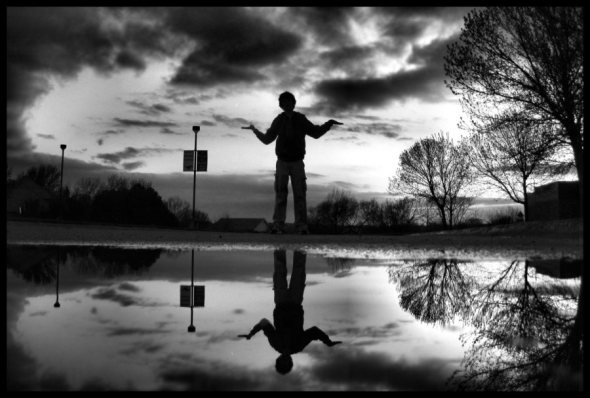
Photo credit: Evan Ludes

Last week, I started a somewhat ridiculously ambitious post wherein, by way of making a whole bunch of points I’ve been wanting to make anyway, I intended to push us all toward strengthening and clarifying our ideas around both digital dualism and augmented reality. In light of some really excellent work by Jenny Davis (@Jup83), PJ Rey (@pjrey), and Tyler Bickford (@tylerbickford), in addition to some old-fashioned conversation on these topics with PJ and Nathan Jurgenson (@nathanjurgenson), I’m now going to change course a bit. In this middle installment, I’m going to revisit the three problematic dualisms of digital dualism (Atoms/Bits, Physical/Digital, and Offline/Online), take up the two recent major critiques of the digital dualism framework, advance a few provocations in the service of breaking dualisms and promoting clarity, and then finally conclude for this week with a preview of this essay’s final destination.

more...

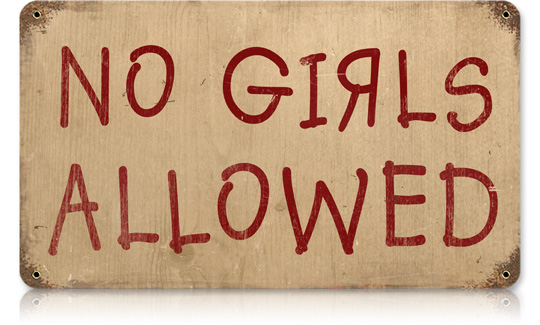
no-girls-signIf you’re a regular reader of Cyborgology, chances are good that you caught the most recent “brouLOL” (yes, that’s like a 21st century brouhaha) over digital dualism and augmented reality. If you’re a careful reader of Cyborgology, chances are good you also caught (at least) one glaring omission in much of the writing featured in this wave of commentary. What was missing?

Ladies, gentlemen, and cyborgs, allow me to (re)introduce you to Jenny Davis (@Jup83) and Sarah Wanenchak (@dynamicsymmetry)—oh yeah, and my name’s Whitney Erin Boesel (I’m @phenatypical). None of us identify as men, and all of us have written about digital dualism. In fact, you may have seen our work referenced recently under some collective noms de plume: “the other digital dualism denialists,” “others on this blog,” “others,” “other Cyborgologists,” “other regular contributors,” etc. If you’re a crotchety sociologist with a penchant for picking apart language (ahem: guilty), it doesn’t get much better than this. During the conversation earlier this month, the named and cited Cyborgologists were (almost) always men—while Jenny, Sarah, and I were referenced obliquely (at best) in an unnamed “other” category. more...

With police dismantling Zuccotti Park and other #Occupy encampments throughout the country and impending Winter weather, pundits and activist alike are asking: Does the #Occupy movement have a future? To survive, #Occupy must begin—and, in fact, has already begun—a tactical shift. However, before I attempt to discuss #Occupy’s future, let me first be clear: The #Occupy movement is already a success. Recent months have witnessed a radical shift in mainstream political discourse, where concerns over America’s widening income and wealth gaps now have near equal footing with the deficit-reduction agenda. It has become common knowledge that the top 1% receive roughly a fifth of America’s collective income and control a third of the wealth. More Americans view Occupy Wall Street favorably (35%) than Wall Street (16%), government (21%), or the Tea Party (21%); and, though the country is gripped by a state of general cynicism, more people hold unfavorable impressions of big business (71%), government (71%), and the Tea Party (50%), than of #Occupy Wall Street (40%). Put simply, #Occupy is the most popular (and least unpopular) thing we’ve got. more...