news

PowellThe hack and leak of Colin Powell’s emails have brought with them a national conversation about journalistic ethics. At stake are the competing responsibilities for journalists to respect privacy on the one hand, and to inform the public of relevant ongoings on the other.

Powell’s emails, ostensibly hacked and leaked by Russian government forces, revealed incendiary comments about both Donald Trump and Hillary Clinton. Known for maintaining a reserved and diplomatic approach, the indiscreet tone of Powell’s emails had the appeal of an unearthed and long suspected truth.

The news media responded to the leaked emails by plastering their content on talk shows and websites, accompanied by expert commentary and in depth political analyses. Line by line, readers, viewers, and listeners learned, with a sense of excitement and validation, what Colin Powell “really thinks.” more...

Panama Papers

Hacking is the new social justice activism, and the Panama Papers are the result of an epic hack. Consisting of 11.5million files and 2.6TB of data, the body of content given to German newspaper Süddeutsche Zeitung by an anonymous[1] source and then analyzed by the International Consortium of Investigative Journalists (ICIJ), is uniquely behemoth. It puts Wikileaks 1.7GB to shame.

The documents were obtained from Mossack Fonseca. The company is among the largest offshore banking firms, and their emails and other electronic documents tell a compelling (if not entirely surprising) story about untraceable monetary exchanges and the ways that state leaders manage to grow their wealth while maintaining a façade of economic neutrality. By forming shell companies, people can move money without attaching that money to themselves. This is not a sufficient condition for illegal activities, but certainly fosters illicit ones. more...

5366688138_743dabd609_o

Atrocities in Eritrea atop my Twitter feed. A few tweets below that, police violence against an innocent African American girl at a pool party. Below that, the story of a teen unfairly held at Rikers Island for three years, who eventually killed himself. Below that, news about the seemingly unending bombing campaign in Yemen. Below that, several tweets about the Iraq war and climate change—two longtime staples of my timeline. It reminds me of the writer Teju Cole exclaiming on Twitter last summer that “we’re not evolving emotional filters fast enough to deal with the efficiency with which bad news now reaches us….”

This torrent of news about war, injustice, and suffering is something many of us experience online today, be it on Facebook, Twitter, in our inboxes, or elsewhere. But I wonder about the ‘evolutionary’ framing of this problem—do we really need to develop some new kinds of emotional or social or technical filters for the bad news that engulfs us? Has it gotten that bad? more...

–Listen to the show here–

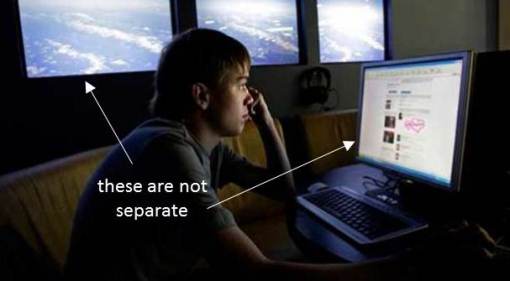
The Diane Rehm Show took to the air, ending 45 minutes ago, to debate how Facebook is making us lonely and disconnected and ruining just about everything. This is my quick first-reaction. On one side was Sherry Turkle, that avatar of “digital dualism” (more on this below) who recently wrote “The Flight From Conversation” in the New York Times and Stephen Marche who wrote “Is Facebook making us Lonely?” in The Atlantic. On the other side was Zeynep Tufekci, a researcher who communicates as well as these journalists*, responding to Turkle (also in the Atlantic). While Turkle and Marche’s headlines are intentionally catchy and dramatic, they are also sensationalist and misleading. The reality is not as captivating and Tufekci’s headline in response is far more accurate: “Social Media’s Small, Positive Role in Human Relationships.”

This is one of the many lessons provided by this hour of NPR: catchy arguments tend to trump data, even on nerdtacular public radio. Tufekci, outnumbered, did well given the dearth of air time provided relative to the more sensationalist ideas on the show. Further, the show (@drshow) seemed completely unaware of the fast-moving and engaging Twitter backchannel discussing the topics in much more nuance and detail than much of what was said on-air. [You’ve already enjoyed the irony of this as opposed to Turkle’s argument, right? Obviously.]

The next lesson more...

Social theory should both grow out of, and be applicable to, empirical phenomena. As such, an important part of theorizing is to understand the substantive realities about that which we theorize. When theorizing about new technologies, this means keeping up with a highly complex and quickly changing empirical landscape. This post is a roundup of some recent empirical findings about social media trends, with a focus on Facebook—the current social media “hub.”

more...


This July, a new mobile app called SceneTap will further augment the hook-up scene. The app is linked to cameras in bars which count the number of patrons and based on facial features determine the average age and the male-to-female ratio. Of course, the decision to go to a particular bar (and not to go to another) effectively alters the dataset. We therefore make decisions about where to go based upon technologically transmitted data about physical bodies. The presence of our own physical bodies then become data to be recorded, transmitted, and factored into the social plans of others.


There is an important space between old and new media. This is the grey area between (1) the top-down gatekeeping of old media that separates producers and consumers of content and (2) the bottom-up nature of new, social media where producers and consumers come from the same pool (i.e., they are prosumers).

And in the middle are projects like Global Voices, what might be called curatorial media: where content is produced by the many in a social way from the bottom-up and is then mediated, filtered or curated by some old-media-like gatekeeper.

The current protests in Syria can serve as an important example of how curatorial media works. Especially because foreign journalists have been banned from the country, creating a dearth of information for old media. Alternatively, more...

Project Cascade from the New York Times seeks to visualize how news stories break and are disseminated online. By illustrating how stories explode through the social web it provides a glimpse into our highly networked information society.