I have not seen the new Star Wars but ambient levels of Star Wars have reached such a peak that I feel eminently qualified to review it without actually seeing the film or even reading a plot synopsis. In all honesty I probably will not watch it until I can assure that I will see a high definition version for free through whatever means comes to my disposal. What I have seen, the cross-promotions, the essays, and the toys, tells me everything I need to know to assess it as a piece of culture. Star Wars is not a movie, it is a platform for media and a financial vehicle. Star Wars has plot like America has elections. It’s almost a formality, the official pomp heralding in a new wave of characters, theories, and controversies. If we black box the film itself and instead look at all of the culture that spews out from its unknown (to me) depths, I think we get a much more cohesive (I’d even go so far as to say honest) assessment of the entire event. more...

Paul Budnitz describes himself as a “serial entrepreneur” having created other companies that make artisanal toys and luxury bicycles. This is not the typical road bike most people have. He’s also the creator/founder/president/charismatic leader of Ello. And when a social network launches with a manifesto that proudly proclaims “You are not a product”, there’s more on the line than embedded video support. Despite the radical overtures of the initial launch, we shouldn’t expect any more from Ello than we would from a luxury bicycle. more...
If you haven’t yet noticed (you’ve probably noticed), Facebook likes to appropriate features from competing apps and platforms. You can credit the demise of the old “[Name] is…” status update prompt, for instance, to the rise of Twitter. You may also recognize the “share” feature on your friends’ status updates from Tumblr; the place check-ins from Foursquare; the friend “lists” from Google+; the photo albums from Flickr (or any other photo sharing site); the photo filters from Instagram (back before Facebook bought Instagram outright); the vanishing images of Poke (that’s a newer Facebook app, not the older Facebook feature) from Snapchat; the “Music” app from Myspace (new or old); or even the “Work and Education” profile field from LinkedIn. Yes, that’s right: voracious media amoeba that it is, Facebook has even engulfed some of LinkedIn. Icky.
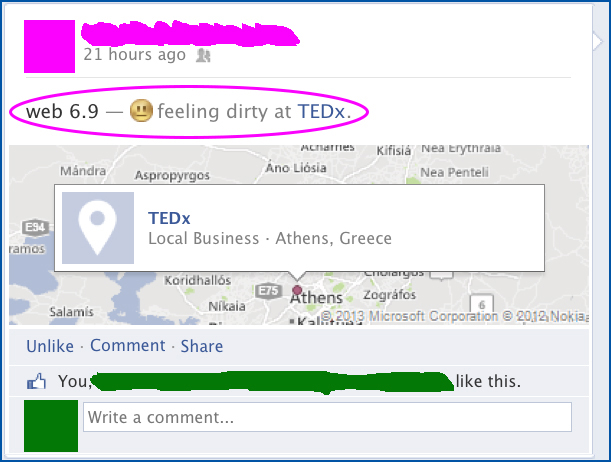
Yet in its seeming quest to digest and regurgitate elements from every digital social technology ever, Facebook most recently appropriated features not from a competing platform or app, but from the pre-Web-2.0 ‘sharing’ stalwart LiveJournal[i]. Remember the “Current Mood” field, and the various “Mood Theme” icons you could use to answer when you weren’t feeling up to free response? If you don’t already, you’ll soon have something similar in a new field on your Facebook status update prompt. Go into that new field and select “feeling,” and you’ll get to answer “How are you feeling?” with one of roughly 200 preset emoji/emotion combinations like it’s 2001 all over again. Your profile will then show something like the image above.
There are some significant differences between LiveJournal’s “Current Mood” field and Facebook’s new “feeling” icons, however, and these differences get at the heart of why—potentially cute/annoying emoji notwithstanding—talking about your emotions with the new Facebook feature is very different from talking about your emotions on LiveJournal. more...
Willingness to overpay for an overhyped experience
The shot of Jager is dropped into a glass of Red Bull and chugged until all evidence disappears down the throats of the youthful.
Felix Baumgartner jumps higher and faster than anyone ever before. Image c/o AP
As I (and a record 8 million other live Youtube viewers) witnessed Felix Baumgartner jump from a floating platform 128,000 feet in the air, I could not help but think about those little red bulls on his helmet. Red Bull, the ubiquitous energy drink and funder of all things Extreme™, had branded nothing less than a moment in human history. A monumental achievement brought to you by a peddler of a sugary drink that has fueled some of the worst decisions in the world [NSFW]. There was a day when the United States government was in the business of dazzling humanity with its feats of technological superiority and raw tenacity. For three years we were landing on the moon almost every six months. We made it look easy. Baumgartner’s jump is truly incredible, but it also makes me a little angry. I am tempted to bemoan the fall of civic life and the rise of corporate-sponsored spectacle, but ultimately I cannot find a moral handhold. Do I want an arms race or consumer capitalism to fund the greatest technological achievements of my lifetime? more...
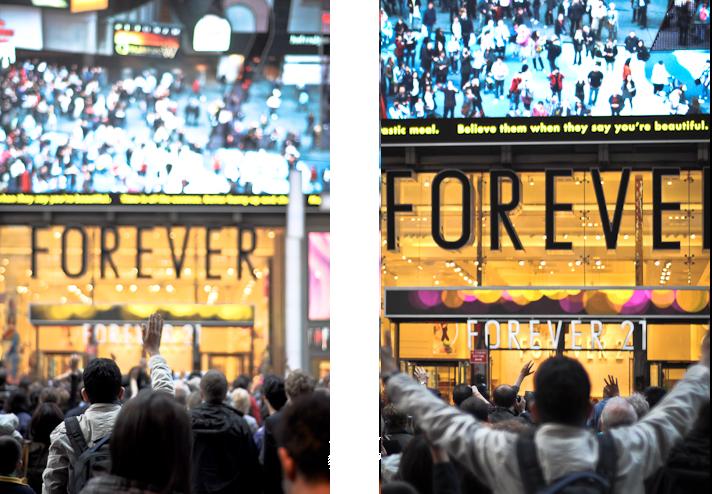
Crowds in Times Square waving at themselves on the big screen. Photos in this post by nathan jurgenson.
Something interesting has been happening in Times Square this summer. As has been occurring for a century, the crowds gather with necks perched upward looking at all the famously illuminated billboards. But now there is a new type of buzz in the crowd: they stand together facing the same direction, cameras held high and their hands waving even higher. They are not just watching celebrities or models in this the most expensive ad-space in the world; today, they are watching themselves on the big screen.
This is all part of a new billboard for the company Forever 21 currently in use in Times Square in the heart of New York City. It struck me that this billboard is nothing short of a consumer-capitalism-happening, and started snapping photos and thinking about what this all might mean. more...
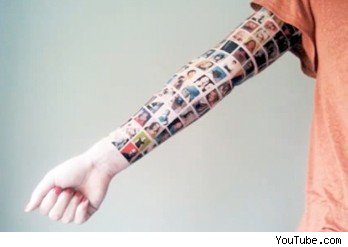
Nonetheless, the viral video itself made its way around the Internet, serving as but another case of tattoos as advertising. Much has been written on the topic already (Bengsston et. al 2005; McKelvey 1999; Kosut 2005), but I want to theorize further the use of tattooing in marketing as it relates to the phenomena of brand tattoos and lifestyle consumption and the repercussions these trends have for understandings of consumer culture. more...
Advertising on social media is more than those segregated paid-for-spaces that display ads paid for by companies (e.g., on the far-right of your Facebook screen). This sort of paid-advertising has been shown to be so highly ineffective that some have predicted it will be the downfall of the social web. However, these predictions do not understand that the fundamental point of the social web (2.0) is that users are prosumers; they are simultaneously both consumers and producers of content. And advertising is no different. Advertisements that we simply consume worked in a consumer medium, like television. However, social media is a prosumer medium, and today we are the ones doing the advertising work of integrating corporate logos and branding into our profiles and news feeds.
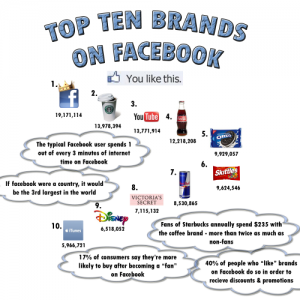
Facebook’s ubiquitous “like” button reflects our modern task of self-presentation (and distinction) based on our taste in just about anything and everything, documented and compared to the various “likes” of any other visitor to your profile (and remember: what someone “likes” may not be what they actually like but what they want others to see that they like). In modern consumer culture, this collection of displayed “likes” will include corporate brands that one identifies with. This might mean clicking “like” on the Starbucks or Victoria’s Secret pages, which then becomes a part of your profile. more...
About Cyborgology
We live in a cyborg society. Technology has infiltrated the most fundamental aspects of our lives: social organization, the body, even our self-concepts. This blog chronicles our new, augmented reality.