infrastructure

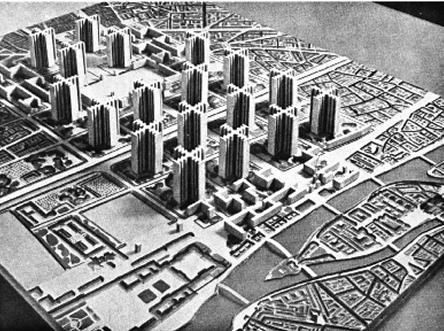
Le Corbusier's La Ville Radieuse
Le Corbusier’s La Ville Radieuse

The motor has killed the great city. The motor must save the great city.”

-Le Corbusier, 1924.


In the fast and shallow anxiety around driverless cars, there isn’t a lot of attention being paid to what driving in cities itself will become, and not just for drivers (of any kind of car) but also for pedestrians, governments, regulators and the law. This post is about the ‘relative geographies’ being produced by driverless cars, drones and big data technologies. Another way to think about this may be: what is the city when it is made for autonomous vehicles with artificial intelligence? more...


Both are technology books that came out in 2015, and John Durham Peters’ The Marvelous Clouds is perhaps the best counterpoint, or antidote, to Sherry Turkle’s Reclaiming Conversation. Turkle is the avatar of digital dualism, seeing a real world that is natural versus technology that is inhuman and added on. Peters instead puts forward a view of media and technology as part of the environment, and the environment as inherently technological and itself a type of media. Peters doesn’t think of only one all-encompassing environment but of many elements, be they water or language or fire or digitality. Each is its own intersecting environment. Whether you like to think of digitality as part of one world or infinity worlds is an improvement over the digital dualist mistake of seeing two. more...

Photo taken by Dheera Venkatraman in Myanmar.

For a little over a decade, those researchers and visionaries originally involved in establishing the infrastructure for the World Wide Web have set their sights higher.  While hyperlinking Web pages has been pivotal to creating a Web of documents, the more recent goals to establish a Semantic Web involve hyperlinking data, or individual elements within a Web page.  In attaching unique identifiers (in the form of Uniform Resource Identifiers or URIs) and metadata to data points (rather than to just the documents where those data points appear) machines are able to interpret, not just what the browser should display, but also what the page is about.  The hope is that, in providing machines with the capacity to interpret what data is about, it will be possible to drastically improve Web search and to allow researchers to perform automated reasoning on the massive amounts of data contributed to the Web.  There are numerous examples where this infrastructure is already having impact (albeit largely behind-the-scenes).  For instance, the New York Times has already “semantified” all of its data and created a Semantic API where researchers can query its database.  Facebook’s Graph API, which employs Semantic Web infrastructure to structure user profile data, has been the foundation for several studies attempting to make sense of human behavior and interactions through the platform’s “big data.” more...

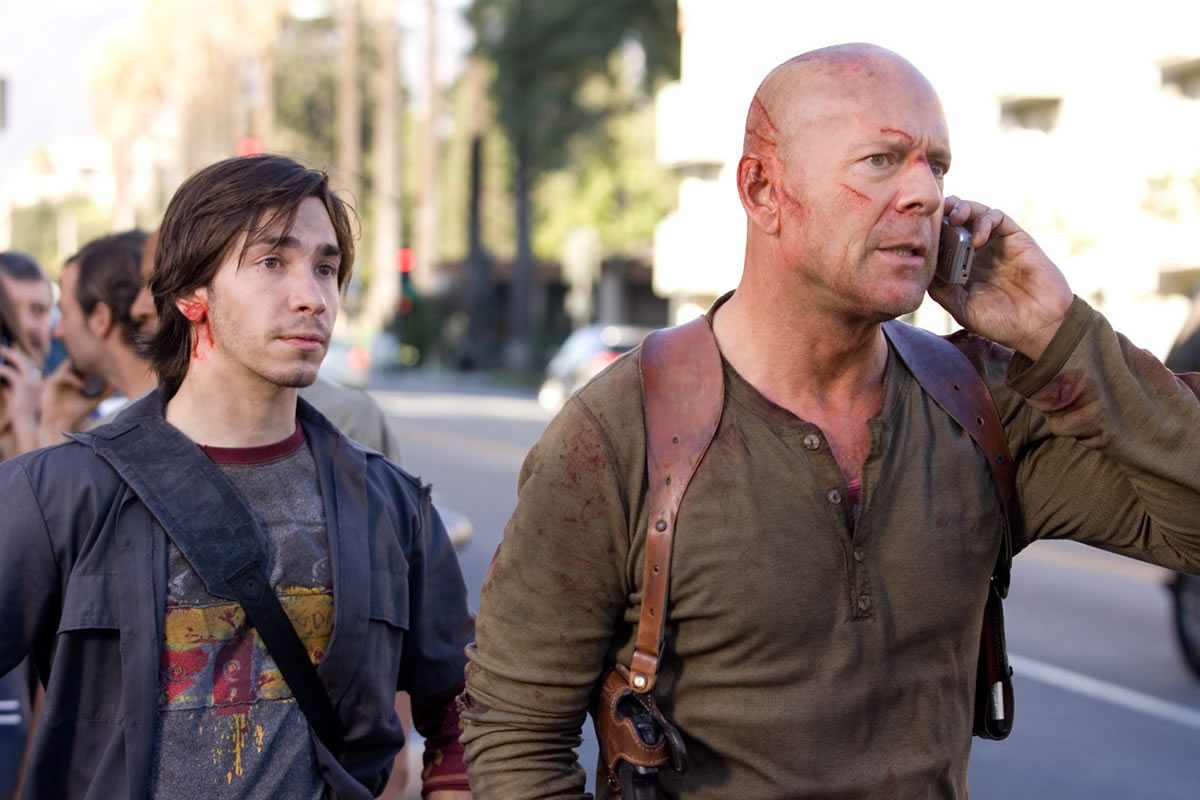
Scene from Die Hard 4: Live Free or Die Hard

David Graeber has republished his popular essay Of Flying Cars and the Declining Rate of Profit in his new book Utopia of Rules with some small changes that go toward supporting the book’s over-all argument that the hallmark of American neoliberalism is not dynamism and a freeing up of individuals to peruse “creative class” jobs but rather a bureaucratization of every aspect of life. This total bureaucratization (almost literally) papers over the structural violence that supports capitalism. Of Flying Cars specifically argues that the utter failure to deliver on the implicit promises of Jetsons-level automation by the 21st century is not necessarily a matter of market forces (no one actually wants a flying car!) or technical impossibility (Moore’s law hasn’t delivered thinking computers yet!) but is in fact a product of both squashing the imagination through bureaucratic devices, and the immense devaluing of labor and elimination of corporate profit taxation that leads to paltry civilian research and development. In essence, capitalism in its present form, is anathema to the future it once promised.

Graeber states in the beginning of the essay that he is puzzled by the near silence from those people who saw the moon landing on their televisions but today do not, themselves, live on the moon (or can easily teleport there, or take a drug that might extend their life to the time that both of those things are available). “Instead,” he writes, “just about all the authoritative voices—both on the Left and Right—began their reflections from the assumption that a world of technological wonders had, in fact, arrived.”

Graeber relatively quickly drops the issue of how our collective expectations of the future could be so quickly and completely re-aligned (his answer is postmodernism) and goes on to explain why such an alignment has become necessary (capitalism’s secret love of bureaucracy) but I want to dwell on the “how” question a little bit longer by offering up a corollary to Of Flying Cars. The argument that follows is also a reprinting of my own work, an article published in a 2012 issue of the International Journal of Engineering Social Justice in Peace, co-authored with Arizona State University’s Joseph R. Herkert. I want to argue that our expectations for the future are purposefully managed through a circulation of imagined threats to capitalism, the popularizing of narratives that flesh out that threat, and the re-articulation of those imagined threats as real ones that must be met with massive government funding. I will demonstrate this process using a beloved and uniquely American franchise: Die Hard. more...

I thought for reruns week I would re-post something I wrote back in February that fits with our ongoing CFP on Small Town Internet. Problems of governance, especially of small, geographically defined groups, is surprisingingly understudied especially when it comes to our present state of augmented reality. 

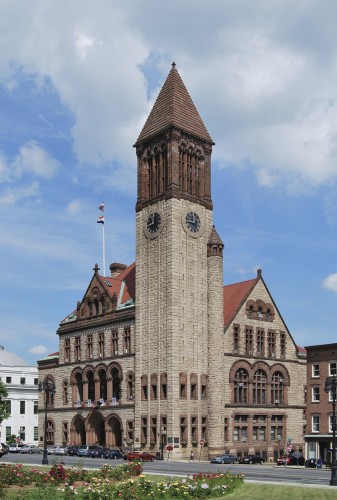
The Albany New York Town Hall


It is certainly good news that the Obama Administration has come out strong for net neutrality. The President recently made an announcement that his office would help promote local broadband competition as part of a broader effort to improve the country’s data infrastructure. More specifically, the federal government plans to help municipalities develop their own data networks, fight state laws that prevent municipal governments from offering public broadband options, and help small businesses compete in local markets with companies like Verizon and Time Warner. The chairman of the FCC followed suit by announcing (in WIRED Magazine…?) yesterday that he would be circulating a proposal to apply Title II to telecom companies and mobile phone carriers, effectively making it illegal to throttle connections based on what sorts of services you are connecting to. This is all good news but I’m also hesitant to trust local authorities with my internet connection. Aren’t these the same governments that defend murderous police forces and cooperated with the federal government to shut down political dissent? Why should these organizations control the network? While I am definitely not a fan of huge telecom corporations, I don’t trust my local government either.  more...

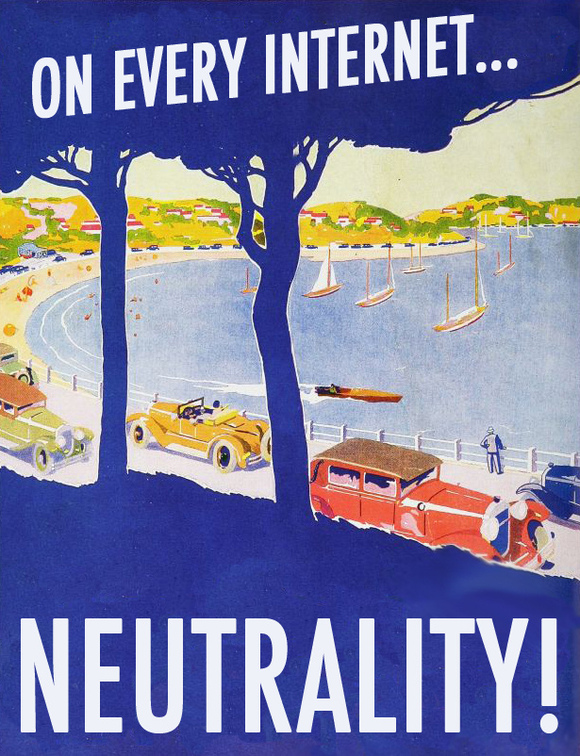
on-every-internetI was working recently on a short essay about net neutrality and, in the process, ended up writing a much longer piece about net neutrality. My aim in writing that longer piece (below) was twofold: I wanted both to demonstrate that net neutrality isn’t too technical and complicated for normal people to understand, and also to trace out how a trio of closely related issues—net neutrality rules, regulatory classifications, and the push to convert all voice traffic to digital—fit together, as well as what their combination might mean for the so-called “open Internet.”

SPOILER: You need to pressure the FCC to adopt strong net neutrality rules, and then you need to do a bunch of other stuff. Net neutrality isn’t enough, and neither Big Telecom nor Big Digital is talking about the pieces that will have the greatest (and most unequal) impact on Internet users.

Without further ado, here’s my attempt at a guided tour through roughly 18 years of Internet-related regulatory history:

more...

The Planned Headquarters of Apple Inc.

The year is 1959 and a very powerful modern art aficionado is sharing a limousine with Princess  Beatrix of the Netherlands. The man is supposed to be showing off the splendor of the capital of what was once —so optimistically— called New Amsterdam. His orchestrated car trip is not going quite as he had hoped and instead of zipping past “The Gut” and dwelling on the stately early 19th century mansions on Central and Clinton Avenues, Beatrix is devastated by the utter poverty that has come to define the very center of this capitol city now called Albany, New York. The art aficionado, unfortunately for him, cannot blame some far away disconnected bureaucrat or corrupt politician for what they are seeing because he is the governor of this powerful Empire State and he has done little to elevate the suffering of his subjects. He resolves, after that fateful car trip, to devote the same kind of passion he has for modern art to this seat of government. Governor Rockefeller will make this city into a piece of art worthy of his own collection. more...

Photo by 'lance robotson'
Photo by ‘lance robotson

Earlier this week, the New York Times ran yet another hilariously digital dualist piece on a new surveillance system that lets retailers follow customers’ every move. The systems, mainly through cameras tied into motion capture software, can detect how long you stared at a pair of jeans, or even the grossed-out face you made at this year’s crop of creepy, hyper-sexualized Halloween costumes. The New York Times describes this as an attempt by brick and mortar stores to compete with data-wealthy “e-commerce sites.” (Who says “e-commerce” anymore? Seriously, change your style guide.) Putting aside the fact that most major retailers are also major online retailers, making the implicit distinction in the article almost meaningless, the article completely misses the most important (and disturbing) part of the story: our built environment will be tuned to never-before-seen degrees of precision. We have absolutely no idea what such meticulously built spaces will do to our psyches. more...

aaa -- minnesota bridgeI remember hearing somewhere that one of the most important things you can teach a child is to delay gratification.

Give a five-year-old a choice between a cookie on the table in front of him right now and two cookies 15 minutes from now, and chances are he’ll take the one cookie right now. Maturity is about learning to live within your means. You want something nice, you save up for it. You resist blowing your entire paycheck on bling so that when the first of the month comes you have enough money to cover the rent.

It’s obvious that the consumer economy wants us to ignore these basic principles. more...

Michael Rogers, Republican Congressional Representative of Michigan's 8th district and sponsor of CISPA

House representative Mike Rogers (R-MI) introduced a bill back in November called the Cyber Intelligence Sharing and Protection Act (H.R. 3523) or CISPA. It has since been referred to and reported by the appropriate committees. Since then, according to Representative Rogers’ own web site, over 100 members of congress have already announced their support for the bill:

The 105 co-sponsors of the bill include 10 committee chairmen.  Additionally, a wide range of major industry and cyber associations, such as Facebook, Microsoft, the US Chamber Commerce, the Business Roundtable, the Internet Security Alliance, TechAmerica, and many others have sent letters of support for the bill.  A list of major industry and association supporters can be found at http://intelligence.house.gov/bill/cyber-intelligence-sharing-and-protection-act-2011

Unlike SOPA and PIPA, CISPA is all about collecting and sharing “cyber threat intelligence” and has less to do with copyright infringement concerns. This bill does not directly threaten the business interests of web companies, which means we should not expect their help in fighting the bill. In fact Facebook, IBM, Intel, Oracle, and Microsoft (among others) have already sent letters in support. more...