The term “meme” first appeared in the 1975 Richard Dawkins’ bestselling book The selfish gene. The neologism is derived from the ancient Greek mīmēma, which means “imitated thing”. Richard Dawkins, a notorious evolutionary biologist, coined it to describe “a unit of cultural content that is transmitted by a human mind to another” through a process that can be referred as “imitation”. For instance, anytime a philosopher ideates a new concept, their contemporaries interrogate it. If the idea is brilliant, other philosophers may eventually decide to cite it in their essays and speeches, with the outcome of propagating it. Originally, the concept was proposed to describe an analogy between the “behaviour” of genes and cultural products. A gene is transmitted from one generation to another, and if selected, it can accumulate in a given population. Similarly, a meme can spread from one mind to another, and it can become popular in the cultural context of a given civilization. The term “meme” is indeed a monosyllable, which resembles the word “gene”. more...
Humor is central to internet culture. Through imagery, text, snark and stickers, funny content holds strong cultural currency. In a competitive attention economy, LOLs are a hot commodity. But just because internet culture values a laugh it doesn’t preclude serious forms of digitally mediated communication nor consideration of consequential subject matter. In contrast, the silly and serious can—and do—imbricate in a single utterance.
The merging of serious and silly becomes abundantly evident in recent big data analyses of political communication on social media. Studies show that parody accounts, memes, gifs and other funny content garner disproportionate attention during political news events. John Hartley refers to this phenomenon as ‘silly citizenship’ while Tim Highfield evokes an ‘irreverent internet’. This silliness and irreverence in digitally mediated politics means that contemporary political discourse employs humor as a participatory norm. What remains unclear, however, is what people are doing with their political humor. Is humor a vehicle for meaningful political communication, or are politics just raw material for funny content? My co-authors and I (Tony Love (@tonyplove) and Gemma Killen (@gemkillen)) addressed this question in a paper published last week in New Media & Society. more...
The What-Would-I-Say App, (#wwis) created by HackPrinceton, has garnered widespread popularity. The app basically amalgamates your Facebook posts, rearranges them, and computes a best guess at what you, the Facebook user, would say. According the app’s creators, here’s how it works: more...
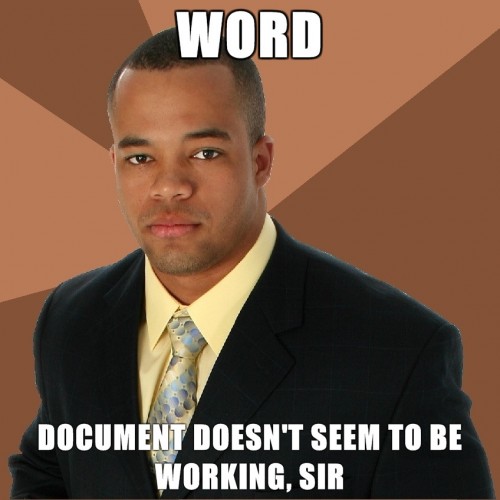
Why successful black guy is successful: The socio-cognitive side of humor
Having read Jenny Davis, David Banks and PJ Rey on internet memes, I felt compelled to share my creative grain of sand on this peculiar ‘web-based’ construct. I often wonder why memes are funny. The simplicity of memes is deceiving: e.g., a Spartan image, often featuring only the face or upper body of a person or animal, and a kitsch colored background that would make Warhol think you’re on acid. Add two rows of parallel text above and below and presto! – You have created funny. Is it really that easy? I would generally think (and hope) that humor is a complex phenomenon, that answering “why is this picture of a cat funny to me?” requires invoking some esoteric philosophical or psychological terminology. I decided to do some research.
One of my favorite memes of all times is “successful black guy”. This is successful black guy explained by know your meme: “an image macro series featuring a Black man dressed in business attire and a witty one-liner satirizing the stereotype of young African American male as street hustlers or gangsters who only care about cars, money and ho’s. The humor is mostly derived from the intentional line break in mid-sentence, with the top line impersonating a black male stereotype (EX: I Got the Best Ho’s) and the bottom line suddenly falling flat in character (EX: Out in My Tool Shed). more...
If you’ve check the Huffington Post today, you will notice something very different: A “Zombie” page has replaced the usual “Culture” section of the website. Just in time for Halloween, the internet newspaper has used the growing cultural obsession with zombies to create a parody of the zombie apocalypse occurring right now in their headquarters. Why? Because why not?
I am a huge fan of the television series “It’s Always Sunny in Philadelphia,” but I want to problematize some of the humor we often take for granted in the show. In a recent interview with Conan O’Brien, Charlie Day discusses some of the changes introduced into the current season of the show. Specifically, about 1:30 in, they discuss the weight gain that Rob McElhenney (“Fat Mac”) accomplished in pursuit of a “funnier” character. Notice how Charlie Day and Conan laugh—freely and unapologetically—at the prospect of Mac contracting diabetes (especially Conan’s mocking “Go America!” response to the image of “Fat Mac”): more...
We live in a cyborg society. Technology has infiltrated the most fundamental aspects of our lives: social organization, the body, even our self-concepts. This blog chronicles our new, augmented reality.