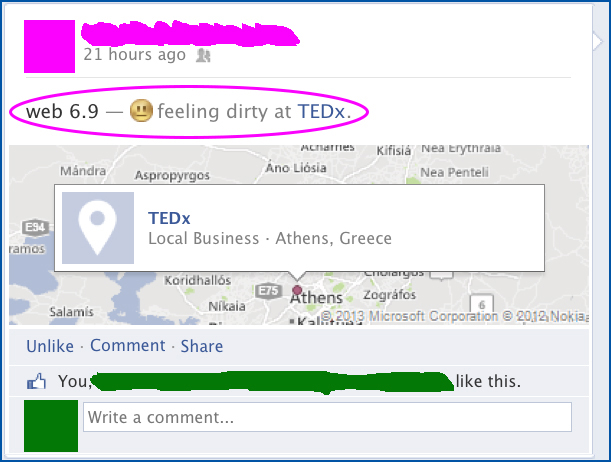
emotions

feeling-dirty2

If you haven’t yet noticed (you’ve probably noticed), Facebook likes to appropriate features from competing apps and platforms. You can credit the demise of the old “[Name] is…” status update prompt, for instance, to the rise of Twitter. You may also recognize the “share” feature on your friends’ status updates from Tumblr; the place check-ins from Foursquare; the friend “lists” from Google+; the photo albums from Flickr (or any other photo sharing site); the photo filters from Instagram (back before Facebook bought Instagram outright); the vanishing images of Poke (that’s a newer Facebook app, not the older Facebook feature) from Snapchat; the “Music” app from Myspace (new or old); or even the “Work and Education” profile field from LinkedIn. Yes, that’s right: voracious media amoeba that it is, Facebook has even engulfed some of LinkedIn. Icky.

Yet in its seeming quest to digest and regurgitate elements from every digital social technology ever, Facebook most recently appropriated features not from a competing platform or app, but from the pre-Web-2.0 ‘sharing’ stalwart LiveJournal[i]. Remember the “Current Mood” field, and the various “Mood Theme” icons you could use to answer when you weren’t feeling up to free response? If you don’t already, you’ll soon have something similar in a new field on your Facebook status update prompt. Go into that new field and select “feeling,” and you’ll get to answer “How are you feeling?” with one of roughly 200 preset emoji/emotion combinations like it’s 2001 all over again. Your profile will then show something like the image above.

There are some significant differences between LiveJournal’s “Current Mood” field and Facebook’s new “feeling” icons, however, and these differences get at the heart of why—potentially cute/annoying emoji notwithstanding—talking about your emotions with the new Facebook feature is very different from talking about your emotions on LiveJournal. more...
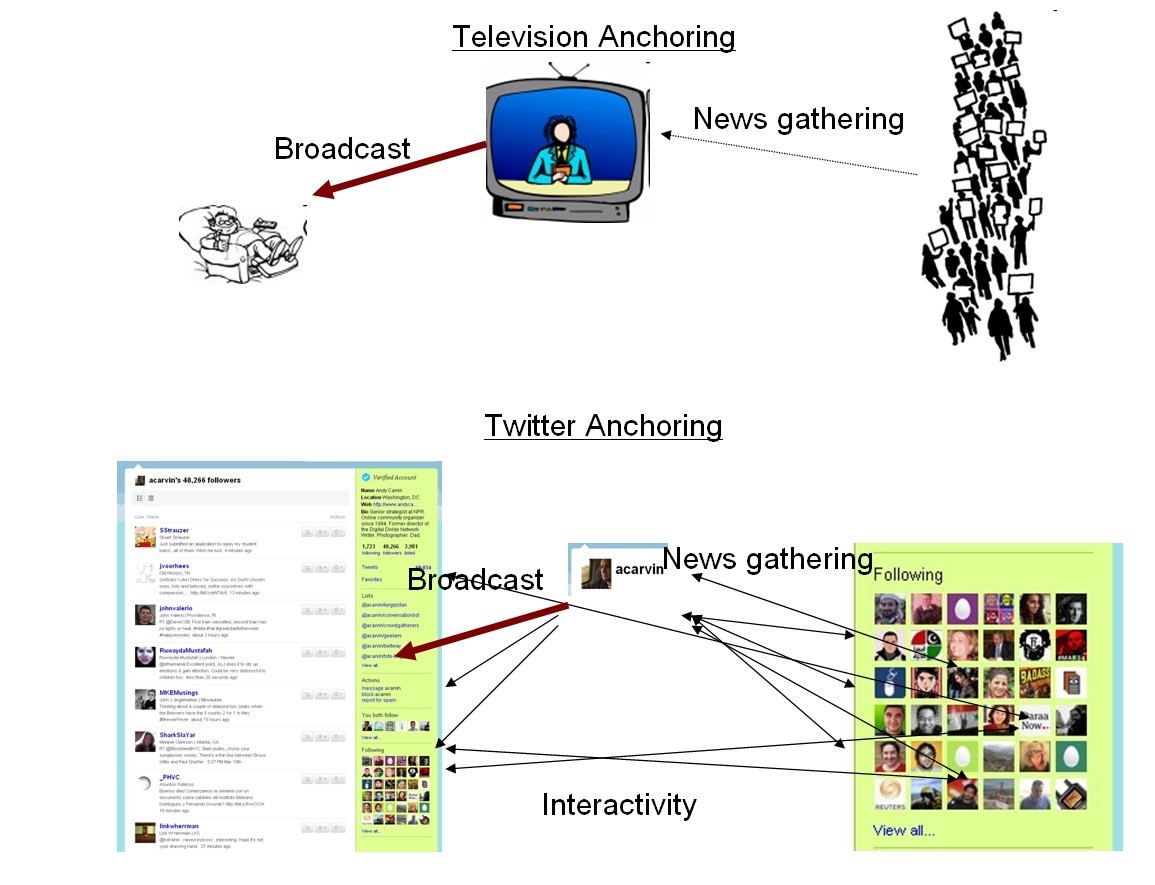

Image from Zeynep Tufecki/Technosociology.org

In the previous installment of this series, I set up what I characterize as the two primary areas of argument that stand against my primary claim: that social media technology and other forms of ICT, far from constraining emotional connections and the emotional power of solidarity-creating rituals, actually serve to facilitate emotions and the powerful connective work that emotional interaction does.

There are a number of ways that one could argue this is done, and Jenny Davis makes an especially pertinent argument in her post about the social cost of abstaining from digitally augmented forms of interaction. For the purposes of this piece, I want to focus my attention on the capacity of ICTs to facilitate the generation of emotional energy around contentious political action – especially contentious political action in a context of violent repression.

more...

Egyptian solidarity protest in Paris, Jan. 2011. Image by Jacques Delarue.

When it comes to thought and research on social movements and technology (separately and together), emotion is that crucial piece of the picture that everyone technically sees but hardly anyone explicitly acknowledges as worth paying attention to in its own right. Some of this is likely because emotion is hard to study in any way that social science would consider rigorous; it’s often taken as something fundamentally irrational and therefore fundamentally inexplicable. It is highly subjective. It is culturally and situationally constructed, and therefore conceptually slippery. It is interior; it is a difficult thing to see and to know. If explicitly drawing it out as an important factor is problematic for some, identifying it as a variable capable of carrying any causal weight is even more so.

Regarding technology and social movements combined, there is the question of how the digital and physical play out as far as what ends up really being important. What is the relationship between the two? Where exactly is the body in augmented contention and is the way in which it matters changing? What is really going on when we see a bunch of street protesters carrying smartphones?

more...

Occupy Berlin!

With all the rhetoric around “Facebook Revolutions” and “Twitter Revolutions”1 that we’ve had to endure over the last couple of years, it’s easy to get the sense that there’s something new about the character of contemporary political protest and revolutionary action, and that this newness is, in some fundamental way, the practical result of the omnipresent nature of technology. It’s difficult to miss the profound interweaving and enmeshing of the physical and digital aspects of protest as we see it in both the Arab Spring and Occupy Wall Street – the weight of the protests produced by the occupation of physical space by gathered human bodies, coupled with the constant documentation and nearly instantaneous sharing of images, video, and text that have chronicled these physical occupations and arguably helped them to grow – in short, the augmented nature of contemporary social action. We see this and to us it feels new. Even if we recognize that there are old things at work here – symbolism, patterns of mobilization and diffusion, pieces of the past reclaimed for the purpose of the present – we at least feel instinctively that there is something novel about the Arab Spring, Occupy, and all the other movements and events that have birthed themselves in correlation.

more...

This post by Adriano Farano originally appeared on owni.eu on January 5, 2011.


The news that in 2010 Facebook overtook Google as the most visited website in the United States is absolutely astonishing. But one might wonder what meaning this has for the way we use the web today?

Facebook and Google seem to me the frontrunners of two separate conceptions of today’s Internet.

On one hand, Mountain View’s giant is the empire of the reason, the quintessence of what I would call the ‘cold web’. Google is used, deterministically, to search for something you are looking for. It can be extremely useful, though rarely exciting; we like it because its algorithms provide an order to the infinite data on the Internet. In this sense, Google is Apollonian. Like the Greek god of sun, light and poetry, later identified with order and reason, Google helps us to shed some light into the abundant mass of information available online.

On the other hand, Facebook symbolizes the ‘hot web’. more...