
china

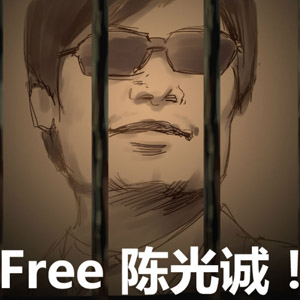
Chen Guangchen faced detainment and physical abuse after mobilizing protests and law suits against the Chinese government

In 2006, my final year of undergrad, I participated in a Chinese language and culture scholarship program. We learned to speak and write in Mandarin for two semesters, followed by a month long trip in the summer.  As tends to happen, I’ve forgotten most of the language. The lessons, however, have stuck with me. Along with humbling experiences of climbing the Great Wall, walking through the Forbidden City, and sampling tea in the rural mountains, I remember a few incidents in which Chinese censorship took me by surprise. For instance, on the day after we visited Tiananmen Square, I studiously went to an Internet café to learn more about the events that transpired at the historic site. Besides iconic images of tanks and soldiers, I was admittedly uninformed about most of the details. The tour guide only made one quiet allusion to the Cultural Revolution, and quickly changed the subject. The Internet, I hoped, would help me grasp the cultural and historical magnitude of the space I’d just inhabited.  No such luck. Google was more tight-lipped about Tiananmen Square than our knowledgeable but cautious guide.

China is infamous for its censorship policies and practices.  Amnesty International claims that China imprisons more journalists and ‘cyber-dissidents’ than any other country, and maintains a sizeable “Internet Police” force, up to 50,000 officers strong. But recent studies by Political Scientist Gary King show interesting and surprising patterns in censorship enforcement.  His data show that government censorship of digital activity is less about quieting criticism, and more about squashing physical mobilization. more...
A couple of weeks ago I posted an entry on technological autonomy. It made the point that a nation’s commitment to advanced technologies can result in a situation where its economic well-being is directly counter to the physical or psychological well-being of its people. The point I’d like to make today is that the commitments of corporations to advanced technologies can become similarly antithetical.

The example in that previous post was Japan’s commitment to nuclear power. Here I’ll consider two examples involving specific consumer products: the international sale of sports utility vehicles and the international sale of snack foods.Both examples raise an important definitional question: Which is the driving force, technology or capitalism? It’s a hard question to answer because at a certain stage of development the two are so closely intertwined that it’s often impossible to separate them. On the one hand, the spread of global capitalism would clearly be impossible without mass production technologies. On the other hand, capitalism is clearly the economic model most responsible for the development and exploitation of mass production technologies.

The historian David F. Noble has argued that technology is “the racing heart of corporate capitalism,” implying that capitalism directs the enterprise while technology supplies the motive force. I think you could just as successfully argue that the opposite is true. The best solution is probably to say that the relationship between technology and capitalism is dialectical, or symbiotic. Sometimes technology stimulates capitalism, other times capitalism stimulates technology; in advanced technological/capitalist societies neither could exist without the other. From either perspective an expansion of influence becomes a priority that overwhelms every other consideration, which is another way of defining a condition of de facto autonomy.

more...

Pear Tree in a Walled Garden by Samuel Palmer, c. 1829


While our collective imagination has been gripped with the images of downtrodden folks in other parts of the world uprising in seemingly spontaneous acts of defiance, here at home, we late industrial consumers continue doing what we do best: passively and uncritically absorbing whatever is in front of us.  In our zeal to dive into the next hot thing that the market offers us, we seldom have occasion to question what is absent—what is quietly being denied us—and what social costs are obscured by the price tag of a commodity.

Apple is an interesting contradiction in consumer society because, on the hand, it seems endlessly capable of producing new devices that we never knew we needed; yet, when we pick them up, they seem almost magical, enabling us to do things we hardly imagined—or, rather, to consume things in ways we never imagined.  In light of its continual innovation and its capacity to generate “cool,” Apple is often seen as progressive organization.  On the other hand, Apple is notorious for placing authoritarian controls on its products.  As the old quip goes: “Linux is great at letting you do what you want to do (if you are willing to stare for hours at line code), Apple is great at letting you do what they want you do, and Windows is great at crashing.”  Of even greater concern, Apple remorselessly outsources it labor to China’s most offensive factories, some of which recently received attention because they had to install nets around the buildings to end a spate of highly-public suicides.

Two recent artworks highlight the underside of Apple’s pristine white carapace. more...

This is the first of a two-part series dedicated to answering the question “Do we need a new World’s Fair?” It is an honest question that I do not have an answer to. What I aim to do here is share my thoughts on the subject and present historical data on what these sorts of events have done in the past. In the first part, I explore what previous World Fairs have accomplished and what we must certainly avoid. The second part will investigate what a new 21st century fair might look like, and how it would help our economy. Part 1 is here.

Our Generation's Only Exposure to the Concept of the World's Fair. (Copyright Paramount Pictures and Marvel)

Yesterday we looked at the last few World Fairs that were held in the United States. Those  20th century fairs demonstrated technologies that today we take for granted as common-place. Everything from Juicy Fruit gum to fluorescent lighting has been introduced to the world through these massive fairs. World Expos still take place, but are now found in China, Japan and South Korea. The 2012 expo will be held in Seoul, South Korea. The latest World’s Fair, Expo 2010, was held in Shanghai, China and set historic records as the largest and most well-attended expo. But the success of the Shanghai Expo doesn’t quite translate to America’s shores. As The Atlantic’s Adam Minter wrote last year:

To American ears, the concept of a World’s Fair sounds archaic, and when applied to Shanghai, a contemporary symbol of all that is new, vibrant, and even threatening, it’s disconcerting. But in Shanghai, where the future is an obsession, this reported $46 billion hat-tip to the past makes perfect sense: just as New York once announced its global pre-eminence via World’s Fairs in 1939 and, again, in 1964, the organizers of Expo 2010 view the six month event as nothing less than Shanghai’s coronation as the next great world city. more...

Zizek writes this week in Inside Higher Ed about how cloud computing is a space dominated by two or three companies (read: Apple and Google). He states,

“cloud computing offers individual users an unprecedented wealth of choice — but is this freedom of choice not sustained by the initial choice of a provider, in respect to which we have less and less freedom? Partisans of openness like to criticize China for its attempt to control internet access — but are we not all becoming involved in something comparable, insofar as our “cloud” functions in a way not dissimilar to the Chinese state?”

Is a computing market dominated by a few private companies really similar to the “Great Firewall” (officially, the “Golden Shield”) of China?

Twitter users, likely from outside of China itself, are calling for people to “stroll” in Chinese public areas. The strolling protestors are not to carry signs or yell slogans, but instead to blend in with regular foot traffic. Chinese officials will not be able to identify protestors who themselves can safely blend in anonymity. [Edit for clarity: the idea is that foot traffic will increase in the announced area, but officials won’t know which are the protesters.]

This tactic is reminiscent of those French Situationist strategies of May ’68 to create chaos and disorder (note that strolling is akin to, but not exactly the same as, DeBord’s practice of “the derive“). The calls to “stroll” have had impact in China with the government shutting down public spaces and popular hangouts. Even a busy McDonald’s was closed. These gatherings announced over Twitter have been highly attended by many officials, police and media, but, importantly, not by many protestors themselves.

This is slacktivism at its best. If this slacker activism is often defined by more...