censorship

Ellen Pao, CEO of Reddit. image credit: Christopher Michel

An unfortunately predictable thing happened on Reddit last week. Reddit’s corporate administrators announced that they would be shutting down “five subreddits that break our reddit rules based on their harassment of individuals.” These were fairly small subreddits, except for r/fatpeoplehate which had 150,000 subscribers at time of banning. The primary mission of r/fatpeoplehate was to find pictures of fat people, make fun of them in the comments and –if at all possible—find these people and harass them for being fat. [If you’re unfamiliar with the structure and vocabulary of Reddit I’ve provided a primer at the bottom of this page.]

The administrators were careful to point that they were “banning behavior, not ideas.” That is, while they know that there are dozens of subreddits devoted to white supremacy, tactics for violent raping women, and doxxing young women for espousing feminist beliefs on Tumblr, (yes, all of those exist and they are a lot bigger than you or I want to believe) those communities should rest assured that they will be safe so long as moderators make overtures to discouraging collective behavior that goes beyond reaffirming each other’s dangerous and hateful thoughts.

One could be forgiven for thinking that banning such disgusting behavior from a small minority of people would be met with some “that makes sense” head nods and any sort of outrage would be directed at the failure to ban more subreddits, not less. What in fact happened was quite the opposite: within the day there were dozens of new subreddits playing host to the kind of content and behavior that characterized r/fatpeoplehate. What’s more disturbing though, is that the content from these new subreddits were making it to the frontpage with thousands of votes. There were also countless posts calling for Reddit’s CEO Ellen Pao to do everything from resign to defile herself. As of writing, a full four days after the announcement, there’s an “Ellen Pao Must Resign” subreddit with over seven thousand subscribers that are still able to get links to the front page. more...


Brendan Eich, the inventor of JavaScript, was CEO of Mozilla for exactly 11 days before stepping down. Image c/o Wikicommons.

Last week Brendan Eich, the newly appointed CEO of the Mozilla Corporation, had to step down amid backlash from his fellow board members, Silicon Valley elites, and the public at large for his $1,000 donation to supporters of California’s Prop 8 anti-marriage equality bill. In the grand scheme of things, a $1000 contribution from a guy that is I-invented-JavaScript-wealthy to a $38.7 million campaign, probably didn’t change much. But the headlines were never about Eich secretly bankrolling Prop 8; it’s been about what kind of person should be allowed to lead the best-known open-source organization that makes the third-most-installed browser on the planet.

There’s lots of people who say that even if you disagree with Eich, this shouldn’t be grounds for him to step down because his beliefs have no bearing on how you build a browser. I deeply disagree, and it isn’t a matter of ideological opposition, but of observable fact: technology always has a bit of its creator in it and technology is never politically neutral. Moreover, I don’t think, as many have claimed, that Eich’s departure was a failure of democracy. In fact I see it as a leading indicator for the free software community’s maturing legal and political knowledge. more...

Twitter_Alerts

Last week Twitter introduced an alert system that they described as “ a new feature that brings us one step closer to helping users get important and accurate information during emergencies, natural disasters or when other communications services aren’t accessible.” The alerts show up on users phones as special push notifications and SMS notifications and are marked with an orange bell in your feed. At first blush it seems like a great idea but, given that I’m writing this during yet another government “shutdown”, are governments and NGOs really the only organizations that should get access to this useful service? What can activists do to push back? more...

Chen Guangchen faced detainment and physical abuse after mobilizing protests and law suits against the Chinese government

In 2006, my final year of undergrad, I participated in a Chinese language and culture scholarship program. We learned to speak and write in Mandarin for two semesters, followed by a month long trip in the summer.  As tends to happen, I’ve forgotten most of the language. The lessons, however, have stuck with me. Along with humbling experiences of climbing the Great Wall, walking through the Forbidden City, and sampling tea in the rural mountains, I remember a few incidents in which Chinese censorship took me by surprise. For instance, on the day after we visited Tiananmen Square, I studiously went to an Internet café to learn more about the events that transpired at the historic site. Besides iconic images of tanks and soldiers, I was admittedly uninformed about most of the details. The tour guide only made one quiet allusion to the Cultural Revolution, and quickly changed the subject. The Internet, I hoped, would help me grasp the cultural and historical magnitude of the space I’d just inhabited.  No such luck. Google was more tight-lipped about Tiananmen Square than our knowledgeable but cautious guide.

China is infamous for its censorship policies and practices.  Amnesty International claims that China imprisons more journalists and ‘cyber-dissidents’ than any other country, and maintains a sizeable “Internet Police” force, up to 50,000 officers strong. But recent studies by Political Scientist Gary King show interesting and surprising patterns in censorship enforcement.  His data show that government censorship of digital activity is less about quieting criticism, and more about squashing physical mobilization. more...

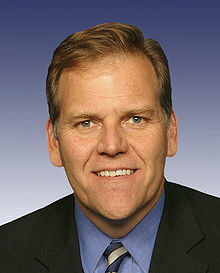
Michael Rogers, Republican Congressional Representative of Michigan's 8th district and sponsor of CISPA

House representative Mike Rogers (R-MI) introduced a bill back in November called the Cyber Intelligence Sharing and Protection Act (H.R. 3523) or CISPA. It has since been referred to and reported by the appropriate committees. Since then, according to Representative Rogers’ own web site, over 100 members of congress have already announced their support for the bill:

The 105 co-sponsors of the bill include 10 committee chairmen.  Additionally, a wide range of major industry and cyber associations, such as Facebook, Microsoft, the US Chamber Commerce, the Business Roundtable, the Internet Security Alliance, TechAmerica, and many others have sent letters of support for the bill.  A list of major industry and association supporters can be found at http://intelligence.house.gov/bill/cyber-intelligence-sharing-and-protection-act-2011

Unlike SOPA and PIPA, CISPA is all about collecting and sharing “cyber threat intelligence” and has less to do with copyright infringement concerns. This bill does not directly threaten the business interests of web companies, which means we should not expect their help in fighting the bill. In fact Facebook, IBM, Intel, Oracle, and Microsoft (among others) have already sent letters in support. more...

This is the full Augmented Activism essay. The two parts provide prescriptive tactics for how to incorporate technology in activist work. Part 1 was originally posted here and part 2 was here.

Part 1

Academics usually do not talk about “tactics.” There are theories, methods, critiques, but we -as professionals-rarely feel comfortable advocating for something as unstable or open to interpretation as a tactic. In the latest edition of the Science, Technology, and Human Values (The flagship journal for Society for Social Studies of Science) three authors threw caution to the wind and published the paper “Postcolonial Computing: A Tactical Survey” [over-priced subscription required]. While the content of the paper is excellent, what excited me the most was their decision to describe their new “bag of tools” as a set of tactics. Kavita Philip, Lilly Irani, and Paul Dourish take a moment in their conclusion to reflect on their decision:

We call our results tactics, rather than methodologies, strategies, or universal guarantors of truth. Tactics lead not to the true or final design solution but to the contingent and collaborative construction of other narratives. These other narratives remain partial and approximate, but they are irrevocably opened up to problematization. more...

Is this an Oxymoron?

Most of our interactions with technology are rather mundane. We flip a light switch, buckle our seat belts, or place a phone call. We have a tacit knowledge of how these devices work. In other words, we have relatively standard, institutionalized, ways of interacting with familiar technologies. For example: if I were to drive someone else’s car, even if it is an unfamiliar model, I do not immediately consult the user manual. I look around for the familiar controls, maybe flick the blinkers on while the car is still in the drive way, and off I go. Removal of these technologies (or even significant alterations) can cause confusion. This is immediately evident if you are trying to meet a friend who does not own a cell phone. Typical conventions for finding the person in a crowded public space (“Yeah, I’m here. Near the stage? Yeah I see you waving.”) are not available to you. In years prior to widespread cell phone adoption, you might have made more detailed plans before heading out (“We’ll meet by the stage at 11PM.”) but now we work out the details on the fly. Operating cars and using cell phones are just a few mundane examples of how technologies shape social behavior beyond the actions needed to operate and maintain them. The widespread adoption of technologies, and the decisions by individual groups to utilize technologies can have a profound impact on the social order of communities. This second part of the Tactical Survey will help academics, activists, and activist academics assess the roll of information technology in a movement and make better decisions on when and how to use tools like social media, live video, and other forms of computer-mediated communication. more...


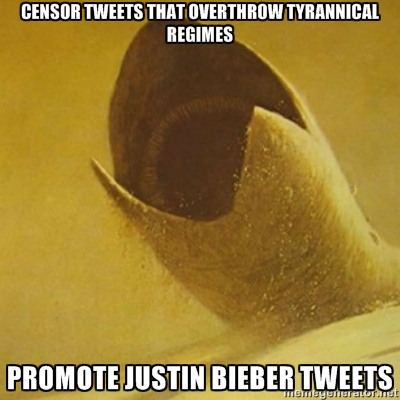
I took the liberty of making a new meme: "Censorship Sandworm". http://memegenerator.net/Censorship-Sandworm

“I must rule with eye and claw — as the hawk among lesser birds.”

-Duke Leo Atreides in Book 1: Dune

Over a week ago, Twitter announced a new censorship policy, stating that it would comply with any “valid and applicable legal request” to take down tweets. The announcement came just as we were still digesting Google’s unified privacy policy and were still debating the (now confirmed) rumors that Facebook was releasing an IPO. Twitter has since been applauded, denounced, and dissected by a variety of scholars, media critics, and business leaders. In this post I will give a brief summary of the controversy, briefly weigh in with a commentary of my own, and conclude with a discussion of what all this means for theorizing online social activity.

more...

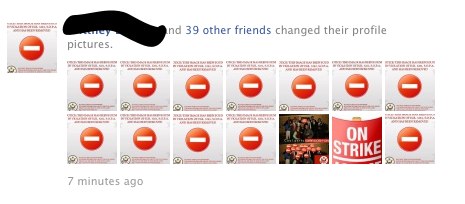
EDIT [2:49PM EST]- Saw this on my wall:


This is the full size of the picture:

EDIT [1:24PM EST]- Buzzfeed has compiled “25 Angry Kids Who Can’t Do Their Homework Because of the Wikipedia Blackout.” While this is pretty funny, it also underscores the need for educators to not just say “don’t use wikipedia” but to help students use networked resources in an appropriate and effective manner.

EDIT [11:25AM EST]- Google has put a black sensor bar over their logo on the search page. Facebook has not done anything officially, but my newsfeed is full of my friends talking about it. Maybe that’s the appropriate response? Public spaces are meant to be forums for discussion, the space itself is somewhat ambivalent.

Original Post- If you’re reading this on January 18th, 2012, then you are probably happy to find something that is not completely blacked out. While many of us, personally, are very much against SOPA and PIPA, all of us at Cyborgology thought it would be better to provide information about participating sites, rather than blackout the blog entirely.

Usually a strike is the beginning of a political battle, but it seems as though the fight to kill SOPA (Stop Online Privacy Act) has already been won by the activists and businesses that feel threatened by some of its provisions. As of last night, Cory Doctorow reported on BoingBoing:

House Majority Leader Eric Cantor has killed SOPA, stopping all action on it. He didn’t say why he killed it, but the overwhelming, widespread unpopularity of the bill and the threat of a presidential veto probably had something to do with it

The companion senate bill, the “Protect IP Act” or PIPA is still alive and well though. If you are unfamiliar with SOPA or PIPA, here is a great video from americancensorship.org that describes why the two bills are so concerning:

It is easy to accuse SOPA and PIPA supporters as money-grubbing intellectual property hounds; greedy millionaires who care about their bottom lines over the freedoms on democratic citizens. But I think greed  is only a necessary -not a sufficient- condition for supporting bills like these. The truth is, Congress does not understand the Internet.

For me, the late Senator Ted Stevens (R-AK) is synonymous with “Congress doesn’t understand the internet.” If you’re of college age or older, you probably remember the 2006 senate hearing in which Stevens emphatically declared that the internet was not “a dump truck” but was in fact, a “series of tubes.” Technologically mediated communities immediately jumped on the gaff and produced  shirts, songs, and even powerpoint presentations to share in a common joke. Once the novelty had subsided though, some started to worry about the fate of the internet. The blog for 463 Communications, a consulting firm in DC, was one of the first to raise the concern:

Regardless of what side one takes on net neutrality, it must be recognized that when the industry gets involved in a pitched, focused battle, not a lot of broad-based education unattached to a specific agenda is going to happen.  Quite the opposite.

Now, six years later, we are facing the same problem and it is a lot less funny. Even if you choose to ignore the humanitarian and civil libertarian arguments for why SOPA/PIPA is a bad bill, it is still incredibly destructive to business. It threatens to undermine the very basis of the so-called “information economy.” By making web site owners liable for something as mundane as a link to a soundcloud page, Congress would effectively halt some of the most innovative work being done in the fields of social media and web design. Even though the MPAA and RIAA are supporters of SOPA/PIPA, they also stand to lose from it as well. The culture industry relies on the ability to remix and appropriate existing material and turn it into something new and unique. But even something as mainstream and pop as Justin Beiber was originally discovered covering Justin Timberlake songs on Youtube.

At the end of the day, I don’t want my congress to pass a bill that would give Girl Talk more years in jail than a serial killer. More importantly, I certainly do not want to see a bill pass that could give governments the ability to shut down entire web sites. If SOPA/PIPA passes, there will be no more augmented revolutions on these shores.

Mozilla Firefox add-on MafiaaFire Redirector

Wired’s Threat Level Blog is carrying a story about the Department of Homeland Security demanding that Mozilla take down an add-on that lets users easily redirect to sites that have been given a take-down notice due to copyright infringement. Maybe censorship is too strong a word, but it certainly appears as such. Mozilla agrees and is requesting a reason for the takedown. The government has yet to respond.

Via WIRED.