augmented warfare

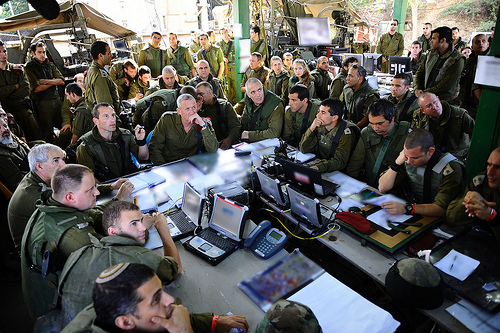
Image from the Israel Defense Force Flickr account.

Don’t tell the Israel Defense Force (IDF) that sharing videos from your Twitter account is ineffectual. They will point to their two-hundred thousand twitter followers that have generated 35 million views on their official Youtube account. They will extoll the virtues of a ruthlessly efficient and effective ad campaign that invites participation without the young Israeli even knowing they are engaged in two wars: a war of flesh as well as a war of mind. Granted, the IDF is no Justin Beiber, but it is hard to deny the impact of the IDF’s 30-person social networking team. The IDF’s social media savvy has not gone unnoticed. Technology and business publications have been more than happy to publish uncritical, lengthy interviews of top officials. This meta-propaganda usually begins by noting that Pillar of Defense was first announced through Twitter. The conversation will then turn to their complete arsenal: (TumblrFlickrFacebook, Pintrest, and even Google+) before commenting on their brief tweet confrontations with Hamas. All of this happens almost apolitically. Every news pieces calls it propaganda, and yet it still has a powerful aesthetic and rhetorical effect. Social media is the Abrams tank of propaganda. Messages must navigate the harsh terrains of corporate and government-owned mass media and arrive safely in the minds of citizens. Unedited, unfiltered, pure. Social media can trample news cycles, navigate the minefields of editorial desks, and maintain total media superiority in the vacuum of Western under-reporting.  more...
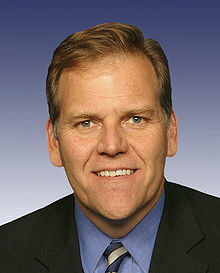
Michael Rogers, Republican Congressional Representative of Michigan's 8th district and sponsor of CISPA

House representative Mike Rogers (R-MI) introduced a bill back in November called the Cyber Intelligence Sharing and Protection Act (H.R. 3523) or CISPA. It has since been referred to and reported by the appropriate committees. Since then, according to Representative Rogers’ own web site, over 100 members of congress have already announced their support for the bill:

The 105 co-sponsors of the bill include 10 committee chairmen.  Additionally, a wide range of major industry and cyber associations, such as Facebook, Microsoft, the US Chamber Commerce, the Business Roundtable, the Internet Security Alliance, TechAmerica, and many others have sent letters of support for the bill.  A list of major industry and association supporters can be found at http://intelligence.house.gov/bill/cyber-intelligence-sharing-and-protection-act-2011

Unlike SOPA and PIPA, CISPA is all about collecting and sharing “cyber threat intelligence” and has less to do with copyright infringement concerns. This bill does not directly threaten the business interests of web companies, which means we should not expect their help in fighting the bill. In fact Facebook, IBM, Intel, Oracle, and Microsoft (among others) have already sent letters in support. more...

Egyptian solidarity protest in Paris, Jan. 2011. Image by Jacques Delarue.

When it comes to thought and research on social movements and technology (separately and together), emotion is that crucial piece of the picture that everyone technically sees but hardly anyone explicitly acknowledges as worth paying attention to in its own right. Some of this is likely because emotion is hard to study in any way that social science would consider rigorous; it’s often taken as something fundamentally irrational and therefore fundamentally inexplicable. It is highly subjective. It is culturally and situationally constructed, and therefore conceptually slippery. It is interior; it is a difficult thing to see and to know. If explicitly drawing it out as an important factor is problematic for some, identifying it as a variable capable of carrying any causal weight is even more so.

Regarding technology and social movements combined, there is the question of how the digital and physical play out as far as what ends up really being important. What is the relationship between the two? Where exactly is the body in augmented contention and is the way in which it matters changing? What is really going on when we see a bunch of street protesters carrying smartphones?

more...

Iran claims to have captured one of the CIA’s stealth drones which, they say, intruded on their airspace. Usually, I would talk about nations’ continuing development of their capacity for “augmented warfare” and maybe throw in some commentary on how this relates to theories on surveillance and the state. But, to be totally honest, I am incapable of doing that right now. Not because I have deadlines for papers coming up, or because I actually promised that my next post was going to be about Actor Network Theory. Its because… Well…

more...