actor network theory


With advances in machine learning and a growing ubiquity of “smart” technologies, questions of technological agency rise to the fore of philosophical and practical importance. Technological agency implies deep ethical questions about autonomy, ownership, and what it means to be human(e), while engendering real concerns about safety, control, and new forms of inequality. Such questions, however, hinge on a more basic one: can technology be agentic?

To have agency, technologies need to want something. Agency entails values, desires, and goals. In turn, agency entails vulnerability, in the sense that the agentic subject—the one who wants some things and does not want others—can be deprived and/or violated should those wishes be ignored.

The presence vs. absence of technological agency, though an ontologically philosophical conundrum, can only be assessed through the empirical case. In particular, agency can be found or negated through an empirical instance in which a technological object seems, quite clearly, to express some desire. Such a case arises in the WCry ransomware virus ravaging network systems as I write. more...


#review Features links to, summaries of, and discussions around academic journal articles and books. This week, I’m reviewing:

Sayes, E. M. “Actor-Network Theory and Methodology: Just What Does It Mean to Say That Nonhumans Have Agency?” Social Studies of Science (2014) Vol. 44(1) 134–149. doi:10.1177/0306312713511867. [Paywalled PDF]

Update: The author, E.M. Sayes has responded to the review in a comment below.

Image from You as a Machine

A few weeks ago Jathan Sadowski tweeted a link to Sayes’ article and described it as, “One of the best, clearest, most explanatory articles I’ve read on Actor-Network Theory, method, & nonhuman agency.” I totally agree. This is most definitely, in spite of the cited material’s own agentic power to obfuscate, one of the clearest descriptions of what Actor-Network Theory (hereafter ANT) is meant to do and what it is useful for. Its important to say up front, when reviewing an article that’s mostly literature review, that Sayes isn’t attempting to summarize all of Actor-Network Theory, he is focused solely on what ANT has to say about nonhuman agents. It doesn’t rigorously explore semiotics or the binaries that make up modernity. For a fuller picture of ANT (if one were making a syllabus with a week of “What is ANT?”) I suggest pairing this article with John Law’s chapter in The New Blackwell Companion to Social Theory (2009) entitled “Actor Network Theory and Material Semiotics.” Between the two you’d get a nice overview of both of ANT’s hallmark abilities: articulating the character of nonhuman agency and the semiotics of modern binaries like nature/culture and technology/sociality. more...

We all know the trope: In The Future—near or distant—food will come in the form of a pill. The pill will offer optimal proportions of all necessary nutrients. It will be calorically dense, vitamin infused, moderately fatted, protein filled, fiber enhanced, time released, and highly precise. The consumer will be satiated. The body will be healthy. This is a pill of perfect consumptive efficiency. This is the predicted diet of the cyborg.

Indeed, as cyborgs, our practices of (literal) consumption are characterized by scientific engineering. Our food and food practices are more a product of laboratory and factory work than the sweat of tilling farmers. And yet, we have not come up with a successful food-replacement pill. Instead, we’ve generally (though not ubiquitously) developed a market and a mindset that  moves away from efficiency, developing and utilizing technological advancements to maximally consume with minimal caloric absorption. I offer here a few examples: more...

Before Zuccotti, before UC Davis, there was the G8 Summit in Seattle, 1999. Image c/o Wikimedia Commons

I am really pleased to see academics tackling the problems of ineffective activism and capitalist oppression. Overcoming such large and complicated problems means trying out every tool in the tool shed. That is why Levi R. Bryant’s “McKenzie Wark: How Do You Occupy an Abstraction?” is so important. It is one of many efforts by academics to apply their reasoning to an active social movement. His recommendations are quite brazen. Bryant writes: “You want to topple the 1% and get their attention?  Don’t stand in front of Wall Street and bitch at bankers and brokers, occupy a highway.  Hack a satellite and shut down communications.  Block a port.  Erase data banks, etc.  Block the arteries; block the paths that this hyperobject requires to sustain itself.” The ends that Bryant suggests are intriguing. They certainly demand bigger and better things from the Occupy movement, but the means by which he reaches these conclusions are severely problematic. I think they neglect to consider the full effects of such actions and I attribute this oversight to his choice of analytic tools: object-oriented ontologies, new materialism, and actor network theory.

more...

Below is the full text of a two-part series that I wrote and posted last month

The body is a technology. One with political potentialities

In what follows, I delineate a language with which we can think about the body as technology, and in particular, politicized technology. We can do so, I argue, with Ernst Schraube’s conceptualization of technology as materialized action. I begin by laying out this theoretical framework. I then apply this conceptualization to the body, with a focus on body size. more...


A radical act?

Last week I delineated Schraube’s concept of technology as materialized action—or the notion that material objects are simultaneously imbued with human subjectivity while independently affecting human experience. I concluded by noting that this relationship between built-in agency and independent efficacy makes the object necessarily precarious—leading often to unimagined consequences.

With this precariousness in mind, I want to focus here on the body as technology, and specifically I want to focus on the body as a potentially politicized technology. I do so using the case of body size.

The body is simultaneously infused with human meaning and independent efficacy. The body is an object created out of human choices about (literal) consumption, adornment, and sculpture. At the same time, the body tells the person to ‘eat this, wear that, desire hir, move like this.’ The body then, as materialized action, is necessarily precarious. We cannot know what affect the relationship between the person and hir body will produce. Does a thin body reflect and affect fitness, or does it reflect and affect poor body image and restrictive self-control? Does a fat body reflect and affect indulgence, or does it reflect and affect acceptance and pleasure? more...

This is part one of a two-part post in which I delineate a language with which we can think about the body as technology, and in particular, politicized technology. We can do so, I argue, with Ernst Schraube’s conceptualization of technology as materialized action. In part one I lay out the theoretical framework of technology as materialized action. In part two, I apply this conceptualization to the body, and focus on the case of body size. more...

I want to start out by saying that “liberatory” is not in the standard OS X spell check dictionary. There aren’t even spelling suggestions. It is totally foreign. I think that’s telling. Also, our blog’s CSS prevents us from giving our entries long titles. The Title is part of the story, so let me put it in a more readable format:

Black Box Tactics: The Liberatory Potential of Obscuring The Inner Workings of Technology


There we go. Now where was I? Oh right, I haven’t started yet. Let me do that: more...

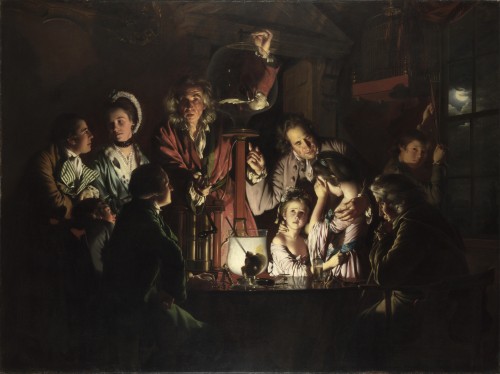
Joseph Wright's "An Experiment on a Bird in the Air Pump" Depicts the beginnings of Enlightenment science

Two weeks ago, I wrote a Brief Summary of Actor Network Theory. I ended it by saying,

My next post will focus on ANT and AR’s different historical accounts of Western society’s relationship to technology. While Latour claims “We Have Never Been Modern” we at Cyborgology claim “we have always been augmented.” I will summarize both of these arguments to the best of my ability and make the case for AR over ANT.

The historical underpinnings of ANT are cataloged in Laotur’s We Have Never Been Modern and are codified in Reassembling the Social. I will be quoting gratuitously from both.

In We Have Never Been Modern, Latour comments on a debate between the political philosopher Thomas Hobbes and natural philosopher Robert Boyle. Latour describes the debate this way: more...