
Tag Archives: crime

terror fail

Times SquareTwo recent failed terrorism attempts have some wondering if terrorists are losing their touch. Christian Science Monitor reports:

Faisal Shahzad, the Pakistani-born US citizen arrested and charged with the attempted attack, appears to have had little real training in explosives technique, according to US officials. And the Times Square bungle was preceded by the Christmas Day incident in which a Muslim Nigerian man on a Northwest Airlines flight tried, and failed, to ignite plastic explosives sewn into his underwear.

Are these twin flops evidence of systemic ineptitude? Perhaps. But it is at least as likely that they show Al Qaeda and its allies have moved towards a new, more decentralized, method of targeting the US and other Western nations.

Although the attacks on 9/11 were spectacular and highly destructive, experts note that typical terrorist attacks are generally less coordinated and more amateurish.

In a way, what the US is seeing now may be judged a return to more usual terrorist tactics.

After all, terrorism, by definition, is an attention-getting strategy employed by those without the ability to mount conventional military attacks.

Criminologist Gary LaFree explains:

“Terrorism is a tool of the less-powerful, and they use what they have at hand,” says Gary LaFree, a professor of criminology and director of the National Consortium for the Study of Terrorism and Responses to Terrorism at the University of Maryland in College Park.

The deadly successes of the 9/11 attacks perhaps have made Islamist terrorists appear more competent than they are, in general. Mr. LaFree counts some 50 or 60 thwarted attacks linked to Al Qaeda or its allies since 2001.

“Terrorists use readily available, low-tech weapons, and they often screw up,” says LaFree.

unintended consequences of immigration

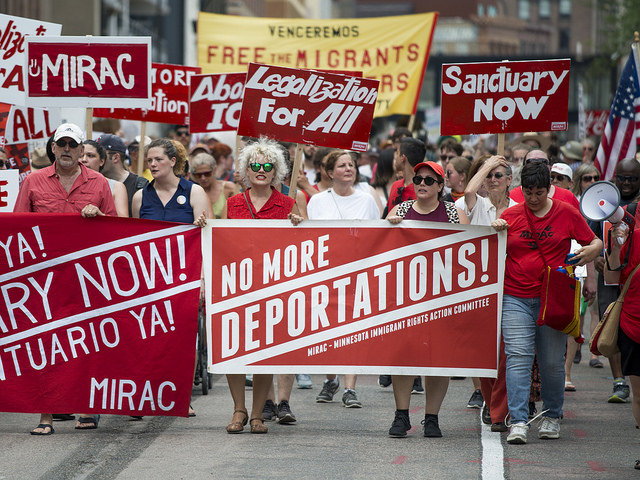
Video of the International Workers Day march in MinneapolisThe San Bernadino Sun recently reported on Louisiana State University sociologist Edward Shihadeh’s recently published research on the effect of Latino immigration on black labor market participation:

true crime numbers?

nypdA recent survey of retired police commanders in New York City has been causing a stir in the news media and the blogsphere this week, including this article in the New York Times:

More than a hundred retired New York Police Department captains and higher-ranking officers said in a survey that the intense pressure to produce annual crime reductions led some supervisors and precinct commanders to manipulate crime statistics, according to two criminologists studying the department.

The retired members of the force reported that they were aware over the years of instances of “ethically inappropriate” changes to complaints of crimes in the seven categories measured by the department’s signature CompStat program, according to a summary of the results of the survey and interviews with the researchers who conducted it.

Further…

In interviews with the criminologists, other retired senior officers cited examples of what the researchers believe was a periodic practice among some precinct commanders and supervisors: checking eBay, other Web sites, catalogs or other sources to find prices for items that had been reported stolen that were lower than the value provided by the crime victim. They would then use the lower values to reduce reported grand larcenies — felony thefts valued at more than $1,000, which are recorded as index crimes under CompStat — to misdemeanors, which are not, the researchers said.

Others also said that precinct commanders or aides they dispatched sometimes went to crime scenes to persuade victims not to file complaints or to urge them to change their accounts in ways that could result in the downgrading of offenses to lesser crimes, the researchers said.

“Those people in the CompStat era felt enormous pressure to downgrade index crime, which determines the crime rate, and at the same time they felt less pressure to maintain the integrity of the crime statistics,” said John A. Eterno, one of the researchers and a retired New York City police captain.

His colleague, Eli B. Silverman, added, “As one person said, the system provides an incentive for pushing the envelope.”

The research has been criticized roundly by some, including former police commissioner William Bratton in an op-ed response yesterday:

The notion that there has been widespread downgrading of felony crime under CompStat is way off base. First, categories of crime that are nearly impossible to downgrade, notably homicide and auto theft, have declined much more than the categories that might be more readily manipulated. Auto thefts, which must be reported accurately because victims need crime reports to make insurance claims, are down 90 percent since 1993, the year before CompStat was inaugurated. In contrast, grand larceny, the category that can be most readily downgraded (by reducing the value of the property stolen), has declined only about 55 percent. Homicides, which generally report themselves when the body is discovered, are down about 76 percent, from 1,951 in 1993 to 471 in 2009.

Sociologist Jay Livingston also provides an alternative look at victimization data for burglary over the same time period in NYC that would appear to back Bratton up.

So, who to believe? Again, from the New York Times article:

The seven-page summary of the survey certainly indicates that many of the retired officers believe the system has gone significantly wrong.

Indeed, the researchers said the responses supported longstanding concerns voiced by some critics about the potential problems inherent in CompStat. The former officers indicate that it was the intense pressure brought to bear on the commanders of the city’s 76 precincts in twice-weekly CompStat meetings — where they are grilled, and sometimes humiliated, before their peers and subordinates, and where careers and promotions can be made or lost — that drove some to make “unethical” and “highly unethical” alterations to crime reports.

Given that concern over crime and crime numbers are not unique to New York, this is undoubtedly not the last we’ll hear on this topic for a long time to come.

disaster does not a crime wave make

New Orleans, The Day AfterDespite rumors and media reports at the time, new research claims that Hurricane Katrina did not spawn waves of crime in other cities. As USA Today reports:

In the current Journal of Criminal Justice study led by sociologist Sean Varano of Roger Williams University in Bristol, R.I., the authors look at statistics for robbery, rape, murder, car theft and other violent crimes in Houston, San Antonio and Phoenix before and after Katrina evacuees arrived in those cities. The 2005 storm, which killed about 1,800 people and caused more than $80 billion in damages, according to the National Hurricane Center, led to the relocation of more than one million people…

The study found a slight rise in murder and robbery in Houston, when adjusted for the long-term crime patterns, but no increase in other crimes (and suggested drops in rape and aggravated assaults); no effect at all in San Antonio; and another slight statistical rise in the murder rate in Phoenix. “Any increase in murder is intolerable,” Varano says, but a lack of increase in crimes such as car theft and robbery, where economic motives most clearly would tempt so many displaced people, argues against a crime wave driven by evacuees, he says.

Meanwhile, “Many communities across the United States … also reported increases in violent crime between 2004 and 2006,” notes the study, including a 30% increase in aggravated assault in cities such as Baltimore and Detroit.

The belief that rises in crime and disorder arise from disasters like Katrina is nothing new.

A crime wave spawned by evacuees is typical of “disaster myths” seen after catastrophes, such as the mythical Superdome riots reported in the days after the hurricane, says disaster management scholar Joseph Trainor of the University of Delaware, who was not part of the study. “This is a very strong study showing long-term effects and (showing) people’s resiliency after a disaster.”

Disasters such as Hurricane Katrina and the Jan. 12 earthquake in Haiti almost always spawn fears of riots or criminality, seen in some early reports from Port-Au-Prince. But on Jan. 18, U.S. Navy Rear Admiral Mike Rogers, Director of Intelligence for the Joint Staff, told a news conference, “we have seen nothing that suggests to us that we have widespread disorder; no sense of widespread panic.”

“Fifty years of social science show people are not victims of disasters, they are survivors,” Trainor says. “People are adaptive and altruistic, mass rioting and mass looting are just disaster myths for the most part.”

The take home message?

“One lesson is that after disasters we have to think about where evacuees land, and not just the disaster site itself,” Varano says. He argues that crime rate changes after displaced people arrive in a city like Houston or Phoenix tells us more about the conditions at the arrival location than about the displaced people themselves. Strong communities undoubtedly handle influxes of evacuees better than already weak ones, he says.

“Another is that public officials, and news organizations, have a responsibility to speak very carefully about the reality of disaster situations,” Varano concludes. “There’s a danger of host cities not wanting to accept people in desperate straits because of false perceptions.”

parenting via western union

western unionAccording to the Jamaica Gleaner, University of West Indies sociologist Claudette Crawford-Brown has identified a new phenomenon: Western Union children.  She said this is replacing “barrel children” in Jamaica:

Barrel children in the past were identified as those who did not have the physical presence of their parents, but were sent goodies through shipments from overseas.  The sociologist, however, said that the barrel-children phenomenon has been surpassed by parents who give their children remittances. The difference between the two is the amount of care involved.

“You don’t have the barrel children as I highlighted seven years ago, where you had parents sending children things in a barrel. We now have what you call ‘Western Union’ children, and these are children who are parented by cellphones and they are sent the money. However, when you have a barrel child, that mother goes into K-Mart or Wal-Mart and I see them and watch them and they say: ‘I wonder if this going fit Sasha’, and she takes out the shoes with the mark out on the paper and match it with the shoes, and say this will fit her, this will fit her. You know what that shows? Some amount of care,” she said.

There are consequences of these changes in long-distance care:

Crawford-Brown pointed out even with remittances and barrels, the absence of mother in a child’s life has the same impact on youths as the absence of fathers. She noted that the absence of parental guidance leaves these children vulnerable to negative influences, where many turn to violence and drugs to cope.

According to her, many of these children who receive money through remittances are not given proper guidance, thus the money they have access to can be used to purchase drugs or facilitate their participation in illicit activities.

The noted child advocate and sociologist said many behavioural problems shown among some children are as a result of the breakdown in the family and exposure to violence. Crawford-Brown also said that Jamaica needs to tackle apathy towards murder in the society, which has trickled down to children she has worked with.

Crawford-Brown’s research on “Western Union children” was also recently featured in a column in the Jamaica Observer.

the complex job of tracking sex offenders

The News Journal recently examined the potential consequences of implementing a national sex offender registry:

The Adam Walsh Act, signed into law by President George W. Bush in 2006, goes into effect later this year and aims in part to smooth out some of those issues by applying a uniform national classification system and implementing a national registry.

Some observers argue that while one-size-fits-all penalties and overly broad classifications may sound good politically, they’re not truly effective in preventing recidivism.

Commentary by University of Delaware sociologist Chrysanthi Leon and Ohio Northern University criminologist Keith Durkin:

“You’ve got a small group of offenders who commit lots of new offenses,” said Chrysanthi Leon, a University of Delaware assistant professor of sociology and criminal justice. “We need to do a better job of distinguishing among the bigger group of offenders, and dedicate more of our resources on this smaller group of high-risk offenders.”

Instead of looking at offense-based criteria, Leon said, the ideal classification system would involve individual assessments of each offender for factors that can increase the potential for repeat offenses.

Those factors include whether force was used, how the offender manipulated his or her victims and the age of the victims, Durkin said.

The current system, he said, leads to police and probation officers getting overwhelmed by the sheer volume of offenders to monitor.

“They’re really trying,” he said. “But they’ve got this huge caseload.”

Read more.

sociological evidence overturns felon voting ban

Can't VoteAccording to the Seattle Times, evidence gathered by University of Washington sociologists Katherine Beckett and Robert Crutchfield overturned the state of Washington’s law banning incarcerated felons from voting.  The case, Farrakhan v. Gregoire, was decided on January 5, 2010:

The surprising ruling, by a three-judge panel of the 9th Circuit Court of Appeals in Seattle, said the law violates the 1965 Voting Rights Act by disenfranchising minority voters.  The decision is the first in the country’s federal appeals courts to equate a prohibition against voting by incarcerated felons with practices outlawed under the federal Voting Rights Act, such as poll taxes or literacy tests.

The two-judge majority apparently was persuaded by the plaintiffs’ argument that reams of social-science data filed in the case showed minorities in Washington are stopped, arrested and convicted in such disproportionate rates that the ban on voting by incarcerated felons is inherently discriminatory.

The article details the sociological research in question:

[The case] was built on research by University of Washington sociologists who found that blacks are 70 percent more likely — and Latinos and Native Americans 50 percent more likely — than whites to be searched in traffic stops.

The research also showed that blacks are nine times more likely to be incarcerated than whites, despite the fact that the ratio of arrests for violent crime among blacks and whites is less than four-to-one. One result of that: 25 percent of black men in Washington are disenfranchised from voting.

The decision, written by Judge A. Wallace Tashima, said the studies “speak to a durable, sustained indifference in treatment faced by minorities in Washington’s criminal justice system — systemic disparities which cannot be explained by ‘factors independent of race.’ “

The state of Washington is appealing this ruling to the U.S. Supreme Court.  To read a somewhat sociological editorial on this decision, you may also want to check out an editorial by Seattle Times columnist Jerry Large.

Voter Disenfranchisement Statistics:

voter-disenfranchisement

theft by gift card

Courier LoveThe New York Times reports a rise in employee theft via gift cards:

At the Saks flagship store in Manhattan, a 23-year-old sales clerk was caught recently ringing up $130,000 in false merchandise returns and siphoning the money onto a gift card.

“Gift card fraud is spiking,” said Joshua Bamfield, author of the Global Retail Theft Barometer, an annual international survey of retailers. “To employees, this is like currency. It’s almost as good as the U.S. dollar.”

Gift card fraud is growing portion of overall retail theft:

Employee fraud involving gift cards appears to be growing sharply as retailers struggle to contain overall theft, now estimated at $36 billion a year in the industry, or 1.51 percent of retail sales, according to a leading national study. Even as total sales have been falling, employee theft and shoplifting have been rising across the United States, industry experts say, with occasional arrests making headlines.

Many of the gift card crimes are straightforward, frequently involving young sales clerks and smaller amounts than the Saks theft. Among the variations of such crimes, cashiers often do fake refunds of merchandise and then, with the amount refunded, use their registers to electronically fill gift cards, which they take. Or sometimes when shoppers buy gift cards, cashiers give them blank cards and then divert the shoppers’ money onto cards for themselves.

A criminologist who studies employee theft comments:

“The retail industry has come to the realization that, as the Pogo comic strip said, ‘We have met the enemy, and he is us,’ ” said Richard C. Hollinger, the survey’s principal author and a professor of criminology at the University of Florida.

The most common type of employee theft is “sweethearting,” in which cashiers fail to ring up or scan goods that friends or relatives present at the register, Professor Hollinger said. Stealing from the till remains a problem, too. But with gift cards continuing to grow in popularity, they are an increasingly easy target.

And…

Professor Hollinger says the rate of theft is greatest among retailers with high turnover rates and many part-time workers, who may be less loyal and under more financial pressure than full-time workers.

He also found higher theft among younger workers. “Older workers know they have a lot more to lose — promotional opportunities, health insurance, 401(k)’s and pensions,” Professor Hollinger said.

bad times = lower crime?

Nr.187A recent piece in the New York Times challenges the conventional wisdom that bad economic times are a hotbed for criminal activity:

[New York] Police Department statistics show that the number of major crimes is continuing to fall this year in nearly every category, upending the common wisdom that hard times bring more crime.

“The idea that everyone has ingrained into them — that as the economy goes south, crime has to get worse — is wrong,” said David M. Kennedy, a professor at the John Jay College of Criminal Justice. “It was never right to begin with.”

To make sense of this, let’s call in the sociologists….

Experts have long studied how shifts in crime might be attributed to economic indicators like consumer confidence, unemployment or a faltering housing market, particularly when it comes to property crime, burglary and robbery. The findings have been “rather equivocal,” said Steven F. Messner, a sociology professor at the State University of New York at Albany who has studied homicides in New York City.

While there is generally thought to be a lag between changing economic conditions and new crime patterns, he said, it is curious that there has been no pronounced jump in street crimes associated with the most recent recession, which took root last year.

“But it could take a while to work its way through the system and into people’s psychology,” he said. “I would say the jury is still out on the impact of this most recent economic collapse.”

Jesenia Pizarro, a criminologist at Michigan State, said that crime is indirectly related to the economy:

Most crime is committed by the poor and uneducated, she said, and a bad economy can aggravate poverty in ways that are not obvious.  “The bad economy leads to social processes that are then more directly related to crime,” she said, citing “less services for youth and young people who are less occupied and don’t have the guardianship they need” or cuts in education “that can lead to crime.”

homophobia out of the closet in turkey?

The New York Times reports on “soul-searching” in Turkey after the murder of a gay man last year:

For Ahmet Yildiz, a stocky and affable 26-year-old, the choice to live openly as a gay man proved deadly. Prosecutors say his own father hunted him down, traveling more than 600 miles from his hometown to shoot his son in an old neighborhood of Istanbul.

Mr. Yildiz was killed 16 months ago, the victim of what sociologists say is the first gay honor killing in Turkey to surface publicly. He was shot five times as he left his apartment to buy ice cream. A witness said dozens of neighbors watched the killing from their windows, but refused to come forward. His body remained unclaimed by his family, a grievous fate under Muslim custom.

A sociologist comments on this “honor killing”:

Until recently, so-called honor killings have been largely confined to women, who face being killed by male relatives for perceived grievances ranging from consensual sex outside of marriage to stealing a glance at a boy. A recent government survey estimated that one person dies every week in Istanbul as a result of honor killings, while the United Nations estimates the practice globally claims as many as 5,000 lives a year. In Turkey, relatives convicted in such killings are subject to life sentences.

A sociologist who studies honor killings, Mazhar Bagli, at Dicle University in Diyarbakir, the largest city in the southeast, noted that tribal Kurdish families that kill daughters perceived to have dishonored them publicize the murders to help cleanse their shame.

But he said gay honor killings remained underground because a homosexual not only brought shame to his family, but also tainted the concept of male identity upon which the community’s social structure depended.

“Until now, gay honor killings have been invisible because homosexuality is taboo,” he said.

Gay rights groups argue that there is an increasingly open homophobia in Turkey.

Read more.