Author Archives: hollie

Pondering Parenting

amy giving nick a violin lesson in our living room - MG 1510.custom blended fused

The Atlantic writer Laura McKenna recently reflected on parenting and came to the conclusion that she is the product of her social class.

Jonah, did you ask your French teacher about why you got that B on that assignment? At 5:00 p.m. today, you have an orthodontist appointment. We’ll pick up Thai food on the way home and then you’ll finish your English homework. Don’t forget to put a book cover on your essay. A book cover always bumps a grade up half a point….

The reader can almost envision McKenna shaking her head at herself as she notes, “Every once in a while, you step back from yourself as a parent and say, ‘Dude! Did I actually just say that? I used to be cool. Did some alien take over my brain and turn me into this Mom Machine?’”

Instead of running with the alien theory, McKenna turned to Annette Lareau’s 2003 book Unequal Childhoods, in which she studied how 88 families from different backgrounds were raising their kids.

Lareau writes that the working class and the middle class have very different methods of raising their children. Poor and working-class parents practice what Lareau calls accomplishment of natural growth parenting. Their children have long periods of unstructured time where they shoot the breeze with neighbors and cousins, roam around the neighborhood, and watch TV with their large, extended families. Parents give orders to the children, rather than soliciting their opinions. Parents believe that they should care for their children, but kids reach adulthood naturally without too much interference from adults.

In contrast, middle-class kids are driven to soccer practice and band recitals, are involved in family debates at dinner time, and are told that to ask their teacher why they received a B on a French exam. They talk, talk, talk to their kids all the time. Even discipline becomes a matter of negotiation and bargaining between the child and the adult. Lareau calls this style of parenting concerted cultivation.

McKenna worries that, while her children may learn how to navigate bureaucracy and manage their time, they may be overscheduled.  “It’s hard to step back and relax when everyone around you is speeding up. My kids can’t go out for a spontaneous game of tag when every other kid on the block is at a band concert or at soccer practice.”

Even more worrisome to her is the idea that different parenting styles may be reinforcing class divisions in the U.S., which is something that a book cover can’t fix.

Touché, Facebook Team

Facebook Apps on Tablet

In mid-January, the Facebook Data Team took a moment to reflect on social networking.  Rightly so, they noted, “Social networking technologies like Facebook let us connect to hundreds, even thousands of people — and have fundamentally changed how people get their information.”

In order to better understand how we use the social network that is Facebook, several members of the Facebook Team conducted a study in 2010.  Contrary to those who claim that Facebook is an echo chamber (in other words, those who claim people only consume and share information with likeminded close friends), they found that the vast majority of information comes from contacts people interact with infrequently.

To contextualize their findings, Facebook turned to the well-known work of Mark Granovetter.

Economic sociologist Mark Granovetter was one of the first to popularize the use of social networks in understanding the spread of information.  In his seminal 1973 paper, The Strength of Weak Ties, Granovetter found that surprisingly, people are more likely to acquire jobs that they learned about through individuals they interact with infrequently rather than their close personal contacts. 

Similarly, the Facebook Team found that information shared by a person’s weak ties had a greater potential to expose their friends to information they would not have otherwise discovered.  Ultimately, they concluded that weak ties are driving information on Facebook.  To read more about how they reached this conclusion, check out the article “Rethinking Information Diversity in Networks” on the Facebook Data Team’s page.

Resisting Race Labels

Australian census forms

An Associated Press exclusive, published by Fox News, explained that 1 in 14 people went beyond the standard race labels in the 2010 Census.

The figures show most of the write-in respondents are multiracial Americans or Hispanics, many of whom don’t believe they fit within the four government-defined categories of race: white, black, Asian/Pacific Islander or American Indian/Alaska Native. Because Hispanic is defined as an ethnicity and not a race, some 18 million Latinos used the “some other race” category to establish a Hispanic racial identity.

Three million other write-ins came from Arabs, Middle Easterns, or others and who don’t fully view themselves as “white.”  To better understand this, the Associated Press turned to a sociologist.

“It’s a continual problem to measure such a personal concept using a check box,” said Carolyn Liebler, a sociology professor at the University of Minnesota who specializes in demography, identity and race. “The world is changing, and more people today feel free to identify themselves however they want — whether it’s black-white, biracial, Scottish-Nigerian or American. It can create challenges whenever a set of people feel the boxes don’t fit them.”

Though it’s personal, racial identity is also a highly political issue.  Census data are used to distribute federal aid, draw political districts, and enforce anti-discrimination laws.  As the number of people identifying as “some other race” has jumped 3.7 million in the last decade, it’s clear this personal and political issue will be something Americans continue to wrestle with.

States’ Rights?

Where I've been, 2011 versionWhen Kelly Clarkson recently explained that she loves Ron Paul because he believes in states having rights, she had no idea the phrase “states’ rights” would stir so many negative memories.  As Fox News explained,

Even before the Civil War, “states’ rights” had become a byword for the protection of black slavery. And since the late Sen. Strom Thurmond ran for president in 1948 as a States’ Rights Democrat, or “Dixiecrat,” the phrase has sometimes been labeled a “dog whistle” for racist elements in the electorate.

Sociologist John Shelton Reed (UNC-Chapel Hill) wasn’t surprised that someone Clarkson’s age didn’t recognize the baggage “states rights’” carried.  Similarly, University of Georgia historian James Cobb noted,

“Any time I hear it, I get this sort of little twitch, because I associate it with Ross Barnett or George Wallace,” …referring to the governors of Mississippi and Alabama who, five decades ago, defied efforts to integrate their states’ flagship universities. “But members of the younger generation, it doesn’t have that kind of connotation to them at all. And whether this is to some extent the fault of those of us who are supposed to be educating the younger generations about their past, I can’t say.”

Both Ron Paul and Rick Perry (before he left the race) have used the loaded phrase recently.  Other candidates make a point to avoid it.

 Whatever reaction it evokes, Cobb, the Georgia historian, said the term has clearly lost much of its sting.  “It’s just become part of the lexicon, without any particular meaning,” he says. “It’s been historically decontextualized to the point that it can be thrown around by a lot of people without a second thought.”

Reed, the UNC sociologist, said that’s not necessarily bad.  “I do believe states’ rights was a sound doctrine that got hijacked by some unsavory customers for a while — like, 150 years or so…I’m professionally obliged to believe that knowledge is better than ignorance, but some kinds of forgetting are OK with me.”


Sad Face

RIP Steve JobsThough Facebook has been known to waste your time, Sociologist Hui-Tzu Grace Chou’s research found that it might also make you sad. Chou and Nicholas Edge interviewed 425 students, asking them whether they agreed on statements like “Many of my friends have a better life than me” or “Life is fair.”  They also asked them questions about their Facebook usage, according to an article on ABC News.

After controlling for gender, race, religion, and relationship status, the scholars found that the more time students spent on Facebook, the more they thought others were happier and had better lives than they did.

 Facebook photos generally depict smiling, cheerful people having good times, conveying a sense of happiness. Of course everyone likes to smile for the camera, so that good cheer may be inflated or false. As others view the photos, they may believe this conveyed sense of  intense happiness is real, making them think that their friends are much happier than they are.

As Chou noted, “We’re not aware of the bias we have… On Facebook we present ourselves at our best. People are affected and they don’t realize it.”

Remembering Martin Luther King Jr.

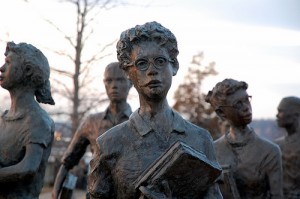
Out of the Mountain of Despair   A Stone of Hope

Who gets remembered, and how we remember them, isn’t left to chance.  Images of the past are malleable, and memories are often altered and changed based on present-day events and actors.

 Today, many are remembering Martin Luther King Jr.  And as CNN points out, some ways of remembering, like the new Martin Luther King Jr. memorial, are quite controversial.

The man himself was controversial, notes LaSalle University sociology professor Charles Gallagher. King — bound up with issues of racial and economic inequality that spotlight America’s worst sins — is a “Rorschach test,” Gallagher says, that people see in King what they want to see.

Still, few of the organizers of the Martin Luther King Jr. National Memorial in Washington may have expected that every little detail would be so scrutinized, criticism that has continued right up to the first Martin Luther King Jr. Day since it opened last fall.

Just last Friday, the Department of the Interior announced that a quotation on the memorial would be changed.  The quotation, which was paraphrased from one of his sermons, reads “I was a drum major for justice, peace and righteousness.”  The longer passage was premised on a conditional that began, “If you want to say that I was a drum major, say that I was a drum major for justice.”  Critics argued that the quote was taken out of context and makes King appear arrogant.

Indeed, King isn’t the first luminary to have a quotation misused. The Jefferson Memorial, across the Tidal Basin “juxtaposes fragments (of Jefferson’s writings) … to create the impression that he was very nearly an abolitionist,” writes historian James Loewen, author of “Lies My Teacher Told Me.”

The memorial was also criticized for freezing a person in stone, something that certainly isn’t unique to this memorial.

Sculptor Daniel Chester French’s Abraham Lincoln, across the Mall, is a gorgeous work, but he is now brooding for all eternity. Franklin D. Roosevelt, nearby, was originally represented by a statue apparently based on the weary president at Yalta; a second FDR, showing him in a wheelchair, was added after protests.

So how is King remembered, and why does it matter?  Check out the complete CNN article for a thoughtful discussion that draws on the insights of sociologists, public health professors, and historians.


Spying Social Capital

20120109-NodeXL-Twitter-waze network graphAs sociologists, sometimes we just can’t stop connecting concepts we read in magazines or on TV to our field.  So, it’s always nice when we see the concepts are connected for us and, more importantly, for a broader public.

As I was exploring internship opportunities for my students this semester, I ran across a tidbit of sociological knowledge on the the website of an organization that supports battered women and children (Casa de Esperanza).  It reads:

Casa de Esperanza works to enhance social capital because we believe that it decreases domestic violence. Social capital refers to the trust, reciprocity, information and co-operation that are developed through social networks.

And it even cites Robert Putnam’s Bowling Alone!  Needless to say, I was impressed.

Teens Talking Back

Angry face

Fights between parents and their teenagers have become a symbol of growing up.  But, new research covered by National Public Radio found that stress and weariness aside, these arguments can provide lifelong benefits to children.

The research, led by Psychologist Joseph P. Allan, videotaped over 150 thirteen-year-olds describing their biggest argument with their parents.  The tapes were then shared with the parents.

 ”Parents reacted in a whole variety of ways. Some of them laughed uncomfortably; some rolled their eyes; and a number of them dove right in and said, ‘OK, let’s talk about this,’” he says.  It was the parents who said [they] wanted to talk who were on the right track, says Allen. “We found that what a teen learned in handling these kinds of disagreements with their parents was exactly what they took into their peer world,” with all its pressures to conform to risky behavior like drugs and alcohol.

The teens were then interviewed at ages 15 and 16.

“The teens who learned to be calm and confident and persuasive with their parents acted the same way when they were with their peers,”…They were able to confidently disagree, saying ‘no’ when offered alcohol or drugs. In fact, they were 40 percent more likely to say ‘no’ than kids who didn’t argue with their parents.

For other kids, passivity in arguments with their parents seemed to be taken into their peer groups, where they were more likely to acquiesce when offered alcohol or drugs. So, effective arguing appears to help teens deal with negative peer pressure.

Their advice to parents?  First, listen. In their study, the kids listened to their parents when their parents listed to them.  It might be tough, but it could be helping children in the long-run.

 ”We tell parents to think of those arguments not as nuisance but as a critical training ground,” he says. Such arguments, he says, are actually mini life lessons in how to disagree — a necessary skill later on in life with partners, friends and colleagues on the job.


Social Media in the 1500s

A Forgery of the 95 Theses

A forgery of the 95 Theses in the Penn Libraries Collection

We often hear how Facebook, Twitter, and other social media contribute to protests and demonstrations by allowing activists to express their views or coordinate their actions. Social media were a big part of Arab Spring, but they were also a large part of the Reformation, says an article from The Economist. Nearly 500 years ago, Martin Luther went viral by circulating pamphlets, woodcuts, and other social media of that day in order to spread the message of religious reform.

The start of the Reformation is generally explained as a three-step process: 1. Martin Luther gets fed up with members of the Catholic Church asking for money to free souls, 2. Luther pins a list of 95 Theses (in Latin) to the Church door, and 3. The Reformation has begun. But, a closer look reveals Martin Luther spent more time thinking about social media:

The unintentional but rapid spread of the “95 Theses” alerted Luther to the way in which media passed from one person to another could quickly reach a wide audience. “They are printed and circulated far beyond my expectation,” he wrote in March 1518 to a publisher in Nuremberg who had published a German translation of the theses. But writing in scholarly Latin and then translating it into German was not the best way to address the wider public. Luther wrote that he “should have spoken far differently and more distinctly had I known what was going to happen.” For the publication later that month of his “Sermon on Indulgences and Grace”, he switched to German, avoiding regional vocabulary to ensure that his words were intelligible from the Rhineland to Saxony. The pamphlet, an instant hit, is regarded by many as the true starting point of the Reformation.

While it sounds pretty different (imagine communicating through woodcuts!), the media environment Luther circulated in shared some similarities with today. It was a decentralized system in which participants distributed messages through sharing—Luther passed the text of a pamphlet to a friendly printer, who could print the small text in a day or two.  Copies of this first edition, which cost about the same as a chicken, spread through the town they were printed in, being picked up by traveling merchants, preachers, or traders, and spread across the country. Local printers would then reprint their own editions, much like Facebook “shares” or Twitter “retweets.”

And, as with collective action in the 21st century, social media could  be dangerous during the Reformation:

In the early years of the Reformation expressing support for Luther’s views, through preaching, recommending a pamphlet or singing a news ballad directed at the pope, was dangerous. By stamping out isolated outbreaks of opposition swiftly, autocratic regimes discourage their opponents from speaking out and linking up. A collective-action problem thus arises when people are dissatisfied, but are unsure how widely their dissatisfaction is shared, as Zeynep Tufekci, a sociologist at the University of North Carolina, has observed in connection with the Arab spring. The dictatorships in Egypt and Tunisia, she argues, survived for as long as they did because although many people deeply disliked those regimes, they could not be sure others felt the same way. Amid the outbreaks of unrest in early 2011, however, social-media websites enabled lots of people to signal their preferences en masse to their peers very quickly, in an “informational cascade” that created momentum for further action.

Something very similar happened in the Reformation. A1523-24 surge in reform-pamphlet popularity (including those written by Luther and many others) served as a collective signaling mechanism of Luther’s support. Luther had been declared a heretic, but, because of his supporters, he was able to escape execution, and the Reformation became established in much of Germany. The power of social media is anything but new.

Protests in China

Photo by Thomas Galvez via flickr

Tunisia. Egypt. Libya. Yemen. Spain.  United States.  Many authors have claimed that protests in these and other countries can be seen as a worldwide movement against inequality.  And, recent New York Times articles add another pin on the world map of protest movements by covering recent protests in Wukan, China, over land seizures.  According to one article, protests in China are becoming increasingly common,

…a reflection of the widening income gap and deepening unhappiness with official corruption and an unresponsive legal system. But the clashes in Wukan, which first erupted in September, are unusual for their longevity — and for the brazenness of the villagers as they call attention to their frustrations. Despite the government’s best efforts to control social media outlets, such frustrations have only grown as millions of Chinese gain access to unofficial sources of information and use new tools to organize protests.

Public scenes of dissatisfaction are comparatively rare in China. But last year, there were as many as 180,000 outbursts of what sociologists call “mass incidents,” including strikes, sit-ins, rallies, and violent clashes.  (For comparison, in the mid-1990s, there were fewer than 10,000.)

People don’t have sufficient faith in legal procedures or the media and feel they have no redress when bad things are done to them,” said Martin K. Whyte, a Harvard sociologist who studies Chinese social trends.

Some of the protests are a response to worsening pollution, while others are a response to police brutality.  Much of the unrest, including in Wukan, is in response to the seizure of land by private developers or government officials.

The discontent in Wukan has been simmering for more than a decade. Residents say land seizures began in the late 1990s, when officials began selling off farmland for industrial parks and apartment complexes. Villagers say more than 1,000 acres have been seized and resold to developers in the past decade or so.  The residents’ ire exploded in September, when thousands of people took to the streets to protest the sale of a village-owned pig farm for luxury housing that netted the government $156 million.

The rest of the article gives more detail on the specific incidents in Wakun.  But, multiple recent new stories on protests in China posit that these events are not isolated and are instead connected across China.  And, to some, these protests are connected to others across borders and oceans as well.