Photo by Chase Carter, Flickr CC

Originally published Oct. 31, 2017

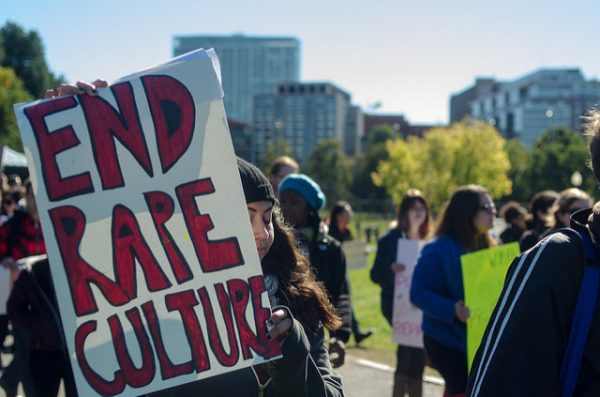
In recent weeks, over 500,000 women and men shared the hashtag #MeToo in response to the following social media tweet: “If all the women who have been sexuallly harrassed or assaulted wrote ‘Me too.’ as a status, we might give people a sense of the magnitude of the problem.” Some participants only shared the hashtag, while others revealed deeply personal stories of sexual harassment in the workplace, child sexual abuse, and sexual assault on college campuses, to name a few. Initially started by activist Tarana Burke, this reinvigoration of the Me Too campaign comes amidst numerous sexual assault and harassment claims against several high status men, including Hollywood mogul Harvey Weinstein, musical artist Nelly, and most recently, House of Cards actor Kevin Spacey. Sexual harassment and sexual assault are certainly not new phenomena. Yet, these campaigns that provide space for survivors to address victimization may signal a renewed public effort to address rape culture – a struggle that social scientists have spent decades trying to resolve.

Consequences of Sexual Violence

Sexual violence frequently results in several psychological and financial consequences for victims and survivors throughout the life course. Many report feelings of depression and posttraumatic stress disorder following the incident, and the trauma that results from sexual violence may alter how victims view themselves. Kaitlyn Boyle argues that assault characteristics like physical injury, perpetrator force, and physical resistance shape one’s self-identification as a “victim” or a “survivor.” Sexual violence may also impact women’s career trajectories. For example, many women that are sexually harassed in the workplace are more likely than non-harassed women to change jobs earlier in their career in order to avoid their harassers and/or employers who failed to fully investigate their claims. These moves often resulted in increased financial hardship.


Defining Rape Culture and Dismantling Masculinity

Feminist sociologists have long pointed out that sexual violence doesn’t simply stem from individual sexual impulses — it emerges as a consequence of masculine ideals that justify men’s aggression and encourage women’s subordination. This is in large part due to rape culture. In their important study on college fraternities and sexual assault, A. Ayres Boswell and Joan Spade define rape culture as “a set of values and beliefs that provide an environment conducive to rape” (133).
Under popular rape myths that suggest “guys will be guys” and “bros before hos,” some men within highly male-dominated peer groups, such as fraternities and athletic teams, engage in acts like harassment and gang rape to connect with and impress their male peers. And while there are many men who openly oppose sexual violence by distancing themselves from perceived rapists and claiming they are “good guys,” they may also reinforce cultural rape myths that only stereotypical “bad guys” — strangers, physically violent individuals, and minority men — commit rape. This ultimately works to cover up the more subtle forms of everyday sexual violence.
Photo by Quinn Dombrowski, Flickr CC

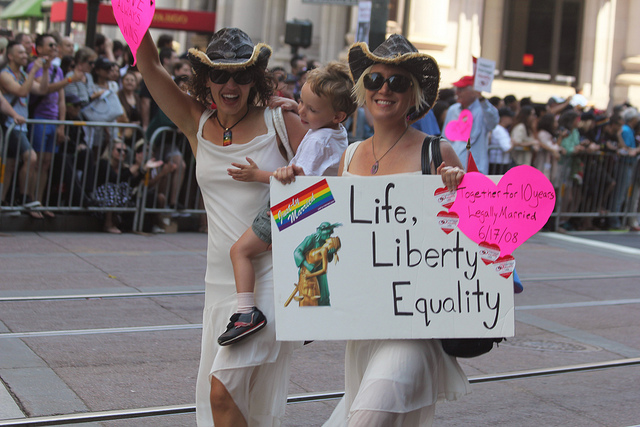
LGBT families are increasingly visible in public life. From famous celebrity same-sex parents like Neil Patrick Harris and David Burtka to same-sex family representations in popular television shows like Grey’s Anatomy and Modern Family, it may be easy to forget the hurdles LGBT families continue to face. For decades, anti-same-sex parenting activists have challenged LGBT parental rights, arguing that same-sex parenting somehow harms the wellbeing of children. Social science research on LGBT parenting has generally refuted  these claims, providing evidence that good parenting occurs under a diversity of family arrangements.

Families have never truly resembled the so-called “traditional” nuclear family, yet LGBT families have indeed expanded definitions of kinship and parenting. Beyond disrupting norms about gender and sexual orientation of family members, many LGBT families use adoption and various methods of assisted reproduction to have children. Some families include two parents, some include one, and others involve co-parenting between more than two people.
Despite a range of options for family structures, LGBT families still face legal challenges to parenting. Legal rights pertaining to adoption and parental rights vary significantly across the United States, as do parents’ understandings of and interactions with the law. In fact, parents’ expectations of what family formation means are often shaped by the legal context in which they live. For instance, if adoption is not an option for the second parent, it may become less important to the parents’ perception of how a family should look.
Over the past decade, research on the well-being and success of children with lesbian and gay (LG) parents has intensified. Evidence overwhelmingly indicates that these children do just as well as children raised by different-sex parents in social and cognitive development, academic performance, and avoiding substance abuse and delinquent behavior. Beyond wellbeing, LG parents may be less likely to enforce rigid gender norms on their children, instead offering a variety of gendered options. Studies have also found that children’s activity preferences are less gendered when parental division of labor is more equally shared between both parents, and this egalitarian form of co-parenting appears to be more common among middle class, white lesbians. However, parents from all backgrounds may be less likely to endorse gender nonconformity with their sons than with their daughters.
While the research base on LG parents and family structures has developed rapidly, we know much less about transgender parents and transgender youth. Similarly, the experience of bisexual individuals has often been ignored or collapsed under LG experiences. This lack of research complicates the notion of LGBT as a comprehensive umbrella term in family studies, as social scientists know far less about the BT than the LG, and even less about queer and asexual identities (QA).
Photo by Phillip Ingham, Flickr CC

The recent passing of the GOP tax plan in the both House and the Senate means that Congress will continue its frantic pace on tax reform to overhaul the tax code by the end of the year. Many legislators are worried about the bill’s potential impact on working class families, and graduate students are anxious about the proposed tax on tuition waivers. No one knows what the Congressional tax plan will look like if it passes both houses and becomes law, but we do know that tax policy affects the structure of social inequality in America. Here’s how — 

The tax code matters for what and who gets taxed. Researchers pay particular attention to the relative tax burden on various groups. The level of progressivity, or how much tax is paid by high income groups as compared to middle income groups, has shifted over time along with macroeconomic conditions such as unemployment, economic development, and budget deficits. Past tax reforms, particularly in 1986 and 2001, also shifted the proportion of taxes that come from wages and salaries as opposed to capital gains or other investments.
Rising inequality as a result of the concentration of income among the highest earners is one of the most prominent points in social stratification research, and has fueled populist movements in the United States like Occupy Wall Street and the Sanders and Trump campaigns. Lower tax rates for the highest earners were a key driver of inequality between 1980 and 2008, along with shifts toward more conservative Congresses, lower union membership, and stock prices. Tax policy decisions that benefit the top half of the top one percent of Americans are clear examples of how organized political interests have more power to set policy than the interests of the average voter.
Apart from debates on whether shifts in tax policy will actually stimulate economy growth, tax revenue affects availability of resources for social welfare programs that address persistent stratification across groups.
Photo by Mark Dixon, Flickr CC

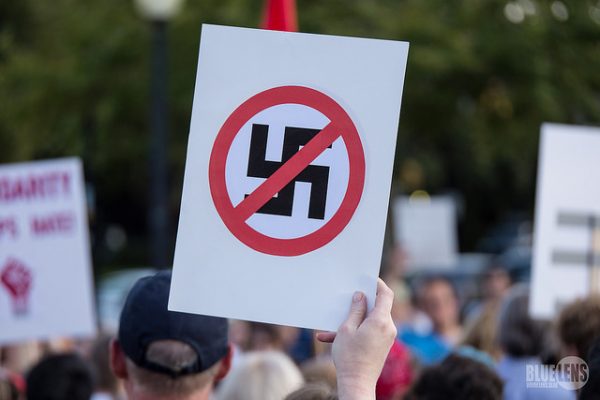
Neo-Nazi swastikas, explicitly racist chants and slogans, and public demonstrations with hoods and torches, as seen recently in places likes Charlottesville, are what signal white supremacy for many Americans. Yet, for over a decade, activists and policy makers have used the phrase “white supremacy” in different ways, moving beyond extremist ideologies and individuals’ bigoted beliefs to focus on the deep historical structure and institutional dimensions of racial inequality in social life. Perhaps not surprisingly, sociologists have been at the forefront of parsing out this broader usage and meaning of white supremacy.

Rather than focusing solely on explicit prejudice and organized hate groups, recent sociological uses of the term describe how the very nature of American society inherently privileges white people, white identities, and the status of whiteness. This includes how white people fare better in economic terms, as well as how white people experience superior outcomes in other ways, such as education and health, and how all of these systemic inequalities happen through established institutional arrangements, cultural norms, and public policies. For scholars with this emphasis, America is a “white supremacist” nation — not because individuals or the law are explicitly prejudiced, but because white privilege is central to American social life.
This is not to suggest that sociologists and other social scientists have neglected the study of extremist white groups like Neo-Nazis or the KKK. In fact, sociologists have continued to track how more traditional white supremacists have evolved alongside changing social backdrops and history. These scholars have documented how white supremacist movements in the 21st century have been shaped by whites’ perceptions of victimhood following increased immigration, globalization, and diversity in America.

With all of these different strands of research and interpretations of white supremacy, it is imperative for all of us — activists and analysts alike, as well as everyone in between — to be thoughtful and cautious about how, when, and in what company we use the term “white supremacy.”

Photo by faungg’s photos, Flickr CC

As the fall final exam season creeps up, students are returning to their notes and — hopefully — recalling everything they learned this semester. But what kind of notes do they have, and will those notes be helpful? We wondered whether taking notes via pen and pencil versus typing made a difference for students. Here’s what we found!   

Technology isn’t going away in the classroom. School districts across the country are getting grants from governments and tech companies to expand their technology options, especially increasing access to technology for traditionally underserved populations and experimenting with new forms of content delivery. But researchers have looked into the potential negative effects of technology on learning, especially the multitude of potential distractions for students using laptops in class. They find that college students who have laptops in lectures are on average less engaged, less satisfied with their education, and perform worse than other students.
In experimental studies, students who used laptops were more likely to write down exactly what was said, which involved less thinking and processing during the notetaking process. Students who took notes longhand were better prepared to answer conceptual questions on the content, even when those who took more extensive notes on laptops were able to study their notes before the quiz.
On the other hand, researchers have argued that technological innovation and changes in classrooms may make notetaking an out-of-date skill altogether. This research focuses on inclusion and the potential ability for technology to assist students with physical or cognitive disabilities.
Photo by Mike Schmid, Flickr CC

Benefits for the wealthiest Americans in Republicans’ proposed tax plan are causing alarm among some Americans, especially because they risk widening an already large wealth gap. According to a recent analysis, the three richest Americans control more wealth than half of the United States’ population. Wealth is different from income, because it takes into account assets like property and debts in addition to earnings, which means wealth inequality in the United States is much greater than income inequality. Social scientists demonstrate that the amount of wealth a person accumulates is associated with a variety of social advantages. And once someone has accumulated wealth, the benefits continue to build up over time and across generations.

Income matters for wealth accumulation, but that is not the only factor. Homeownership is particularly important, though age, wealth of parents, level of education, religion, race, and gender also influence the wealth a person acquires. For instance, unmarried women’s wealth on average is lower than men’s, and a significant gap exists between whites and Blacks in America — a gap that only gets wider in the top tax bracket.
Having wealth is an important indicator of future wealth and well-being. Parents’ wealth is often associated with greater well-being for their children, including higher educational and occupational attainment. Personal wealth also partially explains the gap in marriage rates between people with high and low education levels.
Los Angeles March for Immigrant Rights. Photo by Molly Adams, Flickr CC

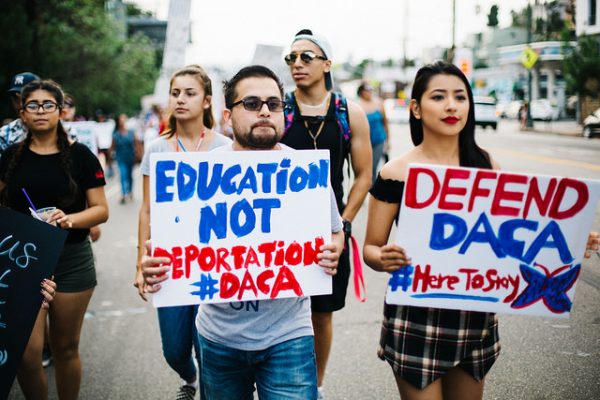
The Trump administration recently discontinued an Obama administration policy known as Deferred Action for Childhood Arrivals (DACA). Established in 2012, DACA provided steps toward permanent residency for undocumented immigrants who have lived in the United States since childhood. Conditions include proof of living in the United States since before age 16, criminal background checks, status as employed or a college-student, and routine renewal and payment every two years. Furthermore, DACA recipients are ineligible for federal welfare, student aid, and citizenship. Public figures, including pundit Ann Coulter and Attorney General Jeff Sessions, have expressed concerns about immigrants taking too many jobs, draining social support programs, and threatening American culture and ways of life. Research shows, however, that these individuals are not a threat to American culture and society — they are in fact a part of American culture and society.

Many DACA recipients are deeply enmeshed in American society, as virtually all have lived in the United States since childhood. Since the DREAM act was originally passed, beneficiaries have experienced better mental and physical health outcomes. Furthermore, the legislation has offered people in precarious positions a way to be better incorporated into their society; nearly all are employed, speak English as a first language, and have family ties to the United States. Rescinding these protections, therefore, could possibly lead to adverse impacts on recipients’ well-being and lifestyle.
The Trump administration has left Congress time to either renew or repeal DACA. Even if DACA is continued, however, research has shown that state and municipal governments vary greatly in the support they provide to undocumented immigrants. So, even if DACA survives at the federal level (which is not at a guarantee), variations in state and local governments could lead to vastly different outcomes for people in different regions across the country.
WE ARE A NATION AND WE HAVE THE RIGHT TO DECIDE! Catalonian Independence Protest. Photo by Paco Rivière, Flickr CC

Recent events in Burma, the United States, and Spain have shown how appeals to nationalism can initiate or heighten violence. Nationalist ideologies, however, look quite different in each of these countries, and many countries with strong national identities do not experience these types of conflict at all. Sociological research helps explain how nationalism develops differently from one country to the next and the consequences that result.

Nationalism is a particularly strong form of identification, as it can surpass personal connections and reinforce a shared bond throughout the borders of a nation. Social identity can help people define their place in the world, and nationalism can provide a positive way through which to do so. It can also be used to advocate for national-scale interests on a global level, promoting diverse perspectives in international institutions. This is especially true when a country was created through a more spontaneous process, where national identity develops simultaneously with the broader identity formation of groups already living in a particular area.
But the path to nationhood isn’t always so organic. Many nations were originally created through decades or centuries of violence and oppression. In other words, national identity works differently when it interacts with different kinds of state power. A majority of countries in the Global South began with ambiguously drawn borders created with the intent of domination. In such states, nationalism stems from (oftentimes violent) renegotiations of identity following foreign rule.
These different pathways to nationhood result in dramatically different forms of nationalism across the globe. Civic nationalism, for example, is based on citizenship as the root of belonging, while ethnic nationalism is grounded in ethnic identity. Ethnic nationalism tends to be more prominent in nations that have experienced more conflict over time. It can also be more exclusionary, with some studies finding lower tolerance for immigrants in more ethnically-nationalist societies. These two forms can also blend together, as civic nationalism can express quieter assumptions about ethnic belonging.
Shepard Fairey’s work on the streets of San Francisco. Photo by Michael Pittman, Flickr CC

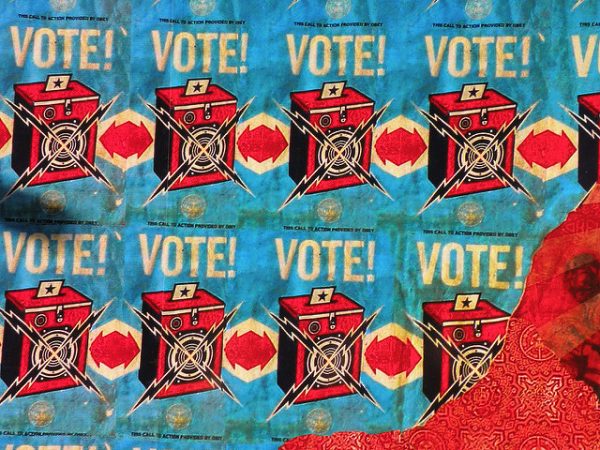
Political spectators anxiously await a final decision from the Supreme Court on the Wisconsin gerrymandering case, Gill v. Whitford. Gerrymandering occurs when legislators redraw voting districts in order to concentrate their electoral dominance. This highly anticipated judicial decision could stop gerrymandering practices and require courts around the country to search for bias in their district maps. While voting is the cornerstone of democracy, social science research on gerrymandering suggests that democratic ideals may not match up to how voting works in practice.

Wisconsin redistricting plans that were ratified in 2011 gave Republicans an advantage over Democrats in translating votes into seats in the legislature. Computer simulations can diminish partisanship in district drawing, but it remains unclear how effective this would be in reducing political polarization in Congress. One study suggests that redistricting does appear to diminish electoral competition, but does not appear to exacerbate polarization along party lines.  
Political sociologists have shown that full voting rights are not as guaranteed in the United States as in many other major democracies, and gerrymandering is just one example of practices that lead to the under-representation of low-income voters and communities of color in the electoral process. For example, partisan gerrymandering reduced access to communication between ward residents, local nonprofits, and their political representatives in Chicago. There is also evidence it changed voters’ choices in Georgia. In short, gerrymandering has real consequences for racial inequalities and representation in the United States.
Photo by Gage Skidmore, Flickr CC

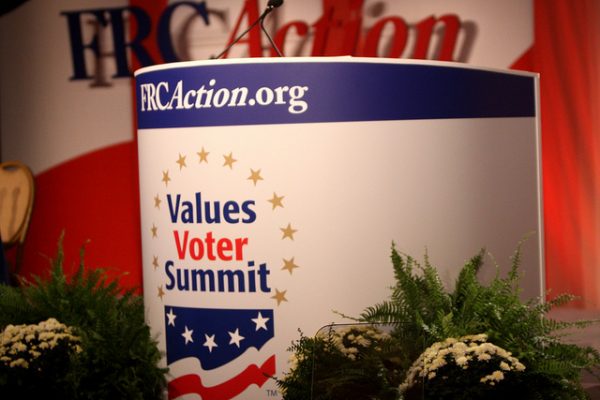
Donald Trump was recently the first sitting president to address the Values Voter Summit in Washington, D.C., where he referenced “attacks” on Judeo-Christian values. But what does this “Judeo-Christian” buzzword really mean? Social science research shows us that national identity is a style of political engagement that can change over time, but also that these cultural changes have real stakes for the way Americans think about their fellow citizens. While the U.S. is becoming an increasingly racially and religiously diverse nation, this demographic change comes up against the persistent cultural assumption that Americans share a distinct Christian identity and heritage.

The meaning of “Judeo-Christian” has changed over time. Once referring to progressive political coalitions, it became a rallying cry that designated socially conservative positions in the “culture wars” of the 1980s and beyond. This case shows us how nationalism is a cultural style comprised of different beliefs and identities. This means that political leaders and everyday citizens can draw on different styles of nationalism.
And these styles of nationalism have real stakes. An emerging trend in public opinion literature shows that Christian nationalism in particular is a strong predictor of negative attitudes toward minority groups. For example, respondents high on this kind of nationalism are also less likely to support interracial and same-sex marriage.