
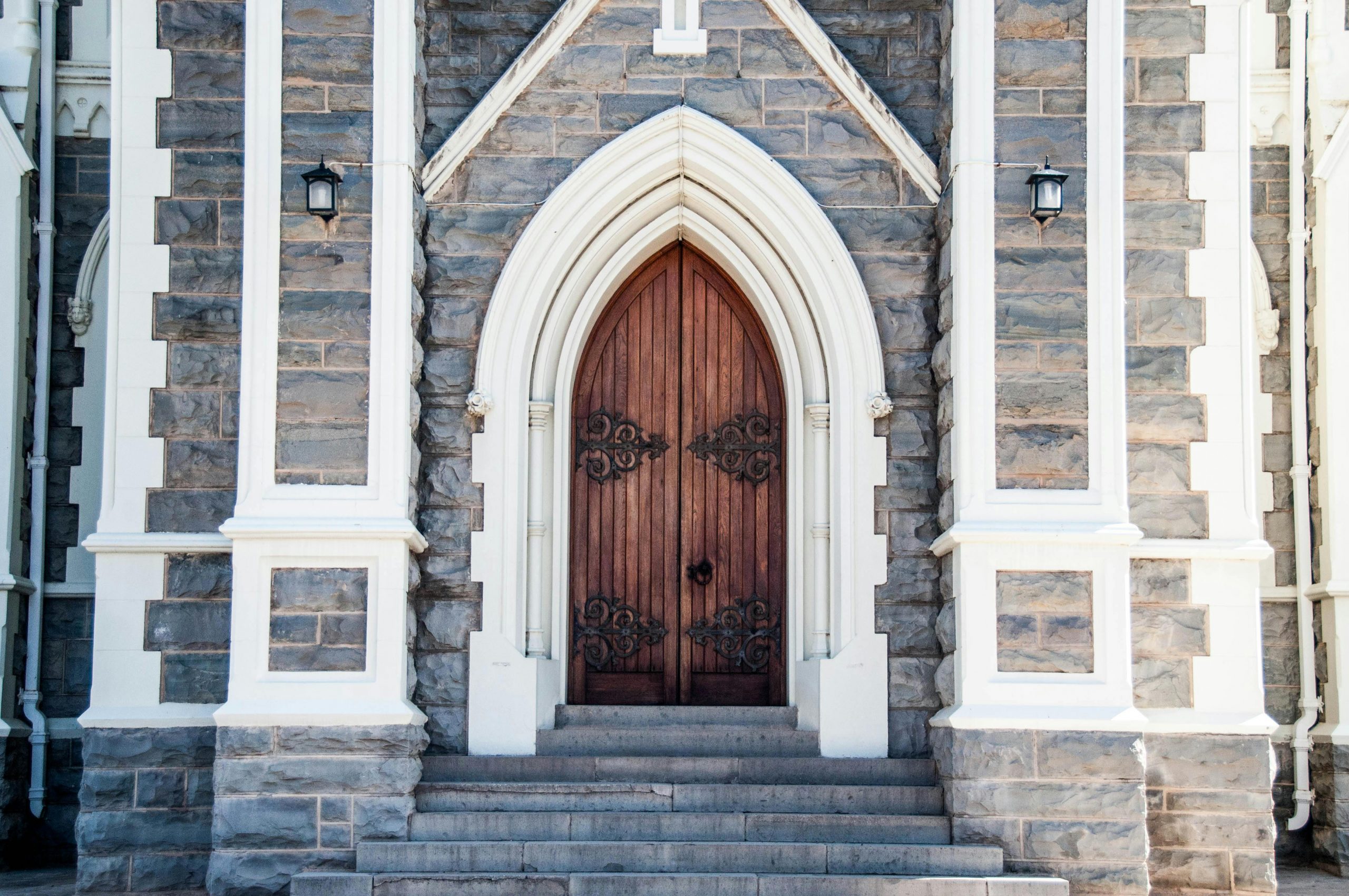
A gothic style church door, with stone steps leading inside. Gothic Church Entrance with Ornate Wooden Doors by Zak H is licensed under CC BY 2.0 in pexels.
Religious institutions such as churches, mosques, religious schools, and religious organizations are not required to follow Title III of the Americans with Disabilities Act (ADA). Recently, reports have suggested this poses a barrier to voting for many disabled Americans, since churches make up 20% of polling places nationally. While inaccessibility is certainly not unique to religious institutions, these barriers evoke important questions regarding the experiences of disabled Americans in religious spaces.
- ADA National Network. 2018. Religious Entities Under the Americans with Disabilities Act.
- Amos Yong. 2011. “Disability from the Margins to the Center: Hospitality and Inclusion in the Church.” Journal of Religion, Disability, and Health 15(4), p. 339-350.
- Suzanne Perea Burns, Rochelle J. Mendonca, and Roger O. Smith. 2024. “Accessibility of Public Buildings in the United States: A Cross-Sectional Survey.” Disability and Society, 39(11), p. 2988-3003.
How Accessible are Religious Congregations?
The state of accessibility varies widely among religious congregations around the country. (Notably, most research on congregational accessibility in the U.S. focuses on Christian churches and does not include other faith communities). Even though religious institutions are not required to follow ADA accessibility standards, many congregations have become more accessible in the decades since the ADA was signed into law. Larger churches typically have more accessibility features (like ramps into buildings or up to altars, accessible toilets, sign language interpreters, or large print materials) than smaller congregations. Additionally, churches whose leaders received some kind of training about supporting people with disabilities tend to be significantly more accessible. While the popularity of livestreaming services online, especially since the COVID-19 pandemic, has made many churches’ teachings more widely available, congregations that lack other forms of accommodation continue to be physically inaccessible to many.
- Jared H. Stewart-Ginsburg, et al. 2024. “A Preliminary National Survey of Accessible Features of Churches in the United States.” Review of Religious Research 66(4), p. 631-648.
- Naomi Lawson Jacobs and Emily Richardson. 2022. At the Gates: Disability, Justice, and the Churches. Darton, Longman, and Todd Ltd.
Other Barriers to Participation and Inclusion
Many people with disabilities also experience significant social barriers to inclusion in religious communities. The prejudice against people with disabilities that exists throughout society influences norms and interactions in congregations as well, often in forms of paternalism or exclusion. Additionally, illness and disability are often treated as sinful. This is visible in unsolicited prayers for the supernatural healing of disabled people, teachings that people would be cured of their disabilities if they had more faith, and worship songs that celebrate ideas such as there being “no lame” in heaven. The degree to which religious congregations accept and include people with disabilities profoundly impacts disabled people’s experiences and perceptions of the community, their place within it, and even the religion more broadly.
- Richard Hobbs et al. 2016. “Individuals with Disabilities: Critical Factors that Facilitate Integration in Christian Religious Communities.” Journal of Rehabilitation 88(1), p. 36-46.
- Melinda Jones Ault, Belva C. Collins, and Erik W. Carter. 2013. “Factors Associated with Participation in Faith Communities for Individuals with Developmental Disabilities and Their Families.” Journal of Religion, Disability, and Health 17(2), p. 184-211.
- Whitehead, Andrew. 2025. “Christian Nationalism and Ableism in the United States.” Social Problems, pp. 1-19.
Efforts toward Inclusion and Reform
Individuals and congregations who have advocated for inclusion and justice for people with disabilities have emphasized the need for religious communities to take on new understandings and theologies of disability. These efforts often draw on resources from their faith traditions about the inherent value of people with disabilities and the need for their inclusion and care. Such advocacy typically portrays disability as a social issue rather than an individual issue, which compels people to view disability in terms of social justice rather than charity or pity.
- Nancy L. Eisland. 1994. The Disabled God: Toward a Liberatory Theology of Disability. Abingdon Press.
- Amy Kenny. 2022. My Body is Not a Prayer Request: Disability Justice in the Church. Brazos Press.