
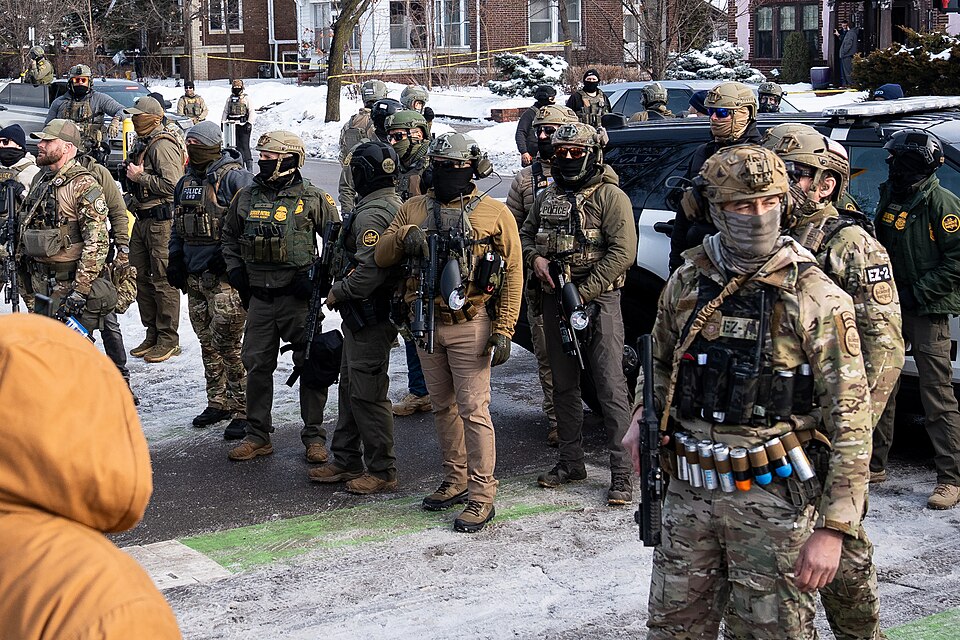
In 2025, Immigration and Customs Enforcement (ICE) operations sparked nationwide outrage in the United States when ICE agents began wearing face-concealing riot gear. The aggressive federal deployment of ICE agents in cities across the country have raised broad discussions about the excessive militarization of American policing, and masks and masking have been at the center of these controversies. More specifically, the visual of anonymous, militarized federal agents in masks making arrests on American streets raises a range of questions about power, accountability, and transparency – all of which are complicated by a long history of masking in protests and by recent practices of masking for health reasons during the COVID-19 pandemic. The research on these different meanings and uses of masks provide important context for understanding the controversies and broader social significance of masking among ICE agents.
Accountability and Transparency in Policing
Context for the controversies surrounding ICE’s use of masks comes from research about transparency and accountability in American policing. “Masks,” in this context, encompass far more than the physical concealment of a person’s face: they also represent a profound struggle over power, visibility, and accountability in modern democracies. These observations evoke important questions regarding what might be called “asymmetrical visibility:” how the state can monitor citizens relentlessly while hiding its own mechanisms of control, eroding the fundamental principles of transparency and accountability of policing in democratic contexts.
- Bovens, Mark. 2007. “Analysing and Assessing Accountability: A Conceptual Framework.” European Law Journal 13(4):447-68.
- Friedman, Barry. 2017. Unwarranted: Policing Without Permission. Macmillan.
- Marx, Gary T. 1988. “Chapter 5: The Complexity of Virtue.” In Undercover: Police Surveillance in America. University of California Press.
Anonymity as Resistance
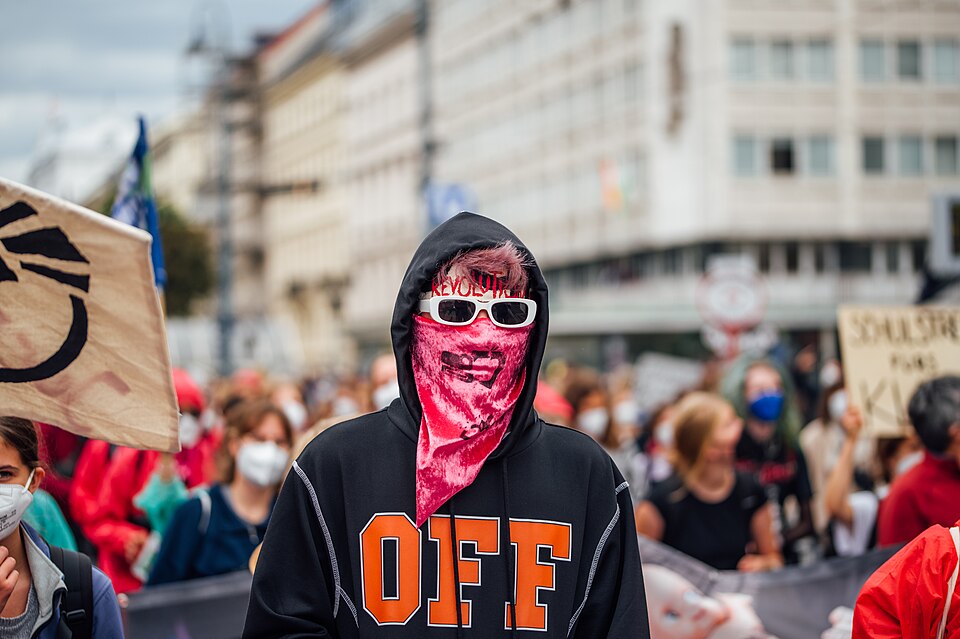
Masks have also long been a tool of collective political resistance against state power. By adopting masks, protesters create a “blank figure” that refuses categorization by the state’s gaze, carving out a liminal space where new political identities can be practiced and expressed freely. This deliberate anonymity decreases the state’s ability to isolate, identify, and punish individual dissenters, allowing citizens to create a unified front. The masked protest serves as a direct challenge to moral and legal structures, allowing marginalized bodies to occupy public spaces without surrendering their identities to state surveillance.
- Riisgaard, Lone, and Bjørn Thomassen. 2016. “Powers of the Mask: Political Subjectivation and Rites of Participation in Local-Global Protest.” Theory, Culture & Society 33(6):75-98.
- Ruiz, Pollyanna. 2013. “Revealing Power: Masked Protest and the Blank Figure.” Cultural Politics 9(3):263-79.
- Spiegel, Jennifer B. 2015. “Masked Protest in the Age of Austerity: State Violence, Anonymous Bodies, and Resistance ‘In the Red.’” Critical Inquiry 41(4):786-810.
The Policing of Masked Protest
In response to protesters using masks, governments worldwide frequently pass severe anti-mask legislation to criminalize citizen anonymity – and, ironically, often deploy heavily armored, faceless riot police to enforce these laws. Empirical studies on protest policing show that aggressive, militarized responses to perceived threats frequently backfire and escalate violence. In contrast, experiments where officers deliberately unmask, wear plainclothes, and engage in open communication with protesters have proven far more effective at facilitating peaceful demonstrations and de-escalating tensions.
- Della Porta, Donatella, and Olivier Fillieule. 2004. “Policing Social Protest.” Pp. 217-41 in The Blackwell Companion to Social Movements. John Wiley & Sons, Ltd.
- Earl, Jennifer, Sarah A. Soule, and John D. McCarthy. 2003. “Protest under Fire? Explaining the Policing of Protest.” American Sociological Review 68(4):581-606.
- Gorringe, Hugo, and Michael Rosie. 2013. “‘We Will Facilitate Your Protest’: Experiments with Liaison Policing.” Policing: A Journal of Policy and Practice 7(2):204-11.
.jpg)
Masks as a Cultural Battleground during the COVID Era
The pandemic era brought these cultural, political, and policing dynamics into direct conflict. On the one hand, public health officials in many countries around the world began requiring masks to counter the rapid spread of the COVID-19 virus. But what began as a public health guideline quickly evolved into a cultural behavior intertwined with ideology, entitlement, and regional identity. Social media discourse, such as the “Karen” meme, highlights how the refusal to wear a mask was often gendered and functioned as an expression of hypermasculinity. As a result, the mask transcended its physical utility to become a highly charged political symbol.
- Bhasin, Tavishi, Charity Butcher, Elizabeth Gordon, Maia Hallward, and Rebecca LeFebvre. 2020. “Does Karen Wear a Mask? The Gendering of COVID-19 Masking Rhetoric.” International Journal of Sociology and Social Policy 40(9-10):929-37.
- Kemmelmeier, Markus, and Waleed A. Jami. 2021. “Mask Wearing as Cultural Behavior: An Investigation Across 45 U.S. States During the COVID-19 Pandemic.” Frontiers in Psychology 12.
Politics and Protest during the Pandemic
For law enforcement, the pandemic introduced a dangerous exercise of biopower, where police officers aggressively enforced pandemic guidelines while actively refusing to wear masks themselves. This practice not only functioned as a public health hazard but also pathologized marginalized communities, asserting law enforcement’s exemption from the very rules they imposed on civilians. At the same time, for activists, the universal mandate of health masks provided an unexpected tactical advantage. The medical mask fundamentally disrupted traditional police surveillance and facial recognition technologies, allowing activists to use it as a tool for both biological survival and political resistance.
- Kowalewski, Maciej. 2021. “Street Protests in Times of COVID-19: Adjusting Tactics and Marching ‘as Usual.’” Social Movement Studies 20(6):758-65.
- Kwok, Kyle. 2021. “Narrativizing the Face Mask as the Design of Dissent at the Intersection of Protest and Pandemic.” Design and Culture 13(1):19-31.
The Shadows of State Power and Asymmetrical Visibility
All of this brings us back to the larger issues of power, visibility, and resistance that have emerged with ICE’s use of masks and masking. While the state punishes citizens who cover their faces, law enforcement increasingly relies on physical and institutional masks to project coercive power while escaping from public supervision. The shift toward a militarized warrior policing model places officers in tactical balaclavas and riot helmets, hiding their individuality and insulating them from the communities they ostensibly serve. This has led to public attention shifting from concerns about violent protesters to the unaccountable violence of masked law enforcement.
- Ruiz, Pollyanna. 2017. “Power Revealed: Masking Police Officers in the Public Sphere.” Visual Communication 16(3):299-314.
Institutionally, police departments meticulously manage their visibility, using public relations strategies to hide systemic failures behind curated heroic narratives. Furthermore, modern law enforcement increasingly rely on the “invisible masks” of undercover infiltration and big data, which compromise citizen privacy while keeping their own activities in the mist. Efforts to reveal this institutional secrecy, such as implementing body-worn cameras, have reached inconsistent results. While the public initially supported the technology, police departments often manipulate data retention policies, ensuring that broader systemic patterns of police behavior remain permanently masked from accountability.
- Brayne, Sarah. 2017. “Big Data Surveillance: The Case of Policing.” American Sociological Review 82(5):977-1008.
- Fan, Mary D. 2018. “Body Cameras, Big Data, and Police Accountability.” Law & Social Inquiry 43(4):1236-56.
- Mawby, Rob C. 1999. “Visibility, Transparency and Police Media Relations.” Policing and Society 9(3):263-86.
- Sousa, William H., Terance D. Miethe, and Mari Sakiyama. 2018. “Inconsistencies in Public Opinion of Body-Worn Cameras on Police: Transparency, Trust, and Improved Police-Citizen Relationships.” Policing: A Journal of Policy and Practice 12(1):100-108.
- Vitale, Alex S. 2021. The End of Policing. Verso Books.
————–
Tianhe Chen is a second-year PhD student in the Department of Sociology at the University of Minnesota. He has long been interested in how market-oriented social transformations and differentiations are deeply intertwined with people’s everyday struggles and self-identities, especially in how people understand their lives and make expression in an unstable society. He is also interested in topics like body/embodiment, language (semiotics), memory, silence, shame, self-destruction, and resistance.
Comments 1
Arooj Iftikhar — June 11, 2026
I appreciate how this article explores the broader social and political symbolism of masking rather than focusing only on the physical act itself.