
Techcrunch took a stab at analyzing Trump’s tweets and found that the President Elect’s Twitter activity has grown exponentially since he took office.
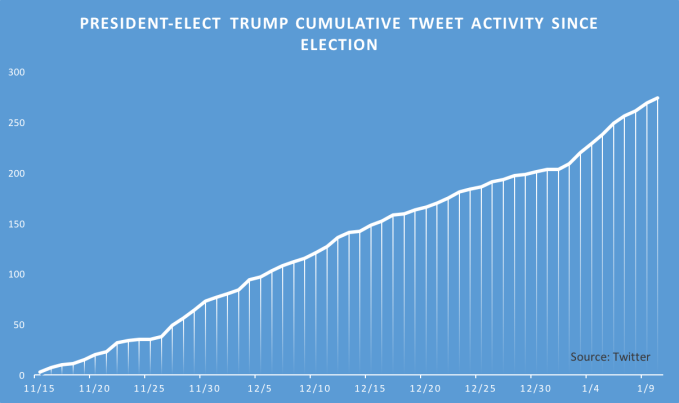
A question that keeps rattling around in my head in our new Trump reality is whether social media posts like blogs, Tweets and status updates work like currency? Is there a “law of diminishing marginal returns” to the effectiveness of using Tweets to communicate?
On one hand, if he keeps up this pace, the novelty of a President of the United States taking to twitter to engage in a flame war will soon dissipate. If it does, we’ll discover what happens when the American public gets tired of a social media presidency.
On the other hand, brand marketers say that you need to be consistent on social media to engage your audience. If his goal is to keep his supporters (and detractors paying attention), constant tweeting is a good thing. Once in office, an attentive electorate can be a potentially mobilized electorate.
Comments 11
Billo Buck — July 3, 2017
I'm already tired of Trump. I don't care if you are the president or some schmo from Podunk Texas I really don't want to know your every thought. There's something to be said for moderation. Trump has made himself into an irritation. By responding to every perceived slight he legitimizes his detractors. The man has the thinnest skin ever seen in political office. I think some presidents probably were too silent when attacked but Trump won't shut up.
Jessica — August 5, 2025
Trump’s constant tweeting blurs the line between addiction and strategy. Just like in business, consistency can build engagement—but only if it adds value.
Ahma Services believe in clear, reliable communication that keeps our clients informed without the noise. Visit here https://ahmatechnicalservices.ae/interlock-installation-dubai/ for interlock services dubai.
Jessica — August 5, 2025
Trump’s constant tweeting blurs the line between addiction and strategy. Just like in business, consistency can build engagement—but only if it adds value.
Ahma Services believe in clear, reliable communication that keeps our clients informed without the noise. Visit here https://ahmatechnicalservices.ae/interlock-installation-dubai for interlock services dubai.
Matthew Mayo — September 3, 2025
Trump’s obsessive tweeting can be seen both as a strategy and a habit, as he uses social media to dominate news cycles, shape public opinion, and keep constant attention on himself. While some argue it reflects addiction-like behavior, others see it as a calculated move to maintain influence—much like how players stay engaged in a Blooket game to remain active and visible.
john tom — November 14, 2025
Interesting take—Trump’s rapid-fire tweeting really does blur the line between impulsive habit and calculated messaging. The idea that constant posting can shape perception, intentionally or not, adds another layer to how political communication works today. I recently came across a related angle while researching digital behavior patterns: Clownfish Voice Changer PC
—different topic, but it touches on how tech tools can influence the way people present themselves online.
tom fair — November 14, 2025
Really interesting breakdown of whether Trump’s tweeting is impulsive or strategic. The idea that constant posting can blur the line between habit and calculated communication really stood out. I’ve been looking at similar behavior patterns while working on a project called Fluxus Key, and this post adds a helpful angle to that discussion.
herry jack — November 14, 2025
Really interesting breakdown of whether Trump’s tweet patterns reflect strategy or compulsion. The part about how repetition shapes public perception especially stood out. I’ve seen similar behavior analyzed in tech communities too, where digital habits blur into strategy—something I noticed while exploring tools like 3uTools for PC
. Great read!
Adhitri — November 16, 2025
"Fascinating analysis on whether Trump's tweeting is strategic or compulsive. It reminds me of how digital behaviors can sometimes blur the line between habit and intention. For those interested in exploring patterns in online engagement, you might find this tool helpful: Download Fluxus
."
2 Minute Timer — April 17, 2026
"2 Minute Timer
Free Online Timer - Perfect for Quick Tasks
Perfect timer tool for Pomodoro technique, quick breaks, cooking eggs, meditation sessions, and workout intervals. Set custom timers from 1 to 30 minutes with multiple sound options."
Jonathan — September 28, 2026
The question of whether Trump's tweeting follows a "law of diminishing marginal returns" is worth revisiting. The article raises a genuinely interesting tension: brand marketers argue that consistency builds audience engagement, yet there is a threshold beyond which repetition breeds fatigue rather than attention. What the analysis perhaps underweights is the asymmetry between different audience segments. Supporters may interpret high-volume tweeting as authenticity and accessibility, while detractors may experience it as noise they eventually tune out. Both reactions can coexist simultaneously, meaning the "returns" are not uniform across the electorate. This also raises a methodological question: how do we measure effectiveness here — by raw engagement metrics, by shifts in public opinion polling, or by the ability to set the news agenda? Each measure could yield a different answer about whether the behavior is strategic, compulsive, or both at once. The distinction may matter less than the outcome it produces in any given news cycle.
Jonathan — September 28, 2026
The question of whether Trump's tweeting follows a "law of diminishing marginal returns" is worth unpacking further. The article raises a genuine tension: consistency builds audience engagement, but novelty fades with repetition. From a behavioral standpoint, these two forces don't cancel each other out — they operate on different audiences. Loyal supporters may reward consistency, while casual observers tune out as the novelty wears off. What's less explored here is whether the sheer volume of tweets functions as an information-flooding strategy — making it harder for any single message to be scrutinized. If the goal is to dominate the news cycle rather than persuade, then diminishing returns on persuasion might actually be acceptable. It would be interesting to see whether the analysis of tweet frequency was also mapped against news coverage volume, to test whether more tweets genuinely translated into more media attention over time.