
thanksgiving

Tis’ the season for throwing down at dinner. Every year the humor and the horror stories about Thanksgiving hit our social media feeds. This isn’t just about politics, either. Family dinners have a strong symbolic significance. When the stakes are high for a once-a-year gathering, other kinds of social conflicts are primed to play out as well.
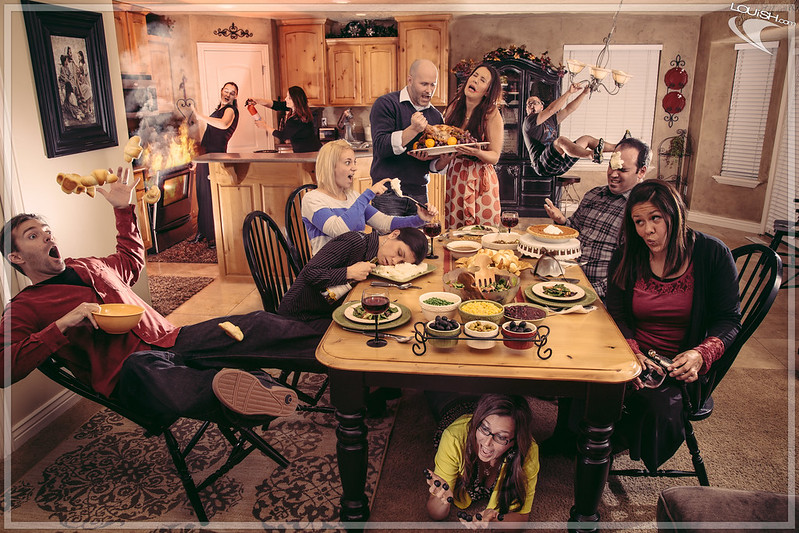
Photo Credit: Louish Pixel, Flickr CC

But for all this talk about fighting, one thing I find really interesting as a political sociologist is just how much work people do to avoid conflict. We know from embedded studies of parent organizations and neighborhood groups that people will tie themselves up in knots to avoid talking about political issues. In some cases, people are more likely to confide in near-strangers or acquaintances than close family members. In an increasingly fraught political climate, the answer for many people might be cutting their visits short. According to research published last year Science, there is some evidence for this happening.

In the article, political scientists matched anonymous smartphone location data from over 10 million Americans to precinct-level voting data from 2016. By doing this, they could see who traveled for Thanksgiving that year and how long they stayed at dinner. People who ate in an opposing political district spent less time at dinner, about 30-50 minutes less on average. The pattern was stronger for people coming from Republican districts to dine among Democrats—they split about 50 to 70 minutes sooner. The authors also find that increased local political advertising was also associated with cut-down dinner time.

Sure, these people could be storming out before that second helping. But I think one of the less-appreciated trends in political life is that many of us are just clamming up and cutting out early to spend time elsewhere. There are many perfectly valid reasons to do this, especially if people are made to feel unwelcome or unsafe. These results suggest we could all do a little more to think about keeping people at the table.

Evan Stewart is an assistant professor of sociology at University of Massachusetts Boston. You can follow his work at his website, or on BlueSky.


Thanksgiving is upon us. Typically, a time in which we all get together and collectively celebrate the genocide of Native Americans at the hands of Puritanical European conquerors. This tradition now includes family gatherings, expressions of thanks, love and self-congratulations, bountiful feasts, and uncomfortable social and political conversations, all revolving around the all-important turkey dinner.

Turkeys are notoriously difficult to cook perfectly and with good flavor. And, while women are generally held responsible for the grunt work involved in turkey preparation, it is men’s contributions that matter the most: carving, traditionally, and, now, seasoning.

Luckily, the invisible hand of capitalism has developed a masculine method for men to fulfill their manly role of seasoning—one that doesn’t involve any sissy sprinkling. It’s Season Shot: a way for a hunter to deliver exactly the right amount of flavor to a turkey, via shotgun, at the precise moment of his victory over nature. It’s boldness and self-reliance in a (nut) shell.

For those girly men and women who don’t know about hunting, shotguns are different from rifles. Instead of a bullet, they shoot a hollow shell full of small balls of steel. Shotguns are especially well-suited to murder most fowl, as it makes it easier to target small, moving game. Season Shot replaces the standard steel with seasoning granules. Why delicately season a fresh¹ turkey, when you can blast in the flavor? Varieties includes Cajun flavor, Lemon Pepper, Garlic, Teriyaki, and Honey Mustard.

We dare you to find a more manly way to do women’s work.

The additional positives of using Season Shot are plentiful. Firstly, dental. You won’t suffer a broken tooth due to a pellet your wife or some other woman failed to fish out of the carcass. All your teeth will encounter is flesh.

Secondly, there is the efficiency.  You season the bird on impact; marinating starts immediately as the body heat melts the seasoned pellets. Men don’t like to waste time.

Thirdly, benevolent patriarchal protection of the environment. As it says on the Season Shot website:

Our environment is the basis for the sport of hunting. Without a healthy environment how would our hunting fare? Why damage the very thing that allows us to do what we love? Season Shot is the answer. This is the first truly environmentally safe ammunition, Season Shot stands out above the rest. Using fully biodegradable shot, Season Shot is the right choice to protect what we love.

The final advantage is a thank you from your ol’ lady. She can’t nag you for spending the whole day eating, napping, and watching football while she furiously coordinates guests, pets, decorations, and a meal large enough for a small army after weeks of extensive thought and preparation—no, not when all of her work would be wasted without you and Season Shot.

In short, Season Shot gives us men a safe and environmentally friendly way to indulge our obsession with guns, protect our masculinity, and produce more egalitarian holiday chores. Thanks, capitalism. You’ve done it again.

¹Note: Authors suggest using extreme caution on frozen turkeys due to potential ricochet. Authors also suggest only using outdoors.

D’Lane R. Compton, PhD is a lover of all things antler, feather, and fur. An associate professor of sociology at the University of New Orleans with a background in social psychology, methodology, and a little bit of demography, they are usually thinking about food, country roads, stigma, queer nooks and places, sneakers and hipster subcultures. You can follow them on twitter.

Tony Love is a fan of most sports, a rural person stuck in the city, and conducts social psychology experiments on his own children and pets for fun. He researches social psychology and criminology as an assistant professor of sociology at the University of Kentucky. He is especially happy when confronted with cookies and especially unhappy when confronted with exercise. Sometimes he writes serious sociology articles that only other sociologists read.