sexuality

It’s Valentine’s Day, and my social media feed is more snarky than smarmy. The Hallmark holiday gets us thinking about love, but it also highlights our unquestioned assumptions about romantic relationships. The culture of love is tied up in all kinds of expectations: what we buy, how we date, even who does the dishes. A lot of sociological thought works to make these assumptions explicit, breaking them down to reveal the (sometimes sad) truth that many of us haven’t really thought that much about how we really want to love and be loved. 

But social science isn’t always depressing! Some recent work actually has pretty good news about the state of our romantic relationships. One example is Philip Cohen’s article published in Socius last year on “The Coming Divorce Decline.” Where many of us have gotten used to a story about rising divorce rates over the past few decades, Cohen finds that the probability of divorce for women has been declining from 2008 to 2017. Especially encouraging, he also finds that the probability of divorce for newly married women has been declining over same time period. 

Cohen, Philip N. 2019. “The Coming Divorce Decline.” Socius: Sociological Research for a Dynamic World 5:237802311987349.

In the article, Cohen writes:

…because the risk profile for newly married couples has shifted toward more protective characteristics, it appears certain that—barring unforeseen changes—divorce rates will further decline in the coming years.

And he even highlights how new data supported this prediction from an earlier draft of the paper!

Another example is a recent op-ed from Stephanie Coontz in The New York Times: “How to Make Your Marriage Gayer.” This piece is packed with current social science on relationships, from how couples split the housework to how they handle stress. One big takeaway from the research is better reported relationship outcomes for same-sex couples, and Coontz explains this in terms of our unquestioned assumptions about our love lives. Heterosexual couples tend to revert to more traditional assumptions about gender and relationship roles. But with fewer assumptions about gender and family roles at play, same-sex couples often have to (gasp!) openly talk about their needs, negotiate expectations, and generally do the things that make a relationship really strong.

So, if you’re grumpy this Valentine’s Day, remember that there’s some good news as well. As we learn more about what makes relationships work, we make it easier to navigate romance in a more open and honest way.
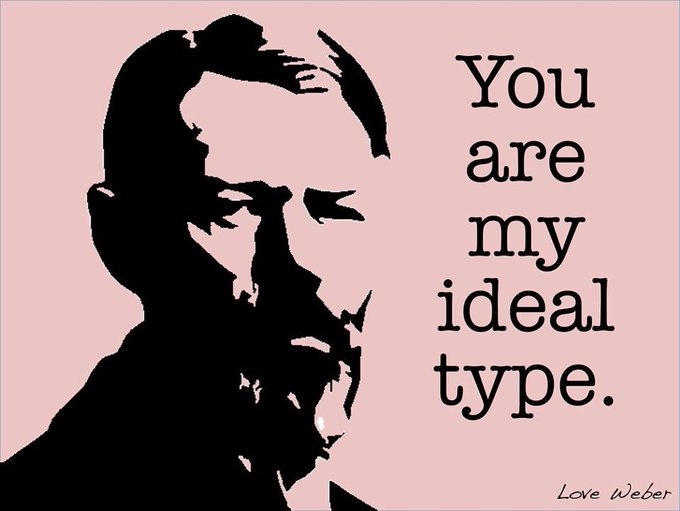
Hat tip to Erin McDonnell for tweeting this amazing SocValentine

Evan Stewart is an assistant professor of sociology at University of Massachusetts Boston. You can follow his work at his website, or on BlueSky.
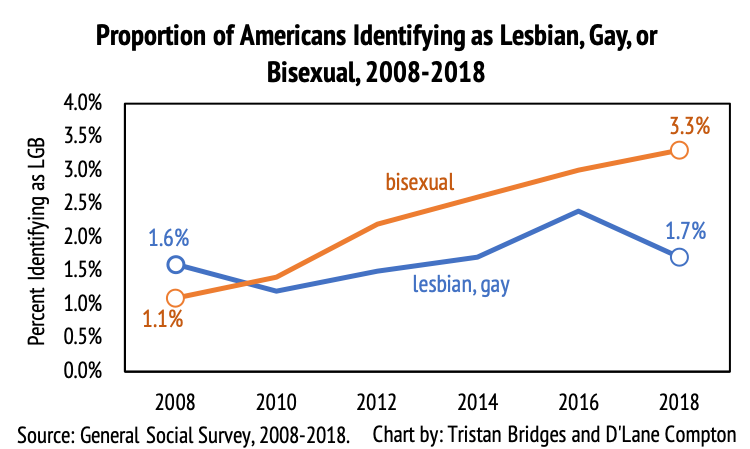
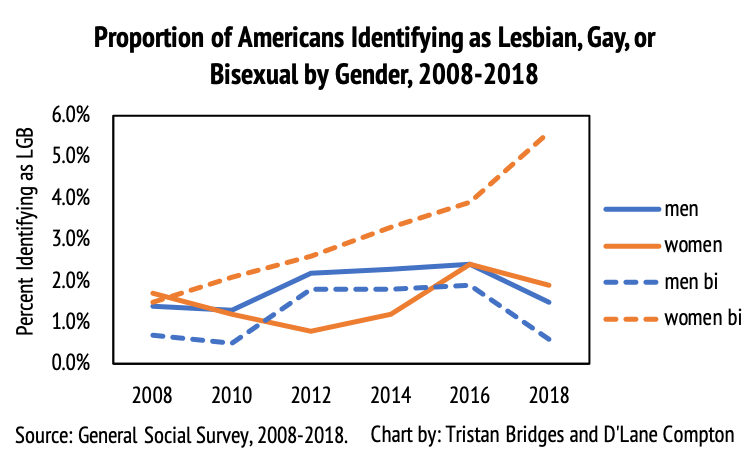
The 2018 General Social Survey data was just recently publicly released. We were eager to see how things shifted, especially for the demographic questions on sexual identity. As of 2018, it has officially been one decade that GSS has been asking respondents to characterize their sexual identity on the survey, you can self-classify as “heterosexual or straight,” “gay,” “lesbian,” “homosexual,” “bisexual,” or “don’t know.” This is only one way to measure sexual identity among many,  but the growth in LGB identity has been generally comparable across instruments in the past.

As Tristan has noted before, reporting on shifts in the LGBT population treats the group as homogenous and artificially presents growth in LGBT identity as though it might be equally distributed among the L’s, G’s, B’s, and T’s. But that’s not true. Bisexual women account for the lion’s share on the growth in LGBT identification. And, as Tristan and Mignon Moore showed in 2016, young Black women account for a disproportionate amount of the growth in LGB identification.

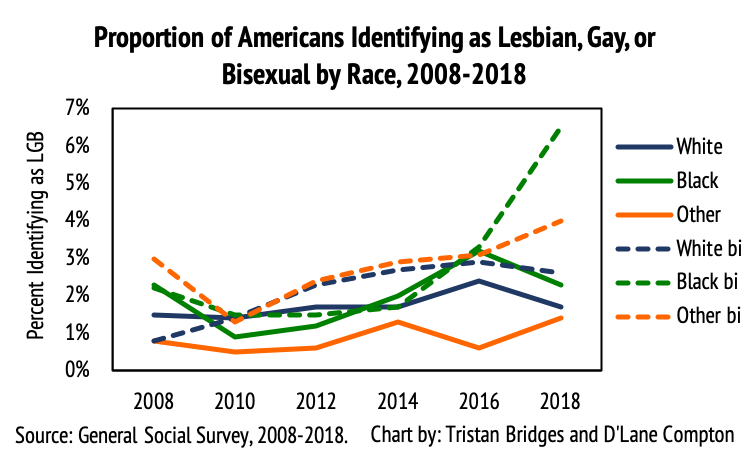
Data from GSS shows an increase in LGB identification between 2008 and 2018. Below, we charted shifts in those identifying as lesbian and gay alongside those identifying as bisexual. Consistent with what Tristan showed in 2016, bisexual identification continues to be increasing at a steeper rate.

In fact, when you look at the proportions identifying as lesbian and gay or bisexual in 2008 and compare those with the proportions identifying as lesbian and gay or bisexual in 2018, lesbian and gay identifications have not really moved much. But bisexual identities continue to increase every year.

This is consistent with other national survey work. For example, using the National Survey of Family Growth (NSFG), Compton, Farris and Chang (2015) found that almost nine percent of women in the sample and about four percent of men in the sample in 2008 and 2002 reported behavior as bisexual; that is, having sex with at least one male and at least one female partner in their lifetime. Rates of self-identification as bisexual were much lower (in 2008 0.43% of women and 0.38% of men). Perhaps with increases in social tolerance people are more likely to claim bisexual identities today, regardless of their participation in the behavior.

Previous work has also suggested that much of the growth in LGB identities is happening among women. The GSS data show that the shift appears to be primarily happening among bisexual women. Indeed, bisexuality continues to be a more popular sexual identity than lesbian among women, but a less popular sexual identity than gay among men, as others have shown. As of 2018, almost 6% of women responding to the survey identified as bisexual compared with 1.5% in 2008. Comparatively, shifts in lesbian identities among women and both gay and bisexual identities among men really haven’t shifted much.

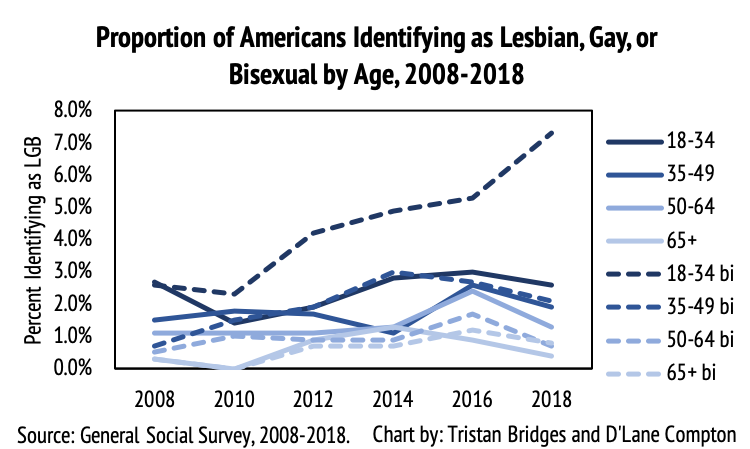
And similar to previous analyses (herehere, and here), this shift is particularly pronounced among the young. The figure below shows changes in lesbian and gay identities alongside shifts in bisexual identities for four separate age cohorts. The real shift in among bisexual identification among 18-34 year-olds. Between 7 and 8% identified as  bisexual on the 2018 GSS survey. This is all the more interesting when you look at the 2008 data on these figures. Bisexuality did not stand out in these data in 2008. In fact, in 2008, more people identified as lesbian and gay than bisexual. This shift has emerged and grown in an incredibly short period of time.

As other data have shown as well (see here and here, for instance), people of color account for a disproportionate amount of this shift. Black bisexuals accounted for almost 7% of Black respondents on the 2018 GSS. That’s a big shift as well. And while bisexual and lesbian/gay identities were moving along similar trajectories for Black Americans through 2016, as of 2018, bisexuality was much more common (as has been true for White respondents and those of other races… yes “other race” is actually the category GSS uses… and no, it’s not a good idea).

So what do we do with all of this? One thing that we ought to take from this is to take scholarship on bisexuality more seriously. As a sexual identity, bisexuality is less studied than it ought to be. But bisexuality has continued to grow and continues to represent a larger number of people’s sexual identities than lesbian and gay combined. This is interesting for a number of reasons, but one is that much of the growth in the LGBT community might actually be the result of changes in the population of bisexual identifying people (and this is a group that is disproportionately composed of women). Whether bisexual identifying people understand themselves as a part of a distinct sexual minority, though, is a question that deserves more scholarship. If we are going to continue to group bisexuals with lesbian women and gay men when we report on shifts in LGB populations, this might be something that deserves better understanding and more attention. Context matters in how we understand identities and how they change or evolve over time.

Originally posted at Inequality by Interior Design. Read more and dive into the details there!

D’Lane R. Compton, PhD is an associate professor of sociology at the University of New Orleans with a background in social psychology, methodology, and a little bit of demography, they are usually thinking about food, country roads, stigma, queer nooks and places, sneakers and hipster subcultures. You can follow them on twitter.

Tristan Bridges, PhD is a professor at the University of California, Santa Barbara. He is the co-editor of Exploring Masculinities: Identity, Inequality, Inequality, and Change with C.J. Pascoe and studies gender and sexual identity and inequality. You can follow him on Twitter here. Tristan also blogs regularly at Inequality by (Interior) Design.

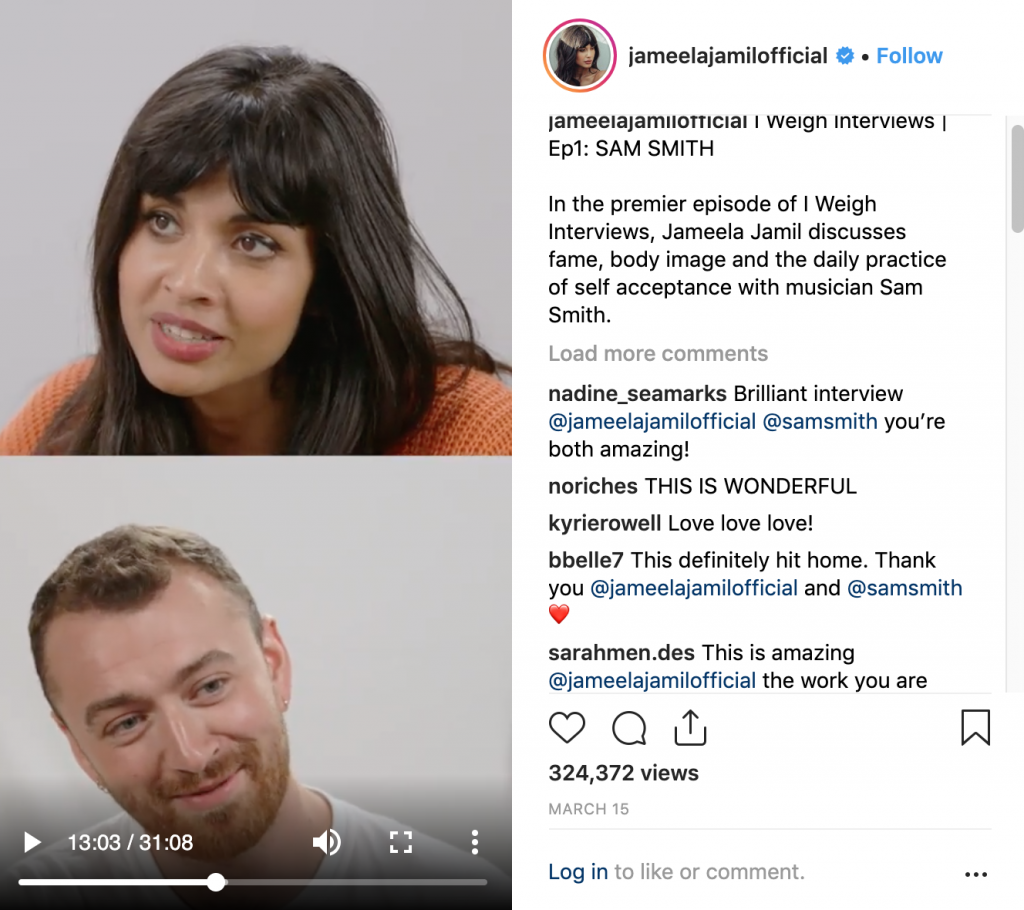
In March, in an Instagram interview with Jameela Jamil, British pop star Sam Smith announced being non-binary in both gender and sexuality, stating “I’m not male or female. I think I float somewhere in between – it’s all on a spectrum” (timestamp 21:50 to 22.10). Smith had made a similar declaration to the Sunday Times in October, 2017, but did not suggest that the media use non-binary gender pronouns at the time. During the interview, Smith also revealed that “the basis of all my sadness” has been body shaming.

This instance of “biography and history” producing a non-binary person haunted by fat-shaming is important to the sociological understanding of gender. It reminds us that gender is lived in the body, not just as an idea but as a “looking-glass self” in which multiple kinds of stigma can simultaneously reduce a person to a “tainted, discounted one”. As culture shapes the way we see ourselves, it can produce an overpowering feeling of what Cooley called “mortification,” because “we always imagine, and in imagining share, the judgments of the other mind.” In Mead’s terms, culture produces this in the “generalized other”; how we imagine ourselves as an object in the eyes of the whole society. 

The intersection of body-shaming and transphobia shows us how bullying turns the body into an object. Jamil recounted in the interview that a photographer had called her a “fat c-word.” This can be compared with C.J. Pascoe’s famous study of how the word “fag” is used in bullying to police the gender of boys. Smith concludes the interview with a vow to promote self-forgiveness and the love of the body. This struggle against the gender binary fits within the mission of Jamil’s “I Weigh” instagram series seeking to resist all forms of cultural bullying and policing of bodies, gender expression and sexuality.

Jonathan Harrison, PhD, is an adjunct Professor in Sociology at Florida Gulf Coast University, Florida SouthWestern State College and Hodges University whose PhD was in the field of racism and antisemitism.

Over the past few years, Chris Pratt has been more public about his faith in interviews, award speeches, and social media. A few days ago, Ellen Page raised questions about Pratt’s church advancing anti-LGBT views. Pratt has ties to both Zoe Church and Hillsong, evangelical churches that are well-known and influential in contemporary Christianity.

My work doesn’t usually dovetail with celebrity gossip, but this case caught my interest because it raises questions about whether we can or should ask people to justify the political work of their religious groups. Thanks to research in the sociology of religion, we know how political attitudes spread through faith groups, and this can help us make better sense of the conversation.

Photo Credit: Mor, Flickr CC

There is good reason to expect people to have their own beliefs that might differ from their church leadership. Research across the social sciences shows that people generally aren’t consistent in the way they express their religious beliefs in everyday life. Also, churches are not often clear about where they stand on these issues. According to reporting in The Huffington Post,

Zoe’s official stance on LGBTQ issues is unclear, according to Church Clarity, a crowd-sourced database that scores churches based on how clearly they communicate their policies on LGBTQ people and on women in leadership. George Mekhail, one of Church Clarity’s founders, told HuffPost he suspects that the ambiguity some conservative Christian churches have around their LGBTQ policies could be intentional.

That last part of the quote gets at the most important sociological point. In these church contexts, people don’t usually get their politics straight from the pulpit. Research on evangelical congregations shows how most of the political socialization in church life comes from lay leaders and fellow members who model their political views for new members. If church leaders want to advocate for a pro-life, anti-LGBT, or other policy agenda, they often don’t have to do it explicitly. The laity has already taught newcomers that this is how “people like us” vote.

Want to learn more about the new politics of evangelicals? There’s research on that!

We also have to consider Pratt’s status as a celebrity congregant. Regardless of his personal views, religious organizations have long taken an interest in cultural influence and worked to foster connections with important social networks in politics, business, and the entertainment industry to legitimize and advance their social agendas.

It might seem unfair to call out a single person for the agenda of an entire church organization. On the other hand, as a sociologist, I come to this debate less interested in what’s in any single person’s head or heart. I’m more interested in where they are in relation to everyone else and what those relationships do. The conversation from Page reminds us that It’s not necessarily about what a person believes, but about what they legitimate with their platform and presence.Evan Stewart is an assistant professor of sociology at University of Massachusetts Boston. You can follow his work at his website, or on BlueSky.
Political drama over the past few years has driven us to take a new look at bridging social division. Pundits worry about filter bubbles, cultural enclaves, and the way “identity politics” might be driving us apart into groups that understand each other less and less. The theory assumes we do a lot of identity policing—we figure out who we are, anchor that on who we are not, and spend a lot of time and effort policing that boundary to keep other people out. If everyone self-sorts into similar identity communities, it can be harder to connect in a diverse society.

But is that really what’s happening? Sociologists know that identities are a key part of cultural membership, but we often complain about “identity politics” for certain groups and ignore it for others. Now, new research shows how focusing on one kind of identity can bring people together, rather than pushing them apart.

Photo Credit: Ted Eytan, Flickr CC

In a new study published in Sociological Science, Adam Horowitz and Charles Gomez look at “identity override”—a process where a shared identity can lead people to bridge other social divides. Using data from the National Longitudinal Survey of Adolescent to Adult Health, they find evidence for an interesting case of identity override: people who identify as lesbian, gay, or bisexual (GLB) have more friendships and relationships with people from different racial groups.

Identity was the key factor here; people who reported same-sex relationships but didn’t identify as LGB didn’t show the same patterns. Rates of interracial relationships also held after the authors controlled for other demographics and whether respondents lived in urban areas. Racial segregation still persists in the United States, but it looks like coming out and coming together encourages interracial social ties that can overcome some of these barriers. Horowitz and Gomez write,

the cross-racial nature of GLB membership allows it to override the otherwise high borders between people without such a second salient identity.

This research provides a little bit of good news for a world that seems full of conflict. In this case, there’s some evidence that investing in an identity doesn’t always mean cutting other people off.Evan Stewart is an assistant professor of sociology at University of Massachusetts Boston. You can follow his work at his website, or on BlueSky.