politics

One of my students last semester wrote a paper in which she looked at sexist images of Condoleezza Rice. Interestingly, much of the online discourse was very similar to the way people talk negatively about Hillary Clinton. It was fascinating to see the same themes used by people with different political viewpoints in their criticisms–both Hillary and Condoleezza were described as bitches and whores and as ugly man-hater lesbians. My student argued persuasively that the reason the online attacks on the two women were so similar was because they weren’t being viewed as politicians or through the lens of their policies, but instead the attacks used a sexist lens that focused on their femaleness–and willingness to trespass on male-dominated political terrain–as the thing to attack, rather than any specific action or policy. Unfortunately for the blog, though good for humanity, I didn’t find as many images that had been made to accompany the hateful rhetoric about Condi as about Hillary.

Here’s an image (found here) I came across (note that George Bush’s face has been super-imposed on the handler):

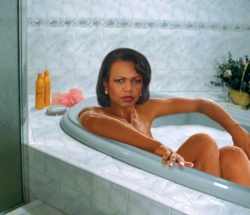
Both Hillary and Condi are often described as ugly. However, I noticed when searching for images of Condoleezza that both supporters and critics occasionally sexualized her (especially in reference to a pair of stiletto-heeled boots that got a lot of public attention at one point). I haven’t found similar images of Hillary from either supporters or critics (whether it would be preferable to be sexualized by a supporter or opponent, I’m not sure). I found this image of Condi in a bathtub here, though it was posted on several other websites I came across in a really brief search.

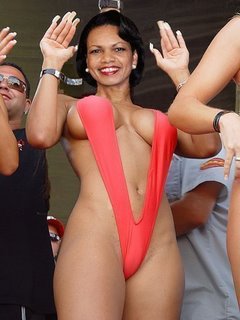
This bathing suit image came from here.

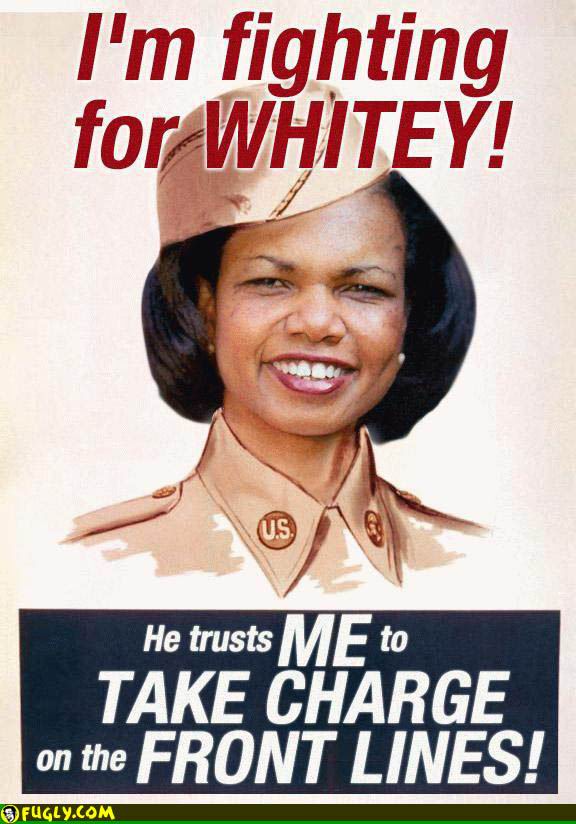
Unsurprisingly, Condoleezza’s race is also a focus in online discussions in a way that Hillary’s isn’t, such as this image (found here) that plays on the idea of the Uncle Tom (the implication being that Black Republicans or military hawks are puppets used by Whites for their own agenda–that is, that they are either duped or are trying to get power by appeasing Whites):

NEW: p.j. sent in this sexualized picture of Condi:

Thanks, p.j.!

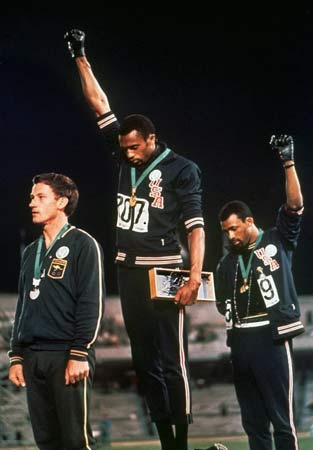
This is the iconic photo of Tommie Smith and John Carlos (found here) from the 1968 Olympics in Mexico City. They raised their arms, wearing black gloves, in a symbol of protest against racism in the U.S. Less often noticed is that they were wearing beads to symbolize victims of lynching and went barefoot to protest the fact that the U.S. still had such extreme poverty that some people went without basics, such as sufficient clothing. Peter Norman, the Australian 2nd-place winner, grabbed a button produced by the Olympic Project for Human Rights (see below) when he found out what the other two were going to do and wore it in solidarity (if you look closely you can see that all three are wearing matching white buttons).


The reaction was immediate and negative. Carlos and Smith were stripped of their medals, ejected from the Olympic Village, and returned to the U.S. to widespread anger. In David Zirin’s book What’s My Name, Fool? Sports and Resistance in the United States (2005, Chicago: Haymarket Books), several black athletes discuss the difficulties they faced as a result of their actions. This 2003 interview with Tommie Smith covers some of the same issues.

Below is a button like the ones they were wearing. Much like we often think Rosa Parks spontaneously decided not to give up her seat on the bus (ignoring the fact that she attended training with other African Americans determined to protest inequality in the South), the assumption is often that Smith’s and Carlos’s gesture was something they decided on at the moment. In fact the Olympic Project for Human Rights, organized by Black U.S. athletes, had tried to organize an athletes’ boycott of the 1968 Olympics. When that was unsuccessful, tactics switched to making statements at the Olympics. This was part of an organized plan on the part of a number of Black athletes who were tired of representing the U.S. but being expected to stay silent about racism in the U.S.

Some of these buttons are for sale ($300 each!) on Tommie Smith’s website.

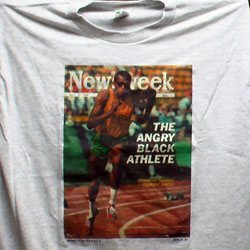
A t-shirt with the cover of the July 15, 1968, issue of Newsweek about “the angry black athlete.”
I looked for a photo of the cover itself but could not find one online. Clearly the nation was anxious about the attitudes of Black athletes even before the Olympics (in October) caused such a stir.

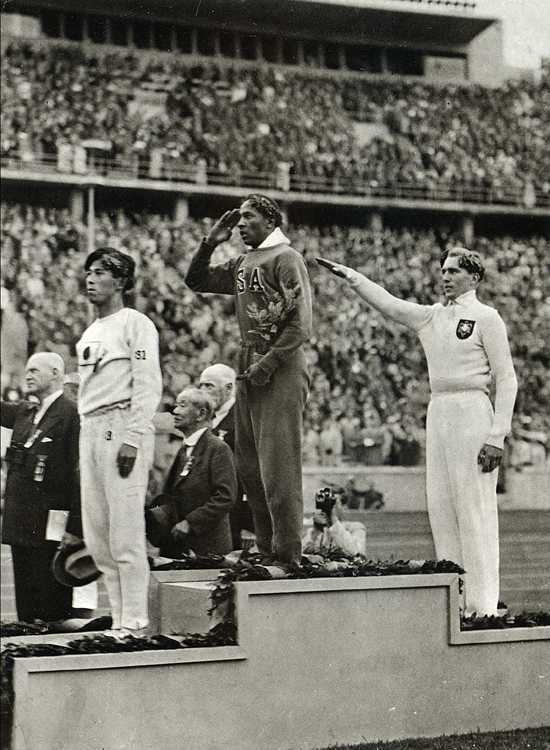
I think these images are useful in a couple of ways. I use them to undermine the idea of the individualistic protester and to bring attention to the ways Civil Rights activists organized and planned their actions. It could also be useful for discussions of politics in sports–the ways in which athletes have at times used their position to bring attention to social inequality, as well as the repercussions they may face for doing so. It might also be interesting to ask why this image caused so much furor, and how the Olympics is constructed as this non-political arena for international cooperation (a topic I cover in my Soc of Sports course). You might compare the image from the 1968 Olympics to this image (found here) from the 1936 Olympics in Germany:

Here we also see the Olympics being used to make a political statement, but in this case the athlete was not thrown out of the Olympic Village or stripped of his medals. What is the difference? Just that time had passed and attitudes toward political statements at the Olympics changed? In the 1936 pose, the athlete was showing pride in and support for his country, whereas Smith and Carlos meant their gesture as a protest of conditions in the U.S.–thus shaming their nation in an international arena (this was a major cause of the anger they faced when they returned to the U.S.–the idea that they were airing the nation’s “dirty laundry,” so to speak, for others to see). Could that be part of the difference in the reaction?

Of course, a cynical person might argue that these seemingly ungrateful, misbehaving black athletes who refused to smile and play along were being publicly punished in the media for getting “uppity” (in a time period where white Americans were also wearying of minorities’ continued demands for equality and social change).

The trouble is… people will answer them.

Found here thanks to commenter Phili-Chan! From an Australian show featuring Charles Firth.

At the Los Angeles Times, found via Scatterplot.

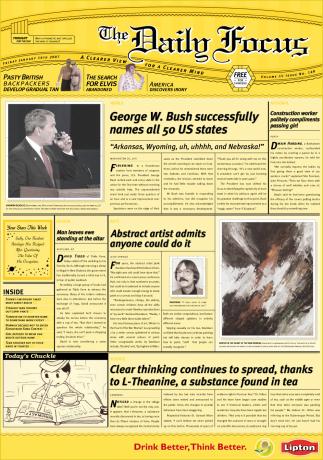
This Australian ad for Lipton tea suggests that it’s mind clarifying qualities are so good that it could help even George Bush achieve the feat of naming all 50 states.


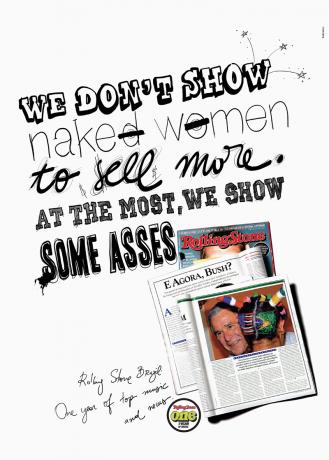
This Brazilian ad for Rolling Stone, featuring a picture of George W. Bush, reads: “We don’t show naked women to sell more. At the most, we show some asses.”


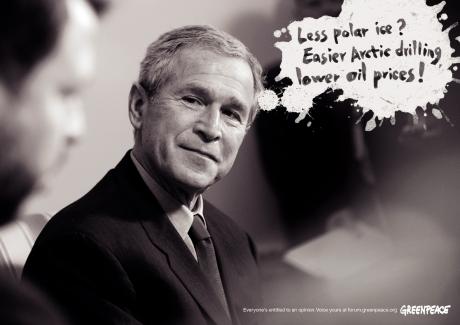
This Chinese Greenpeace ad, portraying Bush’s spin on global warming, reads: “Everyone’s entitled to an opinion. Voice yours at forum.greenpeace.org.”

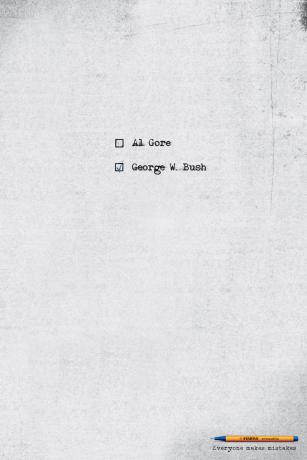
This Chinese ad for an erasable pen reads: “Everyone makes mistakes.” 


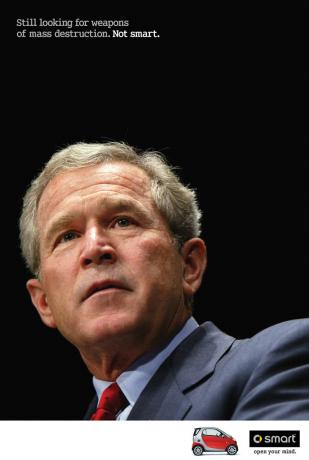
In Malaysia, Bush is used to sell Smart cars.  Text: “Still looking for weapons of mass destruction.  Not smart.” 


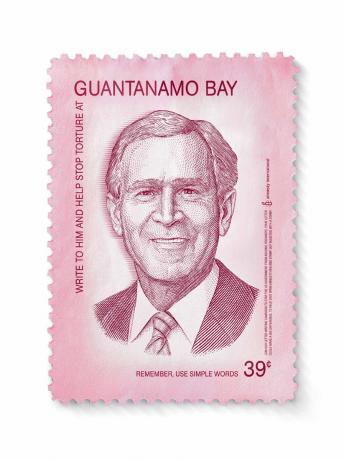
Also in Malaysia, Amnesty International makes fun of Bush in their effort to inspire opposition to Guantanamo Bay.  “Write to him and help stop torture at Guantanamo Bay.  Remember, use simple words.”

This is a Mexican ad for a dog kennel.  “We don’t discriminate any kind of breed.”  (The source says that, in Mexico, like in the U.S., “dog” is a name for a bad person.)

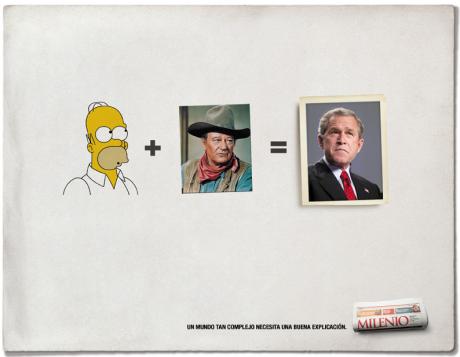
 This ad for a Mexican newspaper reads: “Such a complex world needs a good explanation.”


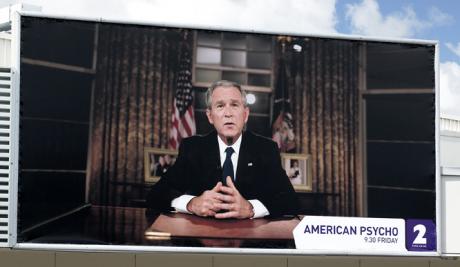
This is an ad for the movie American Psycho in New Zealand.


In Portugal, playing war games (paint ball) is advertised as equivalent to playing George W. Bush.


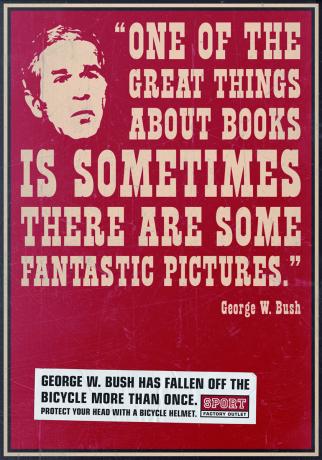
This Swiss ad threatens, if you fall off your bicycle without a helmet, you may end up as dumb as George W. Bush.

These and more borrowed from here, found via adfreak.


Update: There have been some really nice points in the comments about how, in the process of making fun of Bush, we are also seeing the further stigmatization of “people with developmental disabilities, brain injuries, and psychological diagnoses” (that from Penny in the comments). 

For our sociologist and sociologically-inclined readers:

As Wicked Anomie asks, “Sociologist and American are mutually exclusive categories?” Who knew!

She also notes:

…did you also notice that bit about “real issues,” and how they and racial/ethnic issues are mutually exclusive? So, we have the broader category of issues, then we have subcategories of racial/ethnic and “real.”

Indeed.

Via contexts crawler.

This video, produced by Mother Jones, shows Pastor Rod Parsley arguing that America was founded to destroy Islam and has a divine mandate to do so.  It is interesting on at least two levels:

First, as a response to the Reverend Wright story, it reminds us that Wright is not the only preacher who says outrageous things, and Obama is not the only politician to get “spiritual guidance” from a controversial figure.  In which case, the question might be: Which outrageous preachers are most likely to be targeted as problematic?  And by who?

Second, the video could be used to demonstrate how a person can be made to appear frightening or evil through editing.  In this case, the move to slow motion, the use of black-and-white, the strategic stills.

In many ways, this video, produced by the left, uses many of the same tactics as the anti-Reverend Wright clips on Fox News and elsewhere. For comparison, The Daily Show put together a montage of coverage that appears in the clip below (at about 6 minutes, 51 seconds) that uses choice words (“fiery”), tone of voice, and fast motion:

Thanks to Joe DeM. for tipping us off to the Mother Jones video!

Lisa Wade, PhD is an Associate Professor at Tulane University. She is the author of American Hookup, a book about college sexual culture; a textbook about gender; and a forthcoming introductory text: Terrible Magnificent Sociology. You can follow her on Twitter and Instagram.

1.gif

11.jpeg

2.gif

21.jpeg

31.jpeg

See also these and these.

Thanks again, p.j.!