
nation: Jamaica

Flashback Friday.

While preparing a lecture on sex tourism, I ran across this video about men who have sex with female tourists in the Caribbean:

There’s a lot of interesting stuff going on there, no? I was fascinated by the female hotel owner who talks about the men “preying” on the female tourists, clearly placing the power in the hands the men who, she argues, use the female tourists for money but don’t really care about them. I tried to imagine someone talking similarly about female sex workers “preying” on foreign men’s need for affection and attention.

This might make for a great discussion about perceptions of sexual agency: how do gendered sexual norms, economic differences, and the different races and nationalities of the individuals involved affect how we think of their interactions and who we see as the victim?

In her chapter on sex tourism in Race, Ethnicity, and Sexuality), sociologist Joane Nagel discusses the role of racialized sexualities in making some groups attractive tourists looking for an ethnosexual adventure. In the Caribbean, dark-skinned men with dreads are particularly attractive to some female tourists because of stereotypes of Black men as extremely sexual and masculine, which plays into fantasies of being swept away by a strong, skilled lover. At the same time, White Western women may represent the possibility of a better life (through continued gifts of money even after the vacation is over) and sexualized adventures to the men they sleep with while on vacation. Nagel argues that these encounters generally reinforce, rather than challenge, existing racial and gender inequalities, since they play on stereotypes of sexualized Others as animalistic, primitive, and, in the case of men, as super-masculine (and super-endowed).

Then again, Nagel also questions whether any relationship between tourists and “local” men should count as sex work. The individuals involved don’t necessarily think of their interactions in those terms. And who is to decide if a particular situation is “sex tourism” as opposed to a “real” relationship? How does that assumption invalidate the possibility that Black men and White women might have real, meaningful relationships? Or primarily sexual relationships, but with both partners respecting the other?

Originally posted in 2009.

Gwen Sharp is an associate professor of sociology at Nevada State College. You can follow her on Twitter at @gwensharpnv.
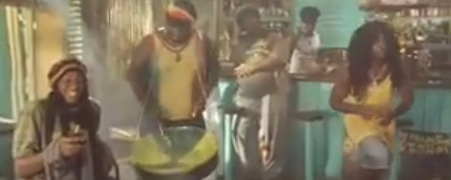
In response to my post yesterday about tourism ads presenting local (often, though not always, non-White) residents of vacation hotspots as tourist attractions and amenities for relatively privileged travelers to enjoy, Lauren J. sent in a Heineken ad that pokes fun at the expectations visitors to Jamaica often have about how Jamaicans would act, and how local residents may feel obliged to play along and give tourists (with their cash) the “authentic” experience they desire:

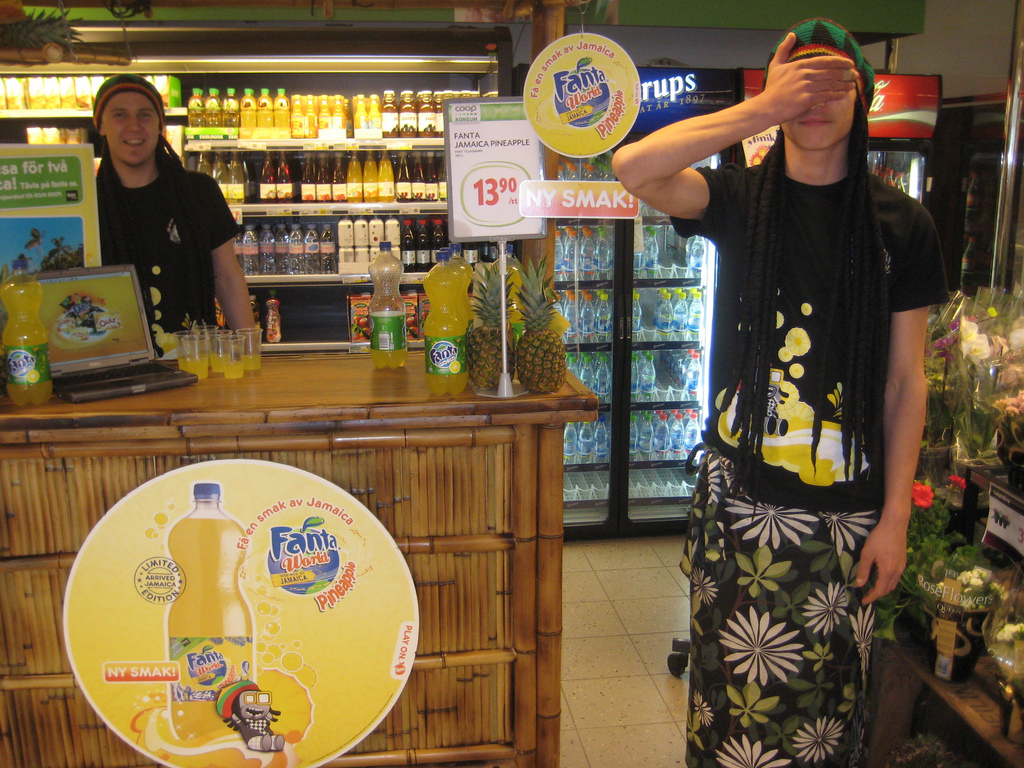
Birdseed sent in this photo he took at a grocery store in Stockholm (which he posted at his blog as well):

3487134506_c2b6058547_b1

The product is a new beverage, Fanta World Pineapple: Inspired by Jamaica. The two guys in the photo were hired to promote it at the little tiki-style counter. Johan says,

A couple of things leap out at me straight away:

* The continued (post-)colonial association of Jamaica with its plantation produce. The “inspiration” seems limited to the fact that pineapples are grown there for the consumption of the global North. (Canned goods like pineapples still have the charming moniker “kolonialvaror” (colonial merchandise) in Swedish retail jargon.)

* The ridiculous (verging on blackface) stereotypical representation of “Jamaicans” that the kids are suppsed to portray. It seems to have been done with extreme sloppiness – for instance, the Polynesian lava lava (a type of sarong) that they wear has absolutely nothing to do with Jamaica at all, but rather acts to represent an identity-less generalised tropics, dehumanised exotica.

The music was, of course, bad reggae.

I think Johan hits on an important issue here–how often the cultures of non-Westernized countries are mixed together into an undifferentiated image of exoticness–for instance, “tribal” fashion and “traditional” handicrafts often supposedly represent “Africa,” which is a meaningless category given the enormous diversity of cultures, languages, clothing styles, artistic motifs, and so on. But if you put some geometric designs and maybe an elephant on some cloth, it evokes “Africa.”

it’s also interesting that a certain hat shape and dreads have become such easily-identifiable shorthand symbols of Jamaica, and that Fanta is commodifying the idea of Jamaica to sell a product that has no reason to be more “inspired” by Jamaica than anywhere else pineapple is grown–Hawaii, Mexico, Costa Rica, etc. etc. etc.

Gwen Sharp is an associate professor of sociology at Nevada State College. You can follow her on Twitter at @gwensharpnv.

Ben O. sent in the video for “Take You There,” by Sean Kingston. Ben said, “The premise of Sean Kingston’s song ‘Take You There’ is that driving through slums is a great idea for a romantic date.”

[youtube]https://www.youtube.com/watch?v=axq1jQTk84w[/youtube]

My original thought, before I watched the video, was that maybe Kingston (who, according to Wikipedia, was born in Miami but mostly raised in Kingston, Jamaica) was trying to humanize the kinds of low-income neighborhoods that non-residents often believe are uniformly terrifying and that anyone who would venture there is going to their certain death. Or, if not that, maybe to show some of the horrid realities of living in economically devastated areas.

Then I watched the video. What struck me is how every resident is portrayed as glowering, threatening, and angry; they’re all the stereotype of the aggressive Angry Black Man.

The other thing that’s interesting is the gender elements. First, here are some of the lyrics:

We can go to the tropics
Sip piña coladas
Shorty I could take you there
Or we can go to the slums
Where killas get hung
Shorty I could take you there
You know I could take ya (I could take ya…)
I could take ya (I could take ya…)
Shorty I could take you there
You know I could take ya (I could take ya…)
I could take ya (I could take ya…)
Shorty I could take you there

Baby girl I know it’s rough but come wit me
We can take a trip to the hood
It’s no problem girl it’s my city
I could take you there
Little kid wit guns only 15
Roamin’ the streets up to no good
When gun shots just watch us, run quickly
I could show you where

As long you’re wit me
Baby you’ll be alright
I’m known in the ghetto
Girl just stay by my side
Or we can leave the slums go to paradise
Babe it’s up to you,
It’s whatever you like

So rather than having any real commentary on slums, the slums become a site to reinforce the idea that women should align with a man to protect them. The slums are just a backdrop for Kingston to impress a hot woman by being able to take her into an exotic world and keep her safe…from all the aggressive, mean Black men they encounter.

Ben continued,

My friend is traveling in Uganda and was reminded of this song when staying in Atiak, site of a gruesome massacre…His comment was: “I thought of Lam, who has dedicated his life to improving this place, to giving his people a future, and finally, of [Sean Kingston], whose highest ambition is to impress girls by taking them on a tour of places like Atiak. What a stupid song.”

Thanks, Ben!

Gwen Sharp is an associate professor of sociology at Nevada State College. You can follow her on Twitter at @gwensharpnv.