advertising

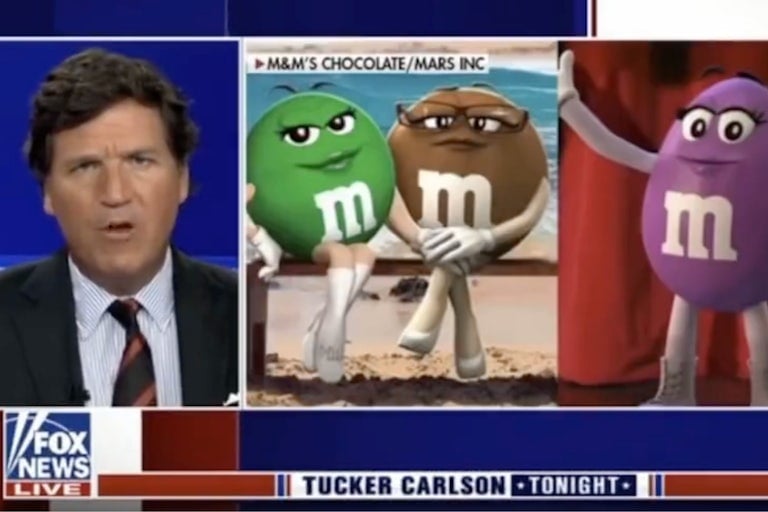
Over the course of the past year, M&M’s have been plastered all over the news, social media, and even Super Bowl commercials. In January 2022, Mars Wrigley gave the brown M&M shorter heels and replaced the green M&M’s boots with sneakers in a push toward more inclusive marketing. 

What resulted was outrage. Tucker Carlson became the face of the backlash, stating, “M&M’s will not be satisfied until every last cartoon character is deeply unappealing and totally androgynous.” Carlson was not the only one speaking out. In a Rolling Stone article titled, “Let the Green M&M Be a Nasty Little Slut,” senior writer EJ Dickson argues, “The green M&M has spent decades building her brand as a horny, sexy bitch, and for what? For her creators to give her Larry David footwear in the name of feminism?”

By September, the purple M&M had made her debut. Carlson soon reignited the war, leading to Mars’ temporary suspension of their spokescandies. On FOX News, he remarked, “The green M&M got her boots back, but apparently is now a lesbian maybe? And now there’s a plus-sized, obese purple M&M.” While all of these comments are nonsensical, they point to the pressure placed on women to conform to gender norms and accommodate men’s sexual desires.
Sexualization of Women in the Media

M&M’s were not the first nor the only gendered commercial food product. In the 1940s, the Chiquita Banana, the world’s first branded fruit, made her debut. The original Miss Chiquita Banana was racialized and sexualized in order to appeal to the American market. Her femininity, specifically, was oversexualized through her flirtatious winking and eye-rolling as well as her frilly dresses and lipstick. 

Smithsonian Magazine, Chiquita Banana’s Recipe Book, 1947
Photo courtesy of Christina Ceisel

M&M’s has long employed the same strategy by sexualizing their female spokescandies. Their hypersexualization not only appears in their dress, but the erotic nature of the commercials in which they have been featured. The green M&M has been pictured pole dancing, stripping, and fondling chocolate, among other overt sexual acts. What’s more, the male M&M’s can be seen ogling her in the background, reinforcing the pervasiveness of the male gaze, in which men actively view women as passive ‘objects’ of their sexual desires.

Emphasized Femininity

Emphasized femininity refers to a range of traditional feminine norms that encourage women to accommodate men’s sexual appetites and desire for control. It legitimizes the gender hierarchy and upholds various forms of oppression. 

As women step away from the “stereotypical cultural notions” of emphasized femininity, men must “negotiate the dilemma of incorporating women’s resistance into their masculine identity projects.” Therefore, when the female M&M’s became less conventionally attractive and “sexy,” those that subscribe to the ideals of hegemonic masculinity felt threatened. They became angry that their sexual desires were not being satisfied, even with regard to a candy mascot.

This outrage reveals that women face the prospect of being labeled “socially undesirable” when they possess masculine characteristics.

In Carlson’s words, “When you’re totally turned off, we’ve achieved equity.” In our patriarchal society, when a woman exhibits defiance or authority, men feel threatened unless they can stigmatize and feminize their behavior.

When this happens, a woman is no longer a “good girl,” but a “bitch,” “lesbian,” or “slut.” Evidently, for women to be valued by men, they need to be subservient to the male gaze.

Impact of Hypersexualization

The hypersexualization of women is incredibly harmful to young people. Adolescents’ exposure to a sexualized media environment leads them to recognize women as sex objects. When women and young girls constantly see their bodies objectified, they begin to internalize the idea that the most valuable thing about them is their body. They become acutely aware that they are seen as “sexual playthings waiting to please men’s sexual desires” and begin to feel unworthy if they do not meet society’s standards. It does not go unnoticed when children see that the very candy they eat is sexualized.

When people become outraged when a female M&M’s shoe is changed, what message does that send? Of course, a so-called “culture war” waged against M&M’s is ludicrous, but there is power behind words, and this controversy’s real-world implications must be addressed. The vicious cycle of sexualizing women, mascots or not, for profit must be brought to an end, and prominent figures need to realize that the oppression of others is not a punchline.

Jillian Nord is a sociology student at Hamilton College.
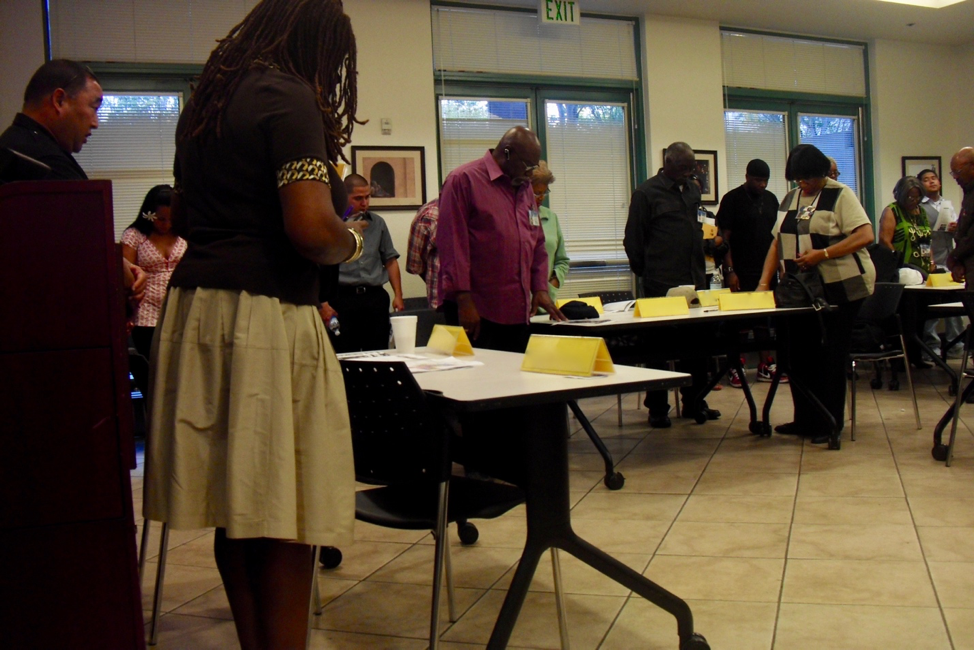
Community-police advisory board bowing their heads in prayer

We bowed our heads in prayer to mourn yet another loss. It was the third murder in a week. The police captain called a meeting together to develop collaborative alternatives to enforcement so the mostly Black and Latino civilian volunteers could get more involved in promoting crime control. Lakeside, where I was conducting research, is in the heart of South LA’s “Black Belt”. The neighborhood is characterized by high rates of gang crime and violence, extreme poverty, widespread resentment toward police and is the site of the most destructive riots in US history. “We have to take our community back!” one meeting participant said as his voice cracked from the tears and frustration welling up inside him. Agreeing that something had to be done, the captain broke us into groups to spitball ideas. One popular idea was to canvass the affected neighborhood. Volunteers would pass out business cards and encourage residents to call with information about the shooting.

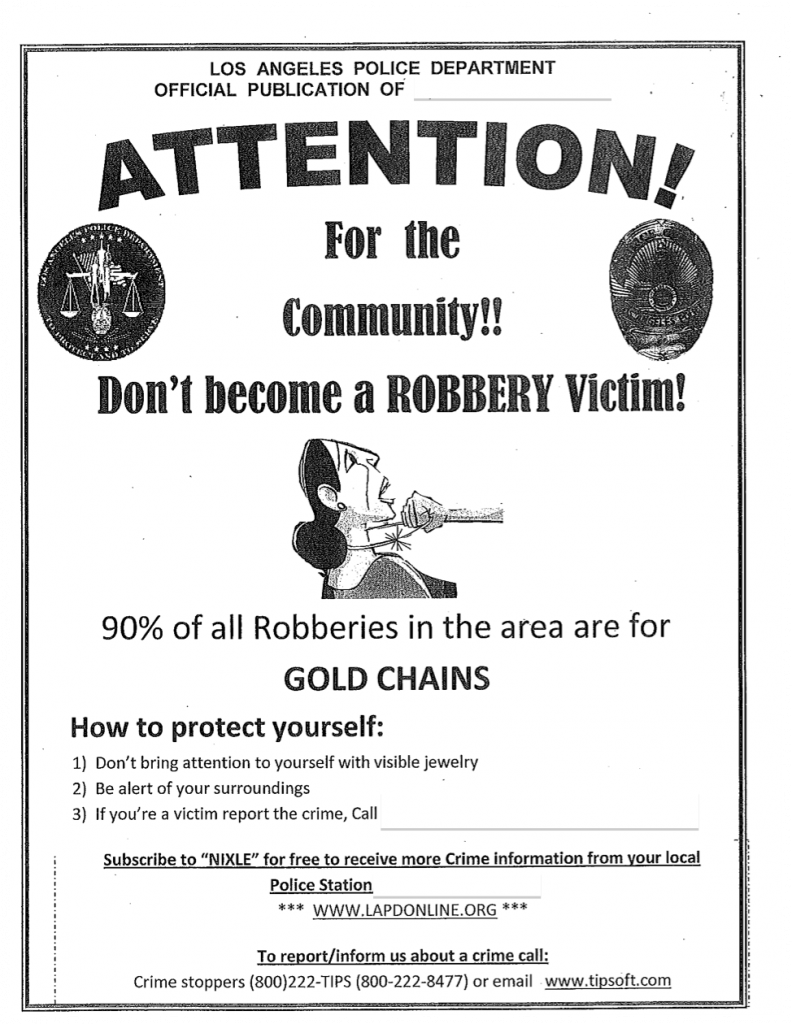
The cards that we handed out door-to-door were simple—bold lettering against a light background, the organization’s name and phone number, and a promise to protect anonymity—but they could also be socially impactful. Until then I was focused solely on power struggles in “community policing,” a post-riot policy that calls for greater civilian participation in law enforcement. Calling 9-1-1 is perhaps the clearest example of civilians “coproducing” social order. And canvassing with these cards only reinforced just how crucial civilian involvement is for law enforcement; their information and the lack thereof can directly shape case outcomes.

Then I started looking more closely at the cards and flyers that police and civilians passed around at community meetings. Visual rhetoricians look at textual and/or visual data and pick apart the “blocks of meaning” that authors arrange when composing documents such as flyers. Composition is a rhetorical act; its intention is to convince an audience. We can interpret these blocks on two registers, the presented and the suggested. The author presents a woman being robbed by an anonymous figure and frightened as a result. They explain how we, the audience, can change our daily routines to minimize our chances of being victimized and give us police contact information. Sociologist David Garland helps us see the suggested elements. He might point to this as an example of the new role of police as a key socializing institution, reflected here in the evocation of a specific outlook. Fear of crime today is at an all-time high; so high, in fact, that it far exceeds the realities of crime victimization in the US. This flyer gives us the sense, however, that crime is everywhere, every day, and that we ought to fulfill our civic responsibility to defend the community.

Drawing on over two years of ethnographic fieldwork and nearly two hundred documents, my new project, The Social Life of Flyers, seeks to understand what these artifacts do in community policing. Specifically, I seek to better understand the nature of flyers—their presented and suggested elements—and their bureaucratic functions beyond canvassing. My findings will reveal how police restrict rather than amplify civilian power in collaborative crime control. This work builds on my recently published coauthored book, The Limits of Community Policing, and can shape future ethnographic studies, research on police bureaucracy, and the craft of visual sociology.

Daniel Gascón is an assistant
professor of sociology at the University of Massachusetts Boston. For more on
his latest work, follow him on
Twitter.

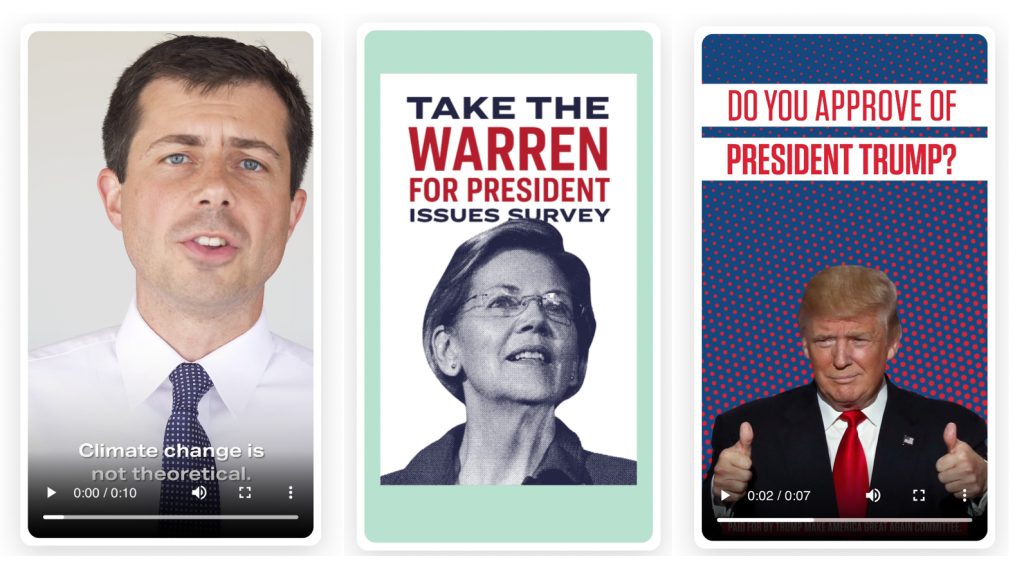
As the primary season heats up, the spotlight is back on political advertising and social media. Recent controversies over “fake” ads on Facebook raises questions about the ethics of campaign strategies that target voters with misinformation. It doesn’t help that many of these tech companies are not exactly transparent about processes for addressing biased or misleading content on their platforms.

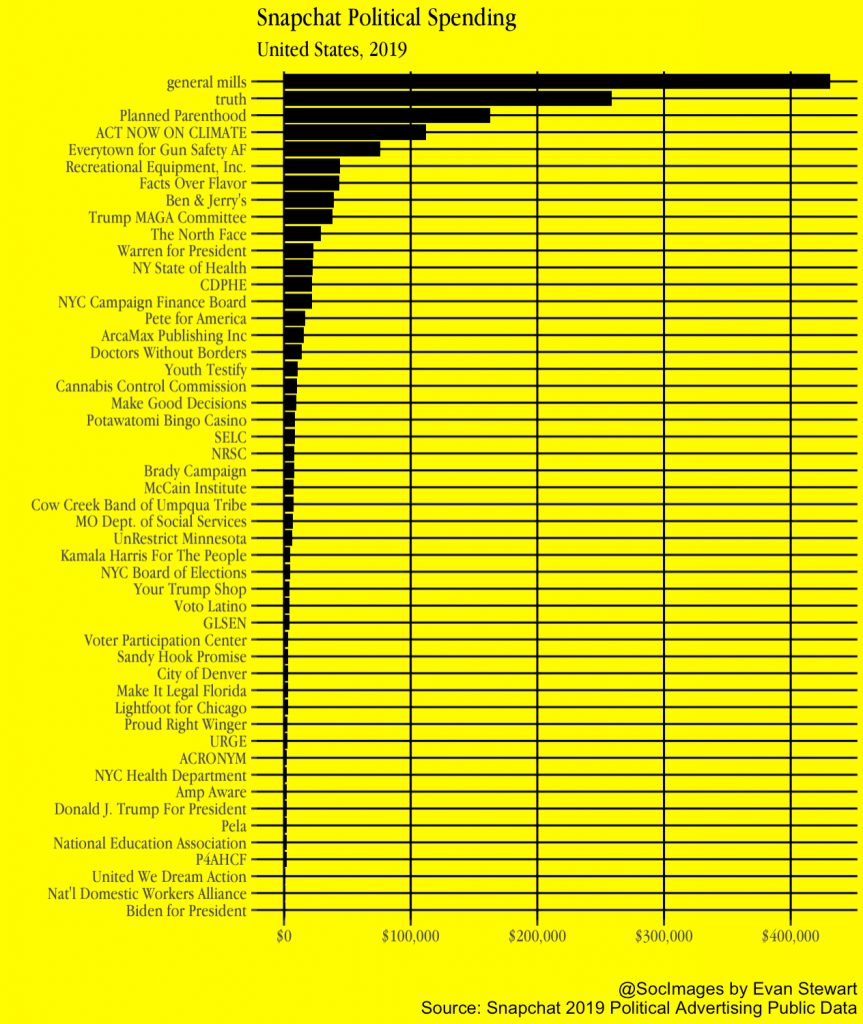
But now we can take little peak behind the digital curtain, because these sites are providing more information about who buys political ads. For example, Snapchat releases a public, full data file on their political advertising. Kudos to them! I took a look at the 2019 data to see where campaigns sit among the top fifty Snapchat spenders:

Some of the results are surprising. What on earth is General Mills doing buying political ads? It turns out they were part of a charity campaign partnership with groups like HRC. Other top spenders include public service announcements from advocacy groups like truth and Every Town for Gun Safety.

It looks like the Trump campaign has spent the most on Snapchat this year across two organizations: the MAGA Committee and Donald J. Trump for President. Among the Democrats, Elizabeth Warren sits at the top, followed by Pete Buttigieg, Kamala Harris, and way down at the #50 spot, Joe Biden.

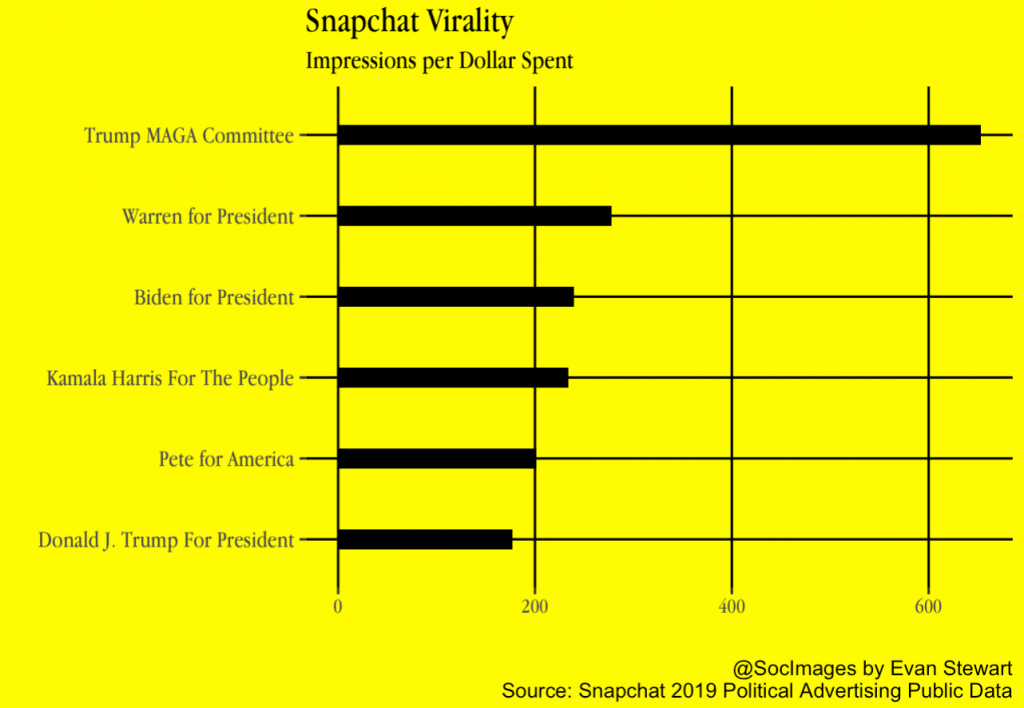
I also looked at how these ads break down for each of the major campaign groups. Snapchat provides the number of impressions each ad got, as well as how much it cost. Dividing the two lets us measure “virality” by looking at how many views each campaign gets for every dollar they spend on the platform.

These patterns follow the conventional wisdom that the Trump campaign gets a lot of “free” media for stirring the pot, because strong emotions (both positive and negative) drive higher attention. Lots of research in political sociology on the media shows why this happens. The patterns among Democrats also tell us a lot about who is investing in new media and targeting a younger audience through new platforms, as well as who is actually turning that investment into attention.

Evan Stewart is an assistant professor of sociology at University of Massachusetts Boston. You can follow his work at his website, or on BlueSky.