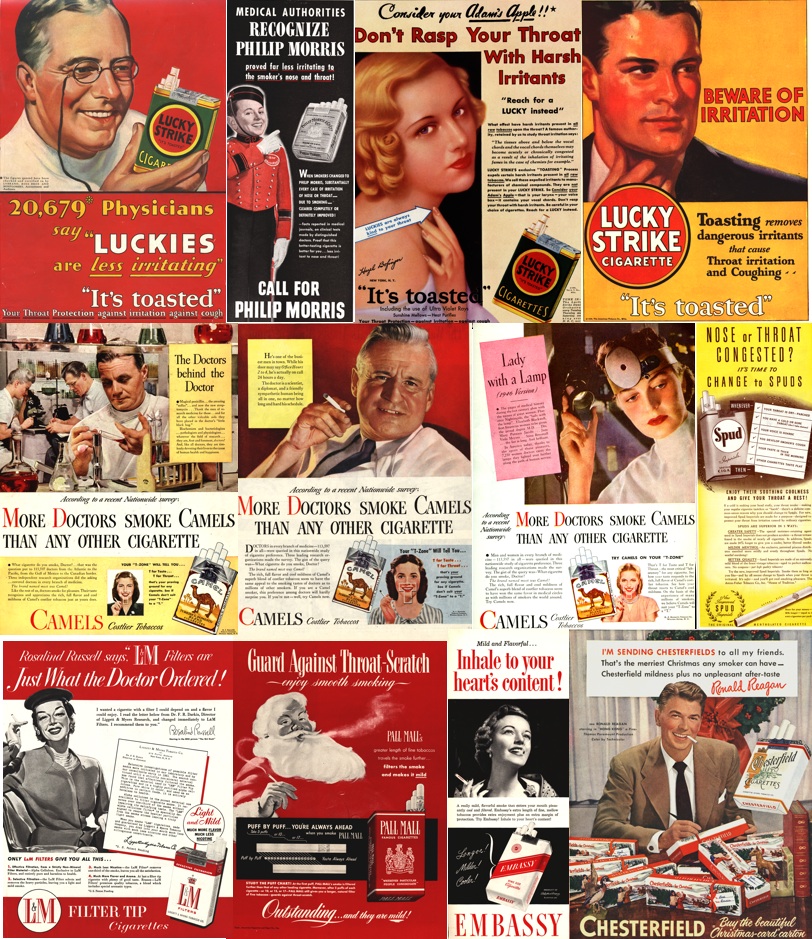
Smoking seems to be a theme this week. I just saw the Stanford School of Medicine’s online tobacco-ad gallery where you can view images by theme or brand. Fascinating.

tobacco-ad gallery flier

From the exhibit “Our intention is to tell—principally through advertising images—the story of how, between the late 1920s and the early 1950s, tobacco companies used deceptive and often patently false claims in an effort to reassure the public of the safety of their products.”

Tourism ad for Australia:

[youtube]https://www.youtube.com/watch?v=gQGMuxJ0vCc[/youtube]

Found here.

Lisa Wade, PhD is an Associate Professor at Tulane University. She is the author of American Hookup, a book about college sexual culture; a textbook about gender; and a forthcoming introductory text: Terrible Magnificent Sociology. You can follow her on Twitter and Instagram.

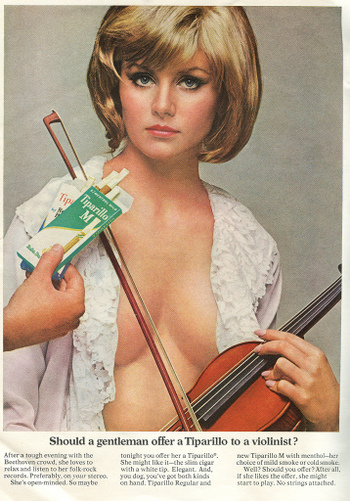
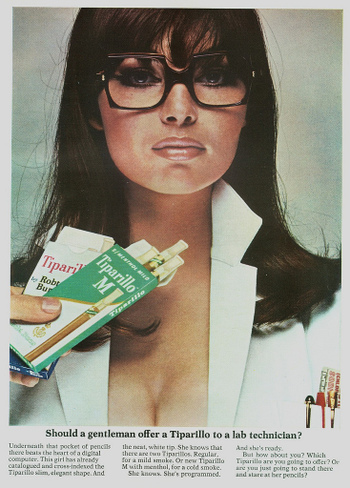
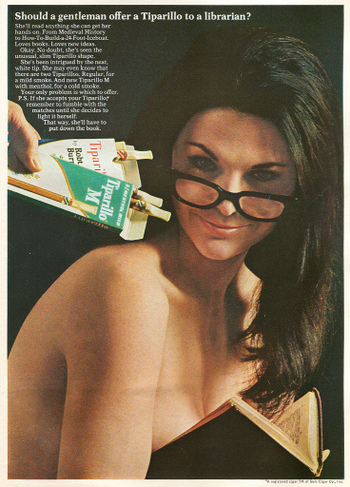
I found these vintage (1967-68) ads for Tiparillo cigars at Found in Mom’s Basement. All answer the question, “Should a gentleman offer a Tiparillo to…” a particular type of woman.

After a tough evening with the Beethoven crowd, she loves to relax and listen to her folk-rock records. Preferably, on your stereo. She’s open-minded. So maybe tonight you offer her a Tiparillo. She might like it–the slim cigar with a white tip. Elegant. And, you dog, you’ve got both kinds on hand, Tiparillo Regular and new Tiparillo M with menthol–her choice of mild smoke or cold smoke. Well? Should you offer? After all, if she likes the offer, she might start to play. No strings attached.

Underneath that pocket of pencils there beats the heart of a digital computer. This girl has already catalogued and cross-indexed the Tiparillo slim, elegant shape. And the neat, white tip. She knows that there are two Tiparillos. Regular, for a mild smoke. Or new Tiparillo M with menthol, for a cold smoke. She knows. She’s programmed. And she’s ready. But how about you? Which Tiparillo are you going to offer? Or are you just going to stand there and stare at her pencils?

She’ll read anything she can get her hands on. From Medieval History to How-to-Build-a-24-Foot-Iceboat. Loves books. Loves new ideas. Okay. No doubt, she’s seen the unusual, slim Tiparillo shape. She’s been intrigued by the neat, white tip. She may even know that there are two Tiparillos. Regular, for a mild smoke. And new Tiparillo M with menthol, for a cold smoke. Your only problem is which to offer. P.S. If she accepts your Tiparillo, remember to fumble with the matches until she decides to light it herself. That way, she’ll have to put down the book.

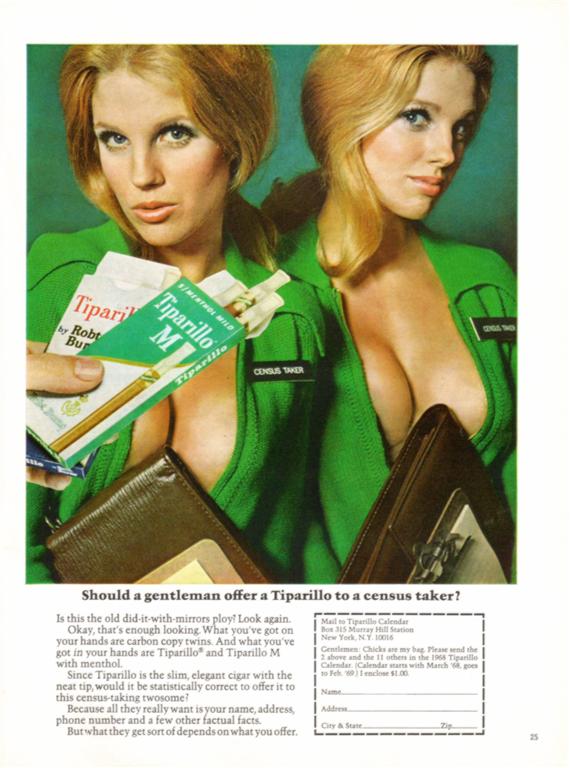
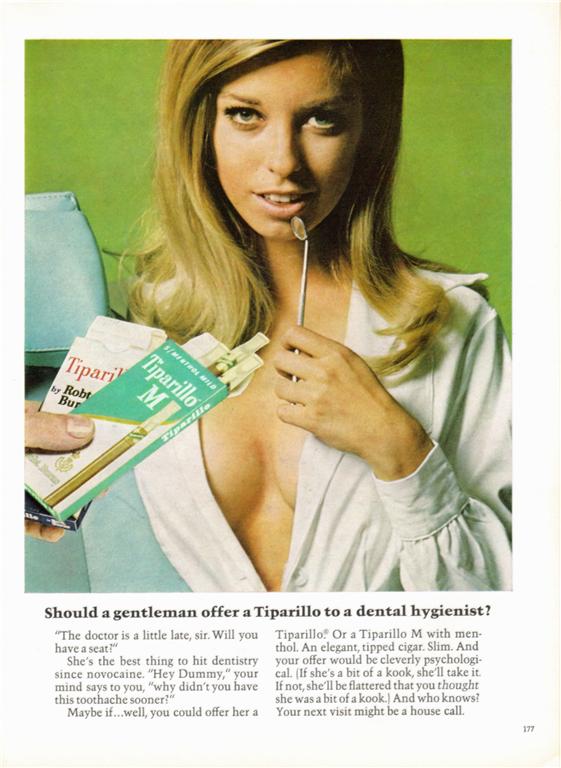
I found these next two on ebay (all these vintage ads can be purchased on ebay, it turns out):

Is this the old did-it-with-mirrors ploy? Look again. Okay, that’s enough looking. What you’ve got on your hands are carbon copy twins. And what you’ve got in your hands are Tiparillo and Tiparillo M with menthol. Since Tiparillo is the slim, elegant cigar with the neat tip, would it be statistically correct to offer it to this census-taking twosome? Because all they really want is your name, address, phone number and a few other factual facts. But what they get sort of depends on what you offer.

“The doctor is a little late, sir. Will you have a seat?” She’s the best thing to hit dentistry since novocaine. “Hey Dummy,” your mind says to you, “why didn’t you have this toothache sooner?” Maybe if…well, you could offer her a Tiparillo. Or a Tiparillo M with menthol. An elegant, tipped cigar. Slim. And your offer would be cleverly psychological. (If she’s a bit of a kook, she’ll take it. If not, she’ll be flattered that you thought she was a bit of a kook.) And who knows? Your next visit might be a house call.

I will lead it to you, dear reader, to decide if there was supposed to be anything else “cleverly psychological” in any of these ads.

The long-running Mastercard “Priceless” campaign follows the trope of putting prices on gifts, all of which are building up to an emotional state. The emotional state, which is assumed to be the culmination of one’s purchases, is labeled as “priceless,” but it’s pretty clear that the commercial equates the consumption of material goods with the emotional state. Therefore, the emotional state does indeed have a specific price tag.

[youtube]http://www.youtube.com/watch?v=0sPVppC6jxY&feature=related[/youtube]

The latest iteration of the “Priceless” series makes explicit the equation of intangible emotional expressions [of happiness] and material goods by showing a woman purchasing smiles, laughter, hugs and other expressions of satisfaction. The intangibles are made material and even buyable! Hmmm…What did that Beatles tune say…”Can’t Buy Me Love”?

Samantha J. brought me two brochures she saw at a doctor’s office the other day, one for Botox Cosmetic and one for Restylane. Here is the front cover of the Botox pamphlet:

I had seen the (ironic) “Freedom of Expression” tagline before (see here and here). But I hadn’t previously seen the “Men and women of all skin colors and ethnicities are enjoying the freedom!” line.

Here are two images found side-by-side inside the brochure:

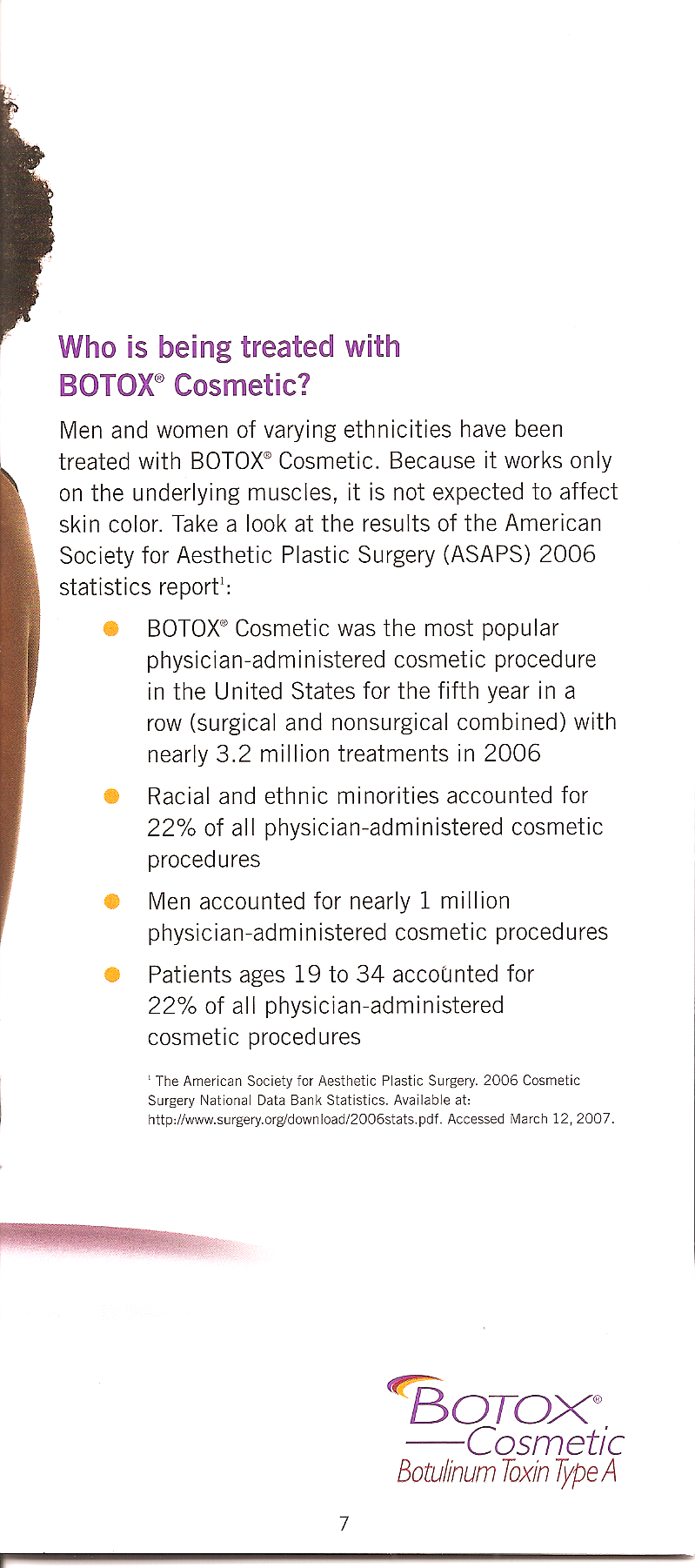
Notice the text under the question “Who is being treated with BOTOX Cosmetic?”

Men and women of varying ethnicities have been treated with BOTOX Cosmetic. Because it works only on the underlying muscles, it is not expected to affect skin color.

I had no idea there was any concern that Botox might affect skin color. Anyway, apparently Botox is making an active effort to market to “varying ethnicities,” represented in the brochure as White and Black.

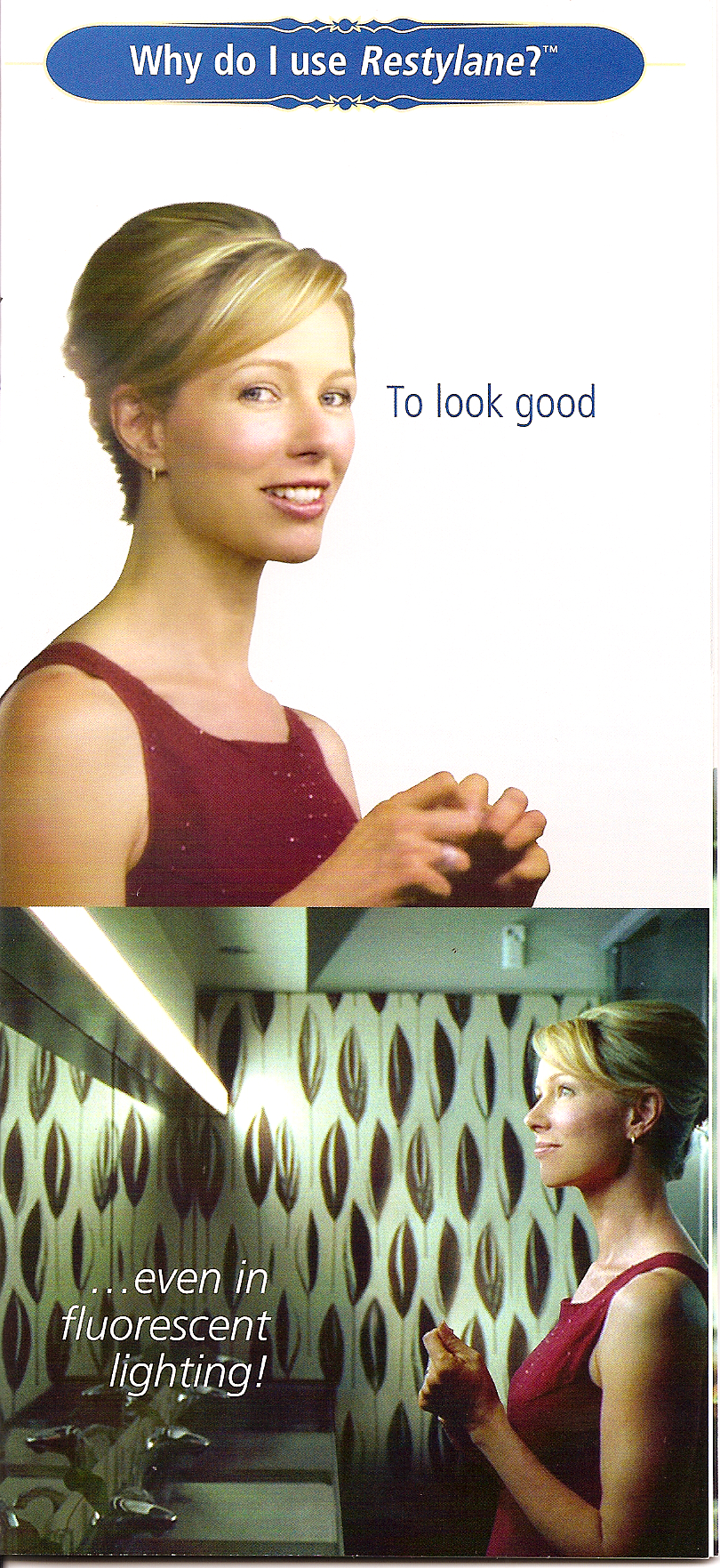
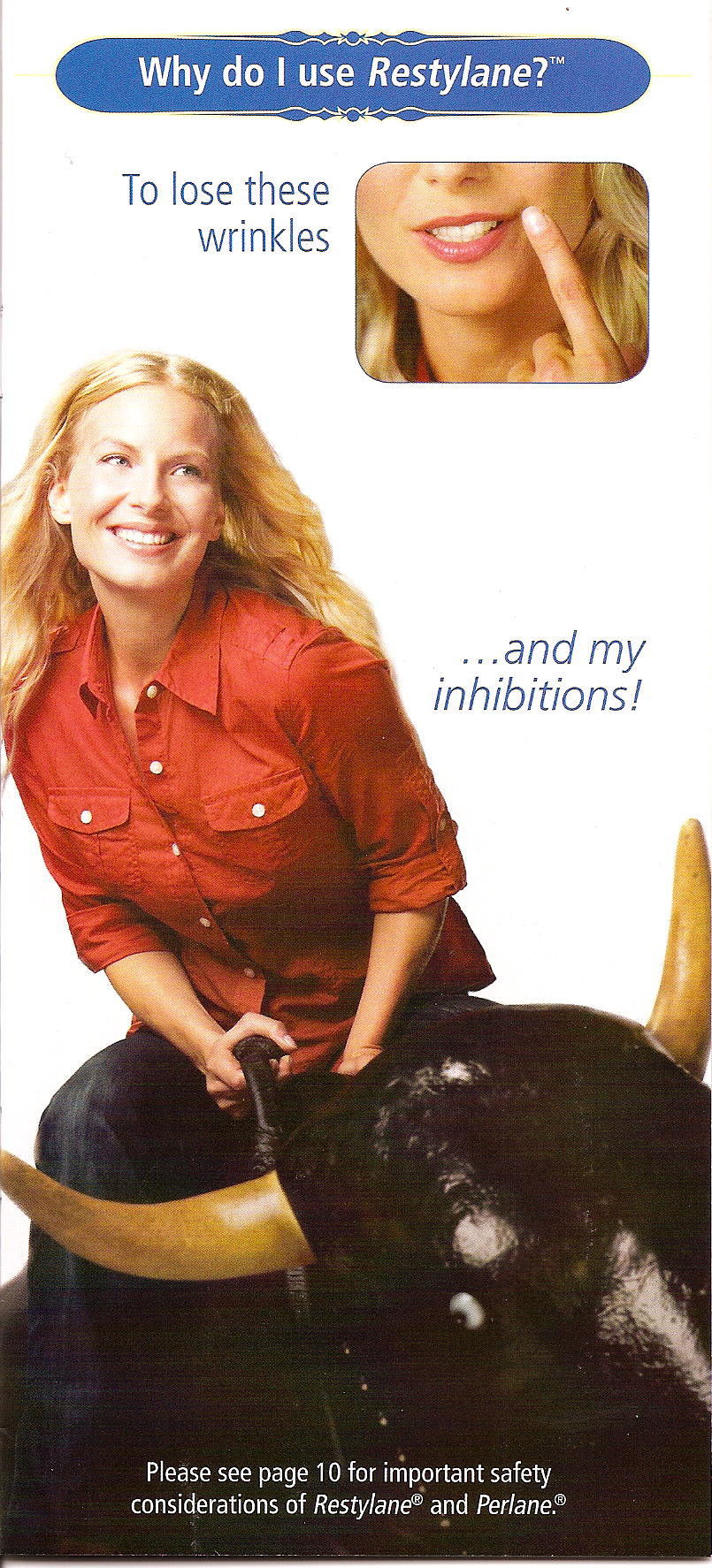
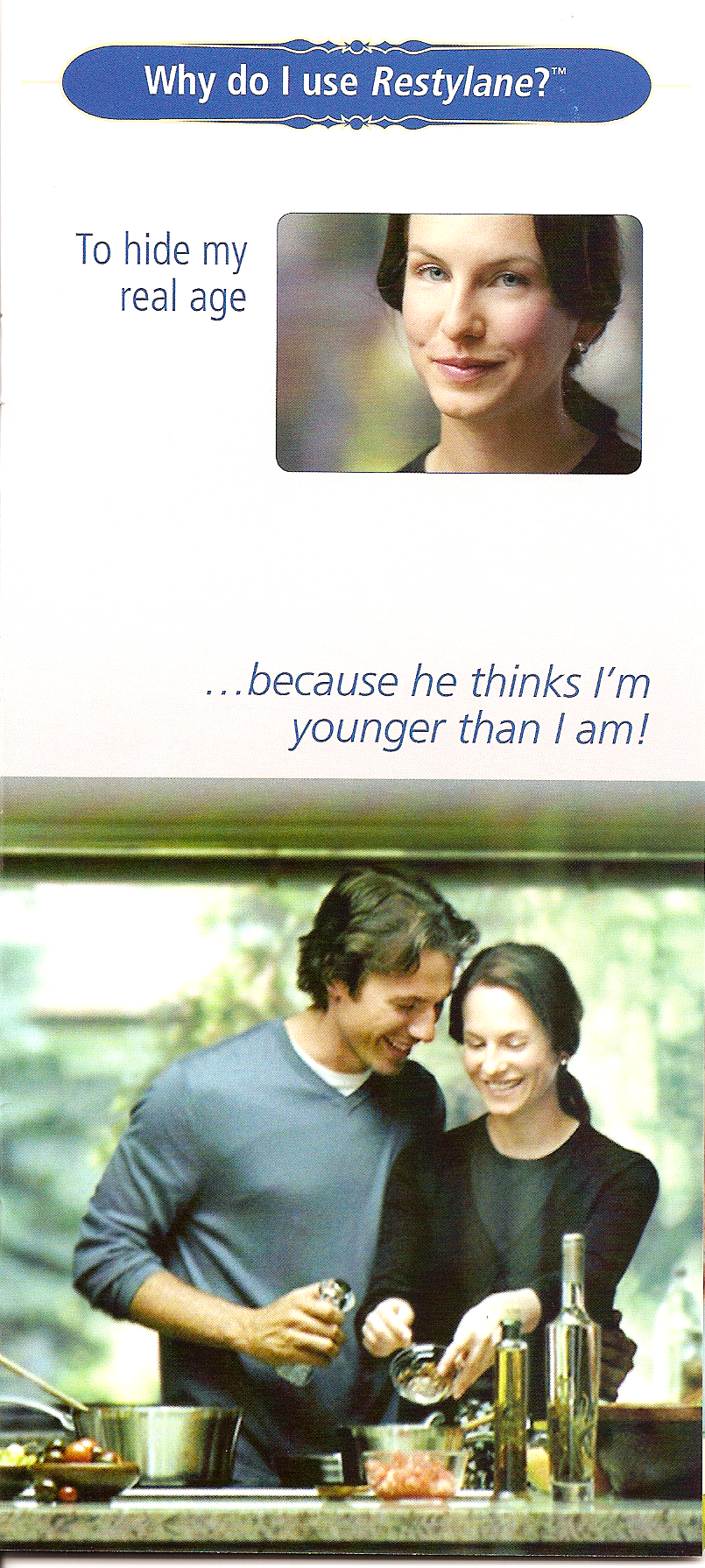
Here are three pages from the Restylane pamphlet, all answering the question, “Why do I use Restylane?”
“To look good…even in fluorescent lighting!”
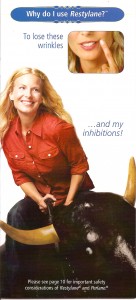
“To lose these wrinkles…and my inhibitions!” (Which apparently means riding a mechanical bull.)
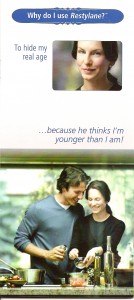
“To hide my real age…because he thinks I’m younger than I am!”

Honestly, those last two sound like parodies of how these procedures would be marketed. I don’t know which one creeps me out more: the connection between getting Restylane and being freed of inhibitions, or the complete normalization of the idea that a woman should lie to a man about how old she is (because what could make for a happier relationship than lying?) and spend money to keep him from finding out the truth, and that if he found out, he presumably wouldn’t love her anymore…not because she lied, but because she’s too old.

Apparently Restylane is not used by people of varying ethnicities, because everyone in the pamphlet is White.

I also think it’s really creepy that these brochures were available at a doctor’s office.

Thanks, Samantha!

Both men and women should be troubled by representations like this.  It is insulting to men, of course. But representations of men as childlike also contributes to the idea that men cannot be held responsible or accountable for bad behavior.  As I have explained elsewhere on this blog:

So long as we buy into the idea that we can’t expect men to be good partners or fathers, we will tolerate women’s responsibility for the second shift and their placement on the mommy track at work.

This extends, too, to not coercing women sexually, not cheating, and being partners and lovers who give as much as they receive.

This portrayal of men as children, idiots, animals  (see here and here), and monkeys perpetuates patriarchy, even as this perpetuation is disguised by the denigration of men.

I found this 1971 ad for Kenmore stoves over at Found in Mom’s Basement:

The woman says,

If you ever broke 14 nails cleaning an oven, you’d know why I want this new self-cleaning one. They say the Kenmore self-cleaning oven even gets the corners clean. You just set the dials. It locks itself and everything. And you know what a horrible job it is cleaning under the burners? No, I guess you don’t. Anyway, with this stove you just flip up the top and give it a wipe. The automatic timer on the oven’s great too. It’ll cook dinner even if I’m out shopping or something.

Her husband says,

That stove’s really put together right. And another good thing, you can sure depend on Sears service. Honey, you’re about to own a new stove.

We still frequently see this message–instead of getting men to share housework more equally, women should buy appliances that make their workload easier…and of course would need their husbands to pay for them. And then you should use it to cook for him, because that’s who it’s built for anyway.

Also…14 nails? Like, she broke all 10, grew 4 more in real quick (or put on 4 fake ones), and then broke them too? Or was she somehow using her feet and some of them were toenails? Burk says that part of the ad makes women seem whiny and as though they exaggerate the difficulties of housework.

I must be a disgusting human being, because the only time I ever worry about cleaning my oven is when I move out of a place I’m renting and have to if I want my deposit back. I’ve never noticed it being particularly disgusting, but then I put a tray under everything to catch drips.

Even though I can’t read the text, I thought this ad was worth putting up.  I think I get the gist of it just fine.

Via Vintage Ads.

Vintage Ads put up another example of an ad, this one from 1931, using the idea of the “savage.”  In this one, her “impossible” behavior is compared to an Electrolux refridgerator.

 NEW!  Vintage Ads offered us another on this theme.  The text reads: “make like a medicine man in Voodoo Shorts.”  Don’t miss the spear.

voodoo_shorts