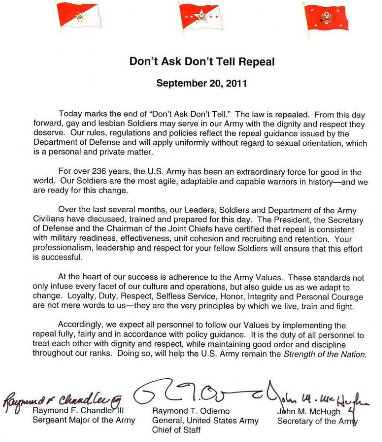
As of today, Don’t Ask/Don’t Tell, the U.S. policy that allowed gays and lesbians to serve in the military only as long as they kept their sexual orientation a secret, is officially over. In honor of this milestone, here’s the official letter from top Army commanders to soldiers announcing the end of the policy:

Via Joe. My. God.

NPR posted interviews with two men who worked hard for repeal, and it’s worth a read.

Carni K sent in an interesting story about Kellogg’s, the cereal company. Kellogg’s is suing the Maya Archaeology Institute (MAI), a non-profit Guatemalan organization aimed at protecting the local history, culture, and natural environment. Why? It uses a toucan in its logo.

For those of you who did not spend your youth eating highly sugared empty carbohydrates for breakfast, the toucan (specifically, Toucan Sam) is the mascot of Kellogg’s Froot Loops. The toucan is also a large-billed colorful bird indigenous to Central and South America, the Caribbean, and southern Florida.
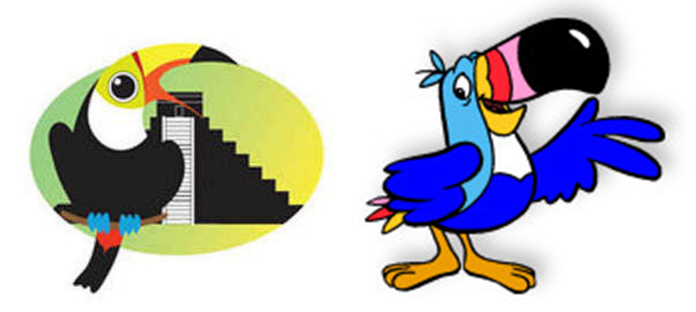
While this sort of cultural cannibalism is certainly common in American culture, it is a bold move nonetheless for Kellogg’s to not only appropriate the toucan, but to claim that no one else has a right to represent the toucan.  Dr. Francisco Estrada-Belli puts it this way: “This is a bit like the Washington Redskins claiming trademark infringement against the National Congress of American Indians.”

And therein lies the problem: who is allowed to claim the symbolic use of this bird—an indigenous Guatemalan organization or a company that makes cereal and other convenience foods marketed to children and families?

To me, this brings up another question: what gives any of us the right to use the toucan at all? While cultural representations of animals may not directly harm animals, and have been central in human cultures for tens of thousands of years, they can contribute to a particular perception of those same animals. And animal advocates know that perception then shapes treatment. If we perceive an animal to be dumb or trivial, for example, then that animal may not seem worthy of our concern.

Many types of toucans, for example, are endangered. Of the more than 40 species making up their family, 35 are included on the International Union for Conservation of Nature red list, meaning that they are either endangered, threatened, or otherwise subject to concern.  Their troubled status comes not from people hunting or eating them, but from the increasing levels of habitat destruction in the tropical regions in which they live… which brings us back to the Maya Archaeology Institute.

The organization’s mission includes protecting Guatemala’s rainforests, including the animals and plants that live there. Kellogg’s, on the other hand, has made the toucan into a funny bird whose large nose lets him sniff out Froot Loops wherever they are hiding.

Who should have the right to represent the toucan?  Anyone?

——————————

Margo DeMello has a PhD in cultural anthropology and teaches anthropology, cultural studies, and sociology at Central New Mexico Community College. Her research areas include body modification and adornment and human-animal studies.

If you would like to write a post for Sociological Images, please see our Guidelines for Guest Bloggers.

In a previous post I discussed data showing the growing income inequality in the U.S.: the middle class is shrinking, the poor are getting poorer, and the rich are getting richer. It turns out that corporations understand what is happening and they are responding.  In brief, they are letting go of the middle class as a market and restructuring their offerings to appeal to the top and bottom of the income distribution.

Below the jump (warning, it automatically starts playing with sound) is an enlightening five minute discussion of this new business strategy on Daily Ticker video:

more...

American Public Media’s Marketplace posted a short animated video summing up the potential problems with health care as an economic development strategy. Many cities are building large, fancy medical facilities with the hopes of drawing “medical tourists,” patients from other areas who would travel to receive care at state-of-the-art facilities, thus creating jobs and injecting money into the surrounding community. Given that we hear that the need for health care providers will grow greatly in the future, this seems like a risk-free plan. But as the video shows, these development strategies can lead to over-supply of services and increased overall cost of health care, without the promised benefits to local economies:

Oh The Jobs (Debt?) You’ll Create! from Marketplace on Vimeo.

For another example of economic development fads that don’t necessarily pay off, see our previous post about sports stadiums.

Last week guest blogger Christina Barmon posted health promotional material from 1922 that emphasized physical fitness for boys and men and grace for girls and women.  She concluded suggesting that such associations were still out there.

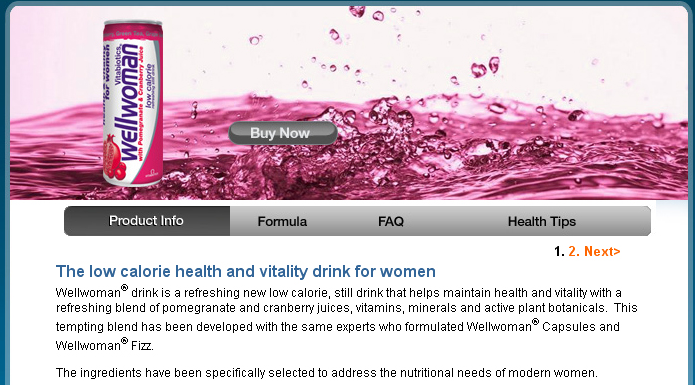
Indeed. Katrin, Greta P., and Sophie J. sent in a nice, succinct example of the divergent expectations for men’s and women’s bodies around today.  We know, if we’re well-socialized, that women are supposed to be thin and men are supposed to be athletic.  And, here, in this ad posted in the London Underground for Wellwoman and Wellman “sports” drinks, the message comes through loud and clear.

Wellman for “high performance health & vitality”:

Wellwoman “low calorie” drink:

Lisa Wade, PhD is an Associate Professor at Tulane University. She is the author of American Hookup, a book about college sexual culture; a textbook about gender; and a forthcoming introductory text: Terrible Magnificent Sociology. You can follow her on Twitter and Instagram.

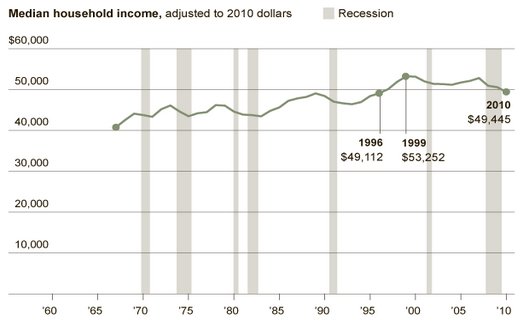
The Census Bureau just published new data revealing trends in living standards as of 2010.  The trends are troubling to say the least. Median household income (adjusted for inflation) fell to $49,445.  That means that the median household now earns less than it did a decade ago.  This marks the first decade since the Great Depression without an increase in real median income.

According to Lawrence Katz, a labor expert and Harvard economist:

This is truly a lost decade.  We think of America as a place where every generation is doing better, but we’re looking at a period when the median family is in worse shape than it was in the late 1990s.

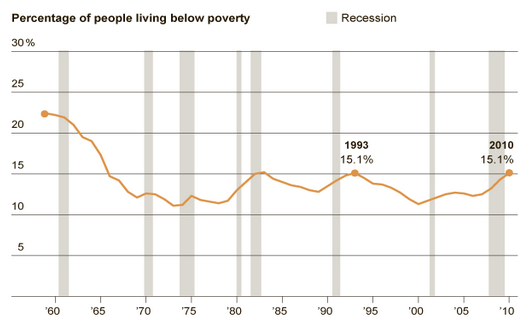
The percentage of Americans living in poverty hit 15.1 percent, the highest percentage since 1993.  There are now 46.2 million people living below the poverty line, the greatest number ever recorded by the Census Bureau. Child poverty stood at 22 percent.

Things are unlikely to get better this year.  State and local governments are slashing employment and programs and the federal government is now moving into cutting mode itself.

This depressing situation is not simply a recession phenomenon.  As the New York Times reports, the expansion period of 2001 to 2007 “was the first… on record where the level of poverty was deeper, and median income of working-age people was lower, at the end than at the beginning.”

Of course, while the great majority of people are struggling, a small minority have been doing very well.  One consequence, as the chart below highlights, is a strong growth in inequality (as measured by the Gini coefficient with higher numbers reflecting greater inequality).  As I noted in a previous post, over the years 2002 to 2007, the top 1% of households captured 58% of all the income generated.

inequality-2.jpg


In brief, there is a small minority that is doing very well and a great majority that is struggling, with a significant number in free fall.

Media depictions of trans people (almost entirely produced by non-trans individuals) tend to be fascinated by bodies. Since the (presumed) inappropriately gendered body is automatically monstrous, weird — or at the very least, available to be gawked at — the accessibility of trans bodies becomes a feature of their depiction.

A big thread that runs through most visual media depictions is a fixation on stripping trans people naked, implying the naked body as “true.” The Crying Game’s big reveal comes when Del undresses, while the penultimate moment of self-fulfillment for Bree in Transamerica is represented by her naked in the tub, touching her vagina. Pre-op Bree’s “parts” trap her in-between, as the movie poster so helpfully informs prospective audiences—without surgery, she’s “really” just a man in a dress.

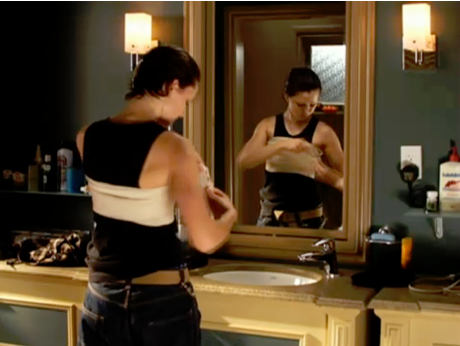
Chest surgery fills much the same function for images of trans men. The body-centrism was so prevalent in the recently released Becoming Chaz, the documentary following Chaz Bono’s transition, one critic titled his review: “About a Boy or About a Body?”  We see a similar interest in trans-bodies in Boys Don’t Cry and the teen soap Degrassi:

(Still shot from film Boys Don’t Cry. Courtesy of Fox Searchlight Films)

(Still shot from Degrassi. Courtesy of Alliance Atlantis)

In all of these cases, the trans person’s emotional and social existence is tied to the state of their body. Bree can’t possibly be fulfilled until she’s had surgery and can strip naked in front of an audience. Bono can “really” be a man only after top surgery and he can go shirtless. Most importantly, trans people appear to have no life outside of their body, and their transition sometimes forms a narrative arc of beginning (bad body), middle (fixing the body), and end (good body).  They are allowed to be a part of the story only as a person transitioning, their trans-status overwhelming everything about them that makes them unique individuals with complex personal stories.

——————————

Avery Dame is currently a master’s candidate in American Studies at the University of Kansas, where he studies media depictions of trans folks and trans vloggers on YouTube. He also blogs at the improbably named Ping Your Spaceman.

If you would like to write a post for Sociological Images, please see our Guidelines for Guest Bloggers.
 

Mary Nell Trautner — University at Buffalo, SUNY — has developed a fantastic new Course Guide for instructors teaching Sociology of Gender. We hope you think it’s as awesome as we do!

Gwen is also hard at work on her Introduction to Sociology Course Guide.

See our Instructors Page for more info on writing Course Guides and other useful stuff.