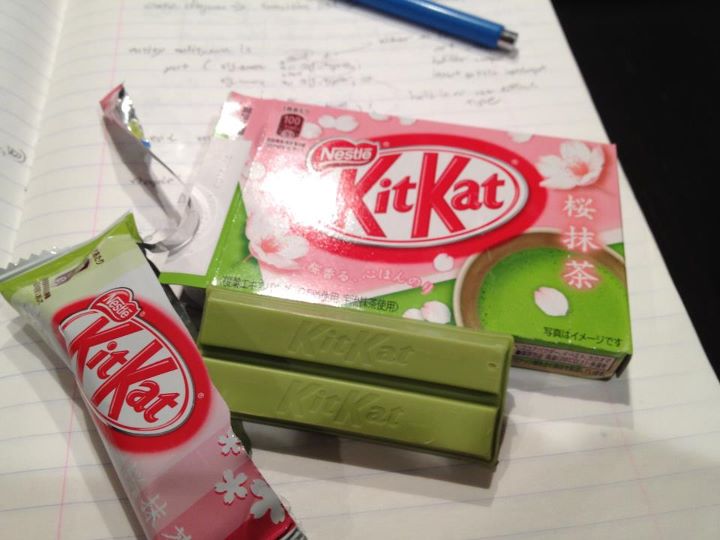
Here’s a fun one for our series on the social construction of flavor!

See also:

And the list wouldn’t be complete without our Jell-O posts:

Lisa Wade, PhD is an Associate Professor at Tulane University. She is the author of American Hookup, a book about college sexual culture; a textbook about gender; and a forthcoming introductory text: Terrible Magnificent Sociology. You can follow her on Twitter and Instagram.

In this 8 1/2 minute talk, sent in by Dmitriy T.M., AJ Jacobs recounts his efforts to perfectly follow every single piece of health advice he encountered.

Lisa Wade, PhD is an Associate Professor at Tulane University. She is the author of American Hookup, a book about college sexual culture; a textbook about gender; and a forthcoming introductory text: Terrible Magnificent Sociology. You can follow her on Twitter and Instagram.

In “Portraying Tiger Woods: Characterizations of a ‘Black’ Athlete in a ‘White’ Sport,” Andrew Billings discusses how race plays a role in sports commentators’ evaluations of golfers, and particularly in how they describe and comment upon Tiger Woods. A content analysis of 37.5 hours of coverage of golf tournaments between April and August of 2001 by CBS, NBC, and ABC, during which 2,989 evaluative comments occurred, revealed patterns in how sportscasters described Tiger Woods compared to other golfers. When he was losing, Woods was more likely than other golfers in the same position to be described as lacking composure or concentration, of “self-destructing,” and of lacking control over his emotions. Overall, Billings found that the types of language other students have found to be applied to Black athletes were applied to Woods only when he was losing. When he was doing well, commentators did not significantly stereotype Woods.

The study is interesting in light of a video sent in by Jason Eastman. This Wall Street Journal segment discusses the results of a study that investigated how media depictions of college quarterbacks’ performances. A recent study published in the Academic of Management Journal found that media coverage rarely gave African American quarterbacks credit for leadership. When their teams do well, it is because of their natural athletic talent; when they do poorly, it is lack of leadership — blame not equally placed on White quarterbacks when their teams do poorly. So Blacks are blamed more for losses but get less credit for successes — an outcome of stereotyping that has disturbing implications for hiring and promotion in the workplace (sorry for the ad):

Full cites:

Andrew Billings. 2003. “Portraying Tiger Woods: Characterizations of a ‘Black’ Athlete in a ‘White’ Sport.” The Howard Journal of Communications 14: 29-37.

Andrew Carton and Ashleigh Shelby Rosette. 2011. “Explaining Bias against Black Leaders: Integrating Theory on Information Processing and Goal-Based Stereotyping.” Academy of Management Journal 54: 1141-1158.

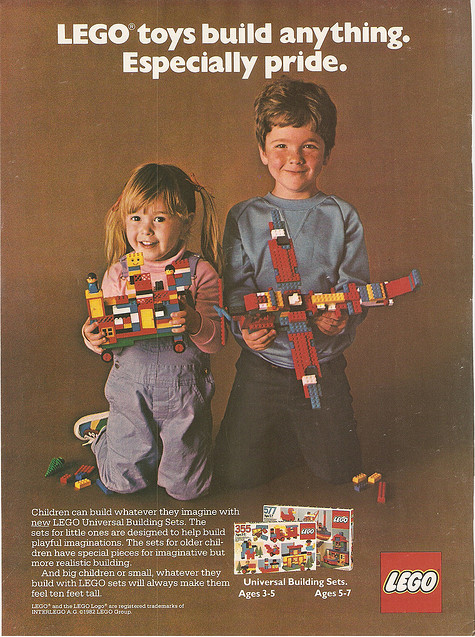
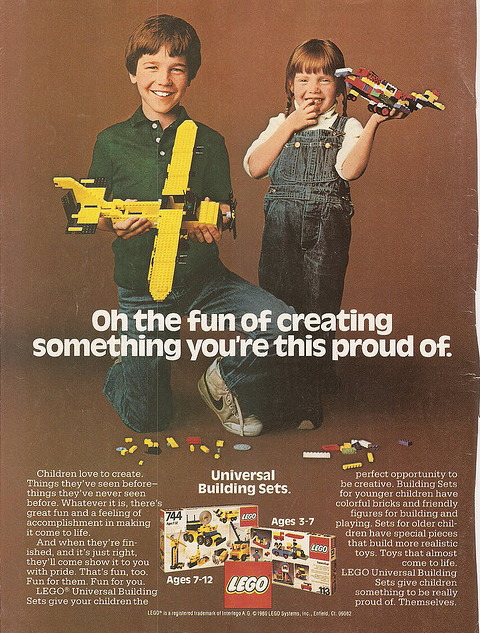
After the recent scandal over LEGO Friends, I am excited to report that I am in the process of working with a LEGO “fanatic,” David Pickett, on a series of posts about gender and the history of LEGO.  In the meantime, as a teaser, I wanted to offer you two LEGO ads that were from the same campaign as the one making its semi-viral way around the internet (1980-1982).  As with the original, these are evidence that advertising doesn’t have to reproduce the idea of “opposite sexes”:

Thanks to Moose Greebles and his Photostream.

Lisa Wade, PhD is an Associate Professor at Tulane University. She is the author of American Hookup, a book about college sexual culture; a textbook about gender; and a forthcoming introductory text: Terrible Magnificent Sociology. You can follow her on Twitter and Instagram.

Cross-posted at Montclair SocioBlog.

What we don’t talk about when we don’t talk about class.  That was the title I wanted to use, but it was too long, and besides, there are already too many of these Raymond Carver variants.

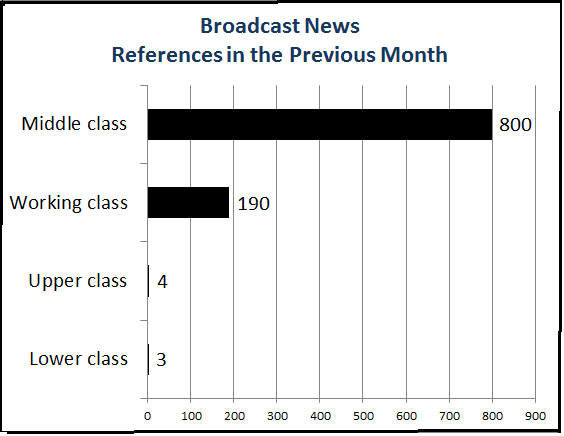
Class seems to have disappeared from public discourse, except for the Republicans’ insistence that to mention inequality at all is to engage in “class warfare.” The only class we hear about, whether from politicians or the media, is the middle class.  Here, for example, are the results of  a Lexis-Nexis search of news transcripts in the previous month.

On TV news, the upper and lower class do not exist.

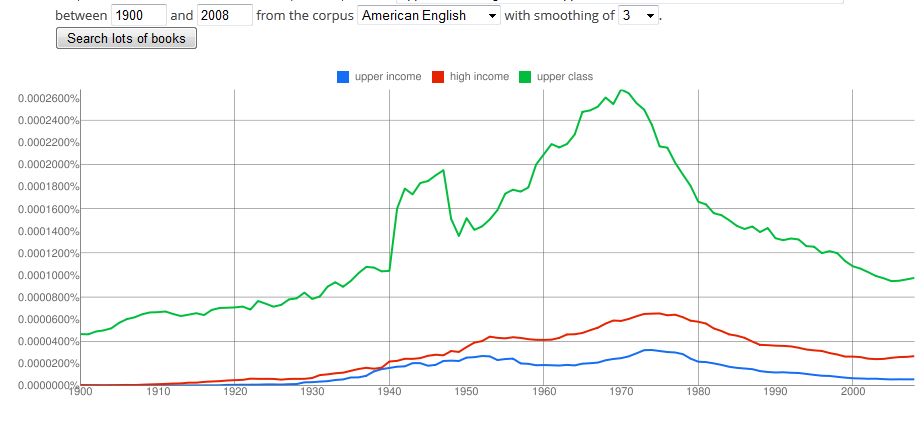
So how do we talk about those at the top and bottom of society?  The discussion of inequality is now all about income.   While “lower class” and “upper class” had only three and four mentions, respectively, in this same period, income terms (high, upper, low, lower) numbered over 300.

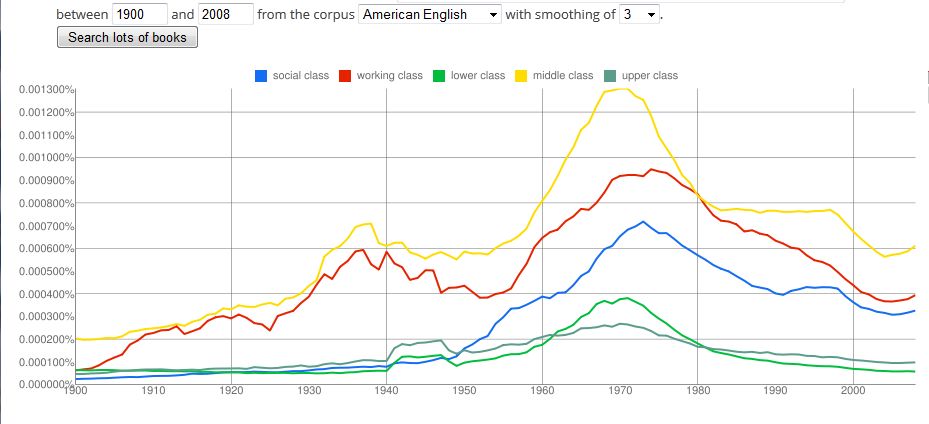
For some historical perspective, I looked at Google Ngrams for the frequency of class terms in books.

The pattern for upper class is similar — a large decline in class talk, a much smaller decrease in income talk — though class references still outnumber income references.

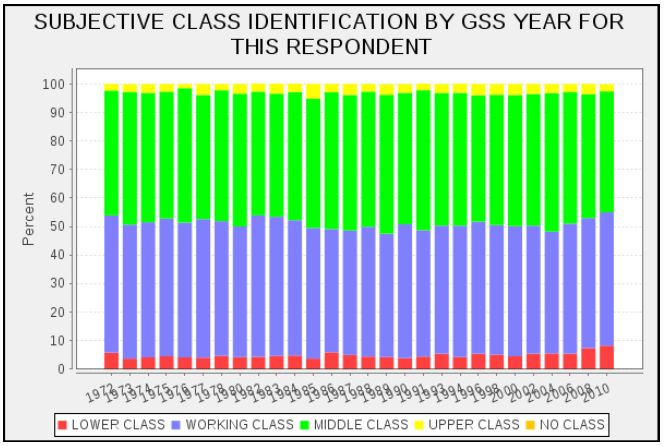
From the media, you get the impression that except for a handful of people at the top and the bottom, there really is only one class in America — the middle class — and that the working class has faded into history.  Yet the GSS subjective social class item (“Which class would you say you belong in?”) gets the same results as it did in 1972: a roughly equal split between “middle” and “working” that accounts for 9 out of 10 Americans.

Dr. Bethany Pope sent in a segment from a National Geographic show about animals’ sexual behavior. The clip is an amazingly gendered discussion, describing animals’ motivations and behaviors through the lens of what is considered normative masculine and feminine sexual behavior, the correct place of males and females in the social hierarchy, and the assumption that males and females are locked in a zero-sum game. The anthropomorphizing of other species begins at the outset, when we learn female hyenas want “more than equal rights, they want to beat males at their own game.”  In fact, “Africa’s plains are among the most macho places on earth…they’re testosterone-fueled battlefields,” filled with “swaggering” males. Bethany sums up the tone regarding hyenas, saying, “The documentary presents them as an abomination, usurping male gender roles.” Indeed, at about a minute in we learn that hyenas “seem mixed up.” A hyena “swaggers,” “confident” and “cocksure,” its penis swinging “low and proud.” But what’s this? The swaggering, cocksure hunter “has a secret”! That’s not a penis, it’s an enlarged clitoris; our hero is a she! Not only that, there’s not a penis anywhere to be found, as this is an all-female pack; “these female are some of the most masculine in the world — and they like to sniff each other an awful lot, too. Compounding the “confusion,” they have a “bulging” sac, like a scrotum. And not only are female hyenas masculinized, but the poor males are emasculated, reduced to being “subservient, servile, and scared.” It is rather stunning example of anthropomorphizing the natural world and applying gendered norms of sexuality to other species, and worth sitting through the full six minutes to get the full effect (the video might not be safe for some workplaces; there are a lot of lingering shots of penises and clitorises. A lot.):

Gwen Sharp is an associate professor of sociology at Nevada State College. You can follow her on Twitter at @gwensharpnv.

In an interesting article at Slate, Libby Copeland observes that Ron Paul has disproportionate support from young people and men.  Why?  She cites political scientists explaining that young people, on average, think in more black-and-white terms than older people:

…age and newness to politics predispose young voters to a less nuanced view of the political world. They’re less likely to take the long view, less likely to have patience, less likely to spin out the implications of their political theories.

Ron Paul does, indeed, articulate a straightforward ideology, especially compared to the other candidates.

Copeland doesn’t do as good of a job of explaining why men tend to like him more than women.  I wonder, though, if it maybe has something, just a little bit, to do with his branding.  Consider this ad:

This ad is a clear adoption of masculinity and a strong rejection of femininity (symbolized by the Shih-Tsu and its supposed weakness).  In this sense, his ad is centrally in the genre of ads designed to associate products with MEN, partly by the deliberate exclusion of women and mocking of anything feminine.

It seems to me that Paul has decided to double down on his appeal, focusing on the market that he thinks is most likely to support him, and throwing everyone else out along with the social programs.

Thanks to Letta and Alex for sending along the article and commercials!

Lisa Wade, PhD is an Associate Professor at Tulane University. She is the author of American Hookup, a book about college sexual culture; a textbook about gender; and a forthcoming introductory text: Terrible Magnificent Sociology. You can follow her on Twitter and Instagram.

Originally posted at Shameless.

Marilyn Monroe is often held up as the antidote to the idea that only thin can be beautiful. “Marilyn was a size 10/12/14,” goes a common refrain (though sizing basically means nothing these days, so what does that even prove?). There have been a couple Marilyn Monroe memes floating around Facebook in the past couple months, and both are troubling. The focus is on Marilyn’s curves, and how her swimsuit clad body is different from what movie stars look like today (oh, the tyranny of the “Best Beach Bodies!” issue). What’s supposed to be an empowering message to women – you don’t have to be a Victoria’s Secret model to be beautiful – is completely undermined by two much older memes: divide and conquer and the male gaze.

In the first photo, Marilyn is compared to another woman in a bikini, who is much thinner. The text reads: “This [pointing to Monroe] is more attractive than this [pointing to the other woman].” While I can totally get behind the title “fuck society,” and add “and its stupid expectations” for good measure, there’s nothing anti-establishment about what’s being done here. This is a common tactic, in which women are pitted against each other, so that we lose sight of the real problem: namely, society. If women are fighting amongst ourselves about who is more “beautiful,” if we compare ourselves to other women endlessly, we don’t have time to notice that we’re trapped in a hamster-wheel of low self-esteem. Society hopes that you’ll buy things, to try and make yourself feel better. In the meantime, it’s hoped that we as women won’t critically examine what beauty is, what’s being sold to us, and most importantly, who profits from all this. Fuck Society, sure, because society tells you that if you’re not extremely thin, you’re worthless. However, extremely thin women? They’re still people. Further, bodies are just bodies. They have no intrinsic worth, no moral value, other than what we assign them. The thought behind this comparison photo is to turn the dominant paradigm on its head, but what it really does is reinforce that for one woman to be good, another must be bad. And that kind of thinking isn’t going to get us anywhere.
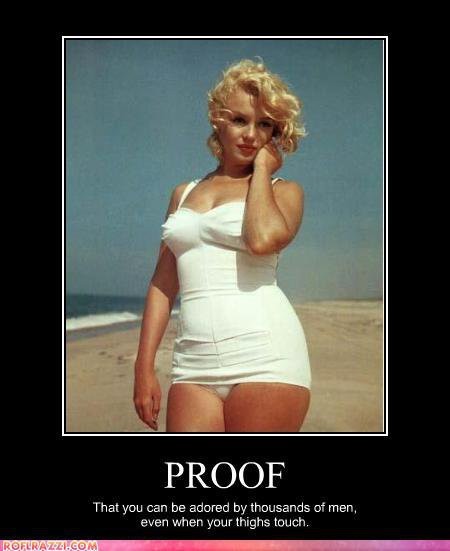
The second is the same photo of Marilyn, this time alone in the Motivational Poster style. The text reads: “PROOF: That you can be adored by thousands of men, even when your thighs touch.” From the start this would seem like a better message. No comparison photo, no pitting women against each other. For some reason, though, this photo troubles and angers me more than the first one does. Because here’s the thing: you are worth more than what men think of you. Marilyn Monroe was, to put it mildly, very sad, very often. She was a sex symbol, and thus, stopped existing as human being, a regular girl. Almost everything that fucked up Marilyn’s later life had to do with being “adored” by men. Men used her, or deified her (and that’s a hard come-down for those dudes when they found a human being in their bed the morning after). Political brothers purportedly passed her around like a toy. Conventional wisdom, political conspiracy aside, has it that Monroe killed herself. Being “adored by thousands of men” didn’t stop her demons from consuming her. It angers me to no end that, again, in the name of self-esteem we’re going to make a poster girl (literally) out of a woman who was notoriously down on herself.

I want very much for us to stop thinking that there is only one body type that is acceptable. I would prefer the focus be on health, rather than appearance. The Monroe Meme seems about the furthest thing from healthy. This is a woman who abused alcohol and sleeping pills later in her life, this is a woman who (probably) died due to depression. But, hey, as long as someone thinks she looks good, I guess that’s what matters.

Heather Cromarty has written for The Walrus Blog, and writes about books and bookish miscellany at In The Midst of Life, We Are in Debt, Etc. Follow her on Twitter: @la_panique.