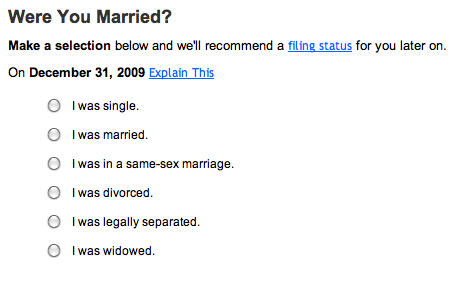
Amanda S. took a screen shot while doing her taxes online at Turbo Tax.  The program asks if the filer is married or gay married:

What a fascinating moment in U.S. history.  In some states a person can marry someone of the same sex, in others they cannot.  Tax programs trying to help people file their federal and state taxes need to record both kinds of marriages because they collect information for both tax returns simultaneously in order to reduce the time burden on the client.

But why not just ask people if they were married?  Perhaps the people who designed these questions thought that the term “marriage” is so deeply associated with heterosexuality that it wouldn’t occur to people who were married to someone of the same sex to check it.  Then again, I would think that those gay couples who are legally married would be especially cognizant of their right to check the “marriage” box whether same-sex marriage was specified or not.

Or are there different tax rules applied to gay and straight marriage?

In any case, if we’re going to separate homo- and hetero-marriage, why not label “marriage” as “opposite-sex marriage” or “other-sex marriage”?  Why normalize heterosexual marriage (real marriage, you know, the original marriage, marriage marriage!) and mark homosexual marriage (the gay kind, duh, so gay)?

I don’t know what they were thinking… but it’s fascinating.

Happy tax day U.S. Americans!

Lisa Wade, PhD is an Associate Professor at Tulane University. She is the author of American Hookup, a book about college sexual culture; a textbook about gender; and a forthcoming introductory text: Terrible Magnificent Sociology. You can follow her on Twitter and Instagram.

At Racialicious, Arturo R. García lodges a complaint against the modern makeover of Speedy Gonzales which is, apparently, underway.  Actor and Comedian George Lopez is scheduled to voice the character in a feature cartoon.

Starting in 1955, Speedy was a recurring character in Warner Brothers cartoons.  Dubbed “The Fastest Mouse in all of Mexico,” Speedy wore a sombrero and spoke in broken English.  In the cartoon below, he helps other Mexican mice steal cheese from across the Mexico/U.S. border guarded by a “Gringo cat” (Sylvester):

Lopez’s wife is on record saying that the new Speedy will not be the same racist caricature, but instead a Mexican boy who “…comes from a family that works in a very meticulous setting, and he’s a little too fast for what they do.”  But García isn’t convinced.  He writes:

The thing is, it’s not just about Speedy, but about the universe he inhabited. If this new film strays from the original Andale! Andale! schtick, critics will decry that the character was neutered by “the PC Patrol.” If it doesn’t, the couple has resurrected a very problematic cartoon character (two, if Slowpoke Rodriguez is also brought back.) What would be the next step – the return of Heckle & Jeckle? Is bringing back an “established brand” like this really a better option than creating an original character and building something positive from the ground up?

He also points out that Lopez’s success has rested largely on his own reproduction of racist stereotypes (of the whites-and-Latinos-are-so-different-hahaha! and Latinos-are-so-Latino-hahaha! varieties). For example:

Yeah… so I can’t imagine that that guy would ever participate in a project stereotyping Latinos.

I guess we’ll have to wait and see but, like García, I’m skeptical.

Lisa Wade, PhD is an Associate Professor at Tulane University. She is the author of American Hookup, a book about college sexual culture; a textbook about gender; and a forthcoming introductory text: Terrible Magnificent Sociology. You can follow her on Twitter and Instagram.

Considering what obvious justice suffrage for women was, it’s surprising that it took 62 years from the birth of the U.S. suffrage movement to come up with an equally simple way of making the case. But in 1910, the National American Woman Suffrage Association distilled their best arguments into one-paragraph gems printed on postcards. Their “Think It Over” series proved to be not only an excellent consciousness-raiser but fundraiser as well, since NAWSA received a commission on each card sold. Here’s a particularly insightful one:

Some other sample sayings on these postcards:

The Declaration of Independence was the direct result of taxation without representation. Either exempt WOMAN from taxation or grant her the right of Equal Suffrage. What is sauce for the GANDER is sauce for the Goose.

Woman, if granted the right of Equal Suffrage, would not endeavor to pass new laws for the benefit of WOMAN only. She would work and vote with MAN on all legislation. …

WOMAN should not condemn MAN because she has not the right of franchise–rather condemn parents for having trained their sons since the beginning of time, in the belief that MAN only is competent to vote.

Of course, suffragists didn’t rely entirely on gentle logic. At the bottom of each card was the phrase, “An ounce of persuasion precedes a pound of coercion.” Symbolism was employed as well. In the upper left corner was a shield of stars and stripes shown as having a dark spot in the center, labeled “The ballot is denied to woman” with “The blot on the escutcheon” inscribed underneath.

Though people today generally associate black and white images and grim determination with the suffragists, here’s proof from 1916 that they could be colorful and whimsical:

The disarming image of a child was common and popular, as above and below. The following image from 1913 was created by  Bernhardt C. Wall (1872-1956), an exception to the rule that most postcard artists labored anonymously:


No doubt the suffragists were well ahead of their time, but the card that follows from about 1916 is unusually far-sighted. (Of course, Victoria Woodhull had already run for president in 1872 on the Equal Rights Party ticket.)

Lots of adults were expressing similar sentiments in 1914, when the card below was in circulation. On May 2, 1914, there were more than 1,000 coordinated demonstrations, parades and rallies nationwide, and that same year the all-male Senate took its first vote on a suffrage amendment since 1887. (It gained a majority, 35-34, but was still well short of the 2/3 required). Of course, the term most suffrage workers in the U.S. preferred for themselves was “suffragist,” because “suffragette” was originally used by opponents in Britain and then the U.S. as a derisive term implying “little voter,” or to give the false impression that all supporters of woman suffrage were female. But in this case it seems uniquely appropriate, since it’s a cute little girl with a ballot in her hand.  The postcard was sent as a Valentine on February 12, 1914 from “Marjorie” to “George”.


Finally, this still-appropriate postcard, issued in Great Britain in 1909 by the Women Writers’ Suffrage League, shows a woman being pulled away from “Justice” by “Prejudice.” The WWSL was founded in June, 1908, by playwright Cicely Hamilton and novelist Bessie Hatton “to obtain the vote for women on the same terms as it is or may be granted to men. Its methods are those proper to writers–the use of the pen.”

Today we might say “the use of the blog,” but the message still rings true !

All postcards are from David Dismore’s personal collection.

———————————-

David Dismore is a television news archivist and feminist history researcher for the Feminist Majority Foundation.  As a teenager he was inspired by a photo and a few paragraphs about the suffragists in his high school history textbook in Greenville, Ohio.  The post below, originally published at Ms. magazine, looks at some of the propaganda that helped earn U.S. women the vote. You can read more from David at Feminism 101.

If you would like to write a post for Sociological Images, please see our Guidelines for Guest Bloggers.

O.S. sent in this neat video found at Flowing Data that illustrates the spread of Wal-Mart and Sam’s Club stores across the U.S. since the early 1960s:

Yes, but not, perhaps, as non-religious as you might think.

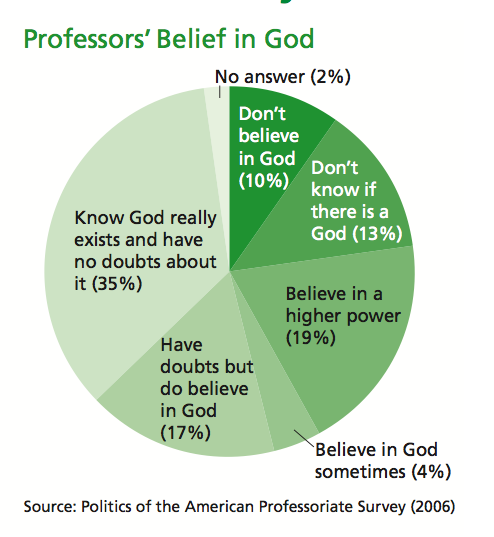
A study just published in Sociology of Religion, by Neil Gross and Solon Simmons, reported that about 3/4ths of professors report some belief in God or a higher power.  About 35% of professors are absolutely certain that God exists, while 21% believe, but are not absolutely sure.

Only 10% of professors are athiests and another 13 percent are agnostic.

So, is 23 percent many or only a few non-believers?

On the one hand, it may seem like very few if you consider that the professoriate is routinely characterized as radically liberal and anti-religious.  As Shannon Golden at Contexts Crawler says:

Devout parents often worry about the “secularizing” effects of sending their children off to college. They envision professors pushing secular thoughts and anti-religious values on their impressionable students.

Despite the stereotype, this data suggests that the majority of professors would welcome religious belief in their classrooms.

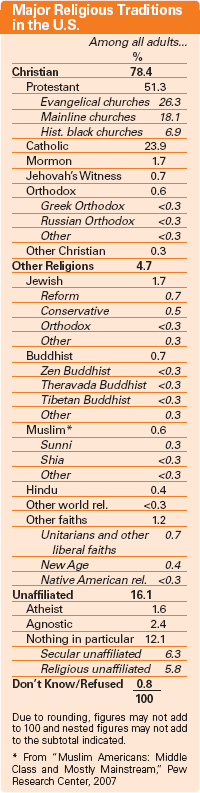
On the other hand, it may seem like a lot of athiests and agnostics if you compare the numbers to the general U.S. population.  According to the Pew Forum on Religious and Public Life, only 4% of the U.S. population is athiest or agnostic (see the data waaaay down at the bottom there):

From this perspective, 23% is a lot.

So what do you think?  Are you surprised by how few professors report being athiests or agnostics?  Or are you surprised by how many?

Lisa Wade, PhD is an Associate Professor at Tulane University. She is the author of American Hookup, a book about college sexual culture; a textbook about gender; and a forthcoming introductory text: Terrible Magnificent Sociology. You can follow her on Twitter and Instagram.


Dmitriy T.M., Jody, and Emily F. sent in a new public service announcement aimed at preventing teen pregnancy. It features Sarah Palin’s daughter, and teen mom, Bristol Palin.

Transcript:

What if I didn’t come from a famous family?
What if I didn’t have all their support?
What if I couldn’t finish my education?
What if I didn’t have all these opportunities?

Believe me, it wouldn’t be pretty.
Pause… before you play.

The ad is fantastic in its raw truth. But not, perhaps, in the way it is intended to be. While the ad is, I think, trying to tell all teenagers (not just non-rich ones) to “pause,” it also clearly lays out who pays the highest price for early motherhood.  Privileged teenagers (who are, by the way, more likely to abort than disadvantaged ones) will often be provided resources that mediate the negative consequences of keeping their child.  In contrast, when disadvantaged teenagers become mothers, it tends to entrench their disadvantage.

So thanks, Palins, for reminding us how nice it is to be rich.

Lisa Wade, PhD is an Associate Professor at Tulane University. She is the author of American Hookup, a book about college sexual culture; a textbook about gender; and a forthcoming introductory text: Terrible Magnificent Sociology. You can follow her on Twitter and Instagram.

Coincidence?  Or based on stereotypes about women and, especially, PMS?

From Dr. Grumpy, sent in by Dan S.  Also from Dr. Grumpy, the shaming vending machine.

Lisa Wade, PhD is an Associate Professor at Tulane University. She is the author of American Hookup, a book about college sexual culture; a textbook about gender; and a forthcoming introductory text: Terrible Magnificent Sociology. You can follow her on Twitter and Instagram.

Below a pro-birth control public service announcement, by a sex-ed-type organization called Sex Really, that makes the argument that all men are total assholes, therefore women should make sure they use birth control…

…but they should still have sex with them of course!  Duh!

Trigger warning for sexist language:

Source: Salon, via Jezebel.

Lisa Wade, PhD is an Associate Professor at Tulane University. She is the author of American Hookup, a book about college sexual culture; a textbook about gender; and a forthcoming introductory text: Terrible Magnificent Sociology. You can follow her on Twitter and Instagram.