
New survey data shows that the average person overestimates the diversity of the American population, both now and in the future.  Today, for example, racial minorities make up 37% of the population, but the average guess was 49%.
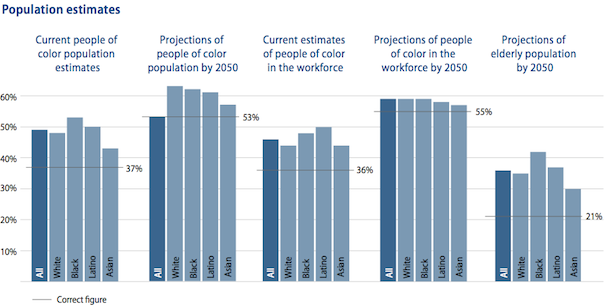
projections

Many Americans fear rising diversity.  Over half worry that more minorities means fewer jobs, nearly half think that it means more crime, and almost two-thirds think these groups strain social services.  If people think that minorities are bad for America and overestimate their prevalence, they may be more likely to support draconian and punishing policy designed to minimize their numbers or mitigate the consequences they are believed to bring.

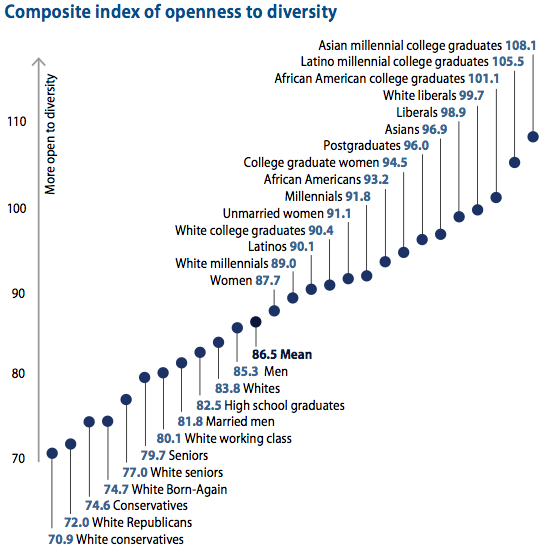
Not all Americans, of course, fear diversity equally.  Below are the scores of various groups on an “openness to diversity” measure with a range of 0-160.
Screen Shot 2013-10-22 at 1.34.24 PM

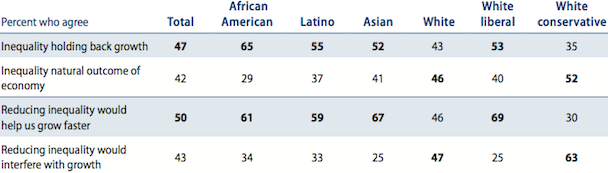
For the future, Americans are still strongly divided as to what to do about diversity and the racialized inequality we currently see.
last chart

Via The Atlantic; thanks to @_ettey for the link.  Cross-posted at Pacific Standard.

Lisa Wade, PhD is an Associate Professor at Tulane University. She is the author of American Hookup, a book about college sexual culture; a textbook about gender; and a forthcoming introductory text: Terrible Magnificent Sociology. You can follow her on Twitter and Instagram.


If you’re looking for just one image that says a thousand words about what’s wrong with America, here’s a contender.  It is a screenshot of the website for the Silver State Schools Credit Union:

facebook_1889026740

Yep, it’s an invitation to K-12 teachers to go into debt to do their job.

Speechless.

Lisa Wade, PhD is an Associate Professor at Tulane University. She is the author of American Hookup, a book about college sexual culture; a textbook about gender; and a forthcoming introductory text: Terrible Magnificent Sociology. You can follow her on Twitter and Instagram.

It’s that time of year again!  Please feel free to use the SocImages Course Guides to help illustrate your lectures:

Thanks to everyone who has submitted a guide and to those of you who are out there working on one!

If you’re a sociology professor or graduate student, we’d love to have more.  One only needs to browse our archives, pull out the most compelling posts, and arrange them in ways other instructors would find familiar and convenient.  The guides can cover entire courses or be designed to help illustrate a theory, article, or book.   We’re even happy to have duplicate guides, since every instructor is different.

We hope these are super useful!

Lisa Wade, PhD is an Associate Professor at Tulane University. She is the author of American Hookup, a book about college sexual culture; a textbook about gender; and a forthcoming introductory text: Terrible Magnificent Sociology. You can follow her on Twitter and Instagram.

This year marks the 40th anniversary of the Equal Credit Opportunity Act.  This granted women the right to have a credit card in her own name.  This translated into an unprecedented degree of independence for women.  Feminists and their allies fought for this new world and it’s a good thing because we love to buy things with our credit cards sooooooo muuuuuuuuch!

And, thankfully, credit card companies like Banif know just how to make us comfortable, by combining feminism and infantilization and kissing our asses because We. Are. So. Special. “Every day is women’s day!” Wheeeee!

23

The husband in this ad, though, likely thinks he would have been better off if his wife wasn’t allowed to make financial decisions without his approval.  Stupid women and their stupid financial decisions. Ruining everything.

Lisa Wade, PhD is an Associate Professor at Tulane University. She is the author of American Hookup, a book about college sexual culture; a textbook about gender; and a forthcoming introductory text: Terrible Magnificent Sociology. You can follow her on Twitter and Instagram.

In this excellent 6 minute video, CJ Pascoe discusses some of the findings of her widely acclaimed book, Dude, You’re a Fag.  She points out that, while being called “fag” and other terms for people with same sex desires are the most common and most cutting of insults between boys in school, they rarely mean to actually suggest that the target is gay.  Instead, the terms are used to suggest that boys are failing at masculinity.

This, she points out, is not “unique to childhood.”  For this reason, calling it bullying it is probably a distraction from the fact that this doesn’t just happen among kids.  She includes, as an example, a bomb destined for Afghanistan with the phrase “highjack this, fags” written on it by American soldiers.

Kids, then, aren’t in a particularly nasty stage.  They’re “repeating, affirming, investing in all of these norms and expectations that we as adults are handing down.”  If we used more adult language, Pascoe argues, we might do a better job of thinking how we’re teaching boys how to be this way.

A great watch:

Lisa Wade, PhD is an Associate Professor at Tulane University. She is the author of American Hookup, a book about college sexual culture; a textbook about gender; and a forthcoming introductory text: Terrible Magnificent Sociology. You can follow her on Twitter and Instagram.

Anita Sarkeesian is back with a new installment in her feminist analysis of video games. This one is a 25 minute discussion of the Ms. Male Character Trope, the phenomenon in which video games spice up their characters by including a female modeled off of the original male character.  It’s a good example of the way in which males are centered, while females, if included at all, are seen as a non-normative kind of human, animal, or thing.

She starts with the classic example of Pac-Man and Mrs. Pac-Man, observing that only Mrs. is marked with symbols of femininity; Pac-Man, who’s not even called Mr. Pac-Man, has no markers at all.  This is typical.  This is how maleness is made simultaneously invisible and front-and-center, while femaleness is othered.  Like this:

Pacman and Mrs Pacman

A fan sent her an example of what a reverse world would look like, where women were the default and men were marked and othered.  Awesome:

2

Here’s the whole video:

Lisa Wade, PhD is an Associate Professor at Tulane University. She is the author of American Hookup, a book about college sexual culture; a textbook about gender; and a forthcoming introductory text: Terrible Magnificent Sociology. You can follow her on Twitter and Instagram.
SureYou absolutely must find three minutes to watch Aamer Rahman defend the idea of reverse racism. Yes, he says, of course reverse racism is possible: “All I would need is a time machine…”  The rest is glorious.

Lisa Wade, PhD is an Associate Professor at Tulane University. She is the author of American Hookup, a book about college sexual culture; a textbook about gender; and a forthcoming introductory text: Terrible Magnificent Sociology. You can follow her on Twitter and Instagram.
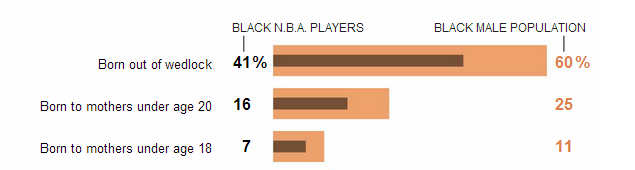
Part of what makes professional basketball appealing, for kids who love to play as well as fans, is the idea that a person can come from humble beginnings and become a star.  The players on the court, the narrative goes, are ones who rose to fame as a result of incredible dedication and extraordinary talent.  Basketball, then, is a way out of poverty, a true equal opportunity sport that affirms what we think America is all about.

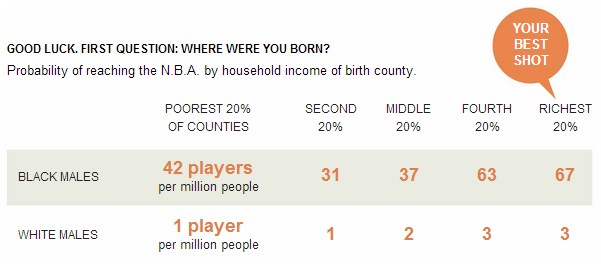
Seth Stephens-Davidowitz crunched the numbers to find out if the equal opportunity story was true.   Analyzing the economic background of NBA players, he found that growing up in a wealthy neighborhood (the top 40% of household incomes) is a “major, positive predictor” for success in professional basketball.  Black players are also less likely than the general black male population to have been born to a young or single mother.  So, class privilege is an advantage for pro ball players, just like it is elsewhere in our economy.

Screenshot_1

.

Screenshot_2

The richest Black men, then, are most likely to end up in the NBA, followed by those in the bottom 20% of neighborhoods by income.  Middle class black men may, like many middle class white men, see college as a more secure route to a successful future.  Research shows that poor black men often see sports as a more realistic route out of poverty than college (and they may not be wrong).  This also helps explain why Jews dominated professional basketball in the first half of the 1900s.

LeBron James was right, then, when he said, “I’m LeBron James. From Akron, Ohio. From the inner city. I am not even supposed to be here.”  The final phrase disrupts our mythology about professional basketball: that being poor isn’t an obstacle if one has talent and drive.  But, as Stephens-Davidowitz reminds us, “[a]nyone from a difficult environment, no matter his athletic prowess, has the odds stacked against him.”

Cross-posted at Pacific Standard.

Lisa Wade, PhD is an Associate Professor at Tulane University. She is the author of American Hookup, a book about college sexual culture; a textbook about gender; and a forthcoming introductory text: Terrible Magnificent Sociology. You can follow her on Twitter and Instagram.