
These images came to us from Dianne who saw this on BoingBoing and dug deeper to find all these great examples!
Illustrating the way in which whiteness is taken-for-granted and others are always, well, other, Plan Toys sells these doll sets labelled “Ethnic Family,” “AsianFamily,” and, “Doll Family.”

They also sell a “farmer” and a “farmer’s wife.” Dianne notes: “Women don’t farm, apparently, they just marry men who do.”
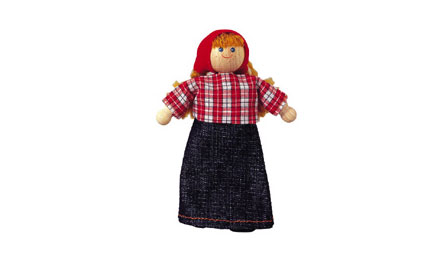
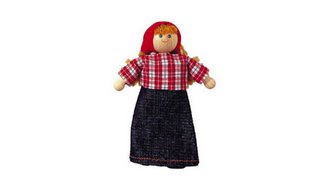
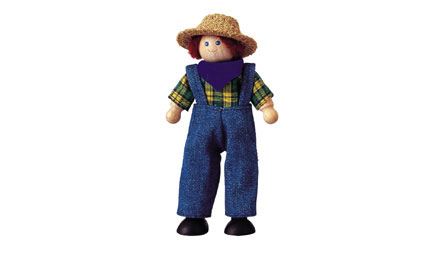
They also sell this generic “Native American set” of which they write:
“Children can create imaginary stories with the Indian figures, camp, teepee and authentic accessories. They can learn about the traditional American tribe and their lifestye.”
Notice how American Indian tribal difference is erased with the phrase “the traditional American tribe.” Diane pointed out that the set actually combines teepees and totem poles which were traditions of tribes in the plains and on the west coast respectively.
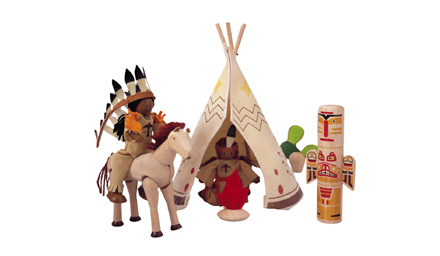
In the “How to Play” section, it says:
“Children can imagine and tell stories about Red Indians, helping to stimulate their imagination and expanding their horizon.”
Yes they really do say “Red Indians.”
Diane notices that, just like the doll family is obviously white, “here again, apparently the default child is white, who can ‘imagine… stories about Red Indians.'”
Ironically, the company claims that they are “socially & environmentally responsible” and promote “good values.”
Thanks so much Diane!
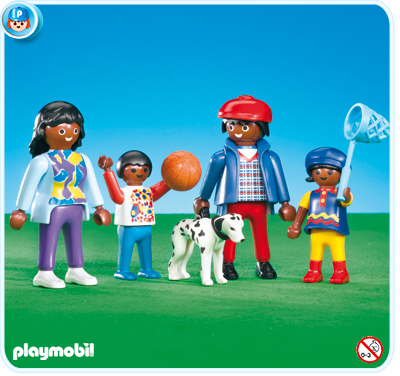
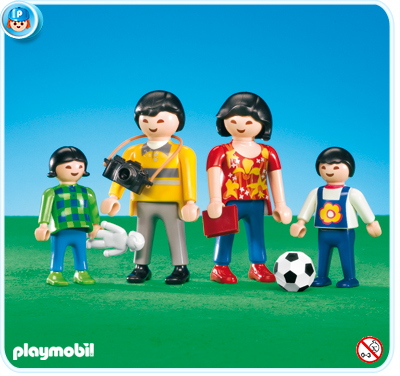
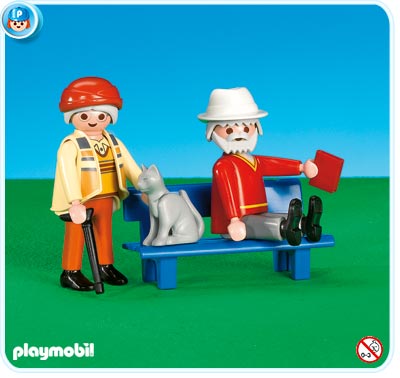
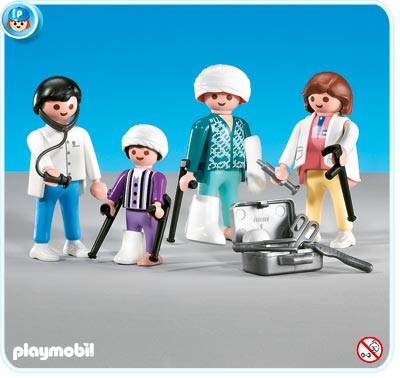
NEW: Kirsten D. sent us this link to a series of Playmobil toys. All of the non-white characters are given racial designations, but the white characters are not. I included some examples below.
African/African American Family:
Asian family:
Grandparents:
Medical Team and Patients:
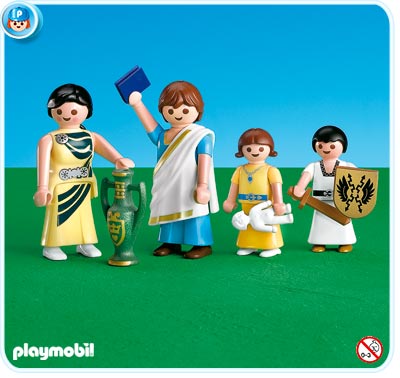
Prince and Princess:
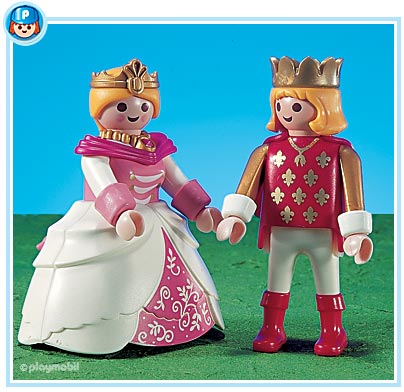
Also in the neutral and the marked: men are people and women are women and from pale to pumped with racial stereotypes.
Comments 24
Murderface — April 2, 2008
The company is Thai, I believe, which makes their "Ethnic/Doll Family" distinction even stranger.
Being Thai (if we assume that English is the author's second language) also mitigates, but doesn't really excuse, the use of the phrase "Red Indian," don't you think?
It makes one wonder how the Thai and Japanese versions of the copy read.
Vee the Monsoon — April 2, 2008
With the "Red Indian" thing I was thinking the company might be British, as they use that term pretty freely there to differentiate between indigenous Americans and people of Indian/South Asian descent/origin. They have, last I checked, simply not been introduced to a more politically-correct term. (But then, political correctness is a cultural distinction, which might invalidate my (American) claim.
Anyway. If it's a Thai company, perhaps their translators are British English? :)
pharmacopaeia — April 3, 2008
What I like about this is that it shows the way in which one culture (Thai) perceives expectations and biases regarding race / gender in another culture (North American) and attempts to use these to market / sell a product - a very strange feedback loop whereby much is lost in translation.
Basically - this is the way that the toymakers think (white) Americans see themselves (and Asian and Indian peoples), and what they consider Americans to believe are 'quality' 'educational' toys.
Kirsten — August 31, 2008
"Native American Indian" is the usual term in Britain, sometimes without the "Indian". That said, the older generation probably would use "Red Indian" and I heard my (fairly liberal) grandmother today using the term "not enough chiefs and too many Indians". This phrase (actually an inversion of the usual management metaphor) does not refer to people from the Indian subcontinent.
As a little Scottish girl in the 80s I had a large collection of "Red Indian" costumed dolls given to me by relatives who had been to America. I was aware that they didn't represent one homogeneous culture, but I don't know if this was typical. (What was the film "The Indian in the Cupboard" called in America?)
I did think (as the person who sent the Playmobil link) that it was REALLY odd that you can only get white grandparents. Do they want to imply non-whites don't live to be grandparents, or what?
Rob Schmidt — December 4, 2008
Here's another example of a mishmash of Native images:
http://www.bluecorncomics.com/pics/playmobl.jpg
Plus a series of "cowboys and Indians" images:
http://www.bluecorncomics.com/2008/05/cowboys-and-indians-images.html
Allie — December 14, 2009
Playmobil is German, not Thai.
Deb D. — December 2, 2010
Americans, apparently, enjoy being offended so very much that they fail to have any respect for the fact that other nations/cultures have different social sensibilities - "How Dare They...!"
Jack Vermicelli — December 22, 2010
Calling it an "African American family" is probably not accurate, as Playmobil is a German company. More likely, it's an "African European family," or somesuch. And to echo previous commenters, "Red Indian" likely does not carry the same stigma or social shibboleth depending on region, just as "Negro" is still just as fine in some places in the world as it once was in the US.
Joe Eagar — September 15, 2011
I hate to tell you this, but European-descended non-Hispanic (and all those other idiot qualifiers for what a "white" person is) do make up around 70% of the American population.
The neutrality of whites in advertising is perfectly natural. There's nothing wrong with it. Now, it wouldn't be right if there were no representations of other groups at all. But there is, and I'm not a big fan of this kind of whining. It reinforces the stereotype of racial minorities as whiny, lazy jerks (I've never met hispanic or black people who fit that bill in real life, and I don't like seeing that stereotype reinforced on the internet).
Joey Joe Joe — July 6, 2012
Hmmm, I'm exceedingly late here, but found that these are still sold so all I can ask is, "Why does the African-American family have a dog?". We all know they're afraid of dogs. I doubt that the Blood in the red plaid flannel and gang colors is a fireman and they're the only stereotypes that would keep a dalmatian. However, the dog's tail is between its legs and head down (extremely unnatural for this breed), so perhaps this is a commentary on the way it has been beaten by this clearly immoral family.
Sheena Leversedge Wood — July 18, 2013
the CAMERA!
nice use of stereotype there.