
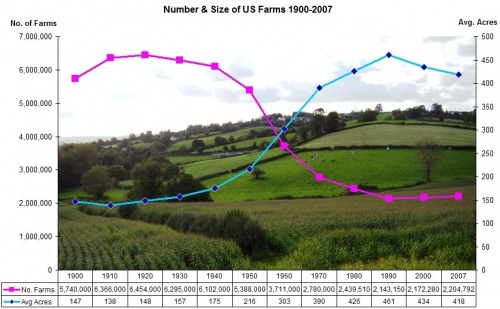
Recently I posted about the loss of genetic diversity in industrial agriculture, partially due to increasing concentration at every link in food commodity chains, from the farm to the grocery store. This image from the Centre for Research on Globalization, sent in by Rick T. of the University of Western Ontario, illustrates the process of concentration at the farm level. In the U.S., the total number of farms has fallen from an all-time high of over 6.3 million to just over 2.2 million. Meanwhile, the average size per farm nearly tripled between 1900 and 2007, from 147 to 418 acres.
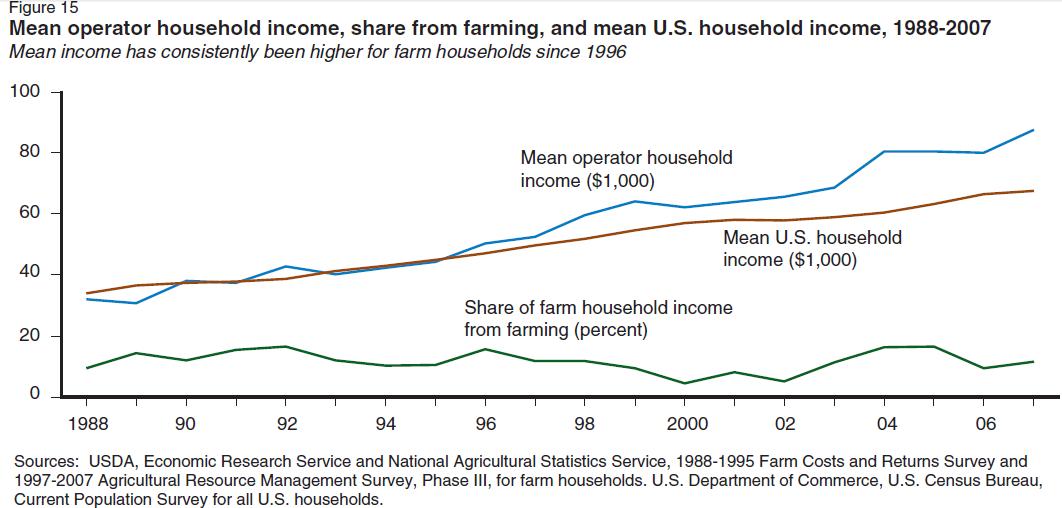
A 2010 USDA report provides detailed information about the structure of U.S. agriculture. For instance, overall, average farm household income is higher than the U.S. average, though I’d rather see the median income to reduce the impact of outliers on the calculation. But as the bottom line shows, farm households are highly dependent on non-farm income for their survival. Overall, farm income accounts for less than 20% of the total income of farming families:
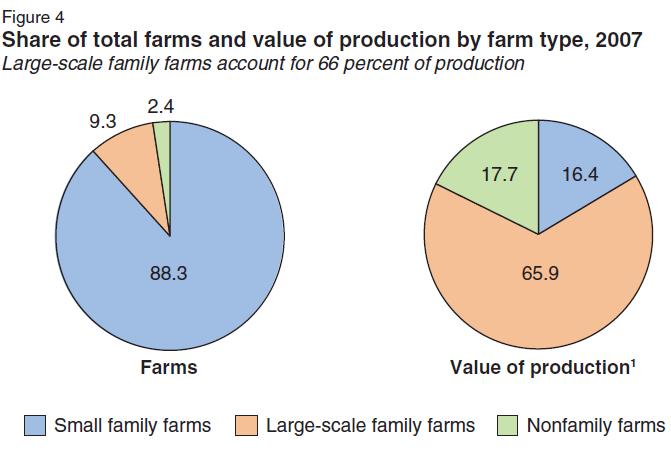
And as we saw recently with the mortgage interest deduction program, the benefits of farm subsidies are unevenly distribution. Small-scale family farms (defined as operator-owned farms with less than $250,000 in sales — which does not mean $250,000 in profit, of course) make up 88.3% of all farms in the U.S., while large-scale family farms (operator-owned farms with sales over $250,000) are 9.3%:
While small-scale family farmers receive the majority of land-retirement payments — that is, subsidies in return for taking land out of agricultural production — large-scale family farms are the major beneficiaries of commodity payments such as price supports that subsidize the cost of production:
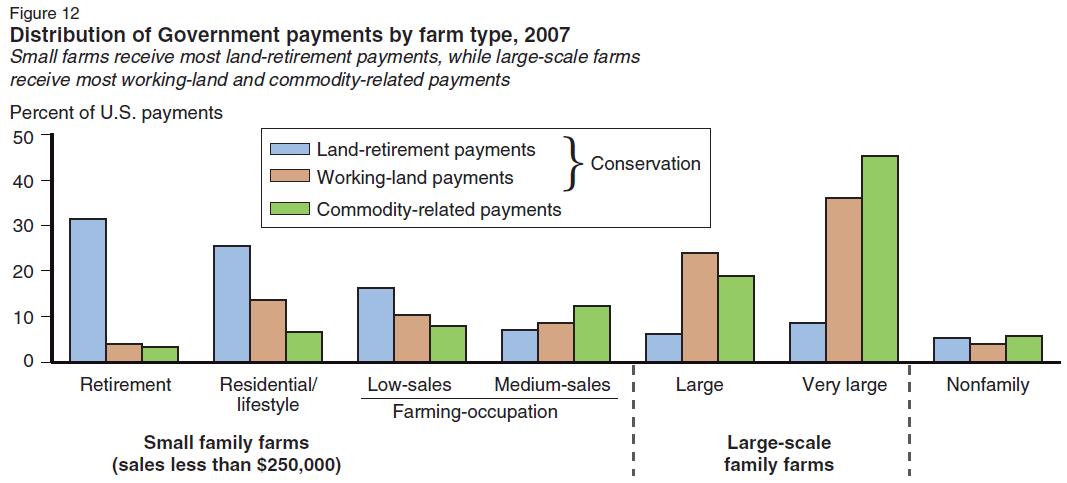
Of course, that doesn’t mean that small-scale producers don’t benefit from farm subsidy programs, but as with the mortgage interest tax deduction, they are set up to reward size — the more you have, the more you get. Whether farm subsidies are essential to preserving small family farms or actually hurt them by artificially supporting capital-intensive large-scale production is a topic of much debate within agricultural circles.
Comments 6
Larrycharleswilson — July 23, 2011
All farm subsidies need to be ended
akkhan — December 26, 2022
There's no doubt that the agricultural industry plays a vital role in our economy and society. It's a key sector that helps to feed the world's population and provides many other important products. The future of agriculture looks very exciting, with new technologies and innovations set to change the way we farm. Farm Machinery is also an essential part of Bright agricultural Future. Farmer are Buying Brand New Massey Ferguson Tractor in South Africa.
Dohn Doe — April 17, 2024
Agriculture is undoubtedly a cornerstone of our economy and society, crucial for feeding the global population and supplying a variety of important products. The sector is poised for an exciting future, driven by groundbreaking technologies and innovations that promise to revolutionize farming practices. Farm machinery, a critical component, is integral to this bright future in agriculture. Farmers are very happy with purchasing Massey Ferguson 375 Tractor.
abebebikila120@gmail.com — April 24, 2024
Indeed, the shift towards industrial agriculture has resulted in a significant loss of genetic diversity, posing challenges to sustainable food production. As the concentration of farms increases, smaller family farms face growing pressures to compete. In this evolving landscape, technology plays a crucial role in empowering farmers to optimize their operations and enhance crop yields. Massey Ferguson tractors offer a solution by providing advanced machinery that enables efficient cultivation and harvesting. With their reliability and performance, Massey Ferguson tractors are indispensable tools for farmers striving to navigate the complexities of modern agriculture. Explore the range of MMassey Ferguson tractors for sale and elevate your farming endeavors to new heights!"