
Sociologists have noted that race and gender have been more politicized in the U.S. than class. In contrast, class is highly politicized in Europe, leading to a much stronger labor movement. The weak labor movement in the U.S. is partly to blame for the stingy federal policies around vacation and holidays. The U.S. federal government dictates that employees are given exactly zero paid holiday and vacation days a year (that means, if you get such things, it is because your employer is being generous/in a benefits arms race with other employers). This is in stark contrast to most other OECD countries:
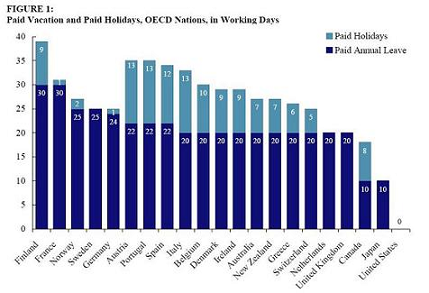
Yep, that’s right. In every country included except Canada and Japan (and the U.S.), workers get at least 20 paid vacation days. In France and Finland, they get 30… an entire month off, paid, every year.
When I show figures like these (and there are many of them, parental leave, work hours, military spending, class inequality, etc) to my students, they are STUNNED. Most Americans are woefully ignorant of how pro-business U.S. policies are compared to the policies of like countries. I think this ignorance contributes to the resistance many Americans display when politicians and activists talk about improving protections for workers.
We’re a nation of people working harder and harder for less and less, and the merest suggestion that we should do anything other than work 9 hour days without pause until we drop dead is met with cries of socialism…
The quality of life of a typical American certainly suffers from our ignorance of life in other nations. If we were more aware of what a strong labor movement could offer, we might be more supportive of those movements.
I’ve always loved this bumper sticker:

Comments 209
Ruth — January 31, 2010
Love this graph. And, after living in France for a year, I totally understand how we are getting the short-end of the vacation stick.
I was wondering if you had a good reading about this that you used in your course?
Sam — January 31, 2010
And, strangely (?), the European economy is equally healthy -- if not more -- than the American...
Heather — January 31, 2010
That's it. I'm moving to Finland!
james — January 31, 2010
Interesting about that bumper sticker. Unions also brought a great deal of the trouble with the big car companies being unable to equal costs. They also tend to drive up the cost of building projects and in some places have ridiculous rules in place that impact the economy and those around them quite negatively. But I guess that doesnt matter.
Naser — January 31, 2010
These data are for working days - so 30 days off in Finland and France means six weeks off, not one month. As someone who has always lived and worked in the UK, I can't imagine how people in the US cope. I've always had at least 25 days paid leave. You are missing out on a lot.
Kat — January 31, 2010
Yup, which is one of the many many reasons, I will never work under a US contract (I'm used to slightly more than six weeks). :)
Kookaburra — January 31, 2010
And people look at me like I'm crazy when they hear about my goal of moving to Norway.
Jonathan — January 31, 2010
A few years ago, I came to the conclusion that the US is not a First World nation. It's a Second World nation. If you look at the statistics, the US doesn't resemble the likes of France, Britain, Germany, or Japan in any way. However, the statistics mesh quite nicely with the likes of Brazil, China, or Korea. There is not one statistic that i could find that varied from this.
Kelly — January 31, 2010
Just because federal law doesn't require companies to give time off, doesn't mean that the average US worker don't get any time off. This chart is pretty meaningless.
Naser — January 31, 2010
Kelly, it says a lot about US government attitudes to regulation, which is what the blog is about. In any case, if you look at this article:
http://www.law.harvard.edu/programs/lwp/papers/No_Holidays.pdf
... you will see that the average paid leave is 9 days in the US, much lower than the statutory minimums in all other OECD countries. So US workers get much less time off than others.
jfruh — January 31, 2010
While I do agree with your larger point, the way you frame it (and the graph too, for that matter) is misleading. You say "The U.S. federal government dictates that employees are given exactly zero paid holiday and vacation days a year." Someone reading would probably assume that the government forbids paid holiday and vacation, which is not the case. In fact, the government does not require paid vacation and holidays, which is not the same thing at all. Similarly, the graph should be labelled "minimum paid vacation and paid holidays required by law", not "paid vacation and paid holidays".
It would be interesting to see a chart that shows the average number of paid vacation and holidays actually offered in all these countries. Perhaps the data could be added as an extra color bar on this chart. The US would still come in far behind such a chart, but it would be interesting to see how much over the minimum required vacation time the average European worker receives.
I am also curious if the vacation requirements in Europe apply to one-person businesses. Is a self-employed person required to take a certain amount of time off each year? If so, how is this enforced? If not, does this give them an unfair advantage over other businesses?
Jess — January 31, 2010
Yes, it's very hard to understand this from a European perspective.
As a sidenote, the chart is out of date. For example, the UK is shown on there as having 20 minimum days annual leave, but it's now 28 days, and the UK still has the lowest leave entitlement in the EU AFAIK.
Chris W — January 31, 2010
I wonder if that bumper sticker should read "Jews: The people that brought you the weekend" b/c of the sabbath.
Luna — January 31, 2010
For what it's worth, in Canada, it goes up to 15 days after 5 years service. I think 20 days after 10, but I'm not sure of that one.
splodie — February 1, 2010
I have 13 years service at a major US-based multinational and I get four weeks vacation and six personal days a year. My sick leave is not rationed.
My company is by far not the norm.
All attempts to organize labor at my company have met with no interest whatsoever...this may change, however, if the company continues to insist on outsourcing.
Johannes — February 1, 2010
I'm in my 3rd month of a 4-month-long paid leave (consists of the mentioned law-dictated paid leave and overtime, etc.).
Kind regards from Austria/Europe!
KarenS — February 1, 2010
I'm in the US, and have 30 days of paid vacation plus 17 days of paid holiday. I like it, wouldn't trade it, but... it means that I'm unlikely to leave this company, since paid vacation is so often tied to the number of years you've worked there.
Ketchup — February 1, 2010
Although it's clear that there are quite different attitudes towards unions and organizing among the countries mentioned here, and these vacation-day differences can be quite big, what this comparison left out that is also quite important are salary rates.
VJ — February 1, 2010
Wow. All of you talking about your personal leave rations are missing the larger point. The gvt should not be dictating how many paid days a company gives its personnel.
I start to think that you're all short-sighted, but then realize that it's just your 'sociological imaginations' that lack economic perspective.
CMS — February 1, 2010
This is a stupid conversation lacking even a shred of context, let's see graphs of unemployment, unemployment vs. age, salary, public debt... and include various years. Because I can remember well BEFORE the latest financial collapse that France (for example) had 25% unemployment in the 18-25yo demographic, because no company wants to take on permanent workers with all the mandated overhead.
You can tell me all day long why the US sucks and you don't want to live here, and apparently you don't live here, so who cares. Not everything is rosy in Europe. The UK, for example, is about to break from public debt... which came from years of policies that result from the popular mindset that "the government should mandate that we should get paid not to work even more."
Plus most of the European countries have pretty low birth rates, who is going to pay for all your social nets and pensions in the future? We have our own broken European state leading the way here, it's called California. Our public sector unions have broken our back. We have 15,000 former public "servants" with $100,000/yr+ pensions. We've had nearly a decade of double digit billion dollar annual deficits. People with skills are leaving, people who want to live off the social net are coming.
LoneSnark — February 1, 2010
American's possess different traditions of work from our peers overseas. For cultural reasons, we prefer to work as hard as we can to earn as much money as we can and then retire early, once we have a nest-egg, a quarter million in the bank, usually a paid off house, etc. In exchange for working so many hours every year, we get compensated far more than foreign workers. Meanwhile, in Europe, they do things differently. They accept a substantial pay cut, with a lower standard of living, and in exchange get to work fewer hours during the year. Such jobs are available in America, there is no law against them, and yet most Americans shun them, as most employment negotiations center only on how much annual salary can be obtained, not time off. This is a choice, so stuff your chart and leave us alone to make that choice. We don't need legally mandated time off, if we want it we will negotiate for it. I chose time off, I like to travel and drive a 10 year old car, I get four months off a year (16 weeks paid vacation), my employer thought I was crazy, but they accepted it in exchange for slashing my salary. A law requiring them to give me that time off would have changed nothing, my salary is slashed anyway, but my neighbors with no interest in travel, but with a burning desire to buy a boat for the weekends, would have their desires destroyed in the name of making us look better in your chart.
Lyndsay — February 1, 2010
I learned sometime in the last few years how much vacation time Europeans get. We should learn this in high school but we don't. I also didn't realize how little Canadians get until recently because my dad worked for the government and they start at three weeks and then go to four, five and near retirement six weeks. I think we need to get a labour movement going. Somehow. Two weeks is not much I think.
Matt Kamp — February 1, 2010
I think sick or vacation days can be just productive as a day in the office, as well as extremely more efficient. Eight hour shifts, five days a week are not necessary to complete the absolutely essential tasks in our jobs.
Check out this approach to business!
www.newsy.com/videos/u...
Social Strata in Seattle is giving employees unlimited paid vacation days. I think this approach to business is a revolutionary idea. Employees know that they still need to get work done while on vacation, thus fueling them to finish their work as timely and efficiently as possible. If this works as it could, a new model for an extremely fast route of project completion could be dawning upon us.
HeGe — February 1, 2010
One small correction regarding vacation in Europe. A week off requires 6 vacation days (Saturday is included) in many countries, so 30 days actually gives you 5 weeks. And you should use max 4 weeks during Summer.
In the US again it is common to have in addition to vacation days also personal and sick days, which do not exist in Europe.
This does not change the fact that the vacations are generally longer in Europe, but merely shows that these things are not so black and white.
HeGe — February 1, 2010
Hi Astrid, agree, these things differ, because "Europe" is not the same thing even after EU. Germany has always had the strongest unions and best benefits (like 5 days = week), also meaning a very expensive work force.
My comment about personal and sick days in the US referred to the fact that there are quotas (actual days) that you can use as needed. Like you could say that your grandma has died a couple of times :-) and use the personal days for that = more vacation.
Seriously, if I used all my vacation, personal and sick days I would not be working too much.
I am a European (Scandinavia) living in the US, working in hightech, BTW.
Kagi — February 1, 2010
I wonder about the feedback loop here: the more we work, the less we travel and read, the less we know about the rest of the world, the more we work?
DexX — February 1, 2010
Apart from tax rates and leave, you also need to consider pay rates. Minimum wage in Australia is around $us12.50 at current exchange rates. That is WAY higher than the minimum wage in the US.
I'm working a moderate-level non-management government job and I get paid the equivalent of about $us50,000. I pay roughly 30% tax, but I get 20 days (four weeks) paid annual leave and 10 days (two weeks) of fully-paid sick leave, as well as nine paid public holidays (it varies from state to state - the data above represent only national public holidays, and each state generally has one or two of its own).
I also have free health care in a public hospital. I choose to pay a bit extra to a government-regulated private health fund to cover extras like dentistry, remedial massage, physiotherapy, and the like. I can't remember exactly what that costs, but I recall it's about $au100 ($us88) a month.
I have a university degree that was partially paid for by government funding. We used to have 100% free university education, but it went to a part-funded-and-part-loan system about fifteen years back.
I guess what I'm saying is that you have to take a lot of factors into account. Sure, you could potentially get paid a fortune in the US, but how likely is it really? The gulf between poor and rich over there is staggering, and the rich devote all their energy to maintaining and widening that divide. Talk about raising the minimum wage just a little, keeping it just in line with inflation, and the fat cats will screech about how it will destroy the economy.
Can I also point out that Australia has perhaps the world's most healthy economy right now? :)
Carr — February 3, 2010
Hello??? Rather than looking at this graph as a result; look at it as CAUSE. Check out what is it like in those places for a typical trip to the grocery store, to the doctor, to the tax man.
Tom — February 6, 2010
To the person talking about Minimum wage. Only 1.5 percent of works work at Minimum wage in the US, and most of them are teens. It's not an argument worth having.
When it comes to vacation. I have 28 working vacation days, 7 personal, and 5 sick day this year. I work at a large US company.
mh — February 11, 2010
I'm a senior manager at a small US company, and get an initial outlay of 10 vacation days a year. That covers sick and vacation leave.
I don't get overtime despite never having a time when I can call wholly my own. On vacation or other PTO (paid time off), I'm expected to take a laptop and my Blackberry and use them...I took one long weekend recently (after working over Xmas on site) and elected to view my vacation time as mine, and hence not respond to calls/emails, and my job was threatened when I returned unless I 'got with the program.'
My staff does receive overtime (good for them) though the owners of the business keep the staff count low enough that it's relatively rare to be able to schedule a vacation that's more than a long weekend. We accrue up to 120 hours max, after which vaca ceases to accrue. This is in CA, and it's unlawful, but the economy is such that no one is going to make a fuss.
The company's been doing this through multiple boom-and-bust cycles. Every time a bust cycle ends, they haemmorhage staff because they treat the staff poorly - and every time, the owners bitch about lack of loyalty.
I would *love* a European system. I've just about had it with trying to make this one work. And I am hoping that techs get fed up with being treated like crap, and turn to unions....
mh — February 11, 2010
If you treat your staff well, they will treat you well in return.
Exactly. There are few staff here who have been here for more than a couple of years; those who have are profoundly damaged human beings.
It drives me crazy that people see setting a floor as 'socialism.' I see it as setting a minimum standard of decency - without it, there is a race to the bottom, a Hobbsian war of all against all, essentially the Indian model. I have been there and have seen it, and if the only reason for that kind of suffering is to reduce consumer prices, then consumer prices - or executive bonuses, come to think of it - be damned.
mike sanchez lll — February 25, 2010
i totes believe that americans should be given atleast some vaca days. we work the hardest and just keep putting so much tension and stress on our bodies. its so unhealthy to think and even experience. we are loosing valuable time to spend in happiness
ben dover — February 25, 2010
we need leave time...relaxation
-AMEN
Little Johnny — March 15, 2010
I live in Australia. I can say that 4 weeks annual leave over here is the bare minimum. The entity I work for has 6 weeks annual leave but closes for 2 over Xmas therefore 8 weeks. On top of that you accrue 10 days paid sick leave every year. Yes you Americans are seriously getting the short end of the stick. What is the point of living with your arrangment. You might as well be social insects like ants. Other differences; You cannot simply be fired in Australia for any whimsical reason. It's quite a process to try and get rid of anyone. Most businesses don't expect employees to work longer than the legal mandated day which is 7.6 hours. More than that and you get paid over time. Finally they are now taliking about 6 months maternity and paternity leave on full pay. In a nutshell the US is the opposite extreme of Cummunist Russia. Both suck big time.
sara — March 29, 2010
I live in Ecuador and it is a wonderful country. Its people are so nice and kind, they will give you the most warming welcome. I have put together a helpful fact sheet, and also an article on Ecuadorian manners and customs.
Klein — June 28, 2010
May I know what's your data source? I also intend to look at the situation in other countries not included in the chart. Thanks
Dave Road — September 14, 2010
It would be interesting to hear how this debate has changed now that many of the Western European economies are going under (Spain, Portugal, Greece)...
Craig — March 12, 2011
Where is this table tAken from? I am a uk employer and our laws state employees must get 5.6 weeks paid holidays per year, which is 28 days if you work a 5 day week. Many uk employers give 20 days plus the 8 public holidays which is the same thing. Employers are not required to give the public holidays as paid leave but often do and therefore only 20 additional days are given. The table should still show 28 days though which puts the uk at the opposite and more generous end of the scale!
Denis Jonnes — March 18, 2011
If American people do not start unionizing--Walmart would be a good place to start--standard of living compared to rest of world will continue to go down. b Corporations will continue to squeeze workers, reduce days off, increase hours, cut medical benefits, and lower wages.
Yes, one of our problems is defense spending which amounts to nearly trillion dollars a year (only minuscule amount of which goes to war on terror)--mostly for weapons systems which are designed for Cold War, which generals, admirals and Congressman still think we are fighting.
Rebecca — May 21, 2011
This is the most intelligent forum I have ever found on this subject! Bravo to all. What follows is a VERY cautionary tale; I am hoping at this point to be reincarnated, and I don't even believe in reincarnation...
I am a 36 year-old American woman originally from an educated middle class New York background where the received ideas of the well-to-do are APPALLING, who figured out the socioeconomic depravity of the US around the time I was 19 and had my first chance to work in London (on a student summer visa). I then spent the entirety of my college years trying to 'establish' myself in both London and Paris, on student visas and then as a lonely freelancer off the British grid. By the time I was 23 I was burned out and desperate because it had never occurred to me that even with my wealth of European experience, because I was an American citizen NO ONE WOULD SPONSOR ME FOR A VISA ANYWHERE IN EUROPE. At the time I was not interested in going back to school as a postgraduate, though that would have been the way to get a Tier 1 visa (system now closed in the UK by the Conservatives, namely that savage Home Secretary Theresa May; immigration into Europe is now so complicated and tech-based as to be effectively DEAD). I returned home to New York at the tender age of 24, had a nervous breakdown even as I was being courted by Condé Nast (bunch of nasty fuckers generally, reputed as such, who barely acknowledged that their three-week vacation offering was GENEROUS), succumbed to lifelong depressive illness, and didn't have the courage to go back to an England that had spurned me until I was 33! And THEN I misunderstood the terms of Tier 1 and didn't put aside the requisite amount in savings (had never filled out an internet application before and no one can make a single mistake when they're dealing with immigration, don't 'cha know; to err is NOT human) whilst a student, and lost my visa appeal, and wasn't permitted to marry my English partner as I was then out of status, and returned with him to New York where we could freely get married but then live in abject poverty, and had another nervous breakdown and am now WAITING TO DIE. My love affair with working and living in France and the UK has killed me and yet I'm still physically alive. This is a fate worse than death, believe you me. Any ideas for an easy suicide? I've tried to take my life so many times and have not as yet succeeded. I'm scarred physically (self-injury pursuant to the scars of a severe skin infection I had when employed but without health insurance in good old New York City) and emotionally by my mental and professional failures at achieving a life in Europe and I'm tired and aggrieved and I WANT TO GO NOW! Fuck it all. It has destroyed my life.
jim — May 27, 2011
Public employment contributes neither to
advantage nor happiness. It is but honorable
exile from one’s family and affairs.
Thomas Jefferson
This says it all. He knew it back then. It is not only our right to change our goverment if we don't like it but our duty.
hacker — May 27, 2011
Jim - with all due respect, your comment misses the point. Public employment isn't the subject; instead, it's the nature of the relationship between work and leisure time observed across a cross-section of countries.
It's demonstrably true - read the comments - that, in general, greater libertarian/corporatist countries tend to have less leisure time and lower overall wellness scores than countries which mandate minimum vacation time and minimum availability of healthcare. Libertarians may love the idea of Hobbes' war of all against all (embracing it as 'the market') but actually living in such a situation is a constant, unrelenting struggle which wears heavily on the strongest and utterly destroys the weak. That's incompassionate and wasteful of human beings....
Susan — June 27, 2011
I am an American school teacher and yes -- by God -- I don't care that I don't make megabucks -- I would rather have the time off with my family and spouse and enjoy life. I think Americans have been conditioned like rats that they need to work long hours, chase the almighty dollar, be productive etc. This is puritanical thinking in my view. There is NOTHING wrong with leisure time and pleasure with family and friends. We have it ALL wrong in the United States -- personally -- I find our culture loathsome, greedy, self-serving, and quite honestly would love to be an ex-pat.
Soonersandbucsthebest — July 3, 2011
Join the US Army, soldiers get a month of leave a year.
Lll — August 15, 2011
Please note that the paid vacation time in Norway and several other places is actually paid for by a deduction from the wage each of the working months. Meaning that if my pay is 120 and i have 1 month paid vacation i get around 1/12 pay each month as opposed to 1/11 for each of 11 months and then 0 for one month. For this purpose it is the total that counts.
Immigration — November 29, 2011
I think it depend on how generous your employer toward their employees.
Anonymous — December 27, 2011
Less goverment, no protection for the worker.no collective bargaining, we will decide your future.get rid of osha,get rid of the epa.Healthcare ?hope you can afford what they decide you have to pay.There is no such thing as global warming yet the average worker has to think who they should vote for.The week they open up the lady walmart art museum with hundreds of millions of art work bought by this modern day simon legree,walmart decides to reduce health benefits for its employees.I will bet that the opening of this art museum will lower this scum of the earth taxes if she even pays any at all.Occupy walmart the company that started it all.
Juras_ogoras — February 14, 2012
Globally the solidarity between people would make longer vacation time possible in the USA, but the system will ensure your only social life can happen inside you employer company, and when you become less productive they will have to get rid of you and then you can have nothing else then the rest of your retired life but by your self with no social life with other people.
This will happen if the economy is bad like today. The poor countries were able to sustain their culture and life by supporting own neighbors during the worst crises. If you had longer vacation time you now more about the people across the street, you could make friends but then it would be harder to control those over 150 000 000 of people who care for each other.
K — February 15, 2012
Americans typically get as many days off as Canadian or Japanese law require. You can always find a different employer or become self-employed if you want more days off. I understand Greece, Spain, Italy etc are not doing as well as the US is right now but no one is stopping you.....
Guest — March 11, 2012
Your article talks about FEDERAL law, not STATE. And many states, and most companies, offer decent paid vacation. On average: 9 paid days of vacation and 6 paid holidays. That's ON AVERAGE, 15 days. It would be nice if our collective ranting would consider both sides of the story.
Carlos — March 28, 2012
For the americans, nowbody is going to give you anything... Those vacations that we now are able to enjoy in europe, were earned with the fight and blood of our grandparents. Now we have the duty, of at least maintaining what they left for us.
Tomorrow there is a General Strike in Spain, and I'll be there.
Tex — May 3, 2012
@LEE"Norway and several other places is actually paid for by a deduction from the wage" of course this is not true. The annual wage doesn’t include any future deduction. On Top of that we have 1h paid break every day, 8 paid days of State holidays and there is +23K$ difference here in Norway and there in US between average wage.
ra44mr2 — May 13, 2012
Try to get a job in France right out of college. I DARE you. Its nearly impossible and although i havent researched i would bet its equally as hard in the other countries. The companies are less willing to take a chance on a college grad because its too hard to fire them and employing people is EXPENSIVE as hell to those countries. This is why none of them are leading nations in the world as the US is. Notice what a powerhouse China is because their workers have 0 rights. Although America is far from perfect at least its still competitive enough to have new jobs created fairly regularly and it has enough time off for its labor to at least have some rest. When the economy is good i can tell you from experience the companies are more generous with pay and time off at least we have the waxes and wanes of that and if the govt were to get off the corporates back those economies could happen much more, when the govt doesnt manipulate the economy and screw it up then there are smaller bubbles that pop more quickly, as soon as one pops another comes up, but because the govt has to screw with everything trying to control it all it just makes things last longer and much worse.
Dani Galski — July 3, 2012
Does anyone know of any activist group (other than a labor union) that is gathering support for a mandated minimum paid vacation for the US?
Dani Galski — July 3, 2012
The real problem is that Americans are so conditioned to being treated poorly that they don't even notice it anymore. They don't have the "let's get change for the better" mentality people do in other countries. There is an underlying fear and misconception here that we owe our employers for the right to work for them.
Erynn Schwellinger — July 21, 2012
I sincerely wish that the UK wasn't all bundled in together in these things. It's very inaccurate. The different government systems have different rules.
Divactparis — January 17, 2013
Hello Lisa. We only have 25 days of obligatory paid vacation in France. Many companies do offer 0.92 days of recuperation per month though, adding 11 days. We also have more paid holidays than in the US. And we only have a 35 hour work week (which is not very efficient though because we do end up working much more than that!).