
Here is a video of the famous “crying Indian” anti-littering PSA from the early 1970s:
[youtube]https://www.youtube.com/watch?v=j7OHG7tHrNM[/youtube]
The actor, Iron Eyes Cody, was not actually Native American, he was Italian American. You can read more about him at snopes.com.
In case you didn’t know, the famous “Chief Seattle” speech about the need to honor the earth and care for the environment was written by a white guy, also in the early 1970s.
These could be interesting for discussions of environmentalism and American Indians. Why do environmental messages somehow have more authority if they supposedly come from an Indian? Would the “Chief Seattle” speech be less meaningful if we knew a white guy wrote it? Why?
They could also be used in discussions about the appropriation of Native American culture and the use of non-Indian actors to play Indian roles. It’s also interesting as an example of how American Indians are often depicted as historic throwbacks who are still living in the 1800s (and are all from plains tribes and wear big headdresses): even though it was 1971 and the guy was standing next to a highway full of cars, he was dressed in buckskin and feathers. Because, you know, that’s what Native Americans wear, all the time. Believe me, back in Oklahoma, that’s all you see.
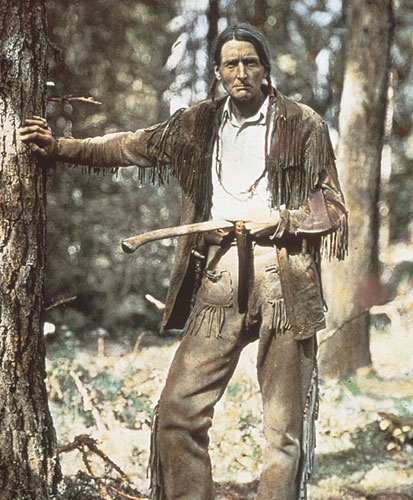
NEW: Another fallacious Native American environmentalist was Grey Owl. Grey Owl was a Britain named Archibald Belaney who adopted an Indian identity and became famous in Canada for his conservationist stance. Here is his wikipedia entry.

Comments 9
Tory — June 17, 2008
The last paragraph made me laugh out loud. Well done. I like my delivery so dry you can plant cactus in it!
Rob Schmidt — December 4, 2008
For more on the subjects you've raised here, see "Indian Wannabes" (http://www.bluecorncomics.com/wannabes.htm) and "Ecological Indian Talk" (http://www.bluecorncomics.com/ecotalk.htm).
T B — August 4, 2009
For analysis of relationships between indigenous peoples and nature, I recommend Murray Bookchin's The Ecology of Freedom --
specifically, a copy that includes the 1991 foreword.
In the initial version of the book, he had highlighted ecological features of indigenous societies; then, in and after the 1991 edition, he complemented that earlier analysis by discussing anti-ecological features of indigenous societies (e.g. indigenous hunting) -- thereby addressing the other side of those questions. Both positions are somewhat valid.
Steve — June 16, 2015
Grey Owl biopic (Pierce Brosnan!):
https://en.wikipedia.org/wiki/Grey_Owl_(film)