Archive: Jul 2017

In the 1950s and ’60s, a set of social psychological experiments seemed to show that human beings were easily manipulated by low and moderate amounts of peer pressure, even to the point of violence. It was a stunning research program designed in response to the horrors of the Holocaust, which required the active participation of so many people, and the findings seemed to suggest that what happened there was part of human nature.

What we know now, though, is that this research was undertaken at an unusually conformist time. Mothers were teaching their children to be obedient, loyal, and to have good manners. Conformity was a virtue and people generally sought to blend in with their peers. It wouldn’t last.

At the same time as the conformity experiments were happening, something that would contribute to changing how Americans thought about conformity was being cooked up: the psychedelic drug, LSD.

Lysergic acid diethylamide was first synthesized in 1938 in the routine process of discovering new drugs for medical conditions. The first person to discover it psychedelic properties — its tendency to alter how we see and think — was the scientist who invented it, Albert Hoffmann. He ingested it accidentally, only to discover that it induces a “dreamlike state” in which he “perceived an uninterrupted stream of fantastic pictures, extraordinary shapes with intense, kaleidoscopic play of colors.”

By the 1950s , LSD was being administered to unwitting American in a secret, experimental mind control program conducted by the United States Central Intelligence Agency, one that would last 14 years and occur in over 80 locations. Eventually the fact of the secret program would leak out to the public, and so would LSD.

It was the 1960s and America was going through a countercultural revolution. The Civil Rights movement was challenging persistent racial inequality, the women’s and gay liberation movements were staking claims on equality for women and sexual minorities, the sexual revolution said no to social rules surrounding sexuality and, in the second decade of an intractable war with Vietnam, Americans were losing patience with the government. Obedience had gone out of style.

LSD was the perfect drug for the era. For its proponents, there was something about the experience of being on the drug that made the whole concept of conformity seem absurd. A new breed of thinker, the “psychedelic philosopher,” argued that LSD opened one’s mind and immediately revealed the world as it was, not the world as human beings invented it. It revealed, in other words, the social constructedness of culture.

In this sense, wrote the science studies scholar Ido Hartogsohn, LSD was truly “countercultural,” not only “in the sense of being peripheral or opposed to mainstream culture [but in] rejecting the whole concept of culture.” Culture, the philosophers claimed, shut down our imagination and psychedelics were the cure. “Our normal word-conditioned consciousness,” wrote one proponent, “creates a universe of sharp distinctions, black and white, this and that, me and you and it.” But on acid, he explained, all of these rules fell away. We didn’t have to be trapped in a conformist bubble. We could be free.

The cultural influence of the psychedelic experience, in the context of radical social movements, is hard to overstate. It shaped the era’s music, art, and fashion. It gave us tie-dye, The Grateful Dead, and stuff like this:


via GIPHY

The idea that we shouldn’t be held down by cultural constrictions — that we should be able to live life as an individual as we choose — changed America.

By the 1980s, mothers were no longer teaching their children to be obedient, loyal, and to have good manners. Instead, they taught them independence and the importance of finding one’s own way. For decades now, children have been raised with slogans of individuality: “do what makes you happy,” “it doesn’t matter what other people think,” “believe in yourself,” “follow your dreams,” or the more up-to-date “you do you.”

Today, companies choose slogans that celebrate the individual, encouraging us to stand out from the crowd. In 2014, for example, Burger King abandoned its 40-year-old slogan, “Have it your way,” for a plainly individualistic one: “Be your way.” Across the consumer landscape, company slogans promise that buying their products will mark the consumer as special or unique. “Stay extraordinary,” says Coke; “Think different,” says Apple. Brands encourage people to buy their products in order to be themselves: Ray-Ban says “Never hide”; Express says “Express yourself,” and Reebok says “Let U.B.U.”

In surveys, Americans increasingly defend individuality. Millennials are twice as likely as Baby Boomers to agree with statements like “there is no right way to live.” They are half as likely to think that it’s important to teach children to obey, instead arguing that the most important thing a child can do is “think for him or herself.” Millennials are also more likely than any other living generation to consider themselves political independents and be unaffiliated with an organized religion, even if they believe in God. We say we value uniqueness and are critical of those who demand obedience to others’ visions or social norms.

Paradoxically, it’s now conformist to be an individualist and deviant to be conformist. So much so that a subculture emerged to promote blending in. “Normcore,” it makes opting into conformity a virtue. As one commentator described it, “Normcore finds liberation in being nothing special…”

Obviously LSD didn’t do this all by itself, but it was certainly in the right place at the right time. And as a symbol of the radical transition that began in the 1960s, there’s hardly one better.

Lisa Wade, PhD is an Associate Professor at Tulane University. She is the author of American Hookup, a book about college sexual culture; a textbook about gender; and a forthcoming introductory text: Terrible Magnificent Sociology. You can follow her on Twitter and Instagram.

Are conservatives happier than liberals. Arthur Brooks thinks so. Brooks is president of the American Enterprise Institute, a conservative think tank. And he’s happy, or at least he comes across as happy in his monthly op-eds for the Times.  In those op-eds, he sometimes claims that conservatives are generally happier. When you’re talking about the relation between political views and happiness, though — as I do — you ought to consider who is in power. Otherwise, it’s like asking whether Yankee fans are happier than RedSox fans without checking the AL East standings.

Now that the 2016 GSS data is out, we can compare the happiness of liberals and conservatives during the Bush years and the Obama years. The GSS happiness item asks, “Taken all together, how would you say things are these days –  would you say that you are very happy, pretty happy, or not too happy?”

On the question of who is “very happy,” it looks as though Brooks is onto something. More of the people on the right are very happy in both periods. But also note that in the Obama years about 12% of those very happy folks (five out of 40) stopped being very happy.But something else was happening during the Obama years. It wasn’t just that some of the very happy conservatives weren’t quite so happy. The opposition to Obama was not about happiness. Neither was the Trump campaign with its unrelenting negativism. What it showed was that a lot of people on the right were angry. None of that sunny Reaganesque “Morning in America: for them. That feeling is reflected in the numbers who told the GSS that they were “not too happy.”

Among extreme conservatives, the percent who were not happy doubled during the Obama years. The increase in unhappiness was about 60% for those who identified themselves as “conservative” (neither slight nor extreme).  In the last eight years, the more conservative a person’s views, the greater the likelihood of being not too happy. The pattern is reversed for liberals during the Bush years. Unhappiness rises as you more further left.

The graphs also show that for those in the middle of the spectrum – about 60% of the people – politics makes no discernible change in happiness. Their proportion of “not too happy” remained stable regardless of who was in the White House.  Those middle categories do give support to Brook’s idea that conservatives are generally somewhat happier. But as you move further out on the political spectrum the link between political views and happiness depends much more on which side is winning. Just as at Fenway or the Stadium, the fans who are cheering – or booing – the loudest are the ones whose happiness will be most affected by their team’s won-lost record.

Jay Livingston is the chair of the Sociology Department at Montclair State University. You can follow him at Montclair SocioBlog or on Twitter.

Originally posted at Scatterplot.

There has been a lot of great discussion, research, and reporting on the promise and pitfalls of algorithmic decisionmaking in the past few years. As Cathy O’Neil nicely shows in her Weapons of Math Destruction (and associated columns), algorithmic decisionmaking has become increasingly important in domains as diverse as credit, insurance, education, and criminal justice. The algorithms O’Neil studies are characterized by their opacity, their scale, and their capacity to damage.

Much of the public debate has focused on a class of algorithms employed in criminal justice, especially in sentencing and parole decisions. As scholars like Bernard Harcourt and Jonathan Simon have noted, criminal justice has been a testing ground for algorithmic decisionmaking since the early 20th century. But most of these early efforts had limited reach (low scale), and they were often published in scholarly venues (low opacity). Modern algorithms are proprietary, and are increasingly employed to decide the sentences or parole decisions for entire states.

“Code of Silence,” Rebecca Wexler’s new piece in Washington Monthlyexplores one such influential algorithm: COMPAS (also the study of an extensive, if contested, ProPublica report). Like O’Neil, Wexler focuses on the problem of opacity. The COMPAS algorithm is owned by a for-profit company, Northpointe, and the details of the algorithm are protected by trade secret law. The problems here are both obvious and massive, as Wexler documents.

Beyond the issue of secrecy, though, one issue struck me in reading Wexler’s account. One of the main justifications for a tool like COMPAS is that it reduces subjectivity in decisionmaking. The problems here are real: we know that decisionmakers at every point in the criminal justice system treat white and black individuals differently, from who gets stopped and frisked to who receives the death penalty. Complex, secretive algorithms like COMPAS are supposed to help solve this problem by turning the process of making consequential decisions into a mechanically objective one – no subjectivity, no bias.

But as Wexler’s reporting shows, some of the variables that COMPAS considers (and apparently considers quite strongly) are just as subjective as the process it was designed to replace. Questions like:

Based on the screener’s observations, is this person a suspected or admitted gang member?

In your neighborhood, have some of your friends or family been crime victims?

How often do you have barely enough money to get by?

Wexler reports on the case of Glenn Rodríguez, a model inmate who was denied parole on the basis of his puzzlingly high COMPAS score:

Glenn Rodríguez had managed to work around this problem and show not only the presence of the error, but also its significance. He had been in prison so long, he later explained to me, that he knew inmates with similar backgrounds who were willing to let him see their COMPAS results. “This one guy, everything was the same except question 19,” he said. “I thought, this one answer is changing everything for me.” Then another inmate with a “yes” for that question was reassessed, and the single input switched to “no.” His final score dropped on a ten-point scale from 8 to 1. This was no red herring.

So what is question 19? The New York State version of COMPAS uses two separate inputs to evaluate prison misconduct. One is the inmate’s official disciplinary record. The other is question 19, which asks the evaluator, “Does this person appear to have notable disciplinary issues?”

Advocates of predictive models for criminal justice use often argue that computer systems can be more objective and transparent than human decisionmakers. But New York’s use of COMPAS for parole decisions shows that the opposite is also possible. An inmate’s disciplinary record can reflect past biases in the prison’s procedures, as when guards single out certain inmates or racial groups for harsh treatment. And question 19 explicitly asks for an evaluator’s opinion. The system can actually end up compounding and obscuring subjectivity.

This story was all too familiar to me from Emily Bosk’s work on similar decisionmaking systems in the child welfare system where case workers must answer similarly subjective questions about parental behaviors and problems in order to produce a seemingly objective score used to make decisions about removing children from home in cases of abuse and neglect. A statistical scoring system that takes subjective inputs (and it’s hard to imagine one that doesn’t) can’t produce a perfectly objective decision. To put it differently: this sort of algorithmic decisionmaking replaces your biases with someone else’s biases.

Dan Hirschman is a professor of sociology at Brown University. He writes for scatterplot and is an editor of the ASA blog Work in Progress. You can follow him on Twitter.

Human beings are prone to a cognitive bias called the Law of the Instrument. It’s the tendency to see everything as being malleable according to whatever tool you’re used to using. In other words, if you have a hammer, suddenly all the world’s problems look like nails to you.

Objects humans encounter, then, aren’t simply useful to them, or instrumental; they are transformative: they change our view of the world. Hammers do. And so do guns. “You are different with a gun in your hand,” wrote the philosopher Bruno Latour, “the gun is different with you holding it. You are another subject because you hold the gun; the gun is another object because it has entered into a relationship with you.”

In that case, what is the effect of transferring military grade equipment to police officers?

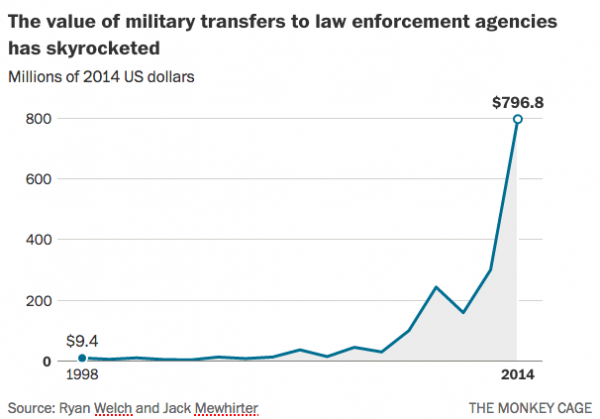
In 1996, the federal government passed a law giving the military permission to donate excess equipment to local police departments. Starting in 1998, millions of dollars worth of equipment was transferred each year. Then, after 9/11, there was a huge increase in transfers. In 2014, they amounted to the equivalent of 796.8 million dollars.

Image via The Washington Post:

Those concerned about police violence worried that police officers in possession of military equipment would be more likely to use violence against civilians, and new research suggests that they’re right.

Political scientist Casey Delehanty and his colleagues compared the number of civilians killed by police with the monetary value of transferred military equipment across 455 counties in four states. Controlling for other factors (e.g., race, poverty, drug use), they found that killings rose along with increasing transfers. In the case of the county that received the largest transfer of military equipment, killings more than doubled.

But maybe they got it wrong? High levels of military equipment transfers could be going to counties with rising levels of violence, such that it was increasingly violent confrontations that caused the transfers, not the transfers causing the confrontations.

Delehanty and his colleagues controlled for the possibility that they were pointing the causal arrow the wrong way by looking at the killings of dogs by police. Police forces wouldn’t receive military equipment transfers in response to an increase in violence by dogs, but if the police were becoming more violent as a response to having military equipment, we might expect more dogs to die. And they did.

Combined with research showing that police who use military equipment are more likely to be attacked themselves, literally everyone will be safer if we reduce transfers and remove military equipment from the police arsenal.

Lisa Wade, PhD is an Associate Professor at Tulane University. She is the author of American Hookup, a book about college sexual culture; a textbook about gender; and a forthcoming introductory text: Terrible Magnificent Sociology. You can follow her on Twitter and Instagram.