Archive: Feb 2017

“Manspreading” is a relatively new term.  According to Google Trends (below), the concept wasn’t really used before the end of 2014.  But the idea it’s describing is not new at all.  The notion that men occupy more space than women is one small piece of what Raewyn Connell refers to as the patriarchal dividend–the collection of accumulated advantages men collectively receive in androcentric patriarchal societies (e.g., wages, respect, authority, safety).  Our bodies are differently disciplined to the systems of inequality in our societies depending upon our status within social hierarchies.  And one seemingly small form of privilege from which many men benefit is the idea that men require (and are allowed) more space.


It’s not uncommon to see advertisements on all manner of public transportation today condemning the practice of occupying “too much” space while other around you “keep to themselves.”  PSA’s like these are aimed at a very specific offender: some guy who’s sitting in a seat with his legs spread wide enough in a kind of V-shaped slump such that he is effectively occupying the seats around him as well.

I recently discovered what has got to be one of the most exhaustive treatments of the practice ever produced.  It’s not the work of a sociologist; it’s the work of a German feminist photographer, Marianne Wex.  In Wex’s treatment of the topic, Let’s Take Back Our Space: Female and Male Body Language as a Result of Patriarchal Structures (1984, translated from the German edition, published in 1979), she examines just shy of 5,000 photographs of men and women exhibiting body language that results from and plays a role in reproducing unequal gender relations.
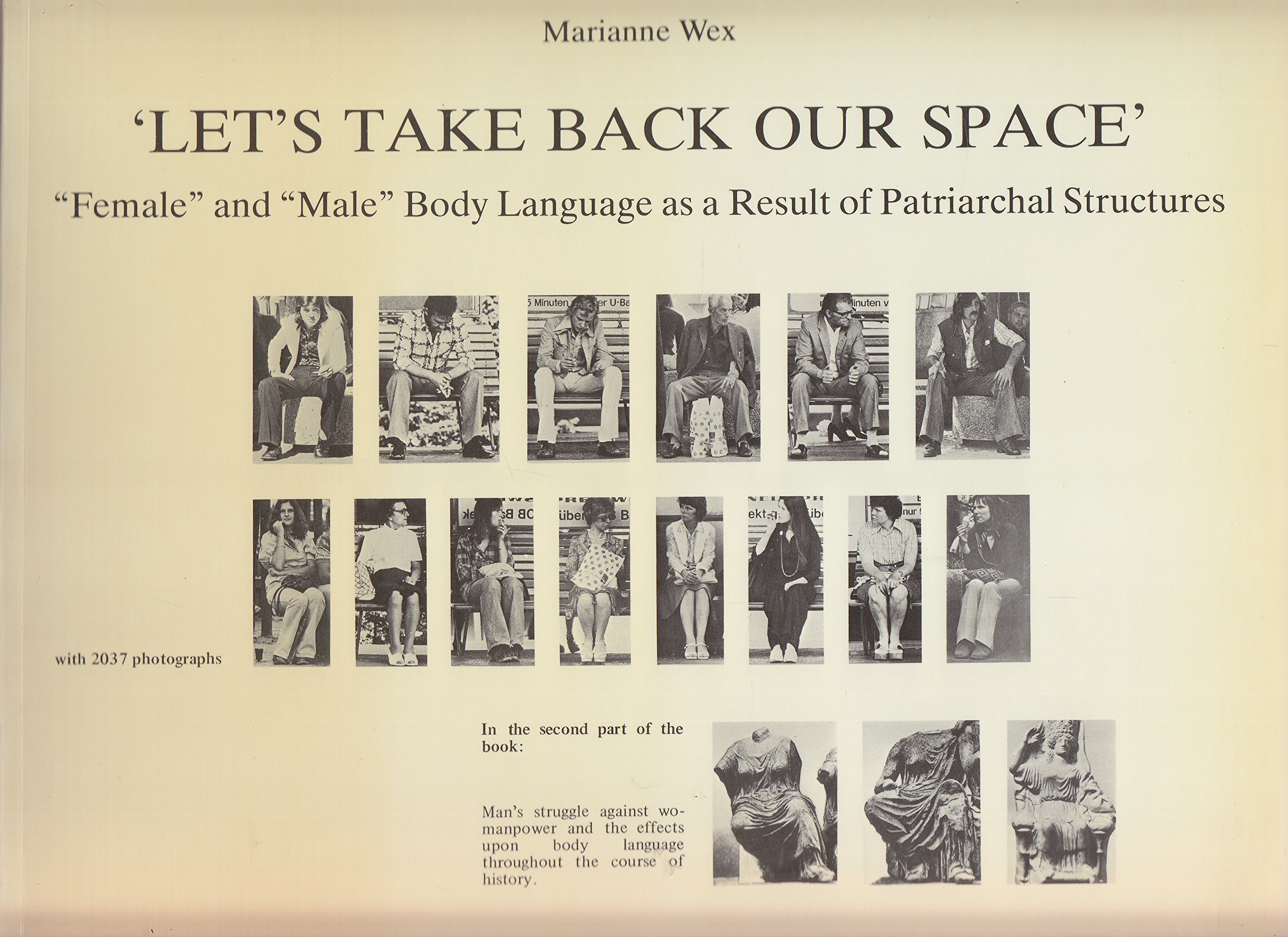
The collection is organized by an laudable number of features of the various bodily positions.  Interestingly, it was published in precisely the same year that Erving Goffman undertook a similar sociological study of what he referred to as “gender display” in his book, Gender Advertisements–though Goffman’s analysis utilized advertisements as the data under consideration.

Like Goffman, Wex examined the various details that made up bodily postures that seem to exude gender, addressing the ways our bodies are disciplined by society.  Wex paired images according to the position of feet and legs, whether the body was situated to put weight on one or two legs, hand and arm positions, and much much more.  And through this project, Wex also developed an astonishing vocabulary for body positions that she situates as the embodied manifestations of patriarchal social structures.  The whole book organizes this incredible collection of (primarily) photographs she took between 1972 and 1977 by theme.  On every page, men are depicted  above women (as the above image illustrates)–a fact Wex saw as symbolizing the patriarchal structure of the society she sought to catalog so scrupulously.  She even went so far as to examine bodily depiction throughout history as depicted in art to address the ways the patterns she discovered can be understood over time.

If you’re interested, you can watch the Youtube video of the entire book.

https://www.youtube.com/watch?v=ScoOF2GDFrM

Tristan Bridges, PhD is a professor at the University of California, Santa Barbara. He is the co-editor of Exploring Masculinities: Identity, Inequality, Inequality, and Change with C.J. Pascoe and studies gender and sexual identity and inequality. You can follow him on Twitter here. Tristan also blogs regularly at Inequality by (Interior) Design.
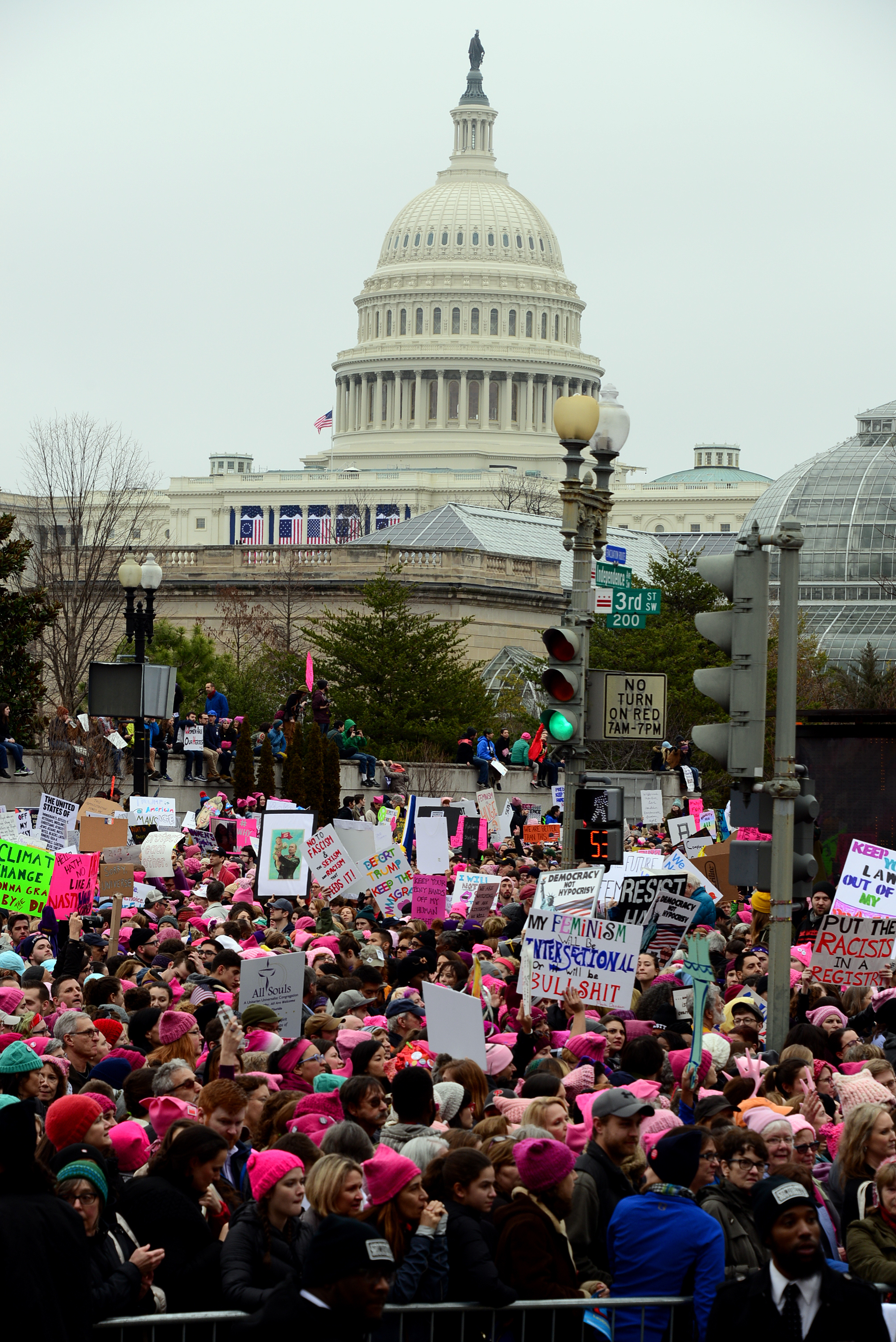
Protestors march in the Woman’s March on Washington D.C. Jan. 21, 2017. The Capital Mall area was the starting point of the march, hundreds of thousands of people attended. (National Guard photo by Tech. Sgt. Daniel Gagnon, JTF-DC).

Waves of pink knitted hats and protest signs packed the streets of D.C. on January 21, 2017, just one day after President Trump’s inauguration drew average crowds. The Women’s March of 2017 was the largest protest in recent history, bringing together over 500,000 people in DC- the location of the flagship march, and over 2.9 million people nationwide. Protesters came from near and far to protect a diverse set of rights that are threatened by the incoming administration. Perhaps the Women’s March can be understood as a partial response to President Obama’s declaration in his farewell address that the most important office in a democracy is “citizen,” and, thus, citizens must work to improve our society, not just when there is an election or when their own narrow interests are at stake. The march was an example of what this kind of democracy looks like. Originally proposed on social media, the idea for the march took off and a groundswell of support emerged from independent individuals and those associated with organizations.  Despite this level of support, many have speculated about who attended the march, whether they voted, the goals of protesters and their level of civic engagement. Some have discounted the protesters as only forwarding the perspectives and issues of white women and eschewing those of other groups such as people of color and/or members of the LGBTQ community.

Combatting this new era of “alternative facts,” a research team led by Dr. Dana R. Fisher, Dr. Dawn M. Dow and Dr. Rashawn Ray from the University of Maryland, College Park provides data-supported facts about participants at the Women’s March. Teams of 2 surveyed participants throughout the march (full details of sampling and methodology available upon request) to understand who was protesting and why. In total, 527 people completed the survey (representing a 92.5% response rate).

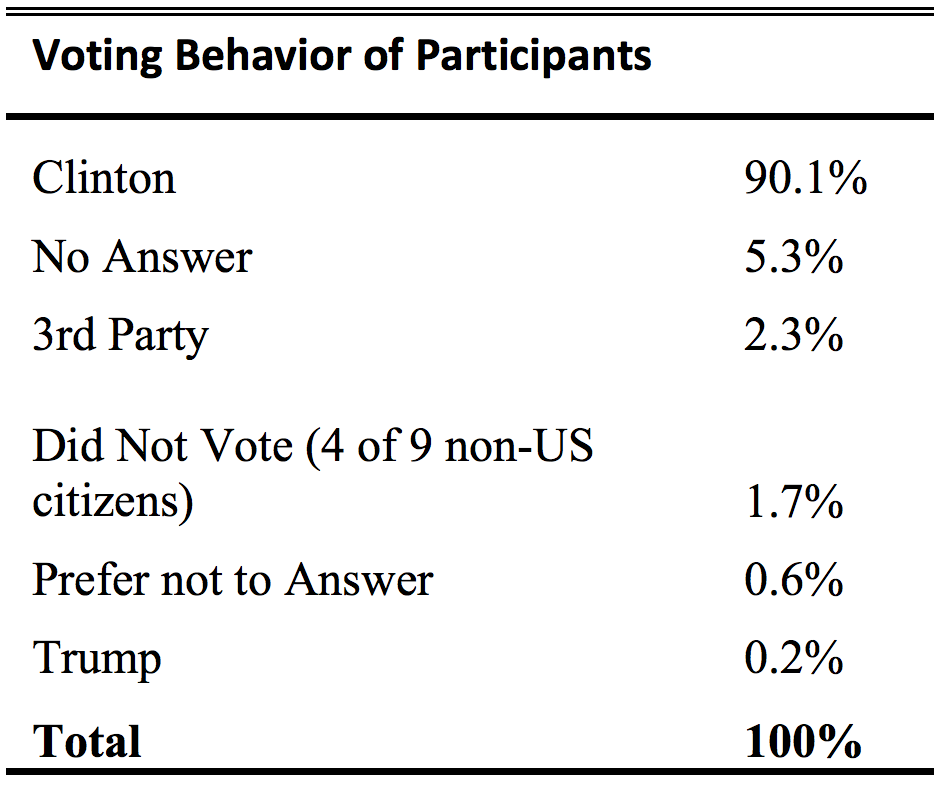
Far from using protesting as a substitute for voting, as a recent tweet from Trump suggested, initial findings from this project show that the protesters at the Women’s March voted, and overwhelmingly for Secretary Hillary Clinton. Among respondents, 90.1% reporting voting for Hilary Clinton, 2.3% voted for a third-party candidate and .2% (one person) voted for Donald Trump. Among the 1.7% who explicitly said they did not vote, nearly half were non-U.S. citizens who are not eligible to do so.

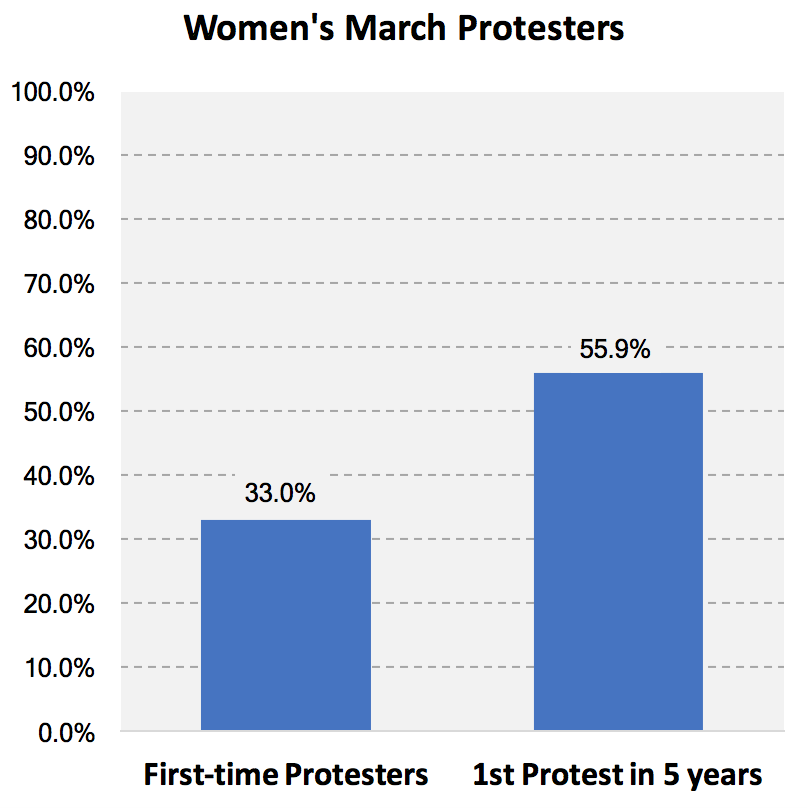
Our findings also suggest that the Women’s March has potentially lit the political fires of a new generation of activists and reactivated the political activism of others. Indeed, a third of the participants reported that the Women’s March was their first time participating in a protest ever. For over half of the participants (55.9%), the March was their first protest in 5 years (including those who had never participated before).

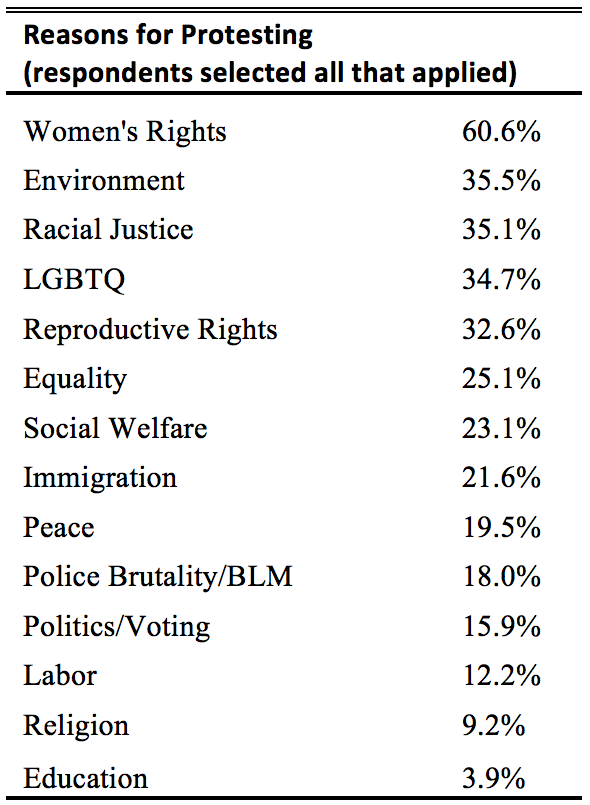
Respondents were also asked to identify the issues that motivated them to protest.  Our data suggest protesters were unified by a range of distinct and overlapping priorities. Given the name of the march, it is not surprising that 60.6% of respondents cited women’s rights as a motivation for protesting.  However, other social issues were also at the forefront of protesters’ minds. Nearly tied for second place, protesters cited the environment (35.5%), racial justice (35.1%), LGBTQ rights (34.7%), and reproductive rights (32.7%) as motivations to attend. Other political issues were also well represented including equality (25.1%), social welfare (23.1%) and immigration (21.6%).  Indeed, rather than representing a narrow set of interests, protesters identified multiple and diverse motivations for participating.

Historically protests focus on one social issue such as equal pay, climate change, voting rights or same sex marriage. The Women’s March was different in that its protesters were seemingly engaged in intersectional activism–a version of activism that is sensitive to how race, class, gender and sexuality complicate inequality. Perhaps the Women’s March is distinct in this way because protesters were not just motivated by concrete issues, but they were also motivated by a desire to protect and reassert a vision of America that embraces diversity and inclusion as a strength rather than a threat. This vision of America is increasingly under attack by the Trump Administration. It remains to be seen how the energy from the march will translate into change locally across the country but recent protests suggest that citizens stand ready to protect their rights and the rights of others.

Dr. Dawn M. Dow is an Assistant Professor of Sociology at the University of Maryland, College Park.  She received a PhD in sociology from the University of California, Berkeley and also earned a JD from Columbia University, School of Law.  Dow’s research examines intersections of race, class and gender within the context of the family, educational settings, the workplace and the law. Her work has been published in journals including Gender & Society, Journal of Marriage and Family and Sociology of Race & Ethnicity.  Follow her on Twitter here.

Dr. Dana R. Fisher is a Professor of Sociology and the Director of the Program for Society and the Environment at the University of Maryland. Her research focuses on environmental policy, civic participation and activism more broadly. She has written extensively on activism and social protest in articles as well as in her second book Activism, Inc. (Stanford University Press 2006).  Fisher’s work on protest builds on data collected from around 5,000 protesters at thirteen protest events in six countries. For more information, go to www.drfisher.umd.edu.  Follow her on Twitter here.

Dr. Rashawn Ray is an Associate Professor of Sociology at the University of Maryland, College Park. Ray obtained a Ph.D. in Sociology from Indiana University in 2010. From 2010-2012 he was a Robert Wood Johnson Foundation Health Policy Research Scholar at the University of California, Berkeley/UCSF. Ray’s research addresses the mechanisms that manufacture and maintain racial and social inequality. His work also speaks to ways that inequality may be attenuated through racial uplift activism and social policy. Follow him on Twitter here.


Originally posted at Everyday Sociology.

When new students move into their residence halls to start their first year of college, they become a part of an institution. In many ways, it is a “total institution” in the tradition of the sociologist Erving Goffman: an organization that collects large numbers of like individuals, cuts them off from the wider society, and provides for all their needs. Prisons, mental hospitals, army barracks, and nursing homes are total institutions. So are cruise ships, cults, convents, and summer camps. Behemoths of order, they swallow up their constituents and structure their lives.

Many colleges are total institutions, too. Being a part of the institution means that students’ educational options are dictated, of course, but colleges also have a substantial amount of control over when students eat, where they sleep, how they exercise, with whom they socialize and, pertinent to our topic today, whether and under what conditions they have sex.

Thumbnail_Press - American Hookup_with frame_978-0-393-28509-3In my newly released book, American Hookup: The New Culture of Sex on Campus, I show that hookup culture is now at the center of the institution of higher education. It’s thick, palpable, the air students breathe; and we find it on almost every residential campus in America: large and small, private and public, elite and middling, secular and religious, Greek- and sports-heavy and otherwise.My own research involves 101 students at two institutions who wrote weekly journals, tracing their trials and tribulations through a semester of their first year, but quantitative and comparative research alike supports hookup culture’s ubiquity. Anecdotally, too, students insist that it is so. “[Hookups are] part of our collegiate culture,” writes a student at the University of Florida. Up north at Connecticut College, a female student describes it as the “be-all and end-all” of social life. Oh, sure,” says a guy 2,500 miles away at Arizona State, “you go to parties on the prowl.” Further up north, at Whitman in Walla Walla, Washington, a female student calls hookup culture “an established norm.”

These comments reveal hookup culture’s pervasiveness, but these students are almost certainly overestimating the frequency of hookups on their campuses. According to the Online College Social Life Survey, a study of over 24,000 students at over 20 institutions, the average graduating senior has hooked up just eight times in four years; a third won’t hook up at all. In fact, today’s students boast no more sexual partners than their parents did at their age. But students can be forgiven for their misimpressions. Hookup culture is a powerful force, leading them to overestimate their peers’ sexual behavior by orders of magnitude.

The topic of my book, then, isn’t just hooking up; it’s hookup culture. Like other cultures, hooking up is a social reality that operates on several levels: it’s a set of widely-endorsed ideas, reflected in rules for interaction and the organization of the institution. Accordingly, hookup culture is the idea that casual sexual encounters are the best or only way to engage sexually in college, a set of practices that facilitate casual sexual encounters, and an organizational structure that supports them.

Students can and do opt out of hooking up, but few can escape hookup culture. Many of the students in American Hookup said so often and explicitly: Partying and hooking up, insisted one, “is the only way to make friends.” “Hookup culture = social life,” another concluded, simply making an equation. “If you do not have sex,” a third wrote forcefully, “you are not in the community.”

Being a part of the community means playing by the rules of hookup culture. It means bringing a certain kind of energy (up, drunken, and sexually available) to certain kinds of parties (dark, loud, and sexually charged). It means being willing to be careless about sexual contact and trying to care less about the person you hook up with than they care about you. It means following a hookup script that privileges male orgasm and a stereotypically male approach to sexuality. It means engaging in competitive sexual exploits: women against women, men against men, and men against women. And it means being stripped of the right to insist upon interpersonal accountability, enabling everything from discourtesy to sexual misconduct.

Some students thrive. About a quarter of the students in my sample truly enjoy hookup culture. Most do not. A third of my students opted out of sex altogether, deciding that they’d rather have none of it than follow hookup culture’s rules. Close to half participate ambivalently, dabbling with mixed results. More students decreased their participation over the course of the semester than increased it.

Almost to the last one, though, students were earnest, thoughtful, and good-humored. Few escaped hookup culture’s grasp, but they never failed to impress me with their insight and resilience. Hearing them tell their stories, it was hard not to feel optimistic, even when the stories did not lend themselves to optimism. I finished the book feeling hopeful. Today’s young people are open, permissive, genuine, and welcoming of diversity. They’re well-positioned to usher in a new new sexual culture.

But students need their institutions to change, too. Institutions of higher education need to put substantial resources and time into shifting cultural norms: they need to establish an ethic of care for casual sexual encounters and they need to diversify the kind of sexual encounters that are seen as possible and good. They also need to change the institutional structures that entrench the worst features of hookup culture, including those that give disproportionate power to the students on campus who most support, participate in, and benefit from it: white, class-privileged, masculine-identified, heterosexual men.

The neat thing about cultures, though, it that they exist only with our consent. We can change them simply by changing our minds. And because residential colleges are total institutions, ones that are bounded and insular, they are particularly responsive to reformation. The new sexual culture on America’s campuses can be improved—made safer, healthier, kinder, more authentic, more pleasurable, and more truly conducive to self-exploration—and faster than we might suspect. I hope that the voices in American Hookup help empower both students and administrators to do just that.

Lisa Wade, PhD is an Associate Professor at Tulane University. She is the author of American Hookup, a book about college sexual culture; a textbook about gender; and a forthcoming introductory text: Terrible Magnificent Sociology. You can follow her on Twitter and Instagram.

The Women’s March in Washington had three times more people in attendance than did President Trump’s inauguration. Many have argued about the reasons for these numbers (see here, here, and here), and used them both individually and together to make claims about activism and political support. But something is missing from these conversations. In order to fully understand the differences in attendance at these events in D.C., and to avoid taking these numbers to mean something they do not, we must account for class and race.

Gender, education and race may have been the biggest rifts in voters this past presidential election, but class is part of this political shift. At least part of why people didn’t show up for President Trump’s inauguration in droves but did show up to the Women’s Marches is a story of class privilege and the cultural capital that comes with it. Upper middle class white women and urban dwellers from all classes had easy access to Women’s Marches, both in D.C. and around the country. Many of Trump’s voters would have had to fly to D.C. Because research shows that only about 50% of the population in the US flies each year, and because that tracks with income and education, Women’s March supporters may have been more likely to fly than Trump voters were. If we look at data from just the five counties with the largest vote share for Trump, we see that, except for Buchanan, Virginia, these locations present great travel distance. Further, President Trump received 4.1% of the vote in Washington, D.C., and lost in surrounding states by large percentages. As CNN points out, a trip to inauguration would be a long one for a critical mass of Trump supporters.

White voters from rural areas and those without a college education represent the largest demographics to turn out for Trump. Many of Trump’s supporters reside in more rural areas that are struggling economically. Cost and familiarity with travel, ease and options in taking time off of work, and geographic proximity to D.C. may have affected participation in Inauguration events. Sociologists talk about cultural capital—or the non-financial goods that help with social mobility beyond economic means. Such capital can include knowledge, skills, and education—things that are both material and symbolic. When Emily lived in rural Arkansas, many people she met had never left the state or in some cases even the county. Indeed, when she told a friend there that she flew home for Christmas and it cost $70, he was surprised that a plane ticket cost less than it did to fill up his truck, because he’d never flown before. Emily’s knowledge of air travel is a form of cultural capital, and one that could put her at an advantage in planning a trip to fly to Washington, D.C. for the March. There is an intimidation that comes from not having done that or been there before—your cultural capital can determine how well versed you are in navigating AirBnB and the slew of cheap flight websites that exist.

Why was the Women’s March so highly attended? Many have analyzed the mass turn-out in D.C., nationally, and internationally. For the first time, the Women’s March brought out highly educated, more affluent white women who have the forms of capital to plan and attend a weekend in D.C. Of course, there were many—millions, in fact—who did not go to D.C., but who showed support in sister marches around the country and globe. For many, their lack of attendance in D.C. could be due to the same barriers that perhaps inhibited many from attending the Inauguration. For others, their participation was possible because demographics likely to participate in Women’s Marches – LGBTQA+ folks and people of color – are more likely to reside in urban communities. But to compare these attendance rates without talking about class, and without talking about the mobilization of white women, muddies the realities of who is ready and willing to act at more local levels.

While the Women’s March may have kicked off a movement that has the tools in place for success, we need to remember that Trump’s path to success was unpredicted. To take his inauguration attendance numbers to mean that his initial supporters have changed their minds or that Trump has lost political support would be a potentially grave mistake. To take what is now the largest protest in U.S. history as evidence of mass, continued mobilization, that may also be inaccurate. White women are just starting to show up—will they continue to do so? In talking about the intersections of class and race, we remember who is able to mobilize and show support when, and we must bring these intersections to the fore in future conversations about mobilization and activism.

Sarah Diefendorf is a PhD candidate in Sociology at the University of Washington. Her research centers on sexuality, gender, and evangelical religious groups. You can follow her on Twitter here.

Emily Kalah Gade is a PhD candidate in Political Science at the University of Washington. Her research centers on political violence, civil resistance and militancy.