
Archive: Jan 2017

If there’s one thing Americans can agree upon, it might be that people shouldn’t be indiscriminately firing guns crowds, no matter how angry they are. The shooting in the Ft. Lauderdale airport is just the latest example. Mass shootings are on the rise and I’m fearful that what we are seeing isn’t just an increase in violence, but the rise of a new habit, a behavior that is widely recognized as a way to express an objection to the way things are.

To register an objection to something about the world, a person or group needs to engage in an action that other people recognize as a form of protest. We know, in other words, what protest looks like. It’s a strike, a rally, a march, a sit-in, a boycott. These are all recognizable ways in which individuals and groups can stake a political claim, whereas other group activities — a picnic, a group bike ride, singing together — are not obviously so. To describe this set of protest-related tools, the sociologist Charles Tilly coined the phrase “repertoire of contention.” Activists have a stock of actions to draw from when they want to make a statement that others will understand.

A culture’s repertoire of contention is in constant evolution. Each tool has to be invented and conceptually linked to the idea of protest before it can play this role. The sit-in, for example, was invented during the early civil rights movement. When African American activists and their allies occupied white-only restaurants, bringing lunch counters to a halt to bring attention to the exclusion of black people, they introduced a new way of registering an objection to the status quo, one that almost anyone would recognize today.

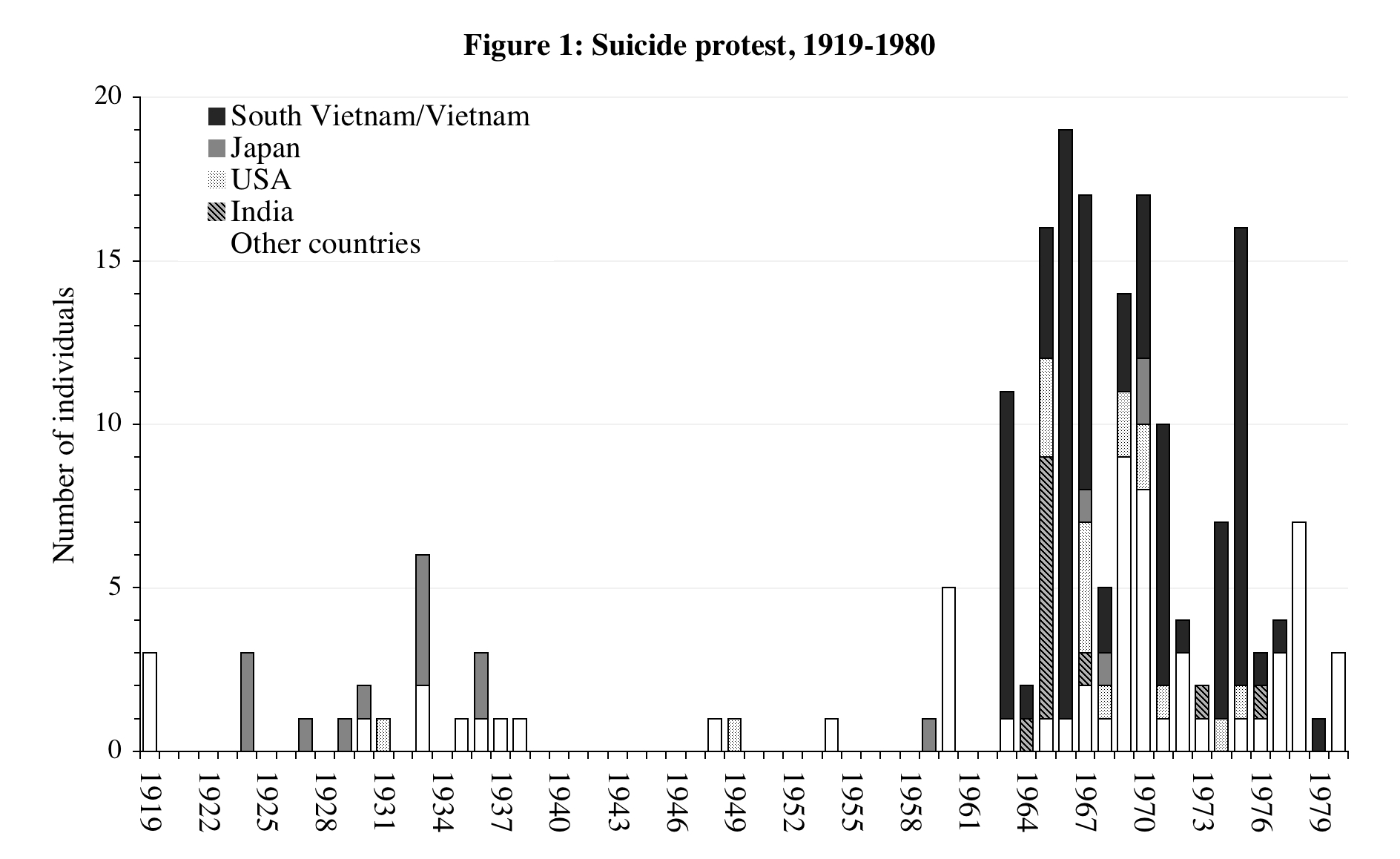
New ways of protesting are being invented every day: the hashtag, the hacktivist, and shutting down freeways are some newer ones. Some become part of the repertoire. Consider the image below by sociologist Michael Biggs, which shows how suicide as a form of protest “caught on”  in the 1960s:
2

I am afraid that mass murder has become part of the repertoire of contention. This is theoretically tricky – others have fought over what really counts as a social movement action – but it does seem quite clear that mass murder with a gun is a more familiar and more easily conceptualized way of expressing one’s discontent and then it was, say, pre-Columbine. If a person is outraged by some state of affairs, mass killing is a readily available way to express that outrage both technically (thanks to gun regulation) and cognitively (because it is now part of the recognized repertoire).

Dylann Roof wanted to register his discontent with the place of black people in American society, Robert Lewis Dear stormed a Planned Parenthood with a pro-choice message, Elliot Rodgers was angry about women’s freedom to reject him, Omar Matteen killed dozens to express his (internalized) disgust for homosexuality, Gavin Long communicated his sense of rage and helplessness in the face of black death by killing police. At some point each thought, “What can I do to make a difference?” And mass murder came to mind.

In the aftermath of such events, the news media routine contributes to the idea that mass murder is a form of protest by searching for an explanation above and beyond the desire to kill. That explanation often positions the rationale for the murder within the realm of politics, whether we call it terrorism, resistance, or prejudice. This further sends the message that mass murder is political, part of the American repertoire of contention.

The terrifying part is that once protest tools become part of the repertoire, they are diffused across movements and throughout society. It’s no longer just civil rights activists who use the sit-in; any and all activists do. Perhaps that’s why we see such a range of motivations among these mass murderers. It has become an obvious way to express an objection that the discontented can be sure others will understand.

Lisa Wade, PhD is an Associate Professor at Tulane University. She is the author of American Hookup, a book about college sexual culture; a textbook about gender; and a forthcoming introductory text: Terrible Magnificent Sociology. You can follow her on Twitter and Instagram.
Originally posted at Work in Progress.

Why do people sometimes resist remediation of pollution in their own backyards? Conventional academic wisdom suggests that it is because they are afraid of losing their jobs, but my recent research in La Oroya, Peru, questions this dominant framework.

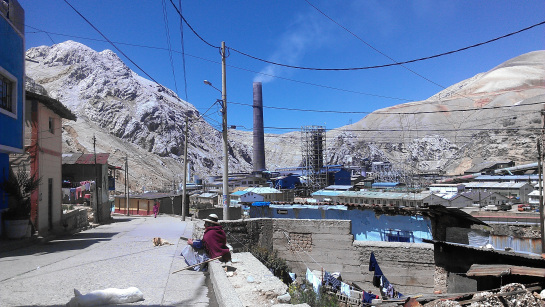
Photo by Pamela Neumann.

Since 1922, La Oroya has been home to three refineries for processing lead, copper, and zinc, and a lead smelter owned until recently by a company called Doe Run Peru. In the late ’90s, several scientific studies demonstrated dangerously high lead levels among the town’s children.

The findings drew extensive attention from the media, but not the kind that some residents appreciated. Tania, a local schoolteacher told me, “In the media there are these ideas that we are nothing but a bunch of slow, sick, contaminated people, but they don’t pay any attention to how some students are very high performing.” Elena, a 45-year old shop owner, agreed, saying: “Of course there are sick children everywhere, slow children, just like in your country [referring to the United States]. But we have children who are doing well, we have professionals, professors.”

School teachers and principals took pride in the achievements of their students, which they felt were ignored in the rush to paint La Oroya as nothing more than a town full of “mongolicos” (a local term for people who have Down’s syndrome or are disabled). In seeking to defend their town’s identity against a barrage of negative media coverage, some residents denied that the contamination was a problem at all. “Look at all the awards we’ve won,” one principal told me, pointing to a row of trophies on the wall. “We couldn’t have done this if the contamination was really a problem.”

In response to the media portrayals, many residents became reluctant to protest against the pervasive lead contamination because doing so affirmed negative stories about their town’s identity. Residents weren’t protective of their jobs, they were protective of their town and of their own reputation as “normal” and “good,” not a place full of “mongolicos.”

These findings suggest that heavy-handed exposes of polluted cities and towns might do harm as well as good. Environmental activists might be better served to find a balance between condemning pollution and uplifting the places and people who are its victims.

Pamela Neumann, PhD is a Post-Doctoral Fellow at the Stone Center for Latin American Studies at Tulane University. A longer version of this post can be found at Work in Progress.

Late last year Covergirl announced a new spokesmodel, a 17-year-old named James Charles. Their Instagram announcement currently boasts over 53,000 likes, though the comments on the post were decidedly mixed. They ranged from “I will never buy another (coverGIRL) because of this” to  “love love love” and “the world is coming to equality and acceptingness.”

In my circles, the overwhelming response was enthusiasm. Charles’ ascendance to Covergirl status was evidence that gender flexibility was going mainstream. And, I suppose it is.

I am always suspicious, though, of corporate motives. Covergirl’s decision to feature Charles does serve to break down the gender binary, but it does other things, too. Most notably, if makeup companies could convince boys and men that their product is as essential for them as it is for girls and women, it would literally double the size of their market.

That this hasn’t happened yet, in fact, is evidence of the triumph of gender ideology over capitalism. Either companies have decided that there’s (almost) no market in men or men have resisted what marketing has been applied. It’s an impressive resistance to what seems like an obvious expansion. There’s just no money in men thinking their faces look just fine as they are; the fact that we’ve allowed them to do so thus far is actually pretty surprising when you think about it.

If Covergirl had its way, though, I have no doubt that it would make every 17-year-old boy in America into a James Charles. Such a change would contribute to breaking down the gender binary, at least as we know it (though no doubt there are more and less feminist ways of doing this). Of course, if it was advantageous to do so, Covergirl would claim that it had something to do with feminism. But, I wouldn’t buy it.

Lisa Wade, PhD is an Associate Professor at Tulane University. She is the author of American Hookup, a book about college sexual culture; a textbook about gender; and a forthcoming introductory text: Terrible Magnificent Sociology. You can follow her on Twitter and Instagram.