
In the aftermath of the revelation that Facebook has been manipulating our emotions – the one that prompted Jenny Davis to write a post titled Newsflash: Facebook Has Always Been Manipulating Your Emotions – the folks at OkCupid admitted that they been doing it, too.
I’ll let you debate the ethics. Here’s what Christian Rudder and his team found out about attractiveness. Let me warn you, it’s not pretty.
OkCupid originally gave users the opportunity to rate each other twice: once for personality and once for score. The two were strikingly correlated.
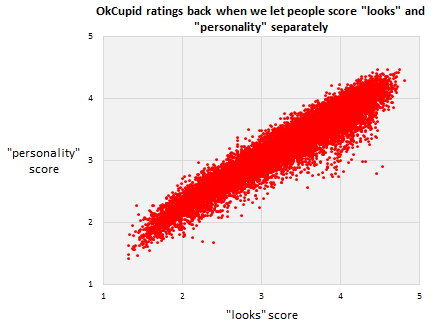
Do better looking people have more fabulous personalities? No. Here’s a hint: a woman with a personality rating in the 99th percentile whose profile contained no text at all.

Perhaps people were judging both looks and personality by looks alone. They ran a test. Some people got to see a user’s profile picture and the text and others just saw the picture. Their ratings correlated which means, as Rudder put it: “Your picture is worth that fabled thousand words, but your actual words are worth… almost nothing.”
Their second “experiment” involved removing all of the pictures from the site for one full workday. In response, users said something to the effect of hell no. Here’s a graph showing the traffic on that day (in red) compared to a normal Tuesday (the dotted line):
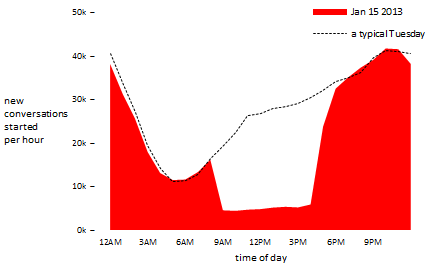
When they put the pictures back up, the conversations that had started petered out much more aggressively than usual. As Rudder put it: “It was like we’d turned on the bright lights at the bar at midnight.” This graph shows that conversations started during the blackout had a shorter life expectancy than conversations normally did.

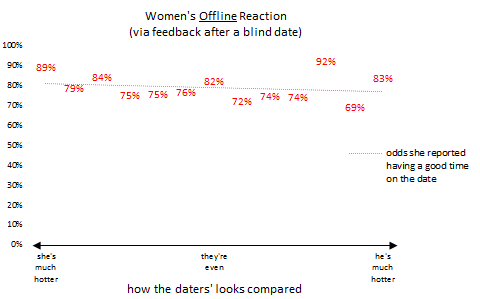
It’s too bad the people are putting such an emphasis on looks, because other data that OkCupid collected suggests that they aren’t as important as we think they are. This figure shows the odds that a woman reported having a good time with someone she was set up with blind. The odds are pretty even whether she and the guy are equally good looking, he’s much better looking, or she is. Rudder says that the results for men are similar.
Comments 5
kristina1 — August 19, 2014
Huge fan, but the "admitted that they'd been doing it, too" is ridiculous. "Tried to point out that people are vastly overreacting" is more accurate. Every major website runs traffic experiments. It's like being shocked, shocked! that the New York Times runs advertisements.
Bill R — August 19, 2014
All these contrived social science experiments get us nowhere. Is this the state of sociological research today? Sad...
Looks might benefit people in the short term but believe me, take politicians and the entertainment business out of the equation and physical attractiveness does NOT equal success.
The 1%ers are plain-looking or worse. That bunch fought back and won. And looks does NOT seem to correlate with happiness at all!
At some point most of those pouty-looking 25-year old girls in bikinis aren't taking the prizes. Hate to tell ya...but nutty research data yields nutty results. Graphs and pro-style stats don't fool us.
Let's step it up.
Do better looking people have better personalities? | BroadBlogs — September 3, 2014
[…] By Lisa Wade, PhD @ Sociological Images […]
Weesly 18 Weesly — June 27, 2021
如果想从零开始学economics代写,建议从微观和宏观入手。因为微观更容易从自身行为或业务运作的角度去理解,而宏观更抽象,更难学习。学完微观和宏观,接下来的问题是怎么学。学习无非就是读书,思考,做题。没有捷径。对于micro经济学,需要阅读几本流行的经济学教科书,然后确定一个精读。高红叶的《微观经济学》、萨缪尔森的《经济学》和曼昆的《经济学》都是经典的教科书,各有advantages and disadvantages。高红叶的书更适合exam,Samuelson的书与曼昆的书更有利于发展经济思惟。记住:多提问! 目前,许多培训机构编制了关于微观经济学的辅助性学习材料,可以作为援助使用。
tarea อุบล — December 29, 2022
This post is written in a good manner and has a lot of useful information for me.
tarea อุบล