
A few years back I posted an photograph of two costumes side-by-side: labeled “Beer Man” and “Beer Girl.” I wrote that the practice of using “man” alongside “girl” “reinforces a gender hierarchy by mapping it onto age.” We see this outside of a Halloween context too, like in this vintage ad for pens.
Sara P. found another example, this time from iparty. The flyer puts a girl and a boy side-by-side in police officer costumes. The boy’s is labeled “policeman” and the girl’s is labeled “police girl.”
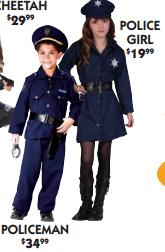
This phenomenon is an example of just how mundane and ubiquitous gender messages can be.
Lisa Wade, PhD is an Associate Professor at Tulane University. She is the author of American Hookup, a book about college sexual culture; a textbook about gender; and a forthcoming introductory text: Terrible Magnificent Sociology. You can follow her on Twitter and Instagram.
Comments 7
Peter S — October 31, 2012
I find reading the posts at http://www.everydaysexism.com/ highlights the same problem. Mundane and ubiquitous is right. Even people who would declare themselves to hate these messages find it hard not to slip into repeating these patterns.
Elena — November 1, 2012
Also, skirts are mandatory. 'Cos you're a GIRL, girl.
mimimur — November 1, 2012
Adding insult to injury, she actually looks older than him.
Geoffrey — November 1, 2012
At least the manufacturers have priced in the difference in the amount of material - the male costume is 15 bucks more than the female one!
You're Not Left Yet — December 3, 2013
Look at how the boys' belt is loose and jauntily low-slung about the hips, while the girls' is distinctly defining her waist.
vivian-li — July 14, 2014
Not surprising in the least -- the misogynistic tendency to infantilize grown adult women by referring to them as "girls" has long been a nasty foothold in our society.