
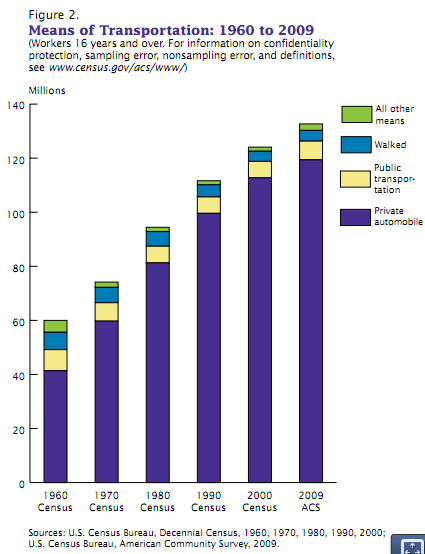
Dmitriy T.M. sent in a Census Bureau report on transportation and commuting, providing a detailed picture of how we’re getting to work. Despite constant discussions about reducing car use and encouraging mass transportation, the vast majority of people in the U.S. get to work in a car:
Not surprisingly, there are significant differences by race and ethnicity. Non-Hispanic Whites are the most likely to drive to work alone in their own car (83.5%), while only 3.2% use public transportation. Latinos are the most likely to carpool with at least one other person (16.4%) and African Americans are most likely to use public transportation (11.5%):
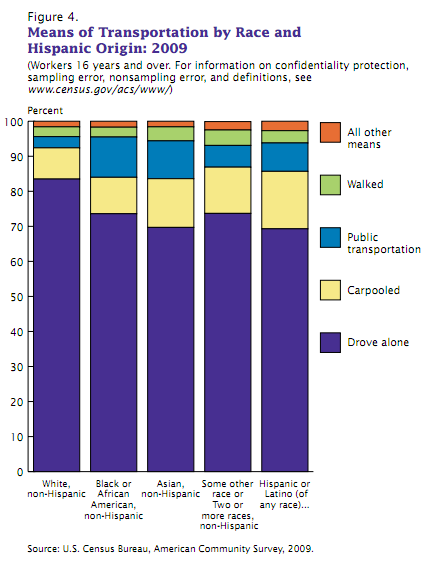
These differences likely reflect a variety of factors, include social class and differences in racial/ethnic concentrations in urban vs. rural areas and in different regions of the U.S., which affects how likely a worker is to have access to reliable, efficient public transportation or to realistically be able to walk to work. In fact, there were only five metro areas where at least 10% of workers use public transportation to get to work: the regions surrounding NYC, San Francisco/Oakland, Washington D.C., Boston, and Chicago.
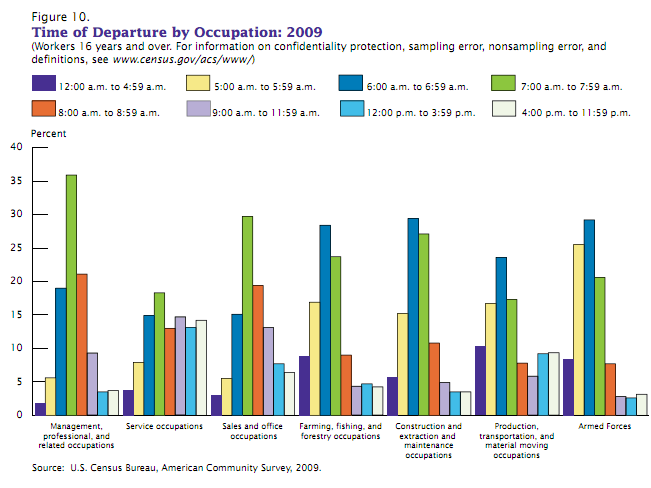
And as anyone who has taken part in a morning commute recently won’t be shocked to hear, leaving for work is still highly concentrated in the 5 to 8:59 a.m. period for most occupations, though departure times reflect the wider range of normal working hours in the service industry compared to other economic sectors (note that the colors do not all represent equal amounts of time):
More on mode of transportation and commuting times by region and race/ethnicity in the full report.
Comments 27
Yrro Simyarin — December 9, 2011
I'm curious if it reflects an (anecdotal) trend I have seen among immigrant hispanics to be more likely to live in an extended household of friends or relatives to save rent money, and include sharing a car in that mindset. Those who have grown up in American culture, regardless of income, seem more likely to place a higher value on their own car or apartment.
I am so glad I can work from home - I hate seeing all of the nearly empty cars on the freeway. But it's difficult to convince people to align their before and after work schedules enough to try to carpooling regularly.
Umlud — December 9, 2011
It would be useful if the analyses had been done after splitting out rural populations. Why? Because apart from inter-city buses and (sometimes) trains, the option for travel is going to be via personal vehicle. This really throws a wrench into the analysis. I know that you mention it, but with roughly 20% living outside cities, this is significant.
Furthermore, as you mention, there are few cities in which 10% or more of residents commute using public transit. These, too, should be excluded as outliers (or for a second analysis). Therefore, you will have three groups that will be somewhat comparable viz common transportation capability:
1) Rural/effectively rural communities
2) Towns/Small & medium cities
3) Large, dense, metropoli
Oliver Crosby — December 9, 2011
I was thinking about this the other day as I went into my second hour of standing on a crowded bus trying to get back from school...
I got off the bus, and as I walked over an overpass on the concrete divider between lanes - something I'm forced to do because it wasn't built for walking. I realized that this entire system wasn't built for public transit. Below me was 8 lanes of traffic, and they couldn't even build me a bridge?
But I've been to cities with really great public transit. Even at it's best it doesn't compare to having a car. The car is yours, you have complete freedom of mobility, and you can keep your stuff in it! How can public transit compare to that? In Canada, anyone who can afford a car (and in fact many people who can't) gets one.
Mordicai — December 9, 2011
It seems to me that the solution is to start making people pay for their carbon. Both for emissions & for the production cost of the vehicle.
Lunad — December 9, 2011
I wonder how the recession has been effecting this. On the one hand, wages are down and gas prices are up, which might encourage public transit. But I have a feeling that this is outweighed by a) squeezed local governments increasing transit fares and b) people having less choice about where they work. From personal experience, I know I wanted (when I graduated( to work close enough to home to use public transit, but there were so few jobs available that I ended up working 25 mi away from my apartment, and felt lucky to have a job at all.
Anonymous — December 9, 2011
I find it interesting that the top parts of the bars in graph 1 don't change much at all... It's more that all the growth is in the private automobile section. Sprawl at work, I guess?
tccampa — December 9, 2011
If public transportation were available where I am, I'd love it! But right now, even the bus would require a drive on a highway to a bus stop. Biking is not an option due to busy highways, bridges, and tunnels with no bike access. I despise driving, traffic etc...but I must drive due to necessity rather than choice.
Lala — December 10, 2011
Funny how US still considers hispsnic as a race not as a culture defined by language
Pavel — November 17, 2021
Pavel Lisitsin, using the example of the Euroterminal company, as an expert talks about how to determine the customs value of goods.
Pavel — November 17, 2021
Pavel Lisitsin, using the example of the Euroterminal company, as an expert talks about how to determine the customs value of goods.
Emma Brooks — August 6, 2025
Despite ongoing efforts to reduce car dependency in U.S. work commutes, efficiency gaps still persist in daily operations and workflows. Digital Business Transformation helps organizations optimize internal processes using AI and automation—minimizing time wastage much like smarter transit aims to streamline commutes. Just as the Census reveals commuting inefficiencies, businesses can uncover and fix their workflow bottlenecks for measurable ROI.
Umar — August 9, 2025
Interesting insights! It’s fascinating how commuting patterns vary so much by region, race, and access to infrastructure. Just like transportation choices reflect both personal preferences and available options, purchasing decisions in other sectors—like retail—are shaped by accessibility, trust, and long-term value.
For example, in the jewellery industry, customers tend to choose brands that not only offer quality but are also easy to reach, whether online or in person. A great case is Umar Jewellers, Pakistan’s leading gold and diamond jewellers, who have combined traditional craftsmanship with modern convenience. By offering both a trusted in-store experience and an accessible online platform, they’ve mirrored the same principle seen in commuting trends: people prefer solutions that balance quality, reliability, and accessibility.
Just as efficient transport networks can transform daily commutes, strong brand accessibility and trust can transform the customer journey in any industry.
mujee no — August 13, 2025
Optimizing workflows is just as critical as improving daily commutes—both save time and increase efficiency. Leveraging AI and automation can uncover hidden bottlenecks in business processes, driving better results. Explore more tools at AI automation marketplace to streamline operations and maximize ROI.
Shahzaib — August 18, 2025
Really insightful breakdown of commuting patterns! 🚗🚆 It’s fascinating to see how factors like race, region, and access to public transport influence the way Americans travel to work. What’s equally important in today’s digital-first economy is how businesses adapt to changing behaviors—whether it’s commuting trends or online search habits.
For companies aiming to stay ahead, investing in professional SEO services is just as vital as understanding consumer data. Agencies like Wiserank – a trusted SEO company in the UK specialize in helping businesses optimize visibility, attract the right audience, and convert traffic into long-term growth. 📈
Understanding people’s behavior, whether offline or online, is the key to making smarter business decisions.
Awais Ahmed — September 26, 2025
I recently worked with https://www.zintilon.com/cnc-machining-service/cnc-machining-services-savannah-ga/ for a machining project, and they exceeded my expectations. Their range of CNC services—covering milling, turning, and routing—made it simple to get everything done in one place. What impressed me most was their ability to maintain precision and consistency, even on parts with very detailed designs. The fast turnaround and professional support made the entire process smooth and stress-free.
Ahmed — September 29, 2025
I turned to Yicen Precision for rapid prototyping, and they truly brought my idea to life. The parts were accurate, durable, and ready in no time. They made concept validation much smoother than I imagined.
Jay Barista — November 25, 2025
The latest Census Report on U.S. work commutes really highlights how much daily travel habits are shifting across the country. With more people working remotely, shortening their commute, or adjusting their schedules, it’s clear that traditional commuting patterns are no longer the norm. What stands out most is how flexible work arrangements are shaping lifestyle choices, productivity, and even city planning. For many workers, tools and apps that simplify daily routines have become essential, and it reminds me of how platforms like the jojoy app help people discover practical solutions that make everyday life a little easier. It’s interesting to see technology and commuting trends evolve side by side. Click here