Archive: 2010

Tom Megginson of Change Marketing and Kandirra sent us a stunning example of the objectification of women in advertising. It’s a commercial for Rosgosstrakh, the largest insurance company in Russia, advertising their car insurance. How do they do so? By painting pictures of vehicles on (headless) women’s breasts and showing various hands fondling/smushing/jiggling them.

Reader lizardbreath pointed out that showing breasts on TV wouldn’t be as shocking in a lot of cultures as it would be in the U.S., which I think is a valid point. What makes it seem objectifying to both of us isn’t just the breasts themselves, but the headless women (so you have disembodied breasts). I also noticed that at one point a woman pushes the (also disembodied) male hands away, which implies she’s being groped when she doesn’t want to be.
more...


The Quesada Mexican Grill in Canada tries to claim authenticity (“real Mexican”) by, ironically, invoking Western stereotypes of Mexicans:

Hat tip to Copyranter.

Lisa Wade, PhD is an Associate Professor at Tulane University. She is the author of American Hookup, a book about college sexual culture; a textbook about gender; and a forthcoming introductory text: Terrible Magnificent Sociology. You can follow her on Twitter and Instagram.

Dimitriy T.M. sent in another interesting link, this time to an interactive map that presents IRS data on inter-county moves — that is, how many people moved from one county to another in 2008, and where they moved to. The map doesn’t capture all moves, since the IRS only presents data if at least 10 people from a county moved to a particular destination county (so a county could have a lot of out-migration, but if people really spread out when they moved, it wouldn’t show up). Despite that limitation, it does highlight some interesting general trends.

For instance, people from counties with big cities move to a variety of places, often far away from where they started (note that the width of the line indicates the number of immigrants, red = out-migration and black = in-migration, and the destination counties show up in blue):

On the other hand, if you look at most counties in the U.S. that don’t have large metropolitan areas, you see that most movement is to relatively nearby counties. Here’s an example from North Dakota:

I suspect that the number of migrants in rural areas is going to be under-represented, since their smaller overall populations may make it more likely that less than 10 people would move to any particular place, so that’s important to keep in mind.

Also not surprisingly, counties with universities see a lot of migration, both in and out, and to a wide variety of destinations. Here is Dane County, the site of the University of Wisconsin-Madison:

When I was looking around, I randomly clicked on Sweetwater County, Wyoming. I was surprised to see quite a bit of in-migration from distant counties:

I don’t know what’s going on there. There isn’t a university in the county. Does anyone know enough about Wyoming to have a guess?

UPDATE: Reader Caitlin says it’s related to  oil production. Thanks for the info, Caitlin!

Anyway, it’s a sort of fun map to mess around with.

Mindy J. and Andrea F. sent in a really interesting project by artist Nathan Vincent.  Vincent recreates masculine items and ideas with feminine crafts in order to upset the gender binary.  He explains:

My work explores gender permissions and the challenges that arise from straying from the prescribed norms. It questions the qualities of gender by considering what constitutes masculine and feminine. It critiques stereotypical gender mediums by creating “masculine objects” using “feminine processes” such as crochet, sewing, and applique.

For example:


More examples of his work at his site.

Lisa Wade, PhD is an Associate Professor at Tulane University. She is the author of American Hookup, a book about college sexual culture; a textbook about gender; and a forthcoming introductory text: Terrible Magnificent Sociology. You can follow her on Twitter and Instagram.

Katrin discovered a particularly ironic bit of photoshopping.  The first picture is of Rosie Huntington-Whiteley on a photo shoot, the second is her ad for the Victoria’s Secret “I Love My Body” ad campaign.  Notice that the body she is supposedly loving has significantly more cleavage than the body we see in the first photo.  Apparently even models’ bodies are unlovable without re-touching (or surgery?).

Lisa Wade, PhD is an Associate Professor at Tulane University. She is the author of American Hookup, a book about college sexual culture; a textbook about gender; and a forthcoming introductory text: Terrible Magnificent Sociology. You can follow her on Twitter and Instagram.

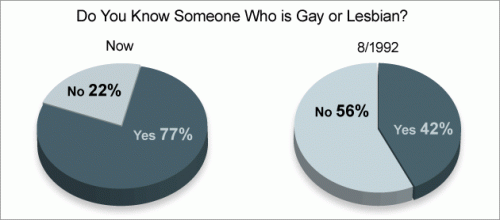
Dimitriy T.M. sent in a link to an article at CBS news about changing attitudes toward gays and lesbians. The poll found that the proportion of people who say they know someone who is gay or lesbian has increased dramatically since 1992:

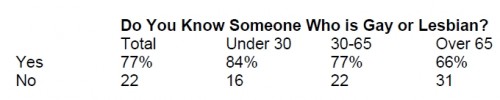
This differs quite a lot by age, however:

It seems likely that the difference is a reflection of increased visibility of gays and lesbians in our culture, such that younger people know more people who openly describe themselves as gay. In general, knowing someone who is gay is correlated with more positive attitudes toward gays and lesbians.

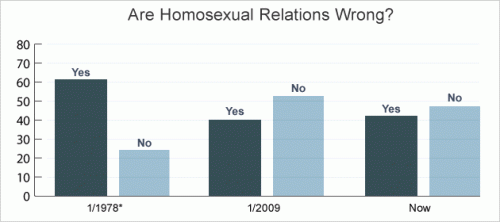
Over time people have also become more accepting of gays and lesbians, though the number saying homosexual relations are wrong has increased slightly between 2009 and 2010 (from 41 to 43 percent).

Over half of Americans believe there should be legal protections to prevent discrimination against gays and lesbians.

The wording of questions seems to affect people’s reported attitudes, with people being slightly less tolerant when relationships are described as “homosexual” than when the term “same-sex” is used:

If younger people are more accepting of gays and lesbians than older generations, it seems that we can expect more increasingly positive attitudes over time, unless it turns out that people become less tolerant of gays and lesbians as they get older. Overall, the responses here seem to justify some optimism about increasing gay rights and decreasing discrimination.

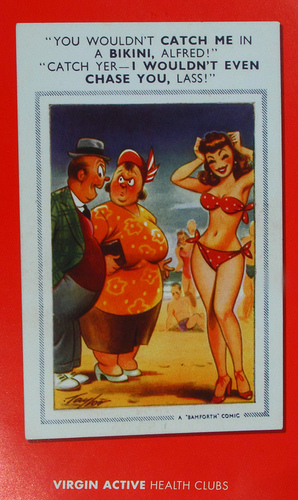
Vintage ad?

Nope. This ad for Virgin Active Health Clubs arrived in D’s mailbox this very month.

Credit: “D & T” of “Wish I Were Baking” at Flickr.

Lisa Wade, PhD is an Associate Professor at Tulane University. She is the author of American Hookup, a book about college sexual culture; a textbook about gender; and a forthcoming introductory text: Terrible Magnificent Sociology. You can follow her on Twitter and Instagram.

A reader who asked to remain anonymous sent in a video about a recent interview by Star Jones with the lawyer for Kelsey Peterson, a teacher accused in 2007 of fleeing to Mexico in order to live with a 13-year-old student of hers (he was 12 at the time they began having sex together). In the interview, the lawyer for Peterson says he “resents” the boy being referred to as a child because he is a “Latino machismo teenager” (a phrase that doesn’t even make sense) and “manly”:

Notice that the lawyer also argues, at about 1:25, that teen boys have a high sex drive, which somehow excuses an adult woman having sex with a 12-year-old. In addition, at 3:30 in Jones mentions that some individuals have implied the kid couldn’t be a victim because he was physically larger than other kids his age (5′ 6″ in 8th grade, which doesn’t sound super unusual to me); it sounds like Peterson’s defenders have questioned his age because of his size.

Jones calls him out on his implication that Latino teens are hyper-sexual and therefore this boy shouldn’t be seen as a victim. At about 5:45 one of her guests discusses the adultification of non-White children — that is, the way they are often treated as adults, regardless of their age. Ann Arnett Ferguson discusses this process at length in her book, Bad Boys: Public Schools in the Making of Black Masculinity. This adultification includes assumptions that they are sexual at earlier ages than White children.

From what Jones and one of her guests say, it also appears that the fact that he was an undocumented immigrant has also been used as a way to undermine his ability to claim victim status. At about 7:55 a guest discusses the way that referring to people as “aliens” dehumanizes them, making it easier to deny them equal legal protection. (Side note: Jones mentions the history of immigration in the U.S. and in doing so says everyone in the U.S. is descended from immigrants, something Native Americans might find surprising, though I suppose if you go back a few thousand years to the migration from Asia to North America, technically yes, they are immigrants.)

When I searched for news stories about the case, I came across one at ABC news in which the boy is described as “a sexually-active sixth-grade student with a crush on her,” which seems to me to be reminiscent of the way female rape victims are often asked about their sexual history, as though they cannot be true victims if they have been sexually active.

The ABC story contains this quote from Peterson’s lawyer:

From the beginning, he was trying to entice her. There’s no question about that…He would try to kiss her, he would grab her, he would do these things. She didn’t initiate this relationship. That young man did.

Again the blame is placed not on the adult woman but on a 12-year-old boy. Peterson says she was shocked the first time he kissed her, which was in her kitchen — a place that maybe a thinking person wouldn’t have a 12-year-old student in. She also says his parents knew about and were fine with their sexual interactions; they dispute this.

Perhaps drawing on the stereotype of macho Latino men, her lawyer said,

He used to tell her what she could wear. And whether she could wear makeup and the length of her skirts in terms of where they were gonna go and what they were gonna do…He had a very, very strong influence over her in terms of controlling her behavior.

The comments to the ABC story are pretty fascinating too.

This is a disturbing example of the way that boys, and particularly non-White boys, are generally denied victim status when it comes to sex because our cultural beliefs include the idea that boys want sex and attempt to get it at an early age, and thus can’t really be vulnerable to sexual assault or coercion. For another example, see this post about how Jimmy Kimmel reacts when Lil’ Wayne confirms that he lost his virginity at age 11.