Archive: 2010

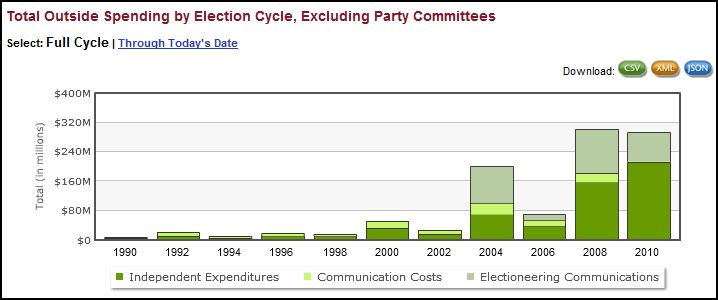
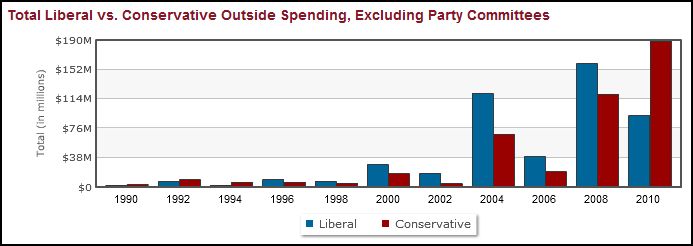
In 2010, as a matter of free speech, the United States Supreme Court decided that there can be no limits on corporate spending on advertisements in favor of a political candidate (Citizens United v. Federal Election Commission).  Open Secrets produced two figures revealing the rise in “outside spending” (i.e., non-party spending) showing the rise.

Total outside spending:
Outside spending for liberals and conservatives:
Open Secrets explains:

…the 2004 election marked a watershed moment in the use of independent expenditures to try to sway voters, with most of that new spending coming from the national party committees.  The 2010 election marks the rise of a new political committee, dubbed “super PACs,” and officially known as “independent-expenditure only committees,” which can raise unlimited sums from corporations, unions and other groups, as well as wealthy individuals.

Hermes’ Journeys editorializes:

You can see that liberals slightly outspent conservatives every election since 1996. Except for this year, when quite suddenly a mysterious flood of funding caused conservative campaign coffers to skyrocket, DOUBLING what liberals could muster. Was this the result of concerned right-leaning citizens becoming active in politics and making individual donations?  Of course not, it was profit-minded corporations…

…enabled, if I may finished HJ’s sentence, by the recent court decision.

Lisa Wade, PhD is an Associate Professor at Tulane University. She is the author of American Hookup, a book about college sexual culture; a textbook about gender; and a forthcoming introductory text: Terrible Magnificent Sociology. You can follow her on Twitter and Instagram.


A couple of weeks ago I posted a vintage ad referring to Bolsheviks and an interesting discussion ensued about the difficulty of knowing how seriously people would have taken ads at the time they were made and whether the ad would have been seen as a parody at the time. We have a tendency to see ourselves as particularly witty, sophisticated consumers of media and to think people in the past were more straight-forward, credulous, and took things at face value (I’ve certainly been guilty of it), as though sarcasm and parody are recent inventions.

I thought of that when I saw the video Michael M. sent in. It was made as an in-house joke by a producer of commercials in the 1960s and makes fun of cliches used in commercials at the time. It’s slightly NSFW–there are exposed breasts at about 4:10 in, as a reader pointed out.

It also, of course, pulls the curtain back on the advertising industry a bit. As Michael says,

We’ve all seen parodies of the old 50s and 60s style commercials, but I thought it very interesting (and telling) to see it parodied at the time of production, in knowing fashion by the very people who make them. These advertisers were well aware they were selling a fantasy.

Gwen Sharp is an associate professor of sociology at Nevada State College. You can follow her on Twitter at @gwensharpnv.


In this seven-minute video, Economist Jeffrey Sachs explains why economic development in Africa remains elusive. He summarizes the geographical, technological, social, and political conditions that held Africa back but propelled parts of Asia forward (he compares to India). Development, he notes, is not simply a matter of wishful thinking and hard work on the part of Africans (as many like to claim), nor is it a matter of just doing what worked elsewhere (as others like to say), but instead requires institutional commitments, economic resources, and global political will.

Lisa Wade, PhD is an Associate Professor at Tulane University. She is the author of American Hookup, a book about college sexual culture; a textbook about gender; and a forthcoming introductory text: Terrible Magnificent Sociology. You can follow her on Twitter and Instagram.

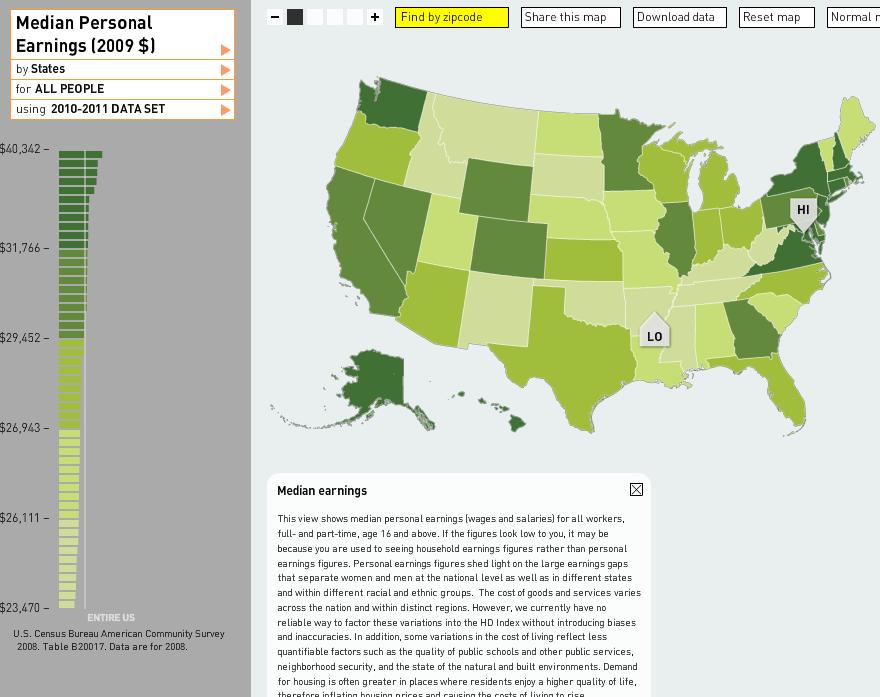
Dmitriy T.M. and Jeff H. sent in a link to Mapping the Measure of America, a website by the Social Science Research Council that provides an amazing amount of information about various measures of economic/human development in the U.S. Here’s a map showing median personal (not household) earnings in 2009:

The District of Columbia has the highest, at $40,342; the lowest is Arkansas, at $23,470 (if you go to their website, you can scroll over the bars on the left and it will list each state and its median income, or you can hover over a state).

You can break the data down by race and sex as well. Here’s median personal income for Native American women, specifically (apparently there is only sufficient data to report for a few states):

Native American women’s highest median income, in Washington ($22,181), is  lower than the overall median income in Arkansas, which is the lowest in the U.S. as we saw above.

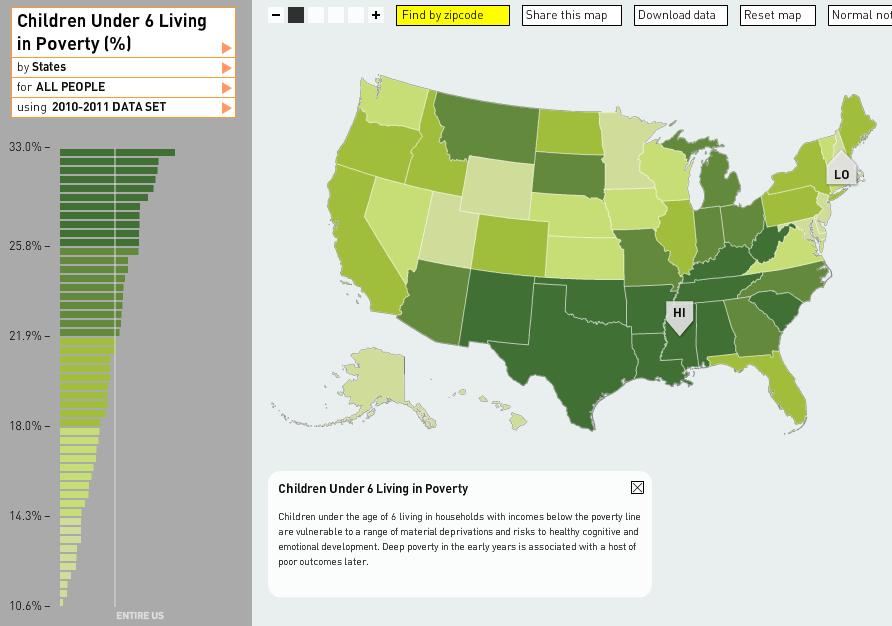
Here is the percent of children under age 6 who live below the poverty line (for all races):

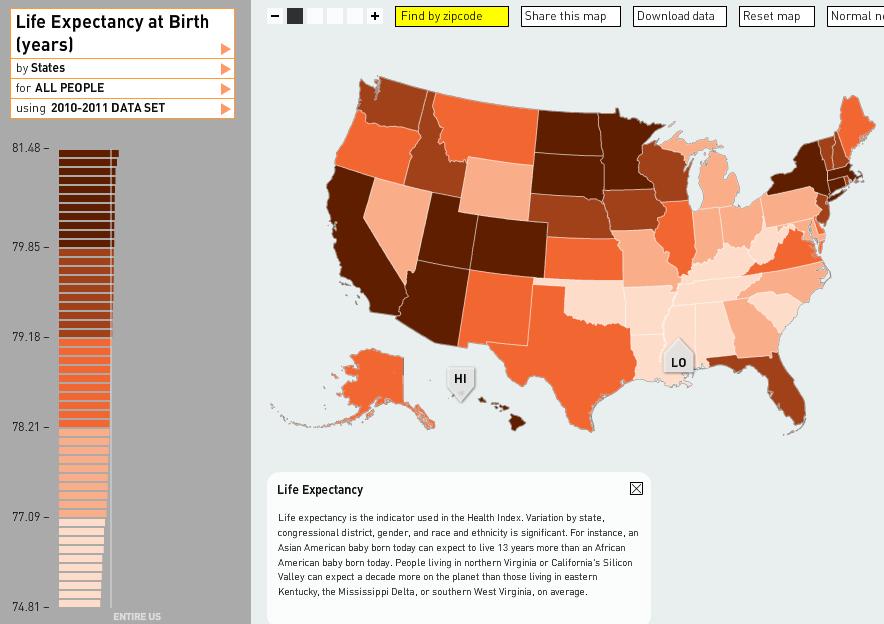
Life expectancy at birth differs by nearly 7 years between the lowest — 74.81 years in Mississippi — to the highest — 81.48 years in Hawaii:

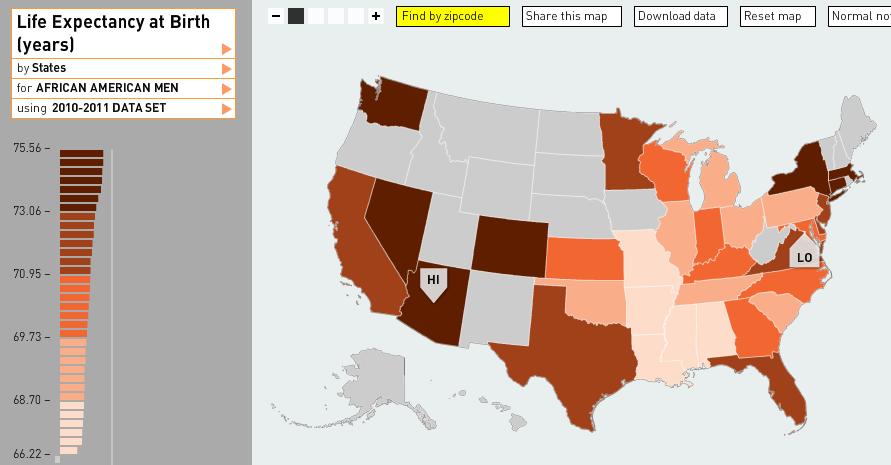
It’s significantly lower for African American men, however, with a life expectancy of only 66.22 years in D.C. (again, several states had insufficient data):

The site has more information than I could ever fully discuss here (including crime rates, various health indicators, all types of educational attainment measures, commuting time, political participation, sex of elected officials, environmental pollutants, and on and on), and it’s fairly addictive searching different topics, looking data up by zip code to get an overview of a particular area, and so on. Have fun!

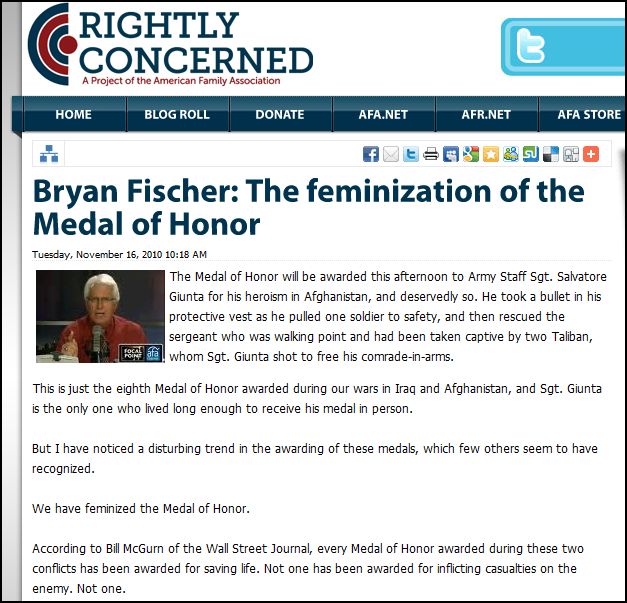
Rich sent in a fascinating example of an attempt to redefine masculinity.  At Rightly Concerned, Brian Fischer argues that the fact that all of the recipients of the Medal of Honor awarded during the Iraq and Afghanistan wars have received the award for saving lives, not taking them.  He calls this trend “the feminization of the Medal of Honor.”

Let’s not get into a conversation about whether the Medal should be awarded for saving lives, taking lives, or both.  Instead, let’s consider what, exactly, Fischer is saying about men and masculinity.  Fischer is suggesting that saving lives is something that women (should) do.  He has arranged saving lives and taking them in a binary layered onto gender.  Women save; men kill.  When men save, they are doing something feminine.

This is in dramatic contrast to the vision of the heroic man who protects others that has long been part of the American imagination (think firemen, policemen, body guards, big brothers, dads, boyfriends, and husbands) and a very interesting example of an attempt to redefine what “real men” do.

Lisa Wade, PhD is an Associate Professor at Tulane University. She is the author of American Hookup, a book about college sexual culture; a textbook about gender; and a forthcoming introductory text: Terrible Magnificent Sociology. You can follow her on Twitter and Instagram.
The “Republican Wave” in 23 seconds, courtesy of Stephen Colbert:

Via Don Waisanen at Thick Culture.

Lisa Wade, PhD is an Associate Professor at Tulane University. She is the author of American Hookup, a book about college sexual culture; a textbook about gender; and a forthcoming introductory text: Terrible Magnificent Sociology. You can follow her on Twitter and Instagram.


Nickey Robare and Maile Martinez, of Reel Grrls, put together a video discussing coverage of several celebrities who have recently lost weight, including the way that changes in body size are linked to changes in personality, with women becoming nicer when they get thinner:

Thanks to Nickey for sending it to us!

Cross-posted at Jezebel.

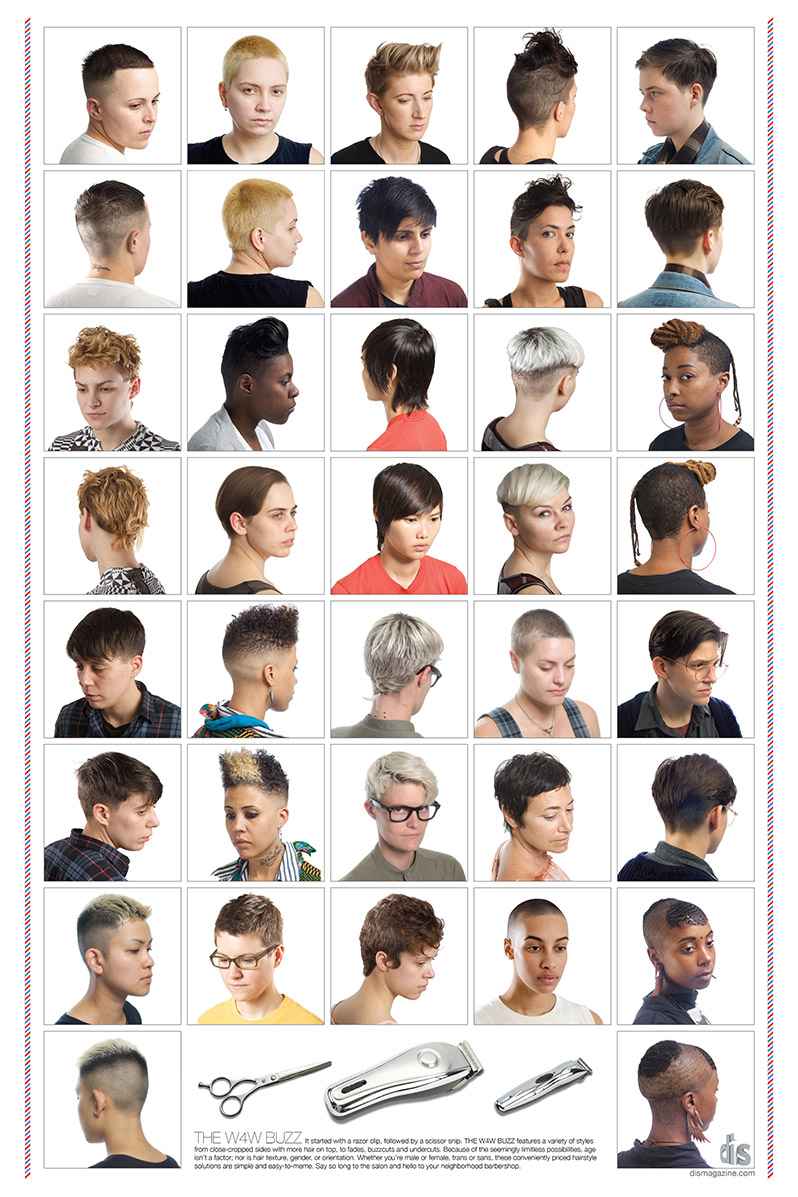
In an effort to disrupt the dominant images about what women’s hair should look like, Lauren Boyle and Marco Roso created an alternative aspirational beauty salon poster that offers women a set of hairstyles usually associated with lesbians.  The collection of these creative and varied haircuts bring into stark relief the hyperfeminized options most women encounter at the salon.

At DIS magazine; thanks to Marco for the submission.

Lisa Wade, PhD is an Associate Professor at Tulane University. She is the author of American Hookup, a book about college sexual culture; a textbook about gender; and a forthcoming introductory text: Terrible Magnificent Sociology. You can follow her on Twitter and Instagram.