Archive: 2008

In this nine and a half minute clip, Tim Wise describes the way in which race was invented by elites in early America in order to divide and conquer the working class… and is still used to do so.

Found here via Alas A Blog.

Lisa Wade, PhD is an Associate Professor at Tulane University. She is the author of American Hookup, a book about college sexual culture; a textbook about gender; and a forthcoming introductory text: Terrible Magnificent Sociology. You can follow her on Twitter and Instagram.

Miguel in Barcelona sent us this government-sponsored poster aimed at promoting egalitarian relationships. He translates the text as:

The love has to be free
Free of machismo
Free of fights
Free of jealousy

This image, as a representation of idealized egalitarian love, is a nice contrast to the representations of love common in the U.S. (and in Spain?) that make power asymmetry sexy, desirable, and constitutive of love. Consider the love affair between this apple and pear and these two images (which look more like the fruit than Miguel’s image above):

Thanks to Miguel for sending us our first image from Spain!>

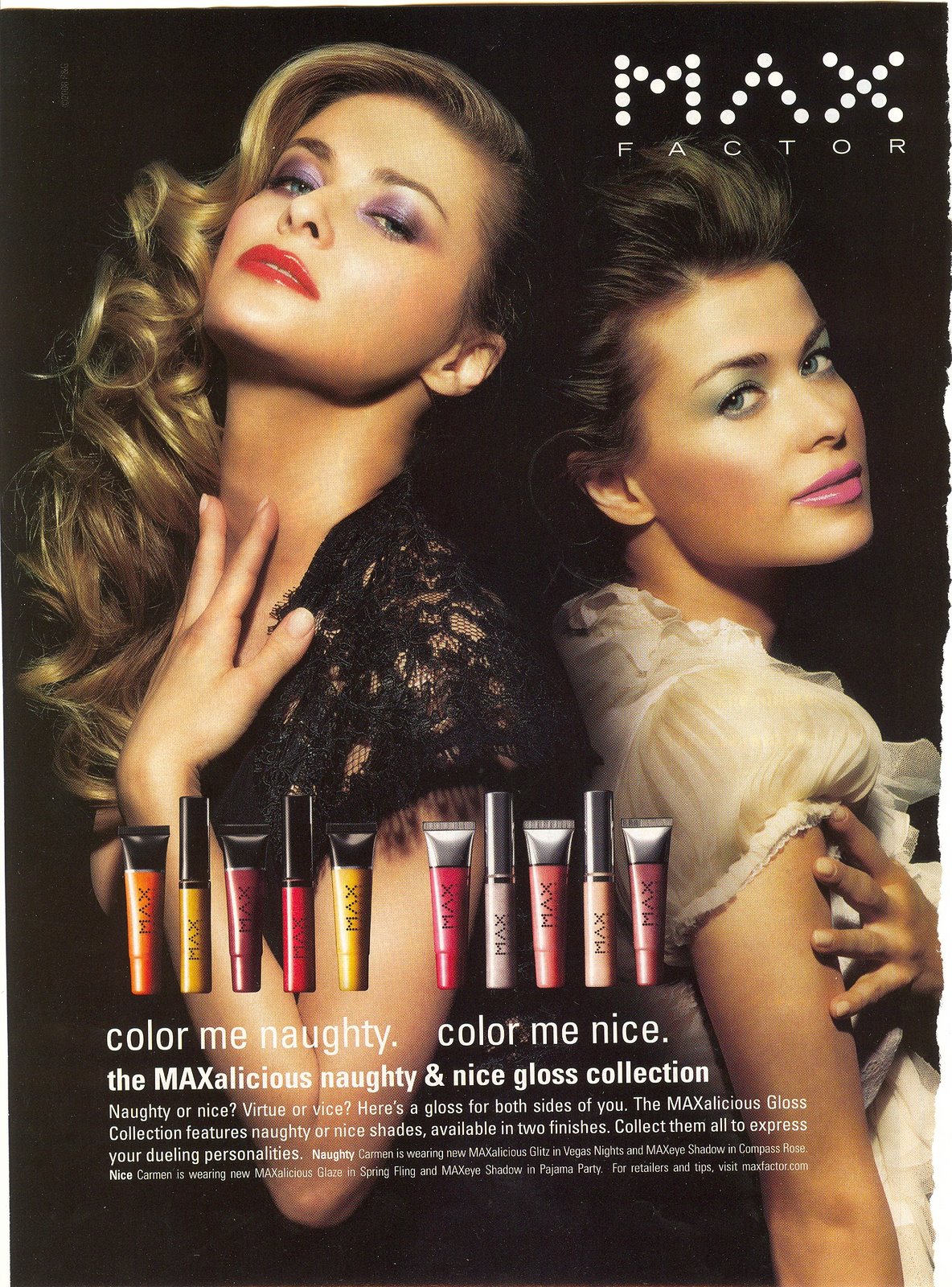
The new virgin/whore dichotomy: We should be both! But at different times, of course.

Text:

Color me naughty. Color me nice. MAXalicious naughty & nice gloss collection. Naughty or nice? Virtue or vice? Here’s a gloss for both sides of you. The MAXalicious Gloss Collection features naughty or nice shades, available in two finishes. Collect them all to express your dueling personalities.

See also this post about the virgin/whore dichotomy.

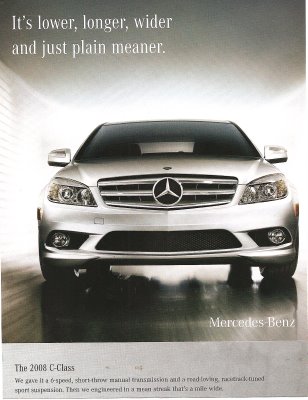
The last line says, “Then we engineered in a mean streak a mile wide.” Can you imagine such a marketing campaign for a Honda Civic or a VW Passat? This is a man’s car–it takes up more space, and it’s mean–characteristics we allow (some) men, but not women, to have.

Note: I like the commenters’ points that this intersects with class more (as well?)–see the comments. They did a better job with the analysis on this one than me.

NEW:

This ad (found here) plays up the fact that some cars are designed to look “mean,” so the Jaguar is actually afraid of the BMW:

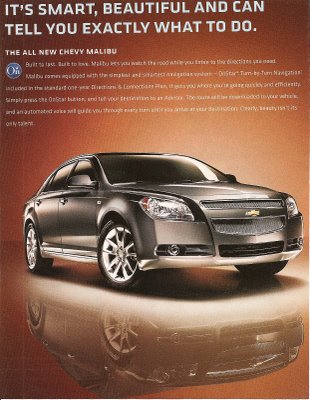
Compare the ads above to these two that link a car and beauty. The first one seems to be portraying the car as a beautiful but bossy woman (“…can tell you exactly what to do”):

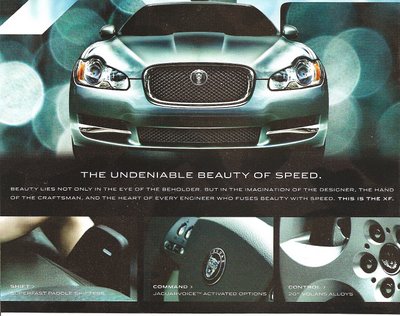
It’s an interesting contrast–these three cars all look very similar, and yet one is mean/masculine and the other two are beautiful/feminine. I like to show comparisons like these in class to make it clear to students that advertisers have many different motifs and meanings to draw from when creating marketing strategies, and that the ones they pick are just that–CHOICES among many, many different ways you could advertise a product, none of which are necessarily more “obvious” or “natural” than others.

The Home Made Simple Squad is a new ad campaign for Proctor & Gamble cleaning products. Five women make up the Squad. From Lori’s bio:

‘I love to entertain in my home, and when people come over, I want them to walk in and immediately feel welcome and comfortable. So I make sure my house is always looking good and smelling fresh.’ Lori, 37, prides herself on her clean and well-organized home that’s always ‘company-ready’. Lori is disciplined about more than just caring for her home – she’s also recently lost 95 lbs, and keeps fit with a regimen of healthy eating, power walking and yoga.

So not only is she a good housekeeper, she keeps herself fit and trim, too!

Although all of the bios mention that the women have children and are busy, not a single one mentions a husband, partner, or other adult who might have some role in keeping a house clean. Or, for that matter, making the kids clean up after themselves.

Thanks to an anonymous commenter on another post for bringing my attention to this one!

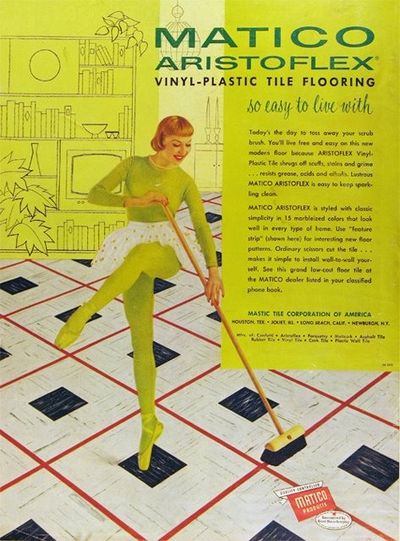
NEW! This vintage ad relates sweeping the floor to dancing… because cleaning vinyl-plastic tile flooring, unlike cleaning other kinds of floors, is a kick!

6a00d83451ccbc69e2011570fdce1f970c-400wi

An Anonymous Reader sent another example of the message that women absolutely love cleaning!  The bucket reads, “What could be better than this?”  I suppose it could be tongue-in-cheek, but I’m not getting that vibe.

Gwen Sharp is an associate professor of sociology at Nevada State College. You can follow her on Twitter at @gwensharpnv.

Here is an image for the website from Just for Men’s Touch of Gray line:


This product covers most, but not all, of a man’s gray hair. From the website:

Why use Touch of Gray? A little gray to show your experience, but not so much
that it hides your vitality.

There are a range of shades available and you can control how much gray is hidden.

The website has a total of four images of men with women. As Vanessa V., who sent this one in, pointed out, none of the women have a “touch of gray.” Nor could she imagine a product like this marketed to women.

Here is another example of an ad that gives men permission to age in a way women never are.

Other men’s hair dye posts: here, here, and here.

Thanks, Vanessa!

NEW: Corey O. found a Just for Men commercial that references Woodstock (sadly, I can’t find a video of it). Corey says,

It has everything you could want in an advertisement: classic rock soundtrack, co-opted counterculture, mixed messages about aging, demonstrations of male virility, minorities on the margins, gender disparity, and attempts to sell a “natural” look. The total package. What really got to me, though, was the gender aspect. Can you imagine a line of hair dye marketed toward women which is meant to leave some grey intact? I don’t think that Just for Men can either — in contrast to the silver-streaked men, none of the women in the ad are sporting a natural look and some look like they’ve had rather recent visits from the botox fairy. This ad is a nice way of illustrating the double-standard that women face in regards to aging: while men can benefit from grey hair as an illustration of their maturity without sacrificing their virility, women must always strive to look as young as possible. Because this is an ad for men’s hair dye, however, it also illustrates that while men may benefit from less scrutiny of their appearance than women, their appearance is also satisfactory only with the use of beauty aids.

I also like the appropriation of Woodstock and the counter-culture movement of the ’60s.

Thanks, Corey!

Gwen Sharp is an associate professor of sociology at Nevada State College. You can follow her on Twitter at @gwensharpnv.

This image demonstrates the disproportionality in the marriage market across the United States (found here). Basically, if you’re a single, heterosexual woman on the west coast or a single, heterosexual man in the New York area, you’re in luck!

NEW! This map is now available in an interactive form in which you can choose which age group to look at.  Below I’ve pasted in screen shots of my current dating pool (30-45) and what I have to look forward to (yikes!).  Click here to interact with the map yourself.

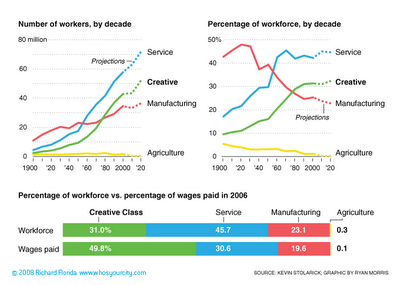
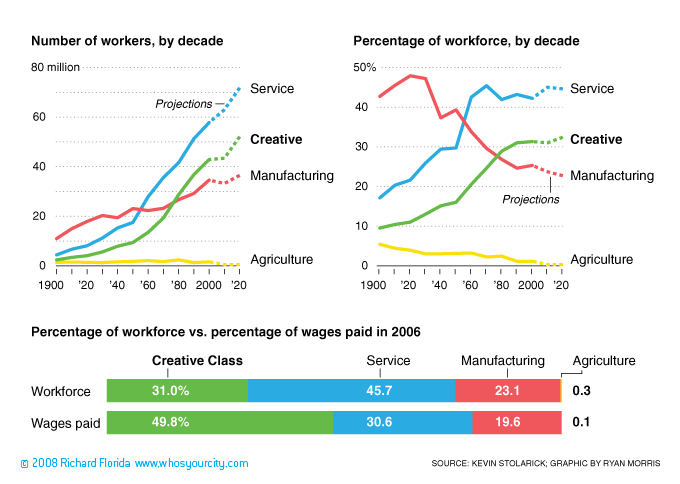
This figure demonstrates the shift from an economy dominated by manufacturing, to one dominated by information and services. As I understand it, it is this shift that is driving the shrinking of the middle class.


Image borrowed from http://www.whosyourcity.com/.