Archive: Nov 2008

This Australian commercial for Toyota Corolla (found here) includes a homogenous, racialized out-group.  More after the video:

[youtube]http://www.youtube.com/watch?v=Ckb-wUHj9WU[/youtube]

The term “out-group homogeneity” refers to the way in which members of an in-group tend to overestimate the extent to which members of an out-group are all alike.  I suppose we don’t know what good kitty’s friends look like (do they all look exactly like him?), but we certainly have the presentation of an out-group that is both categorically different from good kitty and homogeneously so.

I would also like to suggest that that out-group is racialized.  They didn’t use just any kind of cat to represent bad kitties, but a dark-colored cat.   (If I know my cats, the bad “guys” in this video are Russian Blues.)

Update: The confusion in the comments brought to my attention that I embedded the wrong commercial.  See!  I’m not crazy!  Just incompetent.

Enjoy the corrected post:

At least that’s the message I’m taking from this Utah Tourism advertisement featuring anthropomorphized snowflakes (found here):

[youtube]http://www.youtube.com/watch?v=78RZ-UgIMrM[/youtube]

Blanca M. sent in this clip by Penn and Teller, in which a woman gets people at a World Fest rally (which appears to be an environmental event of some sort) to sign a petition to ban dihydrogen monoxide…commonly known as water:

[youtube]http://www.youtube.com/watch?v=yi3erdgVVTw[/youtube]

You might use it in a discussion of social psychology and the way that people tend to go along with what they see other people doing and to do what they are asked or instructed to do without asking many questions (that is, if someone asks you to sign a petition, very often you will, whether or not you really know what it’s about). You could also use it to talk about perceptions of environmental risk, and how bad we are at evaluating it: if something has a chemical-sounding name, we tend to assume it’s bad (but if it sounds “natural,” we think it must be safe).

I think it would be a good clip for talking about political participation and the limitations of passive forms of participation such as these: the require very little of people, so while they might be quick to sign, they’re unlikely to know much about the issue or to follow up. My guess is that politicians keep this in mind, too. Burk M. was a Senate campaign consultant for a while and says that though written petitions are generally taken seriously by elected officials (particularly if signed by constituents and delivered personally in the presence of a media outlet), email petitions are completely ignored (I knew it!) because there’s no real concern that the people who signed it will ever check back in to see what happened (assuming they’re real people to start with). Government agencies, such as the EPA, may not show as much concern for even printed petitions, since they are not made up of elected officials who fear their constituents might be watching what they do. Thus, these forms of minimal-involvement political participation may make people feel like they’re doing something about an issue, when in fact there is little impact (particularly in the case of email petitions).

Thanks, Blanca!

Michael T. sent in an observation about the Yes on Proposition 8 website, which (successfully) aimed at amending the California constitution to disallow gay marriage.  Along the top of the screen, the four different images below accompanied the slogan “Restoring Marriage & Protecting California Children.”  These marriages, Michael surmises, must be the ones that need protecting.   In addition to reproducing heteronormativity and childbearing, notice that the images are self-consciously diverse, but represent all marriages as within race.


Thanks Michael!

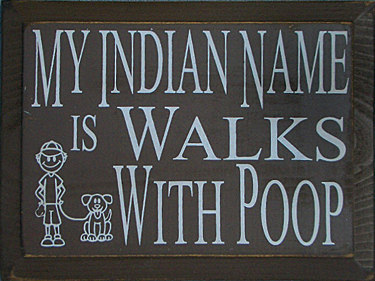
Recently I saw this wood sign for sale in a catalog (available here, if you really want one):

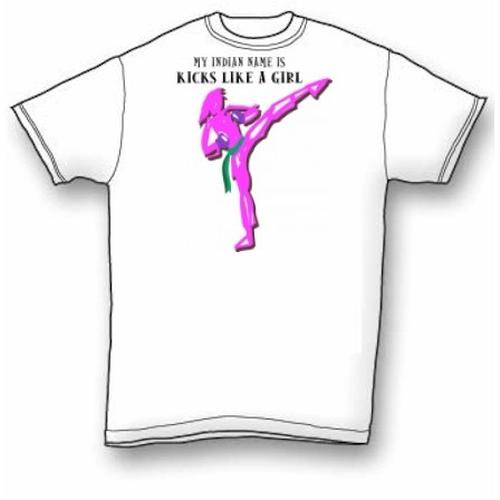
Looking around online I found this t-shirt here, which combines the “My Indian name is” element with a twist on “kicks like a girl”:

I have seen things like this before, and they always irritate me (and I blame the movie “Dances with Wolves” for the whole “Indian names always follow the pattern ‘Present-Tense Singular Verb + With + Noun'” idea). There’s an element of othering here–the idea that American Indian names are funny or weird. Part of what I think is considered funny is that the names are presumably tied to actual activities or things (for example, Mankiller or Redbird). Of course, many European surnames originated the same way (for instance, “Smith” was a surname often used to indicate the person was a blacksmith, silversmith, etc.), but they now hold the status of “normal” surnames that are unremarkable (although Smith has become somewhat remarkable as a symbol of White non-ethnic normality, such that it is often used in movies and TV shows as an alias by spies and others wishing to avoid attention).

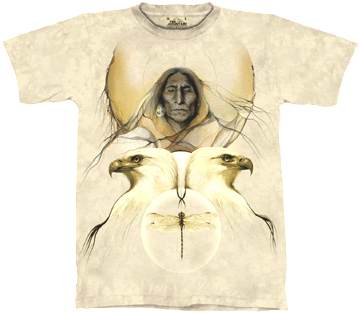
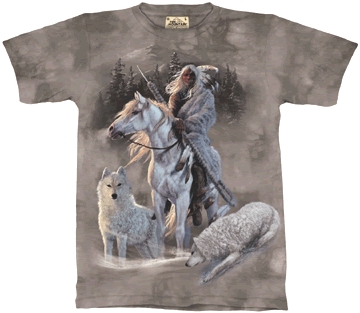
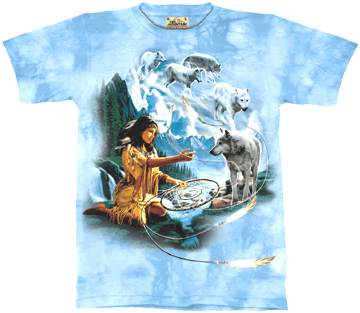
That website led me to this one, where there were lots of “Native American” t-shirts. As far as I can tell, it’s not a Native-owned company, it’s just a bunch of shirts with Native people or themes on them. Some, like these, associate American Indians with animals:

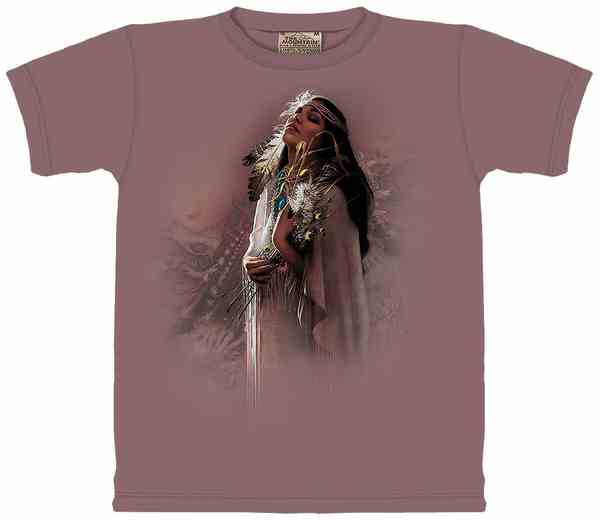
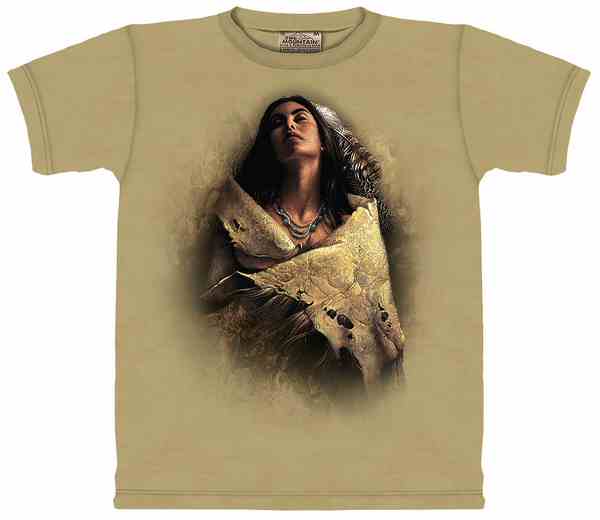
Whereas the t-shirts with men on them tend to show them in battle or hunting, those with women generally have romanticized, sometimes vaguely sexualized images. I noticed several have a common element: the upturned face, often with closed eyes, as well as stereotypically “Caucasian” features, except with darker skin and hair. This one is called “Purity”:

You might use these in a discussion of representations of Native Americans, particularly how they continue to be worn as symbols by other groups. The things associated with American Indians–wildlife (particularly wolves), nature, and the warrior tradition–tend to romanticize their connection to the natural environment and even portray them as part of nature themselves, able to communicate with the other “wild things.”

It’s a weird double bind: on the one hand, presumably American Indians are more “noble” than other groups–surely they wouldn’t have driven wolves, bald eagles, and bison to the verge of extinction, given their close connection to nature. But at the same time, they are depicted as relics of the past, brave fighters from the glory days. American Indians who drive cars and wear t-shirts and blue jeans (and have last names like Smith and Thomas) don’t have a place in our romanticized images of Native groups.

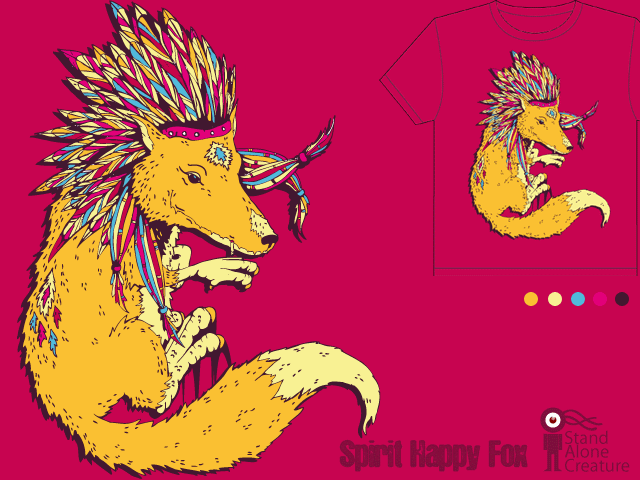
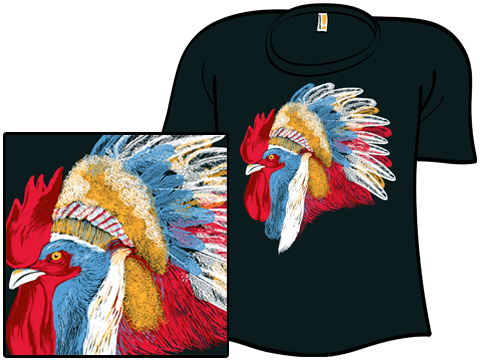
NEW! D. Cho sent in three more t-shirts that draw on Native American icons or images. Here is Spirit Happy Fox:

136230

Chief Many Feathers:

chief_many_featherske4standard

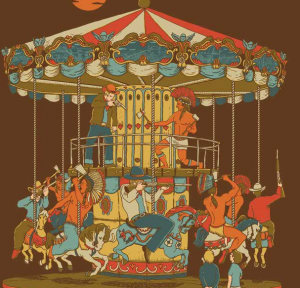
How the West Was Fun:

picture-16

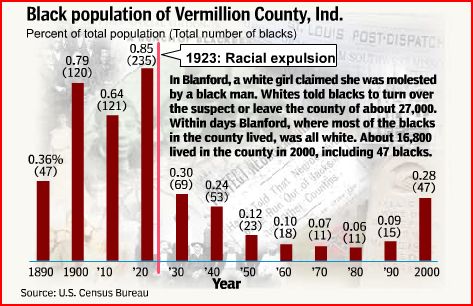
Between 1864 and 1923, there were 14 forced county-wide expulsions of African Americans (alongside many town expulsions).  The figure below shows the percentage of African Americans living in Vermillion County, Indiana in the years before and after an expulsion.

Click here for an interactive website with information about these expulsions made by the Austin American Statesman newspaper.  See also our post about “Sundown Towns,” which kept Blacks out by making it illegal for them to be there after sundown.

Via Jose at Thick Culture.

Anneliese W. sent us this Australian ad campaign for Noble Rise bread.  The claim is that other breads are “bland” and that Noble Rise bread is not.  To make the claim, the advertisements use Black people to signify spice and flavor.  Anneliese writes:

…what really struck me about this campaign is the use of coloured bodies to represent excitement, flavour and coolness. The slogan for the campaign is something like “take a stand against bland” – bland being ‘normal’ and everyday, and in some ads the obvious unspoken is that blandness is white.  Framing blackness as the opposite of ‘bland’ is just another example of the ‘other-ing’ of black bodies, and re-enforcing the idea that white western culture is ‘bland’ or non-existent.

[youtube]http://au.youtube.com/watch?v=aXfxKJnR54Q[/youtube]

[youtube]http://au.youtube.com/watch?v=xpO3eF7wrC8[/youtube]

[youtube]http://au.youtube.com/watch?v=cwIOM3BzjOM[/youtube]

[youtube]http://au.youtube.com/watch?v=h3SSPQgm2jA[/youtube]

I offer several more examples of this phenonemon here.

Click to enlarge:

I think it’s interesting that the National Federation of State High School Associations defines cheerleading as a sport.

(Image by Chris Uggen.  Data from the National Federation of State High School Associations.)