
women

Sexuality & Society welcomes this guest post from Karen Rosenberg, who holds a Ph.D. in Women Studies and directs the Writing Center at the University of Washington Bothell.

________________________________

It has been more than 15 years since The Violence Against Women Act (VAWA) was passed and signed into law by President Bill Clinton. Since becoming law on Sept. 13, 1994, VAWA has provided billions of dollars to bolster the criminal legal response to violence against women, provide services for domestic violence and sexual assault victims, and increase protections for battered immigrant women. 

I got into anti-violence work in VAWA’s infancy and continue to wrestle with the questions that brought me to the movement in the first place. These questions include: Why is there so much violence in intimate relationships? What kinds of activism are most effective for reducing this violence? What role should the state play in regulating (reducing violence in) romantic relationships? What role should the criminal legal system play? What role should our communities play?

Working as a legal advocate in a mainstream anti-domestic violence program in the mid-1990s, I saw VAWA as unquestionably good. Finally, there was federal recognition that violence against women is pandemic, and serious, and worthy of public attention. Federal dollars–billions of them—were going to every corner of the country.  

I worked on several projects funded with VAWA dollars. I collaborated with cops and prosecutors to design trainings and improve the criminal legal response to domestic violence. I began to see fewer cops saying “we don’t get involved in domestics,” or telling violent husbands to “take a walk around the block to ‘cool off.’” I helped women navigate the legal system and advocate for their interests and the interests of their children. I brought the concerns of battered women to policymakers. And every few years, when VAWA came up for re-authorization, I contacted my senators and urged them to continue funding VAWA. I saw these changes in the criminal justice and legal systems as the unquestionably sweet fruits of feminist activist labor.

It wasn’t until I interviewed feminist activists in the course of my dissertation research on responses to violence against women in Seattle, Washington and Vancouver, British Columbia, that I realized that the larger social justice picture was quite a bit more complicated. One activist I interviewed had a particularly powerful critique of VAWA:

“…At first we’re like VAWA has both good things and bad things.  But then I really understood the bad things about VAWA and understood that it was part of…this big, gigantic, monstrous crime bill and inside of this crime bill was where we got…the bullshit around three strikes and mandatory minimums and things that were devastating to our communities.  So if you ask me now whether or not we should have supported VAWA given the money that came to programs and given the general attention that was put on violence against women, both of which are good, I say ‘no.’ (Seattle feminist activist)

Soon after transcribing these words, I began to do some homework. I learned that VAWA, indeed, was part of a massive crime bill. Though then-Senator Joseph Biden (D-Del.) initially introduced VAWA as a stand-alone bill in 1990, it did not command the necessary support to pass. After 4 years of lobbying and revising the legislation, Congress folded it into a comprehensive crime bill. As legal scholar Rachelle Brooks explains, embedding VAWA into a comprehensive crime bill “…placed many feminists in the awkward position of mobilizing around a measure with which they did not agree.” She goes on to say that:

“…the symbolic act of consolidating VAWA in the Crime Bill means that the legislative system grouped domestic violence with other violent crimes and has framed it as a criminal problem.  By associating domestic violence against women with other criminal acts the state can ignore the many other roots of this violence” (Brooks 1997: 79).

Indeed, a look at the budget for the initial VAWA legislation reflects this commitment to the law and order response: over half of the funding—almost one billion dollars—was allocated to criminal legal system remedies. This was a significant infusion of money into criminal legal organizations and contributes to the perception in the US that cops and courts are intimately involved with and the primary responders to domestic violence. The budget also gave significant funding to social service remedies, most notably battered women’s shelters. However, even this funding helped bring the CLS into women’s lives and communities. Much of the VAWA funding required women’s anti-violence organizations to work collaboratively with CLS agencies (such as many of the projects I have worked on).

Another problematic aspect of feminist support for VAWA—which has received even less attention than the problems with the de facto support of a far reaching crime bill—is the removal of the Racial Justice Act from the final version of VAWA. The proposed legislation would have given inmates of color additional avenues to appeal death sentences. Feminist acquiescence to the removal of the Racial Justice Act led to the all-too-familiar feminist prioritization of gender over race. As Brooks comments, by supporting the final version of VAWA embedded in the crime bill “…feminists implicitly endorsed both the removal of the Racial Justice Act…” as well as the racism in the CLS (Brooks 1997: 80).

Where does this leave us now, nearly 16 years after the initial passage of VAWA? While I am acutely aware of the limits of advocacy within the criminal legal system, I do think it makes a difference that the key players in the criminal legal system receive training and tools to intervene in cases of intimate partner violence. As a result I do not regret my support for VAWA.  I doubt that so much attention, and so many resources, could have been dedicated to address violence against women in the 1990s outside of a law and order frame. 

However, as we approach the 16th year anniversary of VAWA, I believe that activists should continue to rethink violence against women outside of a law and order frame, and make connections between interpersonal violence and other forms of violence (the 2001 Incite!-Critical Resistance statement is a powerful expression of the connections between interpersonal violence and state-sponsored violence). I am inspired by the work of local activist groups exploring community-based responses to violence against women that deemphasize the role of the CLS. This work has included, for example, organizing groups of friends who share information about what’s going on in their intimate relationships to counteract the isolation that often accompanies abuse and creating community dialogue about the impact of specific acts of abuse. Here in Seattle, two groups at the forefront of this work are Communities Against Rape and Abuse and the Northwest Network of Bi, Trans, Lesbian and Gay Survivors of Abuse.

VAWA was born of compromise and the tensions that were present at its inception—the focus on gender at the expense of race, the over-reliance on the CLS—are still very much with us. At the same time, the sustained attention and resources directed toward the problem of violence against women has been genuinely helpful in many ways. The critiques of VAWA that activists and academics have developed over the life of VAWA move us powerfully ahead – pointing us toward the importance of community involvement and the dangers of relying too heavily on cops and courts to change a culture that fosters violence against women.

———————————————————-

Karen Rosenberg directs the Writing Center at the University of Washington Bothell and has been involved in anti-violence against women organizing for over 15 years. She earned her doctorate in Women Studies from the University of Washington and her research explores the contradictions inherent in using the criminal legal system to regulate intimate relationships.

Referenced and recommended sources:

  • Brooks, R. (1997).  “Feminists negotiate the legislative branch: the Violence Against Women Act.”  In C.R. Daniels & R. Brooks, (Eds). Feminists negotiate the state: The politics of domestic violence (65-82). Lanham: University Press of America.
  • Incite! Women of Color Against Violence. (2006). Color of violence: The Incite! anthology. Cambridge, Mass: South End Press.

Chapel of St. Ignatius, Seattle University. The design of this chapel is based on the metaphor of "A Gathering of Different Lights," which "describes Seattle University's mission" as well as "St. Ignatius' vision of the spiritual life as comprising many interior lights and darknesses, which he called consolations and desolations." (SU chapel website).

It has been a Wild-kind of month for faculty, staff, and students at Marquette University and Seattle University. After President Wild of Marquette University tore up a signed job contract with a woman who would be their first “out” Lesbian administrator (Jodi O’Brien, of Seattle University) many faculty, staff, and students on both MU and SU campuses have been left in turmoil.

Although Marquette has managed to “resolve” this conflict with a negotiated settlement, President Wild’s actions call into question a number of basic academic assumptions including: 1) the honesty of Marquette University’s statements on commitments to diversity and anti-discrimination, 2) the assumption that GLBTQ people are welcome community members within Jesuit institutions (unlike conservative Catholic and Evangelical Protestant institutions, Jesuits are known for their tolerance, encouragement of fearless intellectual curiosity, and commitment to social justice), and 3) the assumption that University faculty have the rights and responsibilities of sharing the governance of their institution.

Milwaukee Archbishop Jerome Listecki, a key player in convincing Marquette President Wild to tear up his job contract with Jodi O'Brien

The recommendation to hire Dr. O’Brien as Dean of Arts & Sciences at Marquette came after two years of committee searches, interviews, and deliberations. The President and Provost of Marquette also met with committee members and all job candidates, and signed on with the decision to offer the job to O’Brien. This extensive vetting process was obliterated after two local conservative Catholic leaders (neither of them faculty or staff members at Marquette) caught wind of O’Brien’s hire. Somehow, unbelievably, these two men (Milwaukee Archbishop Jerome Listecki and Father Paul Hartmann, the archdiocese’s judicial vicar) were able to trump the entire academic administrative vetting process at MU. The search committee and was abruptly informed that their input — as well as O’Brien’s administrative leadership skills — was neither needed nor welcome.

Despite the strong suspicion among many that this is a clear case of discrimination based on sexual orientation, President Wild has maintained throughout the aftermath of his rescinded offer that this is simply about a mismatch between O’Brien’s scholarship and Marquette’s mission. Wild has yet to adequately specify how and where O’Brien’s scholarship is anti-Marquette, anti-Jesuit, or anti-Catholic, but Father Paul Hartmann (one of the two local church officials who complained) explains that O’Brien investigates a particular “subject matter” that may create “dichotomies,” “tensions,” and “contradictions.” According to the Milwaukee Sentinel (May 12, 2010):

“Hartmann sent a March 3 letter  to the chair of the search committee that said the gender studies professor “pursues subject matter that seems destined to actually create dichotomies and cause tensions (if not contradictions) with Marquette’s Catholic mission and identity.”

As long-time colleague, mentee, and friend of Jodi O’Brien, and as a former lecturer at Seattle University (a place I still hold near and dear to my heart) I am very familiar with O’Brien’s work, as well as her commitment to Jesuit education. Ironically, what the conservative church leaders fear is actually what makes O’Brien a successful Jesuit scholar and administrator. Namely, O’Brien’s ability to embrace (rather than denounce or deny) contradictions and tensions— may in fact be a pinnacle Jesuit model of intellectual and spiritually complexity.

In her 2009 Presidential address to the Pacific Sociological Association, Professor Jodi O’Brien describes the personal growth that comes with wrestling religious and spiritual contradictions:

My research with queer Christians led me to understand and define the social self as a process of wrestling contradiction. We are in a constant state of becoming. This “becoming” is shaped through processes of interaction and revealed through the internal dialogues in which we observe, feel, comment on, and try to make sense of our own complexity. The process of self-understanding is a dialectical process of definition, a continual interplay between personal experiences and attempts to fit experience into existing conceptual categories and representations. All of us struggle to make sense of ourselves, to find ways of self-expression, and to be heard and understood. Our sense of self undergoes constant revision as it encounters friction, contradiction, and conflict along the various boundaries that constitute meaning (O’Brien 2009, Pp. 15–16).

She continues to describe how the intellectual process of finding connections in the face of conflict provides an opportunity for personal as well as professional transformation:

Isn’t this what we’re doing as sociologists when we strive to practice scholarship that matters: finding connections, revealing patterns, striving to bridge seemingly contradictory perspectives by offering deeper, richer frameworks of understanding? My suggestion is that when we experience fully the contradiction, conflict, and pain of engaging with our own teaching and research, we can’t help but be transformed  …. This produces an epistemology of contradiction that, together with the principles of the “sociological imagination,” enables us to navigate through complex personal and professional terrain in ways that both resonate and inspire (O’Brien 2009, P. 20 )

Rather than embracing the powerful teaching moments of such everday contradictions, Marquette University officials have chosen to rescind them, putting themselves closer to the edges of rigidity, fear, and fundamentalism, rather than intellectual curiosity, creativity and, I would argue, spiritual vitality.

I will leave it to Jodi O’Brien to describe the nuances and evolution of her thinking throughout her illustrious scholarly career. However, for those interested in reading more about how stereotyping and prejudice works, O’Brien’s own social psychology textbook, The Production of Reality is a great resource.  In this text as well as in the dozens of lectures she’s given to churches and universities around the country, including other Jesuit Catholic universities, O’Brien teaches us about  the subject matter of  “permissible prejudice” – in other words, prejudice that is deemed ok if those in positions of authority justify it as such through their actions or non-actions.

And it is this critical perspective on prejudice and power that is the deeper “subject matter” at hand. This is the kind of subject matter that creates critical reflection on all forms of power relations, including but certainly not limited to that pertaining to religious institutions. This is precisely why those invested in maintaining an uncritical stance on particular power relations within the larger Marquette community needed her to leave; this is also precisely why Gay Catholics and religious academics need leaders like O’Brien now more than ever.

———————————————–

Referenced and recommended sources:

O’Brien, J. (2009) “Sociology as an epistemology of contradiction.” Sociological Perspectives 52, 1, 5-22.

O’Brien, J. (2007).”Queer Tensions: The Cultural Politics of Belonging and exclusion in same gender marriage debates.”” Pp. 125-149 in Interdisciplinary Readings on Sex and Sexuality. Amsterdam: Rodopi.

O’Brien, J. (2005).  The Production of Reality: Essays and Readings in Social Interaction, 4th Edition. Newbury Park, CA: Pine Forge Press (Sage).

O’Brien, J.  (2002).  “Heterosexism and Homophobia.” Article length entry for the International Encyclopedia of Social and Behavioral Sciences.  Oxford: Elsevier Publishing.

Jaschick, S. “Stained Glass Ceiling.” Inside Higher Education. May 11, 2010.

While this case underscores timeless clashes between religion and sexuality—particularly in the form of gay and lesbian “permissible prejudice” within religious institutions — some argue that this discrimination is rising in a backlash movement against the fight for equal rights by gays and lesbians. For example, On March 6, 2010, the Washington Post reported that Virginia Attorney General Ken Cuccinelli, a conservative Republican, advised Virginia’s public colleges and universities to revoke policies protecting employees on the basis of sexual orientation.

See also the National Gay and Lesbian Task Force statement on ending job discrimination.


Related posts on Sexuality & Society:

https://thesocietypages.org/sexuality/2010/05/12/in-annuling-contract-with-obrien-marquette-can-assume-its-missionary-position/

https://thesocietypages.org/sexuality/2010/05/10/marquette-rescinds-job-offer-to-sociologist-and-sexuality-scholar-jodi-obrien/

We welcome this guest post from Jayne Swift, who is currently a graduate student in Cultural Studies at the University of Washington, Bothell and an employee of the Seattle Lusty Lady Theatre.

—————

In the 1970s, U.S. manufacturing jobs were decimated, with thousands of workers losing what had once been well paid and valued jobs. It was a deindustrialization crisis that would come to be remembered as a national loss.  Many saw it as a sign that Americans were losing their birthright to work that is fairly compensated and unionized; work that produces a sense of pride, identity, and community. 

If you have spent any time within the Seattle Lusty Lady Theatre lately, you would hear similar, albeit scaled down, testimonials from Lusty Lady workers. But unlike the massive public outcry around automotive plant closings, few outside the workers of the Lusty Lady seem to care about the historical and economic impact of Lusty Lady labor.

To be sure, as Carly Chillmon mentioned in her recent post on Sexuality & Society, many DO care about the loss of the Lusty marquee. The marquee should be missed as a beacon of Seattle’s bawdy past. Yet, the public focus on the marquee also masks the reality of actual people labouring and loving inside. For almost three decades, the Lusty Lady was more than a job to countless employees—it was our GM plant, our place.

Book cover for "The Lusty Lady," by photojournalist and Lusty Lady worker, Erika Langley (1997).


I have known I wanted a place in the Lusty Lady world for a very long time. When I was 17 and first saw the Lusty Lady while on vacation in Seattle, I was enthralled by the robed women standing outside, smoking, talking to each other, seemingly unmoved by the (potentially hostile) stares of passers-by.  I wanted to know more about this place and these women.

Shortly thereafter I realized I had already knew something about this place and these women. I grew up in a feminist-intellectual home and was an avid consumer of texts that explored questions of feminism, gender, and sexuality. In particular, I sought to understand the feminist sex wars and the fierce battles over pornography and prostitution they engendered.

Like many of my “third wave feminist” ilk, I discovered a burgeoning field of literature that articulated what might be called a “sex-positive” vision of sex work; anthologies that featured the voices of sex workers discussing their work on their terms. The Lusty Lady was a recurring feature in many of these texts—used as a site for sex workers to think through the value of their work, articulate experiences of sex work not often validated in the larger world, and sometimes organize to serve their own best interests as workers and people. Indeed, a cursory look at U.S. sex worker literature[i] reveals the Lusty’s significance to the growth of the contemporary sex worker rights movement. The battles to unionize the San Francisco branch of the Lusty (dramatized in the 2000 film Live Nude Girls Unite!). the memoirs published by Lusty workers, and the uniquely female management made the Lusty Lady a rich site for theorizing commercial sex cultures and producing a sex worker feminism.

Image from the documentary film, "Live Nude Girls, Unite!" (Dir. Juilia Query, 2000).


Throughout my undergraduate years I studied the Lusty from afar as something akin to a feminist destination, something I might do with my education and training in Gender/Sexuality Studies. After finishing my M.A. in Women’s Studies at the University of Iowa I moved to Seattle and got up the courage to pursue what, quite simply, had become my dream of working at the Lusty Lady.

For the last several years that dream has structured and animated my life. Like all jobs the Lusty involves its share of drudgery, and more than many jobs a host of emotional and physical challenges. Yet, unlike a lot of other jobs I’ve held (in and out of the sex industry) the Lusty has consistently demanded that I grow on an embodied ethical and intellectual level. The Lusty is the space in which I was able to claim the term sex worker and feel prepared to defend my worth. Every day at the Lusty presented an opportunity to reflect upon some of my central intellectual preoccupations, including: the performativity of gender, theories of objectification, feminist agency and resistance, the production of desire and power, queer theory, the intersections of labor, feminist, and local history and struggle.

It might seem odd to some, but the Lusty made me a better thinker and scholar. Perhaps just as important, the Lusty also forced me to examine and change myself on a more grounded, personal level.

At the Lusty, I learned that there were all kinds of beautiful bodies and personas. I learned that being desired and being able to desire are not contingent upon achieving a pernicious beauty standard. The Lusty taught me—in a way that no therapy or degree could—that my body was mine and I had better find a way to feel good and strong in it in order to survive. In doing so, the Lusty also taught me to look customers, men, in the eye and find a way to show up to their desires and needs when they asked for them respectfully—and stand up to them when I was disrespected. The Lusty reaffirmed my commitment to honoring other people’s erotic selves and gave me a tangible venue in which to perform that commitment. The Lusty taught me that one’s work could be good for others as well as me, that I had a right to be treated fairly and respected, and that I need to pursue the respect I want. Perhaps most importantly, the Lusty challenged me to reconceive of and enact the thing that feminists once called “sisterhood.” 

My Lusty sisterhood grew not out of consciousness raising groups but out of my grounded working conditions: the Lusty required employees to find ways to work alongside each other, often across multiple lines of social difference. The physical and social structure of the business, instead of breeding the competition found in many other legal sex businesses, inculcated workers with a sense of collectivity and common purpose. As my co-worker Wildflower puts it,

“much like a contrived women’s support group…we share the most tender and raunchy parts of ourselves. Something about being naked, playing a role and entertaining the gents keeps things light enough to share some heavy challenges.”

Indeed, the workers of the Lusty often express a bond with each other simply due to our shared love for this place and what is has given us. My experience of the world tells me that it is rare for people to describe their workplaces in terms that another co-worker, Lux, does as the place where she “grew up”:

“It was a safe place for me to be unconditionally loved, a place where it was alright for me to be me, a place no matter what I did I would be accepted.”

Gypsy, another co-worker, reiterates this theme of kinship. For her the Lusty was the site of a unique and “incomparable connection with female co workers/”family.”

I probably could have espoused it, but until I actually became a Lusty Lady I don’t think I really understood what people—feminists often—meant when they talked about the need for sisters, allies, family. 

Home, family, erotic temple, feminist teaching ground, support system, or as Lux put it, “place of belonging”—these are the organizing narratives and metaphors we (the workers) often use to describe and explain our experience of the Lusty Lady.  No one is arguing that it was a perfect place; a utopia. However, many of us, myself included, are currently charged with trying to make sense of this time, place and labor we have shared with each other. We want the world to understand the Lusty’s powerful and at times beautiful resonance in our lives and our grief about its ending. The loss of this place—a local institution which employed countless people over three decades, inspired its workers, and at times brought women together in a world that often profits by driving us apart—matters, whether or not you’ve ever dared to set foot inside it.

I can only hope that when we close our doors in June we are greeted by other mourners, all those who care about sex workers, standing respectfully on the other side of the marquee.

—————————————- 

Jayne Swift was lucky enough to take her first baby steps in six inch heels at the Lusty Lady theatre and is currently completing an M.A. in Cultural Studies at the University of Washington-Bothell.


Referenced and recommended works:

[i] See:Brooks, Siobhan “Dancing Towards Freedom” Whores and Other Feminists, Ed. Jill Nagle  Routledge: 1997.

Dudash, Tawnya. “Peepshow Feminism,” Whores and Other Feminists, Ed. Jill Nagle  Routledge: 1997.

Eaves, Elisabeth. 2002Bare: On Women, Dancing, Sex, and Power. Knopf.

Funari, Vicky “Naked, Naughty, Nasty: Peep Show Reflections” Whores and Other Feminists, Ed. Jill Nagle  Routledge: 1997.

Langley, Erika. 1997. The Lusty Lady. Scalo Zurich-Berlin-New York.

Queen, Carol. 1997. Real Live Nude Girl: Chronicles of a Sex-Positive Culture. Cleis.

Administrators at Marquette University have found themselves in an awful mess this week after revoking a job offer to Jodi O’Brien, their top candidate  for the position of Dean of Arts & Sciences. (See our earlier post for details on the case).

The official reason for this radical breach of academic, professional, and legal decorum is still murky, coded in terms like “marriage,” “family,” and “the Catholic mission.” President Wild and Marquette spokesperson Mary Pat Pfeil claim that the reversal had nothing to do with the fact the O’Brien is a lesbian. Indeed, since she was “out” during the entire process, this might be true. Indeed, Marquette’s website includes several specific references to the idea that discrimination based on sexual orientation is not acceptable. Below is one example:

As a Catholic, Jesuit university, Marquette recognizes and cherishes the dignity of each individual regardless of age, culture, faith, ethnicity, race, gender, sexual orientation, language, disability or social class … Through our admissions and employment policies and practices, our curricular and co-curricular offerings, and our welcoming and caring campus environment, Marquette seeks to become a more diverse and inclusive academic community dedicated to the promotion of justice. (Marquette University’s statement on Human Dignity and Diversity.)

So if O’Brien wasn’t disqualified because she is gay, per se, what is “really” going on? Maybe it’s just the sort of gay she is, the sort who likes to talk openly about sexuality, and moreover to discuss it critically within the context of social institutions such as religion and family. An article in the Milwaukee Journal Sentinel provides a few more clues in this direction:

Officials haven’t provided more detail about what writings might have raised red flags. But Wild told members of the dean search committee last week that there was an article in which “sex positions” and “sex toys” were mentioned, and that the passage could be interpreted as autobiographical, said psychology professor Stephen Franzoi, who served on the committee. O’Brien’s work includes a sociological study of vignettes on lesbian sex. Franzoi said members of the search committee reviewed the work again and did not believe the passages were autobiographical and that the article was a scholarly work.

So let’s get (or make) this story straight:

  1. Jodi O’Brien has worked and lead for 15 years in a Jesuit institution (Seattle University), and is an enthusiastic proponent of the Jesuit mission (e.g. see her cover letter to Marquette).
  2. Marquette’s interpretation of the Jesuit Mission is to NOT discriminate on the basis of sexual orientation. 
  3. Marquette and O’Brien agreed that their union would be mutually beneficial.
  4. After Marquette proposed a job offer and O’Brien accepted, leaders in the Marquette extended family became concerned about O’Brien: In particular, her critique of the patriarchal family and her open discussion of non heteronormative sexuality. These previously unnamed members (today named as two Milwaukee archdiocese leaders, judicial vicar Paul Hartmann and Archbishop Jerome Listecki) became suspicious that O’Brien’s writings were not purely intellectual, but could be actual autobiographical and public representations of a sexual life led outside of heteronormative boundaries.

Simply stated, my conclusion is this: This is not a conflict between O’Brien’s lesbian identity and Marquette’s Catholic Jesuit Mission. This is about conservative, Milwaukee-based Church officials needing to divert the attention (of parishioners, as well as of media) away from critical sexuality scholarship and back toward its (silent) missionary position.

O’Brien’s critical sexuality scholarship is threatening to conservative Church leaders because it calls into question the utility of silence around discussing sexual matters. This is much more than just about an Archbishop’s distaste for sex toys: this is about a distaste for discussion of the great sexual variance found within the human species and analysis of how heterosexist family formations are not universal and “natural” but are created, regulated, and enforced by social institutions such as the Catholic Church.

Make no mistake, there are many people living and working within Catholic and Jesuit instituions who live their lives outside of heternormative married couples and families. The very core of Catholicism is based on elevating these non heteronormative models in the form of priests and nuns.

Unlike some religious traditions, Catholicism offers women and men a legitimate option to REFRAIN from marriage and to join vibrant homosocial communities. But the Marquette situation illustrates that this freedom from marriage and heterosexuality may be delicately balanced upon a strict code of silence. Even if a Marquette faculty or staff member has no personal interest in marriage or heterosexuality, the lesson learned here is that they must only discuss these views and practices in distinctly NON-SEXUAL ways. Although invisible on Marquette’s website, the consequence of violating the code of sexual silence is real. O’Brien got dis-invited to lead the Marquette family not because she crossed a line of heteronormativity, but because she discussed these matters publicly.

—————————————–

Related Sexuality & Society blog posts:

Dworkin, S. and Lerum, K. “Marquette rescinds job offer to sociologist and sexuality scholar Jodi O’Brien.” May 10, 2010. 

Lerum, K. “Catholic Priests, Sexual Abuse, and Learning how to talk about sex in church.” Sexuality & Society March 29, 2010.

Referenced news articles:

Farden, K. “SU Prof. O’Brien was eager to take Dean position at Marquette.” Seattle University Spectator. May 12, 2010 

Johnson, A, Sharif Durhams, S. and Ferral, K.”Listecki raised alarm over Marquette hiring: Comments are first indication Milwaukee archdiocese raised concerns about O’Brien.” Milwaukee Journal Sentinel. May 12, 2010.

Professor Jodi O'Brien

Last month Marquette University –a Jesuit University in Milwaukee, Wisconsin — offered esteemed Sociologist Jodi O’Brien the position of Dean of the College of Arts & Sciences. After carefully weighing the vast professional and personal transitions that such a move would entail, O’Brien accepted the offer. She signed the contract and mailed it back to Marquette. She and her partner were preparing to put an offer on a house in Milwaukee. But early last week, after pressure from unnamed sources, Marquette backtracked. The official reason? As Marquette President Father Wild told the New York Times,“We found some strongly negative statements about marriage and family.”

This abrupt turn away from O’Brien — a job candidate actively pursued by search committees at Marquette for the past TWO years — has left O’Brien’s extensive and loyal network of colleagues, friends, and students vacilliating between complete disbelief and rage. Hundreds of her would-be Marquette colleagues and students are also shocked by this news and have organized several protests. Two Facebook support groups have emerged, one originating from Marquette, one from Seattle University. Marquette Professor of Theology Daniel C. Maguire has written a scathing open letter to Marquette President Robert Wild and Provost John Pauly, calling for Wild’s resignation and for Wild’s successor to re-offer the job to O’Brien.

In this post we will simply list some of the facts of this case. We will provide an overview of O’Brien’s scholarship, as well as the legal and social implications of Marquette’s actions in a follow-up post.

  • Jodi O’Brien has been a leader at her home institution of Seattle University (a Jesuit University) since she arrived as an Assistant Professor in 1995. She quickly became promoted to Associate Professor and has served as Chair of the department of Anthropology, Sociology, and Social Work for seven years. O’Brien was promoted to Full Professor since 2005. In 2007 she received the honor and responsibility of being named the Lewis B. Gaffney Endowed Chair, a two year rotating position that carries with it the mandate of connecting academic and community life with the Jesuit mission.
  • Dr. O’Brien has a long history of leadership positions in national professional organizations including the American Sociological Association and the Pacific Sociological Association. From 2008-2009 O’Brien served as President of the Pacific Sociological Association.
  • O’Brien is the author of dozens of articles and the author and editor of several books, including Everyday Inequalities, and The Production of Reality (now in its 4th edition),  a leading textbook in the field of Social Psychology.

Marquette’s excuse for reversing their offer is not sitting well with many, including those deeply committed to the Catholic and Jesuit mission. In his letter to Marquette University President Father Wild, Professor Maquire is incredulous that although Father Wild and Provost Pauly based their “decision on an interpretation of what was or what was not compatible with Catholic teaching,” they did not consult Catholic theologians in their decision. Maguire scolds:

(Y)ou did not consult the faculty experts on Catholic moral teaching on this campus.  The Theology Department is one of the major theologates in North America, just a few yards away from your offices.

As well, Maguire reminds Father Wild and Provost Pauly that they also “ignored teachers of ethics in the Philosophy department and professors in Sociology, Dr. O’Brien’s field.”

As professors in Sociology and long term colleagues of Dr. O’Brien, we are most happy to offer our assessment of O’Brien’s scholarship on religion and sexuality. Stay tuned.

———————————————–

Referenced news articles:

Dillon, S. “Marquette rescinds offer to Sociologist.” New York Times. May 6, 2010.

Durhams, S. and K. Ferral. “Marquette on hot seat for rescinding job offer to Lesbian.” Journal Sentinel, Milwaukee Wisconsin. May 6, 2010.

Finnegan, L. “Marquette Withdraws Job offer to Lesbian Dean Candidate Jodi O’Brien.” Huffington Post. May 7, 2010.

How to not hire a dean.” Editorial. Journal Sentinel, Milwaukee Wisconsin. May 7, 2010.

We welcome this guest post from Carly Chillmon, a Ph.D. candidate in sociology at University of California, Santa Barbara.

—————————————–

When I began constructing my dissertation project in the fall of 2008, I was met with one recurring response, “You should check out the Lusty Lady.” I was developing a study to examine how legal sex businesses are regulated and operate within the urban setting of Seattle.  In my research the majority of people I have spoken with identify the Lusty Lady (a woman-managed peep show) as a true Seattle gem… a last-stand to Seattle’s not-so-metronatural past.  Sadly, this beacon of sexual expression announced on April 11, 2010, that it would be closing for business in June.

While in many instances adult entertainment is met with contention with those who don the cloak of moral superiority, the Lusty Lady did not meet such policing. In fact, Assistant Chief Jim Pugel of the Seattle Police Department told me that,

“…I can’t recall the last time we had a complaint of a robbery, of a drug deal, or any other activity that is usually associated or part and parcel with prostitution or people engaged in vice.” — Seattle Chief of Police, Jim Pugel

In other words, the Lusty Lady maintained its status of a legal business without ties to criminality and vice. The Lusty Lady’s humorous billboards also helped bridge the social distance and discomfort that often exists between the sex industry and the broader public. In my same interview with the Seattle Chief of Police Pugel, the Chief said that “.. their billboards are just the best billboards you’ve ever seen.”

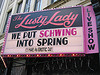
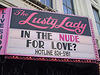
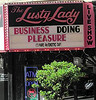
At a time when freedom of speech is often in need of defense, the Lusty Lady openly expresses sexuality in an engaging and often topical tongue-in-cheek fashion. Passersby on 1st Avenue are met with such greetings as “We Takeoff More Than Boeing,” “Business Doing Pleasure,” “We Give Raises,” and one of my timely favorites, “Check Our Stimulus Package.” The pink and black marquee offers a sense of humor and a savvy way to make people think, even for just a moment, about sexual desire.

When I spoke with local politicians about the regulation of legal sex businesses, the Lusty Lady was consistently noted as something special. Seattle City Council Member Tim Burgess stated,

“The Lusty Lady is interesting because it is kind of iconic in a way and I think that’s because of their billboard…”

Burgess went on to note that:

“…That might not be my choice of a business to patronize or to run clearly but I don’t think it’s the government’s role to get engaged there. As long as they’re not breaking the law and as long as they’re keeping a clean facility and getting along with their neighbors and they’re policing themselves, then I have no reason to question them or get involved with them.”

Council Member Burgess demonstrates an understanding of the legality of the business and a marked absence of complaint as a means to justify the existence of an establishment that he may personally not patron but politically accommodates.

Former City Council Member Peter Steinbrueck reflected on the relationship of the Lusty Lady to its across the street neighbor, the Seattle Art Museum. In his interview with me he said,

“In a quirky way, the Lusty Lady was accepted as sort of living art right next to the art museum. They have a small billboard, a marquee over the entrance, and they put artful little messages up there that can be seen from the galleries of the Seattle Art Museum so there is a funny kind of relationship there that is, I think, mutually acceptable…It seen as part of the cultural life of the city basically…They (the Lusty Lady) were there before the art museum and they are part of the neighborhood.”

Through its play on words, the Lusty Lady was able to enhance its status and move away from the usual connection to deviance and stigma that is associated with adult entertainment. The Lusty Lady was able to move towards a place of cultural significance and artful appreciation.

However, such cultural standing is not resistant to the impact of the current economic recession. Management of the Lusty Lady reported through many local news outlets that they are a prime example of how the adult entertainment industry is not recession-proof (see articles by Kiley, Lacitis, and Cohen below). During these economic hard-times when many local small downtown businesses are closing, the Lusty Lady is just one of many casualties. Coupled with the rise of access to free pornography on the Internet, we can better understand why the Lusty Lady’s income dramatically dropped from the late 1990s to today.

It is also important to understand that this particular neighborhood has been undergoing dramatic change since the 1970s. The Pike Place Market preservation and development project, an influx of investment into real estate, particularly high-rise developments and office space, and a general evacuation of Seattle’s Flesh Avenue greatly altered this city’s landscape.

City Council Member Jean Godden, a former Seattle Times columnist, referred to the changing landscape of downtown Seattle, specifically of the changes that occurred along 1st Avenue. She stated,

“It (the Lusty Lady) is sort of the last bastion. There really isn’t much anymore… It’s very different than it used to be ,and 1st Avenue, in particular was the one that certainly has gentrified so to speak, if that is what one wants to consider it over the years.”

Peter Steinbrueck further sheds light on the the ways that downtown Seattle has changed: “There were sex shops…up and down 1st Avenue, there were multiple pawn shops, second-hand businesses, used clothing, and, I think, right next to the main entrance to the Market was a porn theater of some sort…That was the kind of neighborhood that it was. I guess it would be described as a little seedy.”

In contrast to its “seedy” past, Seattle now boasts a premiere art museum, a Four Seasons Hotel and Residences, and a revitalized Pike Place Market. And, until June, the Lusty Lady still stands as a reminder to Seattle’s history and as a contributor to its cultural development.

While many are quick to praise the creativity of its marquee, the lack of recognition of the work that goes on within the Lusty Lady needs mentioning. As part of the material culture of Seattle, the Lusty Lady also holds symbolic meaning for many people. The lapse of comprehension that “real” work went on beyond that marquee is possibly another reason for the Lusty Lady’s demise besides the economic downturn and Internet access to porn.

Further research must be pursued to understand the nuances of sex work in the legal business world. Without scholarly investigation into how sexual spaces are regulated, zoned, and operated, we fall victim to using the lens of sex work as deviant rather than sex work as legitimate labor and business organizations. It is not only important to understand the sex industry at moments of moral panics, but is vital to recognize how these businesses operate under a set of specific socio-political and economic conditions.

The Lusty Lady is a Seattle landmark; all of us, even those who are neither patrons nor workers at the Lusty Lady, will experience a cultural loss when it is “clothed” for business.

———————————————————-

Carly Chillmon is currently an adjunct professor of sociology in the department of Anthropology, Sociology, and Social Work at Seattle University. The working title for her dissertation is “The Regulation of Sex Businesses: Place, Policy, and Politics.”

Recommended links:

Last week Iceland made history by becoming the first European nation to abolish strip clubs — made effective by passing a law that makes it illegal to profit from the nudity of employees. The law will take effect on July 1, 2010. What is perhaps even more unusual on a global scale is this law is being reported as a NOT a result of religious, but of feminist influence. Julie Bindel in Guardian UK writes:

Kolbrún Halldórsdóttir, the politician who first proposed the ban, firmly told the national press on Wednesday: “It is not acceptable that women or people in general are a product to be sold.”

Bindel continues:

According to Icelandic police, 100 foreign women travel to the country annually to work in strip clubs. It is unclear whether the women are trafficked, but feminists say it is telling that as the stripping industry has grown, the number of Icelandic women wishing to work in it has not.

This news (all of it: that strip clubs will be banned and that mostly foreign women work in those clubs) came as a surprise to many including me. But then again, my only experience of that country comes from a short layover in Reykjavik a few years ago on my way to Oslo. From my window airplane seat I looked down on a landscape unlike any I’d ever before witnessed, a fascinating result of glaciers, earthquakes, and volcanic eruptions. At the Reykjavik airport in my jetlagged state, I looked for Bjork and wondered if perhaps the plane had mistakenly landed on the moon.

"The Road Home to Reykjavik" wallpaper, from HDR Landscape Wallpapers


Now that Iceland is back on my radar (and I’m not currently jetlagged), I thought it would be a good time to take a better look and to investigate how and why strip clubs are being banned on this North Atlantic island. Bindel’s Guardian UK article credits the triumph of feminism, calling Iceland “the world’s most feminist country.” I’m intrigued by what does appear to be a very strong showing of feminist abolitionist (anti-sex work) sexual politics. But I’m also curious about how the demographic context — including the sex and race/ethnicity of migrant laborers — may be influencing this current abolitionist stance.

First, a look at indicators of gender equality in Iceland. According to the 2007 Global Gender Gap Index (published by the World Economic Forum), Iceland ranks fourth in the world in providing equal economic, political, and health standards for women and men. The current prime minister of Iceland is a lesbian woman, the world’s first openly gay leader.

Iceland Prime Minister, Jóhanna Sigurdardóttir


For some feminist commentators these cultural and structural factors explain how strip clubs became ousted from Iceland. After all, aren’t all feminists and lesbians opposed to the commercial sex industry?

Because the answer to this question above is “no,” I’ll move to another line of inquiry: Might other, demographic, variables also be encouraging this abolitionist stance?

Let’s look at who lives in Iceland. According to Statistics Iceland, the population of Iceland has decreased for the first time since 1889:

On 1 January 2010 the population was 317,630, compared with 319,368 1 January 2009. The population decrease is due to a record negative net migration in 2009, while the natural increase (births less deaths) was 1%.

In other words, people are leaving Iceland, and those who are staying aren’t having many babies. The TOTAL population of Iceland is LESS than the population of most major US cities, and comparable to the population of many Carribbean and South Pacific islands (see list of world populations by country here). The vast majority of people in Iceland live in the Reykjavik area (120,000 in the city proper.)

(Side note: Reykajavik is a small town. It’s not usually a good idea to work as a stripper in the same small town where you grew up. Things quickly get uncomfortable when your brother, uncle, friend, former coach, and dad show up. If you are an Icelandic woman who wants to be a stripper, go elsewhere!)

Given Iceland’s decreasing population, it makes sense that immigrant workers may be needed in many occupational sectors. Indeed, there has been an increase in citizenship granted to immigrants:

“The largest number of those who are granted Icelandic citizenship come from Europe. In 2009 the majority of those originated from Poland (153) and Serbia (76). Asians are the second largest group, with 106 who had formerly a Philippine citizenship and 51 Vietnamese.” (Statistics Iceland).


Click on the graph to see a larger version


This pattern of immigration from Europe and Asia is not new, at least within the past few decades. As seen in the graph to the right, since 1991 there have been relatively stable (and low) patterns of immigration from Europe, Asia, the US and Africa. What has changed however since 2001 is an increase of immigrants from Europe.

It is interesting that in the news coverage of the strip club ban (which has mostly replicated the Guardian UK article quoted above), the topic of “trafficking” is mentioned. What is curious is that there does not appear to be any direct evidence for women being trafficked (forced) in to Iceland to work in strip clubs. If there is, it’s not being reported. Instead, readers are left with comments such as Julie Bindel, who writes:

“I have visited a strip club in Reykjavik and observed the women. None of them looked happy in their work.”

Not exactly reliable evidence of trafficking.

And so I am left once again with the suspicion that this ban isn’t about protecting workers from being trafficked. It’s about the tensions that arise over immigration; it’s about a conflict over the meaning(s) and use(s) of sexuality; it’s about not recognizing sex work as labor, and hence not assuming that sex workers deserve basic labor rights. It’s also about a lack of reliable research which, at minimum, investigates the experiences of people in the industry. Visiting a strip club and thinking that people don’t “look happy” doesn’t count.

Some people, the majority perhaps, cannot imagine ever choosing to be a sex worker. Since they cannot imagine it, they assume that they must be forced into it (and thus either must be saved or punished). Some people also believe this about gay people.  It is no coincidence that the GLBT movement has long fought for freedom from arrogant attempts to “save” and/or punish them.  Thus I find it more ironic than understandable that a lesbian Prime Minister has decided to outlaw the sexual and occupational choices of others.

For more reading about the misdirected politics of anti-trafficking and anti-sex work policies, see Laura Austin’s recent article on the South Africa preparing for the World Cup.

Last Tuesday, Feb. 9, I learned of a Facebook fan page dedicated to “Killing your hooker so you don’t have to pay her.” As a sex worker ally, sexuality scholar, and someone invested in the humane treatment of all people, I became dedicated over the next 24 hours to shut that page down. I immediately reported the page to Facebook administrators, and encouraged all of my Facebook friends to do the same. On Wednesday, Feb. 10 at 1:26 pm (PST) when the site was still up, I posted the following to my Facebook friends:

This was the image for the Facebook page, "Killing your hooker so you don't have to pay her." The group Sexinpower.com inserted the word "Fail" on it to illustrate the failure of this fan page.


“In less than 24 hours, I have seen the FB site dedicated to “killing your hooker” increase from 17,500 fans to now more than 22,000. Please join me in kicking this FB group out of our community; report it to the FB directors. This group is in clear violation of FB rules, including: 6. You will not bully, intimidate, or harass any user.7. You will not post content that is hateful, threatening, … etc”

Many other sex worker activists and humanitarians across the globe were simultaneously doing the same work. By Wednesday at 5 pm (PST), just over 24 hours after I learned of the site, and just days after its creation, Facebook administrators deleted the site. For Facebook, this was not a matter of “free speech”; it was a matter of a clear violation of their community rules. (Hate groups and bullies all of kinds are free to proliferate on the internet, but are not welcome on specific community membership cites such as Facebook).

Unfortunately, I fear and see that this is just the beginning of hate-speech pages on Facebook. Because Facebook allows anyone to set up an account, and because (at least for now) it seems that Facebook administrators are not pro-active in monitoring hate groups, everyday Facebook users (people like me who would otherwise be taking breaks from work to post about their kids or their cats) have found that they have an ethical obligation to also watch out for and report Facebook hategroups.

The group Feministing.com is one such group that this week has found itself to be one of these reporting the abusive, hate-filled page. As might be expected, those behind the “killing your hooker” fanpage are not happy about the critique. Here’s one quote from the “killing your hooker” folks:

“The worthless CUNTS over at Feministing are reporting you because they think they are the policemen (oops policePERSONS) of the internet. Let Feminist cunts know what you think about their crusade to silence all free speech they deem “inappropriate.” (see article in Carnalnation.com)

These slurs against women and feminists are as old as misogyny and a common tactic for diverting attention away from serious, grownup critique and dialogue. The issue of “free speech” is one that is incredibly important, but it is a principle that is always constituted and negotiated within particular parameters. “The internet” is a broad space that allows all (and hence not a true “community”), but Facebook is a smaller space with particular rules.

Carnalnation.com (the group reporting on this story above) is a community that is very much dedicated to freedom of speech and expression, but it too is absolutely opposed to the inclusion of hategroups in the Facebook community. In their mission statement Carnalnation states that:

In our view, fear and disdain of all things sexual have led to a society that too often vacillates between impulsive titillation and compulsive repression. Such extremes can only have a negative impact on our physical, psychological, and social well being.”

Carnalnation.com is encouraging its readers to report hategroups such as “killing your hooker,” and has found that there are “232 (Facebook) groups that currently have the words “dead hooker” in them.  (Dead Hooker Storage, Accidentally Pissing On A Dead Hooker, and A Dead Hooker A Day Keeps The Doctor Away are just three of them.)” Feministing.com is also reporting that “killing your hooker” now has simply morphed into a new Facebook fan page (still live as of this writing), entitled “GTA taught me that if you kill a hooker, you get your money back.” (note: GTA here stands for Grand Theft Auto, a video game.)

According to today’s Sydney Morning Herald the creator of “killing your hooker” has been identified. Who was the creator of this page, Gary Ridgeway?

(Gary Ridgeway, AKA “The Green River Killer,” is serving a life sentence for the murders of 48 women, most of whom he picked up on the streets of Seattle/Tacoma as prostitutes. After his sentencing Ridgeway admitted to a “career” of murdering 71 women.)

No, the source of “killing your hooker” is an Australian boy described as a “Catholic school student”:

A Catholic school student has been “dealt with” after he set up a Facebook page that appeared to advocate killing prostitutes. … The principal of St Laurence’s College in Queensland, Ian McDonald, confirmed a student from the school had been disciplined over the creation of the page.

“It has been sorted out and the boy has been dealt with,” Mr McDonald told AAP on Friday.

Ian McDonald, the principal of the private Catholic school (which at least one Australian newspaper describes as “elite”) went on to underscore that:

“This didn’t happen at the school, but does highlight the fact that we really need to educate the students about the dangers on the internet.” (emphasis mine).

In this logic, the magical, uncontrollable “internet” is the problem, as opposed to cultures that support (or do not directly challenge) the violent degradation of entire groups of people.

Case in point: In one of the several online groups discussing this case today, “Middie” complains about people taking this issue too seriously:

There are so many sites going against this. Jesus people, take a fucking joke. Do you realize this is based on the game GTA? I know the guy that did it, and i’m pretty sure he didn’t make it for real life hookers. By the way, hookers are illegal, so they have no fucking rights in my eyes. (emphasis mine).

Dear Principal McDonald: please note that that “Middie” is probably one of your students. These attitudes do not come to exist in a cultural vacuum. The culture of your school is what you need to be concerned with, not the “internet.”

Dear “Middie“: your point brings us precisely to the larger problem of a lack of support for the human rights of all, including sex workers. And although prostitution is actually LEGAL in parts of Australia (where you apparently currently reside), your point illustrates the need for clearly articulated and enforced sex workers rights in Australia and elsewhere.

Principal McDonald, parents, internet and sexuality scholars and activists, please do not blame “the internet” for sites like this; we must investigate how our own assumptions promote (or stay silent on) everyday acts of cruelty.

_______

Postscript:

In addition the obvious humanitarian need to oppose the degradation of any group of people, many public health scholars emphasize the importance of reducing stigma for sex workers. Here is a link to a recent blog post by Dr. Petra Boynton, on Sex workers, Stigma, and Barriers to Health.


Thirty-seven years ago today (Jan. 22, 1973), women in the U.S. were granted the right to ask for and receive abortions from trained medical professionals. This decision set off decades of protests by pro-life activists which occasionally have turned violent. (In a strange coincidence, the trial of Scott Roeder, who was arrested for murdering Dr. George Tiller, also begins today.)

While stalemate debates over abortion ethics continue, a promising series of side movements have emerged in recent years that help to contextualize the issue of abortion within a larger framework of reproductive, sexual, and social justice. An example of how this shift can occur is provided by Asian Communities for Reproductive Justice, a grassroots community organization based in Oakland, California.

The graph below demonstrates how ACRJ conceptualizes reproductive oppression and reproductive justice, and how to build a reproductive justice movement:

Click here to download a full-size PDF

The following two graphs illustrate how ACRJ conceptualizes the connections between social justice and reproductive justice. Note how the lower circle (which shows ACRJ’s work) also includes principles of sexual justice (although this is unnamed, and in my opinion could and should be more clearly articulated):

We at Sexuality & Society applaud the work of ACRJ;  their leadership in modeling reproduction and sexuality within much larger frameworks of social justice is an inspiration to critical sexuality scholars, practitioners, and activists. Happy anniversary, Roe v. Wade.

See also:


We welcome this guest post from Associate Professor Ruth Gregory on women’s reproductive rights and athletics. The first picture below is a picture of Ruth with competitive downhill skiiers who have been denied entrance into the Olympics!
—————————————————————————————-
With the Winter Olympics right around the corner, there is excitement in the air in the Pacific Northwest. Vancouver and Whistler, Canada, the sites of the 2010 Winter Olympics, are just a short drive away. However, the one sport that I hoped to watch at this year’s games is also the one sport that you won’t see women competing in – ski jumping. Ski jumping and its sister sport Nordic Combined (a combination of ski jumping and cross country skiing) are currently the only sports in the Winter or Summer games that do not have a division for female competitors.

In 2002 I met American ski jumpers Lindsey Van and Jessica Jerome.  At the time they were goofy teenagers with an intense desire to jump off of the sides of mountains at upwards of 60 miles per hour. A couple of months prior to our introduction Van and Jerome had warmed up the ski jumps for the men at the 2002 Olympic Games in their hometown of Park City, Utah. Van had been jumping since she was a child and knew the games were coming to Salt Lake City for several years prior.  She was interviewed by several media outlets and even featured in a Warren Miller film (Freeriders) and every time she said the same thing, “I want to compete in the 2002 Olympic Games in Salt Lake City.” However, her dream of jumping in Jump Like a Girlthe Olympics in her hometown never came to pass.


My filmmaker partner and I made a documentary film about Van and Jerome from 2002 to 2005. At the time they were hoping to be included into the 2006 Winter Olympics in Torino, Italy. However, the International Ski Federation denied them the opportunity to compete in a World Cup, a requisite precursor to the Olympics, and the women were barred from the games again.

Our subsequent documentary, Jump like a Girl, was screened around the globe and represented the first of several documentaries that have been made about the struggles of female ski jumpers. Recently, the news broke that although women had finally competed at the World Cup level (Lindsey Van was the first women’s world champion in 2009) they were still being denied entrance into the 2010 Winter Olympics by the International Olympic Committee. An article from OntheSnow.com highlighted the women’s journey and their continued frustration:

“It’s absolutely absurd, absolutely ridiculous,” top American jumper Lindsey Van said last season. “It’s 2009 and this is almost like a joke. I don’t have words for it anymore, it’s so beyond maddening.”

Lindsey Van answers questions for the press after a recent Canada court ruling regarding the fate of female ski jumpers in the Olympics.  Photo: The Canadian Associated Press.
Lindsey Van answers questions for the press after a recent Canada court ruling regarding the fate of female ski jumpers in the Olympics. Photo: The Canadian Associated Press.

After beating their heads against the stone wall of the IOC – their view – Van and 14 other women jumpers filed a lawsuit against VANOC, the Vancouver Organizing Committee for the 2010 Olympic and Paralympic Winter Games. Their basis? Canada has laws against gender discrimination, VANOC is a quasi-governmental organization, and $120 million in public funds have been spent on athletic facilities at the Vancouver Games. They lost, and then appealed to the Canadian Supreme Court, which has decided not to hear the case. Attorney Ross Clark, lead counsel for the women, said,

“We are very disappointed the Supreme Court of Canada does not view this as matter of national importance and will not have the opportunity to hear our arguments. This case was not just about women ski jumpers. The textbook gender discrimination found by the lower court judge should have been examined by the highest court in the land in light of its significance to our Charter case.”

Lindsey Van at the Ski Jumping World Championships in 2009.

The reasons for not allowing women to ski jump at the Olympic level are varied. First, there is the argument that these female athletes are not good enough (as if this is ever asked of male athletes). There is the contention that the field is too small (at the Olympic level there is a concern that every sport must have high level competitors from multiple countries). But the reason that always confounded me was that there was a rumor that ski jumping damaged women’s ovaries and could lead to infertility.

While no one could substantiate this claim and it never applied to male competitors’ reproductive abilities, the rumor floated in the background of the many conversations that I had with coaches, ski jumpers, and parents over the three years I was a part of the ski jumping world. It also resurfaced in a recent article about the reasons why women were not going to be allowed into the 2010 games: Canadian Walter Sieber, an IOC member who recommended not including the women’s ski jump in the 2010 games, maintains that the decision was not gender-based. Sieber recalled the decision by the IOC to add women’s boxing to the Olympics as proof of the organization’s “true colors.”

But statements made in 2005 by Gian Franco Kasper, president of the International Ski Federation, tell a different story. According to Bryant, Kasper said ski jumping “seems to not be appropriate for the ladies from a medical point of view.” (emphasis mine) Arguing that the women should be included is a moot point; it is something that should have happened long ago. Even the general Canadian population agrees: in a recent poll in Canada 73% of those queried said that women should be allowed to jump in the 2010 games. Canada boosts a strong field of female ski jumpers and so their exclusion makes no logistical or logical sense; the possibility of Canada earning medals in women’s ski jumping is high.

Therefore, the true reason why women will not be allowed to jump remains a partial mystery. Interestingly, the argument that ski jumping leads to infertility in women has a long history in the oppositional rhetoric regarding female entrance into the masculine realm of athletics. Susan Cahn writes extensively about this tension in her book Coming on Strong: Gender and Sexuality in 20th Century Sport.  She states:

“Athletics has long been the province of men…  For many men sport has provided an arena in which to cultivate masculinity and achieve manhood” (3). Many of the opposers to the feminine entrance into sports “…worried that women could ‘feminize’ sport, diluting its masculine content and wording the boundary between male and female spheres of activity” (4).

While women’s inclusion in the world of ski jumping is a contemporary example of the fears of feminization at play in sport, historically the exact same argument (that participating in sport could lead to infertility and that it would damage their health) was used to keep women out of competing in marathons. The first women on record to complete the marathon was Roberta “Bobbi” Gibbs. She stated that she, initially, did not even realize that women were not allowed to run in marathon races.  She just loved to run and so in 1966 she wrote to the Boston Athletic Association that she wanted to compete the Boston Marathon. As Gibbs records in her book, A Run of One’s Own,

“Will Cloney, the race director, wrote back a letter that said that women were not physiologically capable of running 26 miles and furthermore, under the rules that governed international sports, they were not allowed to run.”

“I was stunned. ‘All the more reason to run,’ I thought.”

“At that moment, I knew that I was running for much more than my own personal challenge. I was running to change the way people think. There existed a false belief that was keeping half the world’s population from experiencing all of life. And I believed that if everyone, man and woman, could find the peace and wholeness I found in running, the world would be a better, happier, healthier place.”

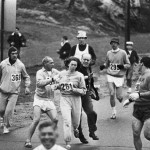
Bobbi Gibbs ran the race with hood over her head and without an official start number. She finished in the top third of the marathon in 1966 and completely shattered all beliefs about women being physically capable of running in the marathon.     Katherine SwitzerHowever, the following year another women, Katherine Switzer, entered the race as a man and was discovered on the track by an official who, literally, tried to push her off the road due to her gendered transgression.

Despite the amazing accomplishments of female marathon pioneers who proved that women could run a marathon and do well, even in a field of men, the International Olympic Committee did not allow women to run the marathon in the Olympics until 1984, almost twenty years after the first women publically competed in the marathon.

The argument that running the marathon or ski jumping could damage women’s ovaries and lead to infertility is also deeply rooted in the historical oppression of women. The need to protect women’s health from harm was one of the reasons that women where initially barred from higher education in the 1800s. An article called “Early College Women: Determined to be Educated” cited one influential medical professional in particular: Some of the harshest were medical personal who felt that

“…a girl could study and learn, but she could not do all this and retain uninjured health, and a future secure from neuralgia, uterine disease, hysteria, and other derangements of the nervous system,” according to Dr. Edward Clark in his widely respected Sex and Education published in 1873. (emphasis mine)

In 1986 Micheal L. Berger delivered an essay entitled “Women Drivers! The Origins of a 20th Century Stereotype

“that detailed how a women’s delicate physique was one of the reasons that women were not allowed or encouraged to drive when automotives first became popular. However, the denotative reason to keep women from behind the wheel was actually more about “keep[ing] women in their place and to protect them against corrupting influences in society, and within themselves” (257).

Interestingly, the contemporary discussion of whether or not any activity could lead to female infertility indicates that there is still a prevailing belief that the ultimate goal for all women is to reproduce; that our lives outside of motherhood are not nearly as important. This type of rhetoric almost never burdens men (the only example that I know of is discussion of high performance male bicyclists and the potential damage that sitting for extended amounts of time could do to male reproduction). This is despite the fact that several performance enhancement drugs that are widely used by professional and amateur male athletes are known to lead to lower sperm counts and, even, erectile dysfunction. Undoubtedly, someone is trying to keep female ski jumpers in “their place” by barring them, once again, from competing in the Winter Olympics.

When I set out to make Jump like a Girl in 2002 I picked the story of women ski jumpers because their trials were akin to my own struggles as a female athlete growing up.  As someone who enjoyed more “masculine” sports (soccer, track and field, basketball) there was always a feeling of transgression whenever I played that I could never really pinpoint the source of.  I never realized that underneath Lindsey Van’s and Jessica Jerome’s public struggle to ski jump in the Olympics there were also broader issues of female sexuality that have plagued women for centuries.  The plight of female ski jumpers still indicates that we have a long way to go for gender and sexual equity and freedom.  What I hope to see in the future is akin to what Bobbi Gibbs wrote:

“I have always had a vision of a world where men and women can share all of life together in mutual respect, love and admiration; a world where we find health through exercise and through the appreciation of the spirit and beauty of the world and of each other; a world based on love and individual integrity, where we all have a chance to do what we most passionately love, to help others, and to become all we can become.”

Let’s continue to make that vision a reality. Let the women jump.

———————————————————————————————-

Ruth Gregory is an Associate Professor of Digital Filmmaking at Shoreline Community College as well as a student in the Masters of Arts in Cultural Studies program at the University of Washington Bothell.  She is new to the blogging sphere, but her other experiments with writing for the ‘net can be read here: http://ruthconsumessomemedia.blogspot.com/

——–

Female Ski Jumping References and Resources:

Other Cited Resources:

Other Resources Regarding Women in Sport:

  • www.womenssportsfoundation.org
  • Lenskyj, Helen. Out of Bounds: Women, Sport, and Sexuality. Toronto: Women’s Press, 1986.
  • Smith‑Rosenberg, Carroll.  Disorderly Conduct: Visions of Gender in Victorian America.  New York: Oxford University Press, 1984.
  • Burstyn, Varda.  The Rites of Men:  Manhood, Politics, and the Culture of Sport. Toronto:  University of Toronto Press, 1999.