education

Do you ever think, “Duh!?” when you read a news story about how fattening movie popcorn or fast food is for us? I get that same feeling when I read that yet another research study has been published proving that girls and boys are equally good at math. How much more proof do we need?

Professor Marcia Linn’s paper focuses in on why there are differences in girls confidence around the world. The answer? Social expectations. [PDF link]

A society’s gendered division of labor fosters the development of gender differences in behavior by affording different restrictions and opportunities to males and females on the basis of their social roles….if the cultural roles that women fulfill do not include math, girls may face both structural obstacles (e.g., formal access to education is limited to boys) and social obstacles (e.g., stereotypes that math is a male domain) that impede their mathematical development.

Many people like to believe that we live in a post-feminist society. The evidence includes Hillary Clinton, Sarah Palin, and women making up half of the workforce. But girls and boys still receive messages on a daily basis that they have roles to play and only those roles. As recently as this past holiday toy buying season, Toys R Us advertised three different magnification power microscopes and  telescopes, guess which one had the lowest power? Yup, the pink one.

Some will argue that we need to pinkify science things to attract girls, but do they also need weaker microscopes too?

And that brings us to another Duh moment…Pink often does stink.
Out of sheer luck of the calendar, this month’s Science Grrl falls on Veterans Day so I had to dedicate this month’s column to the Goddess of Science Grrl Veterans…Rear Admiral Grace Murray Hopper who has an entire conference named after her. Hopper entered the Navy under the WAVES program.

***

Fellow GWPenner Lori mentioned Lise Eliot’s recent book Pink Brain, Blue Brain last month. In my reading of the book, I found Eliot’s balance between nature versus nurture commendable. Despite being a science grrl, I do find myself wanting nurture to win out since then it would be just darn easier to toss out the pink and blue crap.

I hate seeing toys that have no gender to them, like laptop computers, painted pink for girls and not-pink for boys. This country has a problem with the low number of students who want to study computer science, especially girls. I don’t think that having pink laptops will get girls to want to study computer science. But in my conversation with Eliot, she suggests that we hijack this pinkification of our girls world and give it to them, but be subversive too.

But how far do we allow it to go? The Discovery Channel is a great place to find science toys online, but even they separate out girls and boys toys. If you look at the toys offered, a very small number are stereotypical. I assume that they are buying into parents who will come to an online store and immediately look for the boys tab. But I think that the Discovery Channel would do a world of difference for girls in science if they simply had age segregation for their toys. Send a message to parents and gift-buyers that science is gender neutral.

We are shortchanging our girls by making all their things pink. It tells them that their things are different. Luckily the Discovery Channel gender-segregated toy store doesn’t house a pink microscope. So perhaps they are being subversive when a parent goes on and sees “Oh, a girl microscope!” and really it’s just a plain old microscope. I can’t only hope.

Pink Girl, Blue Girl is an excellent read and I believe if we followed Dr. Eliot’s recommendations as we raise our kids, we will see more girls in science.

It seems like every other story in the past month had a science grrl at its core. Some were good, some not so much. I honestly couldn’t make up my mind on which story to write about, so I’ll write a little about all of them:

  • Elinor Ostrom is the first woman to win the Nobel Prize in Economics. The best part of her story? That her high school advisor told her that she couldn’t take trigonometry because she was a girl. It’s been quite some time, but if that advisor is still alive, I hope they give her a call to apologize. Otherwise, girls take note. My high school advisor was horrible my freshman year, so I switched. If you don’t feel supported, find someone else to talk to!
  • Ostrom topped off what has been a banner year of women winning the Nobel. We had the first time two women won a Nobel together (in medicine). The advisor-former graduate student pairing makes my heart a flutter. Now that’s Sisterhood NOT Interrupted! In addition, Ada Yonath won in Chemistry.
  • The motive for the murder of Annie Le is still to be revealed, but for me it doesn’t take much to see this crime as a possible crime against women in science. While I was still pondering the role that gender in the lab played in the crime, another woman was attacked in a lab. Sadly women in science history holds one huge dark chapter: In 1989 a man massacred 14 women as he “fought feminism” in Canada.
  • In animation land, Cloudy with a Chance of Meatballs is telling young girls to not dumb themselves down and embrace their geekdom. My husband took our six-year-old daughter to see this movie while I was out of town over the weekend. She’s certainly not dumbing herself down…yet…but my money is on the fact that she’ll remember that the main character’s dad dies rather than she should be herself.
  • Considering the high participation of women in environmental science and public health, we could see more women winning Nobels if some new awards are added in the future.
  • And while she does fall under science FICTION, I think that Octavia Butler deserves to close out this post. Her novels paint a bleak picture for our future, but the way to avoid most of it are also laid out in her novels. She uses science to craft her stories, even in her last unfinished story arc on vampires science is a huge character. And now the Huntington Library is where her papers will be stored (PDF link). I eagerly await a biography on this genius who was taken from us way too soon.

Sticks and stones my break my bones, but words will never hurt me.

A rhyme I’m sure we’ll all familiar with, perhaps one that we hurled back at someone teasing us as kids. We teach our kids that words don’t hurt, when we know darn well that they do. And science has proved over and over that words impact the way that we take tests and perform in the classroom (anywhere actually). It’s called stereotype threat:

…the fear that one’s behavior will confirm an existing stereotype of a group with which one identifies. This fear can sometimes affect performance.

One recent study [pdf] on stereotype threat had women taking math tests and looking for the cause of poor performance due to the threat.

Because it is not enough to say we know stereotype threat exists and then lather women and other stereotyped groups with love. Why does a woman excellent in math crumble under the weigh of mentioning that “girls don’t do math” before an exam? It seems that our brains spend precious time and energy sorting out our feelings about the stereotype during the exam AND not just that, but it lingers. Thus if we fear the math in a class, say economics, we will fear everything that goes with economics.

We know that economics and statistics is far more than just algebra and geometry, but if that is our weak spot, we will focus so much on that, that we just might submarine our efforts. During graduate school the #1 class that caused students to flunk out was stats. During that year long course (two semesters!) I heard women say time and again, “I’m just not good at math.” My program had also experimented with teaching a math prep course using a computer program before the semester started. Despite the fact that I am a total math geek and my favorite class in high school was geometry (Mmmm….proofs….) and I have a bachelors in science, I was floored at how much basic algebra had rotted away over the years. I am pretty ashamed that I can’t just tell you what sine and cosine mean off the top of my head.

But here’s something I learned in my years working in a lab as an undergraduate: Scientists have reference books on hand. They aren’t doing science off the top of their brilliant heads. Yes, they have it pretty much in their heads, but when it comes time to do an experiment or calculate the frequency of fish fins flapping, they reach for a book or list of formulas. Scientists being pure geniuses is a stereotype!

Lesson? You do need to remember how to calculate wavelength during an exam, but once you get past that, you can whip out that formula sheet anytime. Yes, you will need to know certain things off the top of your head, but when you study the same molecule over 20 years, things will start to stick.

The next time you sit down at that math exam  and you start to sweat, stop and breathe. Remember that you are you. If you miss one problem, no biggie. No one is perfect. But do you want to spend your energy remembering that one jerk teacher who said you can’t do it or do you want to prove to yourself how much you kick ass? OK, so maybe love does have a place in killing off stereotypes.

Donna Bobbitt-Zeher, a sociologist at Ohio State University, set the world a buzz when word got out of her research on the wage gap over a twenty year span:

The good news for women is that during the time period studied, their average salary increased from 78 cents for every male dollar earned to 83 cents. But when Bobbitt-Zeher controlled for various factors, she found that the share of that gap attributable to selection of major had increased…When controlling for all available factors, [she] found that the choice of major explained 19 percent of the income gap between college-educated men and women for the high school class of 1999, nearly twice as much of an impact as could be documented for the class that graduated 20 years earlier. (emphasis mine)

This wasn’t a shock to me as it was something that many of us who work to increase the number of women in science and engineering already suspected. So when Kate Harding from Salon Broadsheet emailed me for a response I wanted to make sure that people know that it’s not just as simple as English versus Chemistry.  “Harder,” male-dominated science and engineering fields, such as computer science, are paid more than female-dominated biological sciences, a “softer” science.

The real question that this wage gap research leads us to is whether or not the increase of women in a career leads to lower wages or not. In 2006, Paula England et al appear (I admit, I only read the abstract) to prove that there is no direct correlation between the increase in women entering a field and the lowering of that field’s wages. But a gendered wage gap is there. England showed it and now Bobbitt-Zeher shows it.

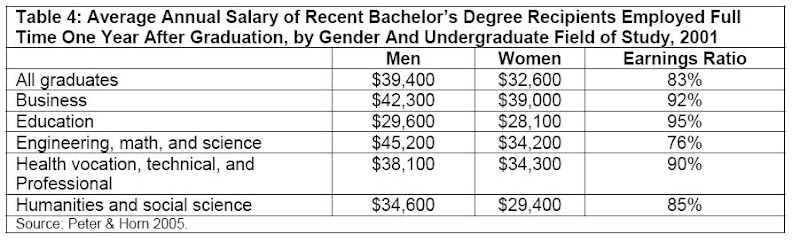
The AAUW also showed this wage gap difference based on major earned 2005 in their “Public Perceptions of the Pay Gap” report, but with a twist:

Ironically, the biggest wage gap is in science and engineering! But even with a 24% gap, women are still earning more than almost any other career field. *shaking head*

So what does this all mean?

There isn’t one reason for the wage gap. We can’t wave it away with one explanation (women’s choices) or correct it with one solution, even comparable work legislation.

For me there is an economic justice reason for women to look to science and engineering for a career. Wage gap or not, they will be earning more money. For women who have a gift for math and science and find joy in the work, go for it. But I would never say do it for the money.

Is it gender? Is it how much society respects the vocation? Is it unionization (teachers have smallest gap)?

Again, further research is needed. But whatever it is, women are getting the short end of the pay stick and all of these numbers are about the average man compared to the average woman. I can only imagine what the gap looks like for people of color!

CuriesThis month Science Grrl looks at the mother-daughter bond in science & engineering.

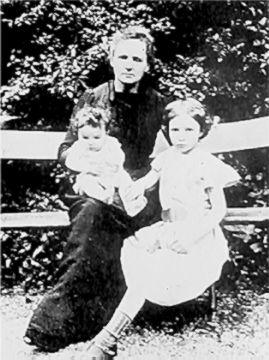
First, the only mother – daughter duo to ever win the Nobel Prize was the Curies. Marie Curie won twice: first in 1903 for her discovery of radiation and second in 1911 in chemistry for her work on radium and polonium. Marie’s daughter Irène Joliot-Curie won the Nobel Prize in chemistry in 1935. Irène had built upon the work that Marie and her father, Pierre, had started. While we can stand in awe of the mother-daughter science-duo and the amazing knowledge they brought to our world, their relationship wasn’t ideal. Marie “was so obsessed with her science and the discovery of radioactivity that she pretty much ignored her two daughters and after her husband’s tragic death retreated into her mind even more.”

I try to temper this view of Marie with the knowledge that she lived in a vastly different time than we do. It was a time when she almost HAD to marry a scientist to gain access to good lab space and equipment. Her partnership with Pierre was born not just from love, but also from need of resources. She was often not chosen for faculty positions because she was a woman or because Pierre already had one. Today universities have spousal hire rules to allow them to hire one “lead” partner for a tenure track position and then hire the “trailing” partner for maybe a tenure track position or adjunct faculty position. A generation ago there were rules at universities that outlawed nepotism or the hiring of both husband and wife into academic faculty positions. While yes, it is nepotism it’s not the same nepotism that we warn against when we think our cousin might be the best person for a job.

Luckily things are far better for moms in science today. It’s far from perfect, but I can only imagine the amazing work the Curie women could have done today!

We also shouldn’t forget to mention that moms are often the #1 advocate for daughters who want to get into science and engineering. My late mom didn’t totally get my aspirations for marine biology, but she supported my decision and that meant the world to me. I found a curriculum online for creating a mother-daughter Science Club. They do recommend you buy their biography books, but I’m sure you can switch out biographies you find online or in your local library. As someone who works with college students, I find that one of the many issues young women have is getting their parents to understand why they want to major in physics rather than biology and go to medical school. The education goes both ways in this issue!

So girls, get your mom involved in your decisions and moms push your daughter to reach for the stars.

One of my most vivid memories of first grade is when Mrs. Gerry wouldn’t let me have a counting strip. It had lily pads on it and a frog at zero. When I got up to get in line to get my counting strip, Mrs. Gerry told me to turn around and sit down. “You don’t need one.” I was embarrassed to have my math skills announced like that to the class. But she was right, I didn’t need it. That was the start of my math nrrd status.

Last week I had my daughter at my office because of report card pick up. Yes, in Chicago, that means the kids have the day off so teachers can focus on parent conferences. She loves being at my office because I have a white board and I let her draw all over it. Normally she draws pictures, but this time she was doodling math problems. I turned around and saw that she was trying to add 15 to 20 and had figured it out. How did my kindergarten daughter figure this out? Well, she drew counters. First 15 then 20 more and counted them up. I also noticed that she wrote the problem out vertically, so I thought it was a good time to teach her how to add double digits. I drew boxes around the right column and told her to add those numbers, then did the same with the left column. I knew it would work because there was no carrying involved.

She looked at me like I was a genius. Then she asked me to write some more problems for her to do on the white board. Yes, I was proud.

The first thing I did when I got to the WAM! Conference at MIT on March 27th was to buy her a MIT sweatshirt. I buy her shirts from almost every campus I visit. Even though I work at a university, I want her to know that college is part of the plan and that there are so many more options than just the one mommy works at. While I was flooded with college brochures in high school, I had no idea how to navigate them. I threw the MIT one in the garbage because I didn’t think it was worth it to apply just to be denied. I want to keep that mentality from rooting itself in my daughter’s head. One of her favorite sleeping shirts is from Spellman.

So while I am a math nrrd and it is obvious that my daughter has some great math skills, I know that parents and teachers are key to making a skill into a passion. The next day when I was busy working when she asked me to write some math problems for her. “Some big ones!” So I did. And I did again when she was done and wanted more.

Girls have caught up with boys in math test scores and I give us parents a lot of credit for it. We stopped listening to naysayers who said math is a boy thing. We listened to feminists who said, hell no! We encouraged our daughters to explore the numbers dancing in their heads. It’s easy to be jaded and think that kids don’t listen to us, even as early as kindergarten. But we need to remember that we can still wow them with simple math magic. You never know where that might lead them.

Now to figure out how to teach her about carrying numbers in a way that keeps me looking like a genius.

Richard E. Nisbett, a psychology professor from the University of Michigan, wrote an op-ed that appeared in the New York Times last weekend about the importance of funding educational programs that really work. All this stimulus package talk has breathed new life into an old conversation: how do we measure the effectiveness of educational interventions?

Nisbett insists that we not overlook the little things, namely boosting children’s self-esteem through high expectations. He writes:

Consider, for example, what the social psychologists Claude Steele and Joshua Aronson have described as “stereotype threat,” which hampers the performance of African-American students. Simply reminding blacks of their race before they take an exam leads them to perform worse, their research shows.

Fortunately, stereotype threat for blacks and other minorities can be reduced in many ways. Just telling students that their intelligence is under their own control improves their effort on school work and performance. In two separate studies, Mr. Aronson and others taught black and Hispanic junior high school students how the brain works, explaining that the students possessed the ability, if they worked hard, to make themselves smarter. This erased up to half of the difference between minority and white achievement levels.

In the age of Barack and Hillary, this is exciting news. The days of “you can’t be what you can’t see” are over for little girls or black kids destined for positions of powerful leadership.

But it’s also got me thinking of other implications for the “stereotype threat.” Is part of why young women are so plagued by eating and anxiety disorders that we are constantly reminded of a stereotypical version of ourselves (emotional, overwhelmed, perfectionist)? Would we be healthier if we were told that our quality of life was, indeed, under our control? How can we pull apart the cultural associations of femaleness and self-sacrifice/internalized anger/stress?

I struggle with this because I wrote a book that traces some of the contemporary causes of perfectionism behavior and disordered eating and exercise. Is Perfect Girls, Starving Daughters: How the Quest for Perfection is Harming Young Women inherently reinforcing an unhealthy perfect girl paradigm just by exploring it? It’s a pretty paralyzing thought, especially for a  feminist and cultural critic. I’ve always believed strongly in the importance of speaking tough truths, naming things, giving voice to pain. But what if, by mirroring the most painful aspects of my generation’s struggle, I’ve inflamed it?

Where is the balance?

–Courtney Martin

January 20, 2009 not only ushered in a new President, but a President who believes in science and wants to fund it. While I haven’t been in the lab in over a decade, my heart is still there, and I have been working on a daily basis for over ten years to convince more women to decide on a scientific research career.
The last few years I’ve had a tough time with this because the level of funding for science has dropped like a lead balloon. I have many reasons for wanting women to enter science or engineering, but one of them is that they can make up to $40,000 – $60,000 right out of college. Economic justice for women can’t happen if we continue to keep women segregated into low-paying jobs. In my insider/outsider status in the scientific community, I’ve seen more and more scientists fight over fewer and fewer dollars. It’s made me think: Is this really the place I wanted to send women?

The women I meet want to change the world with their science and engineering skills. They want to ease, if not eliminate, poverty in drought-stricken environments. They want to cure diseases that they watched their grandparents die from, that broke their parents’ hearts. So yes, of course, I still encourage them to keep moving forward and to chase their dreams. They will change the world.

As I write this, the economic stimulus package has just been passed in the Senate, though it may ultimately be shorn of some essential funding for science and education. Republicans criticized and wanted the removal of funds for the National Science Foundation, which supports much of the basic science that happens at colleges and universities where many of our future scientists and engineers are training. Apparently a number on the right side of the aisle don’t believe in or understand science enough to know that yes, science is stimulus and is shovel-ready. I’ll let my former research adviser, Mark Westneat, take it from here:

…scientific research is basically all about hiring people and buying stuff. NSF grants are not funding elite Ivory Tower endeavors — the money helps everyone. The primary line item in most research grants is salary for students, technicians, interns, post-doctoral scientists, and researchers. These are mostly young people who contribute fresh approaches and new ideas to the research while receiving training in science and technology. While these are not blue collar jobs, all institutions charge an overhead fee on federal grants that is used to fund operational costs, including administrative assistants, plumbers, electricians, and house-keeping staff to keep the research enterprise running. The remaining money is used to buy things, from high-end items such as computers, microscopes, DNA sequencers, and chemicals, to every-day items like office supplies and airline tickets. Most of these things are purchased from American companies and, in the case of my own institution, preferentially from local minority and woman-owned businesses. In addition, scientific institutions provide a significant portion of developmental aid at low cost, by training thousands of students and colleagues each year in developing countries.

In all reality, some of our great institutions of higher learning are putting off building maintenance in order to keep classes open and faculty employed. I’m sure that if those who criticized NSF funding as pork understood that science and education are shovel-ready projects, they would have thrown a few million to universities to fix deferred maintenance on buildings.

Here we are in a new administration, which clearly supports science, and yet we still have to deal with anti-science people who seek to cripple our colleges, universities, and museums from doing what they do best – research, teaching, and preparing a new generation of products and people to bring us economically and scientifically into a new frontier. Science and engineering bring us medical advances and the new gadgets that people line up for days before going on sale to buy. From the smallest iPod to the next Wii, there’s a lot of science and engineering, education and research, behind it. Ever seen the line outside the Apple store? That’s stimulus. And that’s an industry I could feel comfortable telling women to go into in order to derive all possible benefits. But clearly it’s still going to have to take some more Change around Washington to do.

Like others who work in education, I was eager to see who President-elect Obama would select for his Education Secretary, and what that individual would represent. Obama’s selection of Chicago school superintendent Arne Duncan was announced yesterday.

I am heartened by the fact that Duncan represents a both-and approach to school reform, recognizing that both teacher improvement and social support for children outside of school will play a critical role in taking the US education system to a new level of excellence (we can hope, right?).

But I’m left with an important question: Will we see federal leadership for curricular reform? Peggy McIntosh recently pointed out to me that the central structure of the American education system (math, science, English, social studies, etc.) has remained unchanged since the 18th century. To be sure, approaches to these subjects are updated and the curriculum has certainly changed over time. Yet I’m also convinced from experience that the more things change the more they stay the same, and that the status quo reinforces traditional gender stereotypes (along with stereotypes about race and class).

For example, I noticed that my daughter’s kindergarten teacher had divided the girls’ and boys’ workbooks by color-coded baskets (red=girls, blue=boys: hm, at least it wasn’t pink!). I notice when I pick my daughter up from her after-school program that the room is frequently segregated by gender and toys (girls playing with dolls while boys play with Legos).

No doubt you’ve noticed that my examples point to classroom arrangements rather than classroom content, and you might think I’m being too nit-picky. After all, they’re just colored baskets, right? No way! I’m convinced that the classroom arrangements and curricular content reinforce each other (see my previous post where I mention a sex-stereotyping book series that my daughter discovered thanks to her first-grade teacher). It may be red baskets now, but when women still have to fight for equal pay for equal work (among other things), I want to be sure I’ve done my part to make a difference.

When I mentioned my concerns about the color-coded baskets during a conference, my daughter’s kindergarten teacher was shocked to think that she might be perpetuating gender stereotyping. She gave me examples of ways she challenged the students’ gender stereotyping in the classroom (talking about her own love of math, “requiring” girls to play in the block corner). The next morning the baskets were changed, with the kids finding their workbooks based upon the first initial of their last name.
I’m sure that won’t be the last conversation I have with a teacher about gender inequality in the classroom, but I hope that we can expect national leadership and fresh thinking about what goes on in the classroom. Any word on whether Duncan is a feminist? And GWP readers, have you taken any steps to make your sons’ or daughters’ classrooms more feminist learning environments?

-Allison Kimmich