Archive: Feb 2016

I’m beyond delighted to briBeyondBalancePanelng you this post from my friends over at Women Employed, a Chicago-based advocacy organization that mobilizes people and organizations to expand educational and employment opportunities for America’s working women. Below, Adriana Díaz, the Communications Manager at Latino Policy Forum and a leader of the Advocacy Council at Women Employed, muses poignantly and shares knowledge on how we work. Follow her on Twitter @adriana9diaz.  -Deborah
A few weeks ago, I lost several hours of sleep to an irregular bout of insomnia. I went to work grouchy, brain hazy, and started to complain to my coworker—when I realized that she, as a mother of two children under the age of 3, ran on an average of five hours of sleep a night. A sleepless night seemed trivial in the moment, but in our water cooler conversation we gained perspective in our lifestyle differences, and in our shared privileges as women employed by our office—we both work for a company that values family support and work-life balance and offers flexible scheduling for salaried employees to meet those needs. For example, my coworker works 8 to 4 to accommodate her family’s childcare needs. I work 10 to 6. Bonus: we both get to work from home once a week.

While it may seem like a small perk to some, my coworker and I recognize that having flexibility in our workplace is a huge benefit to our quality of life. To be sure our conversation was an “a-ha!” moment for me on workplace issues; one of many I’ve had since becoming an Advocacy Council member at Women Employed (WE) more than a year ago. For too many working women—the benefits my coworker and I view as a given, control over our schedules, paid sick days, maternity leave—are out of reach.

So how do we create conditions in which all of us can thrive?

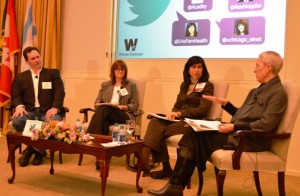
Beyond Balance, a panel discussion hosted by WE, dived into this very question last week. The engaging conversation was moderated by WE Executive Director Anne Ladky and included panelists Susan Lambert, University of Chicago, Associate Professor in the School of Social Service Administration; Iliana Mora, COO at Erie Family Health Center and WE Board member; and Rex Huppke, Chicago Tribune journalist of the popular workplace column, “I Just Work Here.”

The full program is available to watch on CAN-TV, but here are a few more a-ha moments I had that I hope you can learn from too:

  • There is no work-life balance for low-wage workers.
    • As 80 percent of minimum wage workers are adults, and 59 percent are women, Illiana Mora reminded us that for many balance is out of the question, “It’s work, work, work, work, work, work and more work. What they’re talking about is really, survival.”
  • Paying workers well, providing fair schedules and paid time off is not just great for employees, it’s great for business! Employee morale, health and loyalty suffer in industries with low wages and unpredictable schedules. This leads to high turnover among other incurred costs. Susan Lambert said, “We want strong businesses, we want firms to employ people and a strong economy. But the literature shows if you treat people well it pays off too.”
  • Millennials deserve their due credit for revolutionizing the workplace. The demographic is now the largest portion of the workforce and has a strong commitment to social justice.
    • Rex Huppke made the point that Millennial men want to be involved with their families: “Every generation will have its negative side…but Millennials have come along and said, ‘if you don’t provide me with the kind of things I find important, basically the work-life balance issues, then forget it, I’m going somewhere else.’ And then they just leave.”

Catch more highlights here. Interested in learning more about creating fairer workplaces? Visit Women Employed’s website.
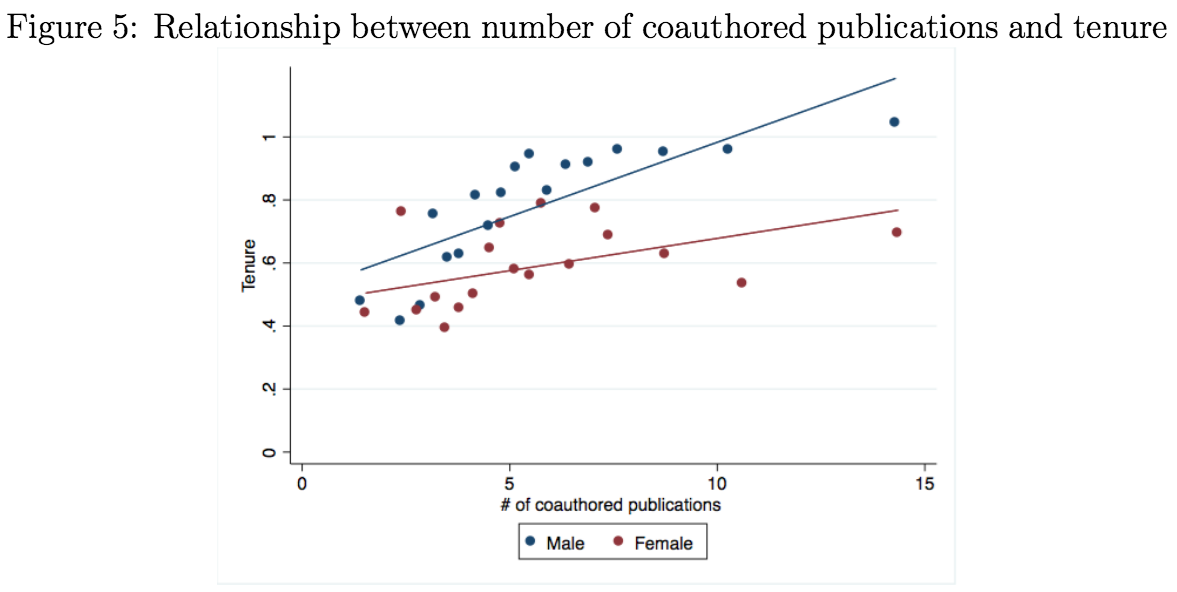
A PhD student of economics at Harvard—Heather Sarsons—generated quite a buzz with her working paper, “Gender Differences in Recognition for Group Work” (HERE for the paper, and HERE for Justin Wolfers’ summary of her research in TheUpshot). Sarsons looked at the careers of young economists recruited by top universities in the U.S. over the past four decades. She discovered that while women publish at roughly the same rates as men, they are significantly less likely to achieve tenure, even after accounting for all the things one might first think to blame for this discrepancy (tenure rates at different universities, subfield differences, quality of publications, influence, etc.). There was one group of women, however, who received equivalent rates of success to men—women who publish without men, either alone or with other women. Simply put, Sarsons finds that when women publish with men, they do not receive the same credit.

Screen Shot 2016-02-03 at 11.53.03 AMBoth of us are sociologists. And, in Sarsons’ paper, she also analyzed sociology and did not find the same difference in terms of how men and women receive credit for collaboration. Economists list authors alphabetically on publications. Sociologists select author order on the publication. Thus, we have publications listed as “Bridges and Pascoe” as well as “Pascoe and Bridges.” We see each of these collaborations as equal partnerships, but have worked out a system for selecting first author that has to do with who manages the various projects on which we collaborate.

We also have a good working relationship in terms of giving each other credit, and for collaboratively taking credit for work that belongs more to “us” than to either of us individually. As we’ve theorized hybrid masculinities, for instance, we have tried to be careful to ensure that the framework is attributed to both of us. The initial publication came out of research Tristan published in Gender & Society—an article that benefited a great deal from C.J.’s reading and feedback. And we collectively realized that part of what Tristan had found was something lots of different scholars were finding. So, we collaborated on a paper for Sociology Compass that creates a more general framework for studying transformations in masculinity. Tristan was first author on that paper (though it was an equal collaboration) in part because C.J. was first author on our recent anthology, Exploring Masculinities (also an equal collaboration). We are currently at work on a separate theoretical article building on the framework we established a year ago and C.J. will be lead author on this. Author order has always been an easy conversation for us.  But we do talk and worry about whether there is or will be an discrepancy in the credit we each receive for the work.

Sometimes we perceive that Tristan receives more credit for our collaborations which may be due to the fact that he is a man. Sometimes we perceive that C.J. receives more credit for our collaborations because of her seniority and previous publishing record. We each attempt to negotiate these potential credit discrepancies differently, hoping to make up for something that might occur in our own collaboration relationship (despite Sarsons not finding it in sociology more generally). And, if we had a finer measure and found the gender credit gap in sociology, we admit that it would be something over which we have little control as individuals. But, as feminist sociologists who believe in the collaborative process, we decided to develop a list of feminist practices for cross gender collaborations.

10 Practices Men Who Collaborate with Women Should Consider

  1. ALWAYS acknowledge your coauthor whenever you discuss or write about the collaboration.
  2. Promote your coauthor’s solo-authored work and accomplishments.
  3. Consider very carefully if and when you are listed as lead author in your collaborations.
  4. Cite your coauthor’s solo-authored work.  #CiteHerWork
  5. When writing about or discussing the work, use “WE” and “OUR.”
  6. Acknowledge this bias when discussing, teaching, citing, other collaborations between women and men.
  7. Involve your coauthor in any attention, recognition, or opportunities that result from the collaboration.
  8. Whenever you can, discuss the work together and/or SHE speaks for US.
  9. Say something if and when you feel you’re receiving an undue proportion of the recognition.
  10. Understand that this issue is structural and you are not always aware of when and how you benefit.

This list is a work in progress and we would love to hear your additions!

#HerWork2

________________________

*Deciding on author order for this post was simply not possible.

As more reports and statements about the Zika virus circulate, the more readers/viewers are reminded of its greatest threat: “malformed babies” or infants with “defects.” Pregnant women are warned against traveling to regions where they could contract Zika as a means to protect their fetuses.

But responses to this disease also reveal a troubling underlying attitude about disabilities and the people who live with them. The message is clear: Disability is something to be prevented at all costs.

Zika is believed to be the cause of a growing number of babies born with “birth defects” like microcephaly (a disorder characterized by a disproportionately small head) and others that affect a child’s vision and hearing. Symptoms of an actual Zika infection are relatively minor, so much so that some mothers who delivered babies with related physical impairments (Zika babies) have trouble remembering even being sick.

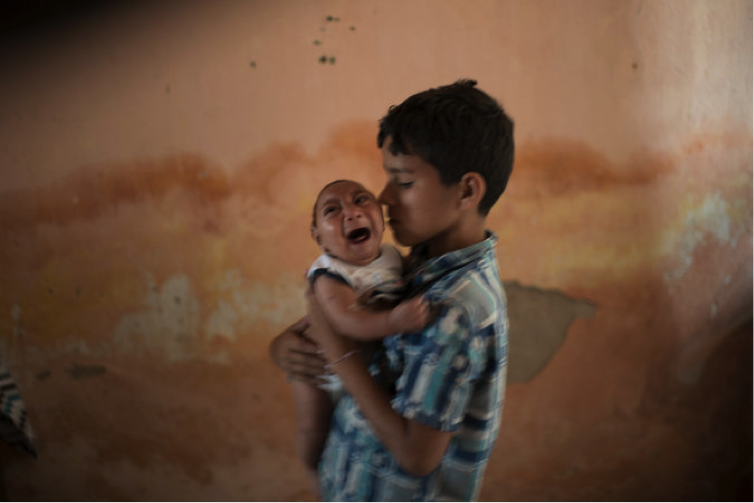
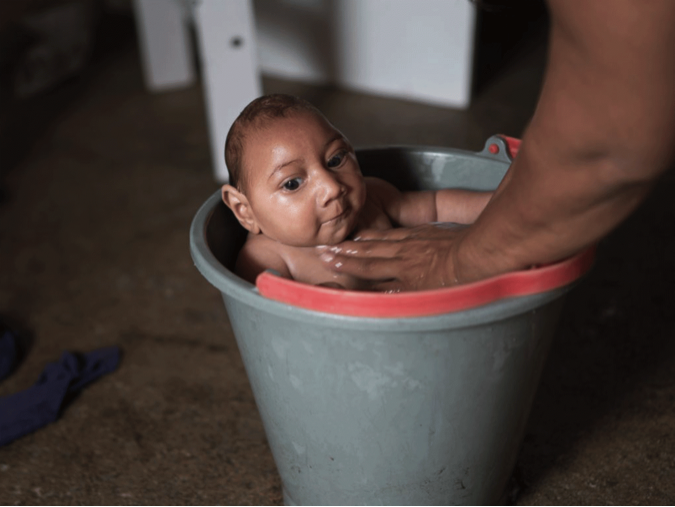
Photos credit: Felipe Dana

Whereas news stories about Ebola since 2014 have often included images of supine suffering bodies surrounded by white hazmat suits, recent images about Zika feature babies born with small heads on the laps of parents (interestingly, often with their own heads cropped out of the frame). The story of this disease is one of disabled children.

Information about a disease gives rise to fears, which is something the Center for Disease Control and the World Health Organization have to negotiate when a new outbreak of a disease occurs. Remember the H1N1 pandemic in 2009? President Obama declared a national emergency to ensure people took the threat of the disease seriously, yet he played golf the same day to assuage fears that declaration was likely to inspire. People fear the pain, inconvenience, disruption, unknown effects, and expense of a disease as well as the potential loss of life.

As news about the Zika virus in South and Central America spreads, so does its companion anxiety—the anxiety about children being born with disabilities. This is surely a serious concern because these children may require additional care and resources, and in many cases, they are born into relatively poor families.

However, the fears associated with this disease are less about the care that will be needed for the children born with disabilities and more about their existence. Their birth is presented as the devastating outcome of the infection as a death count for Ebola or Cholera might be.

Images of children with microcephaly reinforce this point. We can see the impact of this disease and stare at the “malformed” body with the impunity of a computer screen. On January 27, NPR’s Renee Montagne, who interviewed Monica Roa, reported, “It would be fair to say we’re going to be seeing more of these babies being born with the birth defects of the Zika virus.” And seeing these babies is the real threat of Zika.

People with visible disabilities frequently experience staring and gawking as if they were on display. In the United States, the Americans with Disabilities Act and the Disabilities Discrimination Act are meant to protect against the kind of prejudice that can prevent disabled people from securing work, health care, housing, and the assurance of a quality life. The real disabling aspect of life with a disability is the way able-bodied people perceive, react to, and even ignore disability.

Disease—Ebola, H1N1, Cholera, etc.—expose social inequities like contaminated food or water, restricted access to health care, or a break down in public health. And while disability is not a disease, the Zika virus brings a light to cultural attitudes about disabilities as objectionable.

A life with disabilities has challenges and complexities that vary from one person to the next, but it is a life. We need to stop treating the birth of Zika babies as the outcome, the end point of the narrative of the Zika virus and focus on the lives the children and their families will live.

A simple way to begin focusing on the Zika babies as new lives and not tragedies is to change the language used to discuss them. A simple shift from “malformed” and “birth defect” to impairment or disability changes the story. Rather than a medicalized diseased body with its “defects,” we have a human being with a challenging life ahead.

sarah.schuetzeSarah Schuetze is a visiting assistant professor of English at St. Norbert College. She specializes in narratives of disease in American Literature, and she’s currently working on a book project called Calamity Howl: Fear of Illness in Early American Literature and Culture.