Archive: Sep 2015

Tina Pittman Wagers is a clinical psychologist and teaches psychology at University of Colorado Boulder. August 2014 she survived a heart attack. September 2014 she first posted this column. The repost today is in connection with her presentation today at the Stanford MedX conference about her experience, insight, and new research agenda.
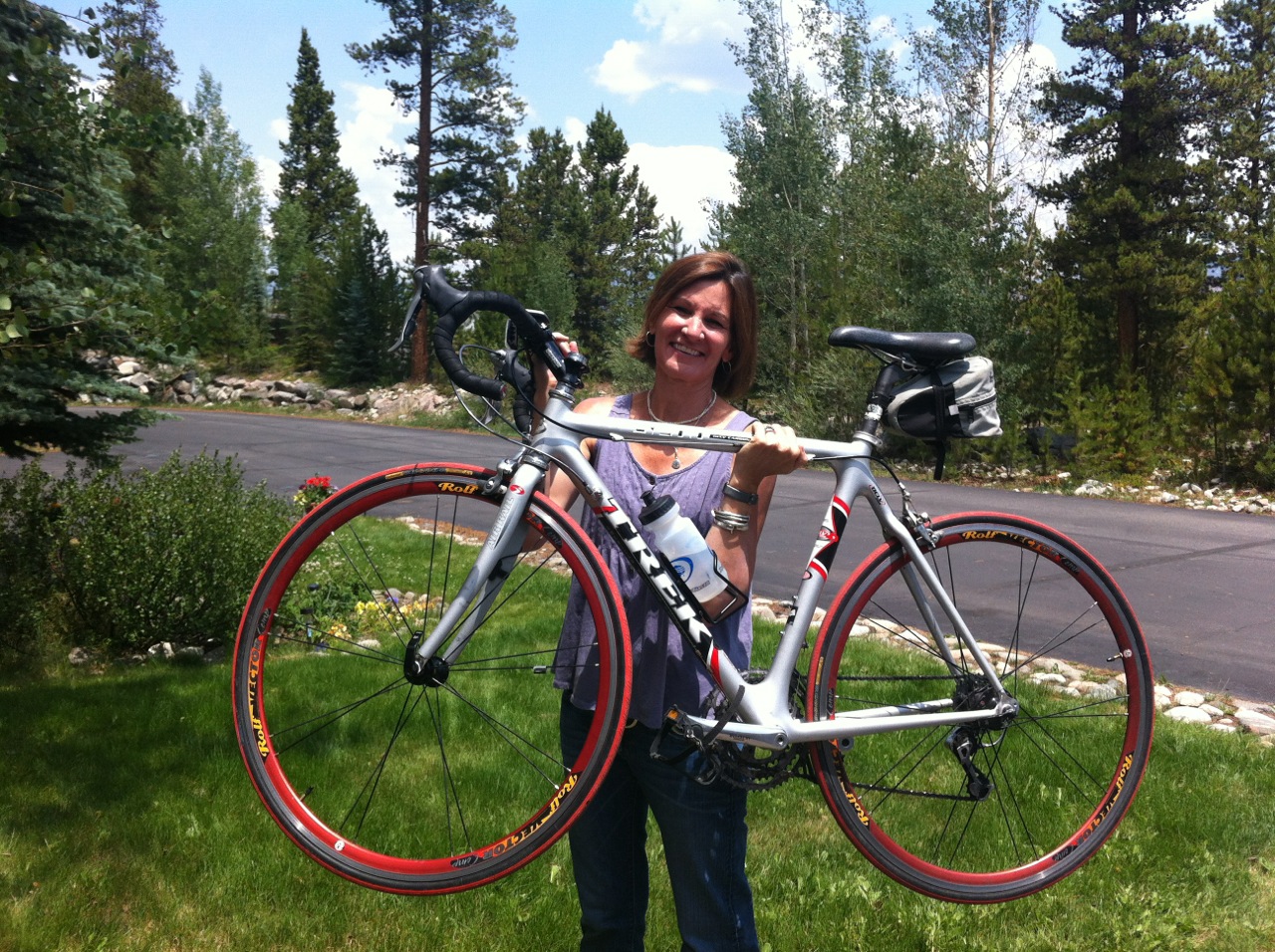
Tina Pittman Wagers finished a triathlon one year and six weeks ago.
Tina Pittman Wagers finished a triathlon one year and six weeks ago; then came the really difficult challenge.

I am new to this role as a heart patient. My heart attack was five weeks ago, and I am getting the feeling that I have just begun down the confusing maze of angiograms, CT scans, EKGs, medications (and lots of ’em), heart rate monitors, cardiac rehab classes and blood tests. Indeed, even the phrase “my cardiologist” is one I never thought would pass my lips. Here’s why: I am 53 (we’ll discuss the significance of this age in a moment). I am fit, active, slim, haven’t eaten red meat for about 20 years and am a big fan of kale, salmon and quinoa, much to the chagrin of my two teenage sons. I live near the foothills in Boulder, Colorado, where I hike with my dog and often a friend or two, almost every day. I had completed a sprint triathlon two weeks before my heart attack. Ironically, this event was a fundraiser for women with breast cancer – it turns out that heart disease kills women with more frequency than breast cancer. But, hey, who knew?

My heart attack happened while I was swimming across a lake in Cascade, Idaho. I was about a quarter mile into the swim when I found that I couldn’t breathe, and was grabbed by an oddly cold and simultaneously searing band of pain about three inches wide across my sternum. My husband, Ken, was on a paddleboard nearby and helped pull me out of the water, and started paddling me back, stopping to allow me to vomit on the way back to shore. If you’ve never been on a paddleboard, it may be hard to imagine the balance it takes to paddle relatively quickly and keep the board from getting tipped over by the unpredictable movements of a heaving passenger in the midst of a heart attack. Suffice to say that I am grateful for Ken’s strength and balance in innumerable ways. An hour later, I was at a clinic in McCall, Idaho, where an astute ER doc was measuring my heart rate (very low) and heart attack-indicative enzyme called Triponin (rising) so I won an ambulance ride to St. Luke’s Hospital in Boise, Idaho. I received excellent care there, queued up for an angiogram the next morning and was diagnosed with SCAD: a spontaneous coronary artery dissection, and, fortunately, a relatively mild one. Twenty percent of SCADs are fatal. Furthermore, I have none of the typical risk factors for heart disease, like high blood pressure, diabetes or high cholesterol.

I do have one of the main risk factors for this kind of heart attack, though: I am a woman. Eighty percent of these heart attacks occur in women. The average SCAD patient is 42, female and is without other typical risk factors for heart attacks. The current thinking about SCADs is that they are not as rare as originally thought, but are under- diagnosed because they happen in women who don’t look like typical heart patients.

Another related factor: I am menopausal. The majority of SCAD patients are post-partum, close to their menstrual cycle or menopausal – all times in women’s lives during which we experience significant fluctuations of sex hormones. Up until five days before my heart attack, I had been on low doses of Hormone Replacement Therapy (HRT), in an effort to vanquish the hot flashes, sleep disruption and cognitive fogginess I was experiencing. I suppose HRT might have also represented an attempt to hang on to youth, in a youth-and sexuality-obsessed culture in which the transition to menopause often means a dysregulated and sweaty march into irrelevance.

Since I had my heart attack, I’ve spent a lot of time (and money, but that’s another column) interacting with professionals in the cardiology world, trying to figure out what happened to me, and how I can avoid having another SCAD – the rate of recurrence in my population is about 20-50 percent. I have encountered some lovely people, but almost all of them are baffled about what to do with me. I am atypical, as they inevitably explain, but the medications, the treatments, the rehab programs that they have to offer are designed for typical patients. So, that’s what my doctors try, but there is a lot of “voodoo vs. science” as one cardiologist explained, because science doesn’t have the answers to my questions. (I would add that there is a cardiologist, Dr. Sharonne Hayes at The Mayo Clinic, who is doing a lot of the research and seeing the patients who’ve had SCADs. I hope to meet her one day. I imagine a scene something like my 13-year-old self meeting David Cassidy, only in an exam room in Rochester, Minnesota– it’ll be just that cool.)

One of the factors that contributed heavily to my medical predicament was no doubt my menopausal and HRT status. The American Heart Association points out that lower estrogen levels in post-menopausal women contributes to less flexible arterial walls, clearly a factor in SCADs. The question then arises: how might HRT help prevent another heart attack? However, as anyone who’s even scratched the surface of the HRT world, there is a lot of conflicting data about who should use HRT, who shouldn’t, what the benefits and risks are, and what the differences may be between different formulations and methods of delivery of HRT. One study, the Women’s Health Initiative study, was a large study started in the early 1990s, and was a valiant attempt to gather data about the effects of HRT on women’s health, including cardiovascular health. Unfortunately, the average age of the women in this study was 63 – 12 years older than the typical age of the American woman hitting menopause and considering HRT, so the results have been criticized for their poor generalizability to newly menopausal women.  The research on HRT since the WHI study has been scattered, often contradictory, and hard for the average woman to access.

Why do we know so little about women and heart attacks, why they happen, what the symptoms are, and what we can do about hormonal factors that contribute? A big part of the problem is that, until the National Institute of Health (NIH) Revitalization Act in 1993, researchers largely excluded female humans from their studies. NIH has just this year (2014!) decided to use a balance of male and female cells and animals in their research. Up until now, 90 percent of the animal research has been conducted on males. Animal research, which is often a precursor to clinical trials in humans, has been missing out on vast pieces of investigation related to the female body. I am living (fortunately) proof of the fact that the delays in including females in research have translated into significant gaps in clinically relevant knowledge related to women’s health. Well-meaning physicians and practitioners only have the “typical” approaches to try with their “atypical” patients. Why this appalling delay to include female subjects? Because female rodents as well as humans experience menstruation and menopause, which are frequently considered dysregulating nuisances to many scientists. As a consequence, we have an enormous amount of catching up to do in order to understand what factors affect female bodies and health problems in different ways than our male peers.

Emma Watson gave a great talk last week to the UN about feminism meaning equal access to resources. One of the most important resources we have is scientific knowledge that can be applied to responsible, effective and efficient clinical care. Let’s hope that women can start to be understood as typical research subjects and patients, not as inconvenient, fluctuating, atypical anomalies.
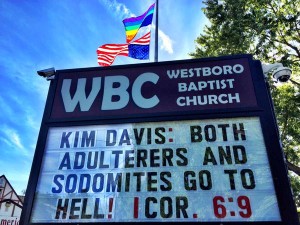
WBC sign on Kim DavisI couldn’t decide if I was surprised or not when I read that Westboro Baptist Church (WBC) was protesting Kim Davis. WBC is notorious for their protests, and their targets have ranged from U.S. soldiers killed in combat to country western singer, Blake Shelton. Add Kim Davis to a long list. But of course it is peculiar that the “God Hates Fags” church would protest the person who, at least this month, epitomizes religious resistance to gay rights. Dr. Rebecca Barrett Fox, who has studied WBC for more than a decade, generously agreed to answer some questions about this seeming contradiction.

Rebecca first encountered Westboro Baptist Church when she accidently stumbled into Fred Phelps’ kitchen where his wife was frying eggs for breakfast. She was a graduate student interested in studying the congregation and arrived on a Sunday morning to find all doors locked except for one to an adjacent building, which happened to be the pastor’s house. That was in 2004 and since then, she has spent countless hours observing church services, conducting interviews, watching pickets, and witnessing arguments at the Supreme Court. A book based on her ethnographic work with the church, God Hates: Wesboro Baptist Church, the Religious Right, and American Nationalism, will be released in 2016 by the University Press of Kansas.

 KB: Most readers know about Westboro Baptist Church (WBC) from the media storm they have created by protesting gay people and military funerals. Can you explain the religious ideology that fuels their attitudes about what and why to protest?

RBF: In WBC theology, all people are sinners by their nature; all people are totally depraved and unable to do a single thing to bring them out of sin or closer to God. This includes every member of WBC. The good news is that God has elected some people to love and save and others to punish and damn. And if God has elected you, you cannot resist him, so you will heed his call and turn toward righteousness. That is, you live a godly life, even though you are by nature a sinner, because God has elected you; you don’t get into heaven because you live a godly life. It’s important in this theology not to reverse the cause and effect.

Same-Sex Marriage Dooms NationsWhile we can’t know who is going to heaven (since righteous living is only a hint that you might be elect, not a reason for it), we can know who is going to hell—or at least some of them. If you aren’t living a godly life, it’s because God hasn’t elected you; and he hasn’t elected you because he hates you, which is his prerogative as your creator.  Remember that the elect can’t resist living a righteous life, so the only people left to dwell in disobedience are the damned, those chosen by God for his holy hatred before they were even born.
That theology is not unique to WBC; it’s called hyper-Calvinism, and while it is not popular, it informed a lot of the work of Puritans. We are seeing, more broadly, a neo-Calvinist revival here in the US, with a few churches even using the word “Puritan” in their name again.  Even so, WBC’s particular strain of theology seems mean-spirited to most Christians.

What is striking, I think, is though nearly every conservative Christian church condemns Westboro’s pickets and disagree with their theology, they actually end up at the same place: that gay people (and their supporters) are destroying America. For WBC, God doesn’t hate people because they are gay; they are gay because he hates them. This is different from the “love the sinner, hate the sin” theology of other conservative churches, which Cynthia Burack and others have artfully explored, which say that God loves gay people but just hates that they have same-sex relationships. In the end, though, both groups have God casting those people into hell. Does it matter if God sends you to hell because he hates you (the WBC perspective) or because, despite the fact that he loves you, you just won’t stop being gay? I’m not sure that the Religious Right’s “loving” God here is more appealing than the angry God of WBC.

Both WBC and the Religious Right argue that America’s acceptance of gay people is leading to our doom, both in practical terms—like a weakening of important institutions such as the military and marriage—and in spiritual terms, as God grows angry with us for failing to adhere to his moral code. WBC takes this message to scenes of national tragedy, including military funerals as well as scenes of gay pride. The link seems strange to some, but here it is: In 2003, the US Supreme Court, in Lawrence v. Texas, codified acceptance of same-sex intercourse by striking down state anti-sodomy laws. When it did that, according to WBC, the nation became the enemy of God. And, of course, God punishes his enemies through national tragedies and by destroying the military. Thus, every bad thing that happens to us as a country—every mass murder, every oil spill, every economic downturn, every tornado, every military death—is actively ordered by God to punish us for our acceptance of homosexuality.

But why protest at all and why these moments?

Pickets are one way that God can reach the elect. When you hear WBC, you either dismiss them or hear God’s voice. You don’t get saved by WBC preaching or picketing since your election happened before your birth. However, by your response to WBC, you reveal your election or damnation. Additionally, church members have to picket because they see it as something that God demands of them; they need to do it regardless of how it is received. From a sociological perspective, picketing also serves to discipline the group, to create and maintain boundaries between the inside world of the church, where people have hope for election, and the outside world, which is evil, and to invest people in the church. The picket is as much about the picketers’ performance of their faith as it is about the reactions of passersby, which usually reinforce the church’s view of the world as hostile. And they picket tragic moments, in particular, they say, because this is when people are most vulnerable and thus most open to hearing their message. It seldom works to find new members, of course, as few people hear their words as the words of God, but the point is as much to help people see their damnation as their salvation, so every picket is a victory in that sense.

Were you surprised when you learned that WBC was speaking out against Kim Davis? Why focus on the private life of Kim Davis, when her public voice aligns with what seems the most pressing beliefs of WBC? What about forgiveness of sin? 

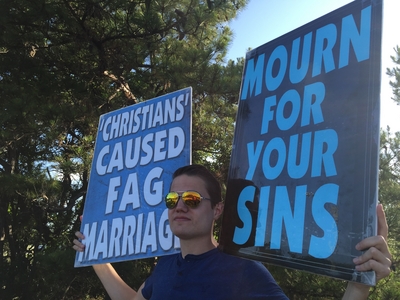
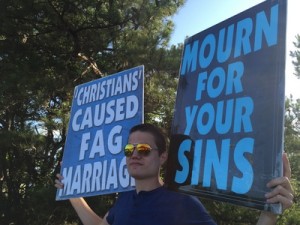
Christians Caused Fag Marriage Isaiah Phelps-RoperIf religion and sex are in the news, WBC usually weighs in. The Davis case is an example, in WBC eyes, of how Christians have failed to prevent the advancement of the gay agenda by failing to adhere to God’s standards about sexuality more broadly. WBC sees homosexuality as the last sin a culture will accept; by the time we decided to legally recognize gay marriage, we’ve already legalized divorce and remarriage, made adultery commonplace, and legalized abortion. Homosexuality is the last stop on a train we should never have boarded, in this line of thinking. And that is not unique to WBC. The Southern Baptist Convention just excluded a church whose pastor questioned the Convention’s willingness to allow pastors to follow their consciences on marriage for divorced people but not gay people. Many church leaders, including Albert Mohler of the SBC, have had to figure out how to defend a long history of marrying divorced people while denying marriage to gay people.

Kim Davis, from WBC’s perspective, can’t fully endorse their message because she is living with a man who is not actually her husband. What Davis should do, according to WBC, is to repent of her three most recent marriages and return to her first husband; if he has remarried or is no longer interested in pursuing a relationship with her, she should remain single.  For WBC, divorce is only part of the sin; remarriage is also a sin, and you can’t both live in a state of sin and ask for forgiveness for it—just like you can’t both be sexually active in a same-sex relationship and ask for forgiveness for it, a premise shared by WBC and conservative Christian churches. Many Christians, far beyond those at WBC, are willing to call out non-celibate gay Christians as unrepentant but would never ask a divorced and remarried person to abandon their marriage. WBC sees that as hypocrisy.

Are Kim Davis and WBC two sides of the same coin? Or are they really different factions of fundamentalism? 

In the end, they both want to deny gay people rights and respect. The theology behind that matters very little in couples’ and families’ lives, and our democracy should not carve out religious exceptions that allow the denial of rights to individuals.

On the other hand, I find Kim Davis far more threatening to democracy than WBC. She is more powerful, able to immediately shape the lives of people in dramatic ways because of her role as an elected official. She is attractive to the Religious Right, and already conservative pundits are using her case as a litmus test for the Republican presidential nomination.

Kim Davis—and the anti-gay Religious Right more broadly—has a friend and a foil in WBC, in that the church recalibrates the scale of hate to make the Religious Right look more reasonable and tolerant. As long as Westboro Baptist Church is there, the Religious Right can point to them and say, “We’re not like that! We love gay people! We just hate their sinful ways!”

People like Kim Davis and members of WBC are an increasingly marginal group in the contemporary U.S. Should we pay attention to what they say?

 Yes, I think we must. These groups are marginal in the sense that they are small and often times reviled. But they do important work for those who oppose hate by revealing, in a community’s response, where it fails to protect those on its own margins. It’s easy to rally against hatred in general; it’s harder for a community to rally against homophobia and even harder to really question its own investments in heteronormativity. It’s easy to organize a counterpicket and drive a small group of people you already see as nutty out of your town, especially when they are really only in town for an hour or two anyway; it’s harder to build coalitions across long-standing prejudices and suspicions held by neighbors. Can communities embrace those challenges? I’m hopeful.


rebecca.barrett-fox Dr. Rebecca Barrett Fox teaches sociology at Arkansas State University, where she continues her research on religion and hate groups.

Reading Rachel Hills’ The Sex Myth was like reviewing my Sociology of Sexualities syllabus. Application of Foucault’s theory of power and social regulation? Check. Discussion of heteronormativity? Check. Mention Gayle Rubin’s charmed circle of sex? Three checks! Hills offers an analysis of contemporary sexual norms that is rich saturated with sociological research. She touches on many of the issues I unpack with my students at City College, but adds her own journalistic flare, making this book not only an informative but enjoyable read.

Hills argues that in this age of supposed sexual liberation and unprecedented freedom, sex has actually become heavy with significance, warping our perceptions and expectations. For instance, pressure has shifted from not having sex to having sex – and lots of it. Thus, the social denigration of virgins after a certain age or those with few sex partners. Hills finds that people tend to assume everyone around them is having more sex than them, and this becomes a race to keep up. She refers to this as a “gap between fantasy and reality.” One consequence is that folks become pre-occupied with whether or not they are having enough sex. The measurement of “enough” is based on assumptions and occasional check-ins with close friends on how much sex they are having. A better barometer of sexual satisfaction, though, would be asking yourself whether you’re having all the sex that you want. This may vary depending on what else is happening in your life.

This is just one of the many examples Hills offers us of the consequences of “the sex myth” – the belief that sex is all important, powerful, and indicative of how we’re doing as individuals and a society. She also points to the troubles caused by holding too precious ideas of “normality” when it comes to sex as well as the influence of masculinity and femininity in shaping sexual expectations.

Overall I found The Sex Myth to be a great read. I appreciated Hills’ generous use of sociological research to ground her arguments as she weaved in personal narratives from her life and the lives of people she interviewed. It was also refreshing to read many of the concepts I teach in academic settings covered with the delightful writing style of a journalist.

My only critique is the limited age range represented in the stories Hills highlights. One of the lies the sex myth promotes is that your sex life peaks in your twenties and it’s all down hill from there. Unfortunately, Hills inadvertently reinforces this myth by only featuring the stories of twenty-somethings. There were only two interviewees over the age of 30 featured, and one of them was experiencing a lengthy sexless period of their life. Perhaps selfishly, as someone migrating my way through my 30s, I wanted more representation of sexual experiences across the lifespan and how these experiences are shaped by or counter the sex myth. If Hills wanted to focus on sex-pectations for twenty-somethings, that’s fine, but that frame should be made clear from the start.

Other than this age caveat, I recommend without reservation this book to anyone looking for a fun subway read, an introduction to thinking critically about contemporary sexuality, or a book to offer your undergrads in human sexuality classes.

This post originally appeared at Inequality by (Interior) Design on March 15, 2014

__________________

HNA7078r1+ToyStories_Jacket_edit1203.inddPhotographer Gabriele Galimberti’s project on children around the world depicted with their most prized possessions was recently published. It’s an adorable set of photos of children with odd collections of items they feel define them. The photos are collected in a volume—Toy Stories: Photos of Children From Around the World and Their Favorite Things.

Initially, I was reminded of JeungMee Yoon’s “The Pink and Blue Project” (here), where she took pictures of girls surrounded by all of the pink things they owned and boys surrounded by their blue clothes, toys, and décor. Some of what struck me was the global uniformity in the objects surrounding children. It’s a powerful statement of globalization to see that children are growing up all around the world with some of the same cultural influences: from characters, to colors, to cars and weapons, and more.

Enea, 3, Boulder, Colorado.But, at a larger level, I think this project reflects one way we like to think about identity: that each of us has one of them and that it is established early on and that it (or elements of “it”) stick, such that we can recognize vestiges of our childhood identities in our adult selves. Indeed, when I’m explaining Freud to students, I often start by summarizing what I take as Freud’s central insight—“Life history matters.” It matters for who we are, who we might become, and more.  But, “life history” is rarely captured in a snap-shot.  We think of it this way–but out identities are projects that unfold in time.  Some things make larger marks than others, but identifying exactly what is important and why is often more difficult than we like to think.

Naya, 3, Puerto Viejo de Talamanca, Costa Rica.Galimberti’s project is wonderful and the pictures vividly capture a moment in a child’s life. I’ve often looked for signs of who my first child might become in some of his early interests. For a while, he was much more interested in cooking utensils than toys. We actually brought a pasta claw on a plane once to distract him during a flight agreeing that the pasta claw was our best option at the time. I have all sorts of pictures of my son playing with wooden spoons, spatulas, whisks, and more when he was just learning to crawl. And if he turns out to be a chef some day, I can imagine pulling these out and saying, “You know, he was always interested in this. He was born to be bake.”

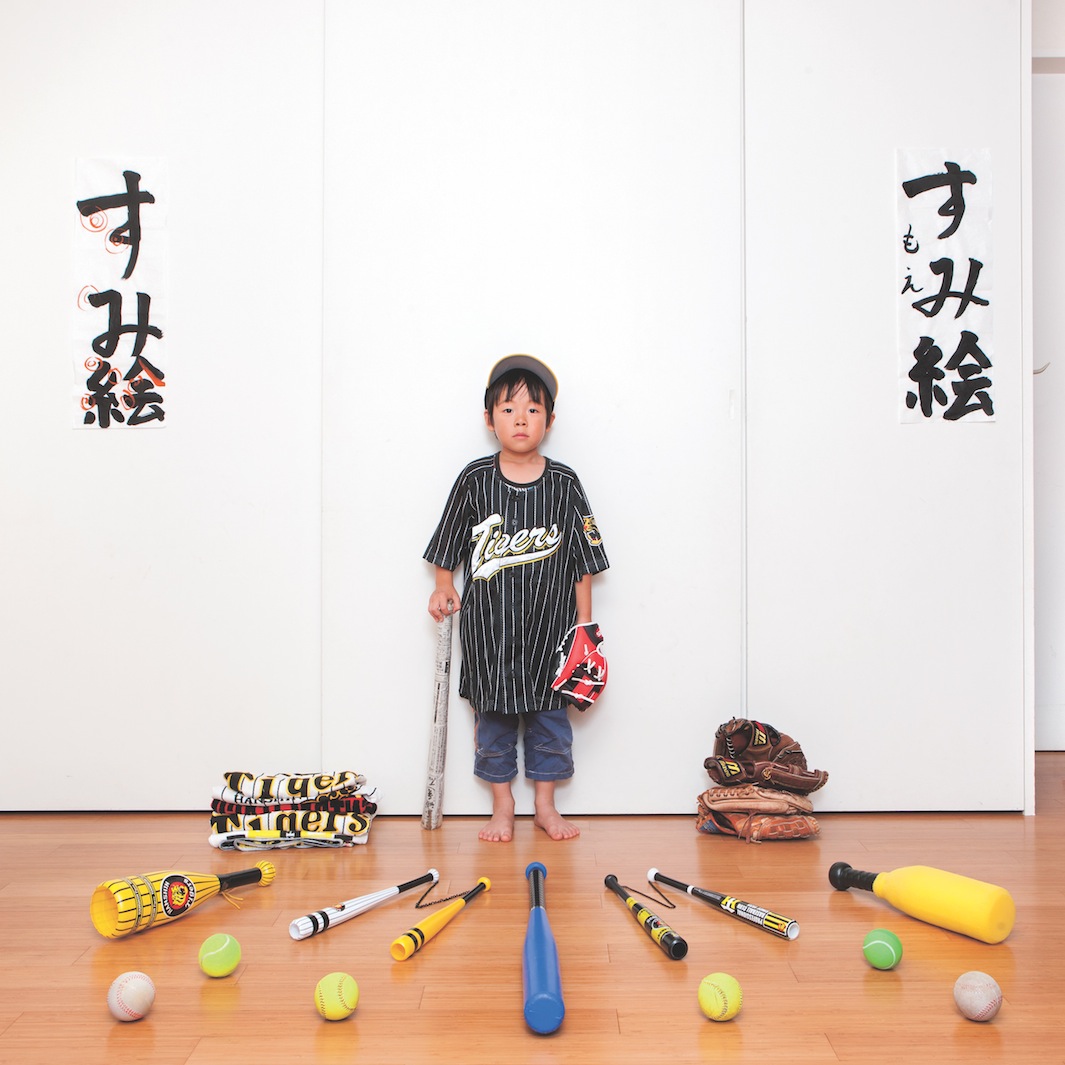
Shotaro, 5, Tokyo, Japan.I caught myself wondering what my son would have pulled off the shelf to display were he included in Galimberti’s project—or, indeed, what I’d pull off the shelf for him if I were asked to identify his most prized possessions. Today, for instance, I think I’d select a truck or two, his heart wand, a blown-up balloon, a rubber spatula, his grocery cart, an assortment of rainbow colored wash clothes, a few of his stuffed animals, a toy train, perhaps one of his dolls, and I’d probably include a hodge-podge of his favorite books. But, the most important word in the last sentence isn’t one of the objects I selected; it’s the word “today.” If you asked me a week ago, I’d have a slightly different answer—a month ago, I might have had a completely different answer.

Mikkel, 3, Bergen, Norway.The photo series reflects a bias against an understanding of identities as flexible projects—an issue that is, perhaps, best illustrated in childhood. Every morning, I have a discussion with my partner about what we’re having for dinner that evening. We’re both mentally planning on what the end of the day is going to look like. But, our son has picked up on this and loves talking about dinner each morning as well. Sometimes he asks me what our evening meal will be when I get him up in the morning. But, often, when we get to the meal, he declares: “I love ____________. ____________ is my favorite!” Not every dinner (or book, or toy, or experience, or…) is his “favorite,” but it’s more often the case than not.

One way of explaining this would be to say that he doesn’t understand what “favorite” means—we like to think you can have lots of things you like, but only one “favorite.” But, I think if he could articulate it, he’d either say that he has more than one favorite, that everything is his favorite, or that his “favorite” is, like mine, a continuously evolving category that changes depending on his mood, the time of day, what he’s wearing, how he feels, who he talked to that day, what he’s reading right now, and more. His identity is no different from the rest of us. It’s a work in progress—and that is a beautiful thing.

Gabriele Galimberti came up with this project, not the children he photographed. I love the pictures. He asked them to select their most prized possessions; they didn’t ask themselves. Galimberti has a talent for capturing these children’s spirits—at least in that moment. But, how to read these photos or what these photographs actually mean about the children they depict is another question entirely.

When we create our own narratives, thinking through the people we “know” ourselves to be, it’s not uncommon to say, “Well, I’ve always liked ______________” or “Ever since I can remember, I was a _________________ person. It’s just who I am.” But, for every instance of identifying moments in childhood we feel like stand out as representative of who we are are a series of moments that might have been identified as meaningful had we turned out to be someone different altogether.

I grew up with two sisters. So, it wasn’t uncommon for the three of us to play games together, organized primarily by my eldest sister. We’d play dress-up and I can remember wearing tutus, dresses, and all sorts of feminine attire. My parents took a great picture of the three of us in our back yard—all in “girl” one-piece bathing suits. I’m sandwiched between them. My dad has the picture in a photo album at home with the caption “My son the gender scholar!” next to it. I imagine if I’d gone on to later identify as a woman, this picture might have been intensely meaningful to me.  Indeed, the blog “Born this Way” collects childhood pictures of gay men and lesbians who identify their sexual identities as shining through when they were children–often in the form of some gender transgressive outfit, haircut, pose, or activity.  Today I like the photo of my sisters and me in “girl” bathing suits because I like to think it represents my spark and my passion for questioning boundaries. But, there are many more photographs of me playing with sling shots, water guns, and all manner of “boy” toys that my parents and I might not identify as important parts of my identity today—though perhaps we should.

We allow children to “play” with identity much more than we allow others.  But, even children’s identity play is limited and limiting when we ask them to take a stand for who they are early on.  Perhaps there’s something important about having 17 “favorite” dinners that we ought to preserve–it allows kids to recognize their various selves and acknowledge their capacity to change, shift, and change back again.

When I haphazardly label my son lately, I always get called out.  If I say, “Look at you.  You’re a dancer” when we’re jumping around in the evenings, Ciaran looks at me and says, “I no dancer, Dada.  I Ciaran.”  He might think I’m suggesting “Dancer” is his name.  But, maybe he’s just resisting being boxed in, and maybe I should be listening.